
Galacto-oligosaccharide Market Report Scope and Overview:
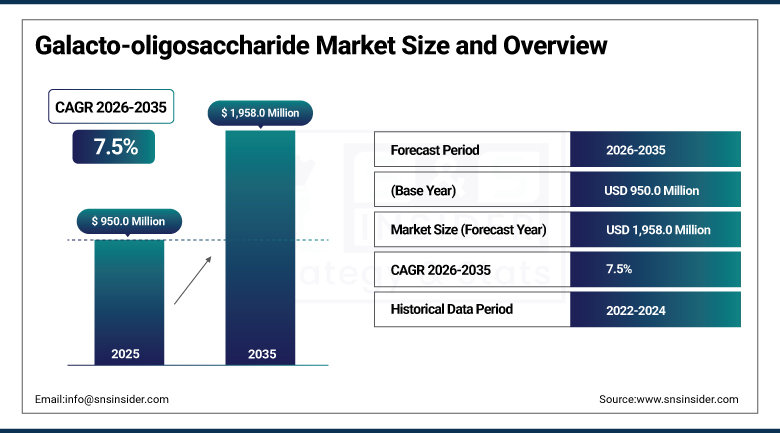
The Galacto-oligosaccharide Market was valued at USD 950.0 Million in 2025 and is projected to reach USD 1,958.0 Million by 2035, registering a CAGR of 7.5% from 2026-2035.
The galacto-oligosaccharides are prebiotic fibers derived from lactose and discovered due to their ability to enhance digestion, support the immune system and stimulate the growth of beneficial bacteria in the gut such as the bifidobacteria and lactobacilli. The prebiotic fiber GOS has increasingly become incorporated into food and beverages due to the health benefits offered to digestion. The rising awareness among customers regarding gut health and the health benefits offered by prebiotics has played an important role in the rising inclusion of GOS in different products. The support provided by the European Food Safety Authority for the regulation has made it easier for producers to incorporate GOS into their products.
GOS continued being studied throughout 2025 for its potential neuroprotective properties, with implications for the gut-brain axis continuing to drastically improve the possibilities of GOS for cognitive and brain health products, as an older demographic globally became increasingly aware of and interested in digestive health, expanding GOS applications into new adult dietary supplement and functional nutrition categories.
Market Size and Forecast
-
Market Size in 2026E: USD 1,021.3 Million
-
Market Size by 2035: USD 1,958.0 Million
-
CAGR: 7.5% from 2026 to 2035
-
Fastest Growing Region: Asia Pacific
-
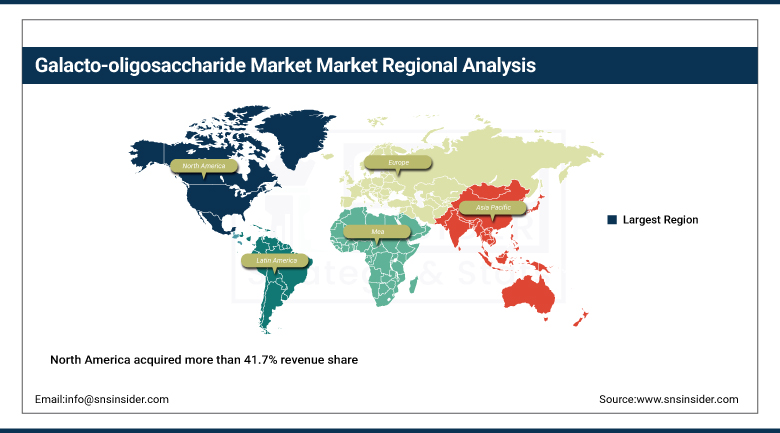
Largest Region: North America (41.7% share in 2025)
To Get more information On Galacto-oligosaccharide Market - Request Free Sample Report
Galacto-oligosaccharide Market Trends
-
The increasing use of prebiotic ingredients in skincare and personal care formulations aimed at supporting skin microbiome balance and barrier function continues expanding GOS applications.
-
The rising adoption of plant-based diets continues driving the inclusion of GOS in a wide range of non-dairy products to improve nutritional value.
-
Manufacturers continue prioritizing natural and clean-label ingredients, positioning GOS favorably as a genuinely recognizable, lactose-derived prebiotic fiber.
-
Heightened investment in research and development for health supplements continues expanding GOS applications beyond traditional infant nutrition and dairy categories.
-
The increasing prevalence of digestive disorders continues reinforcing sustained consumer demand for prebiotic fiber ingredients across functional food and beverage categories.
The US Galacto-oligosaccharide Market Outlook
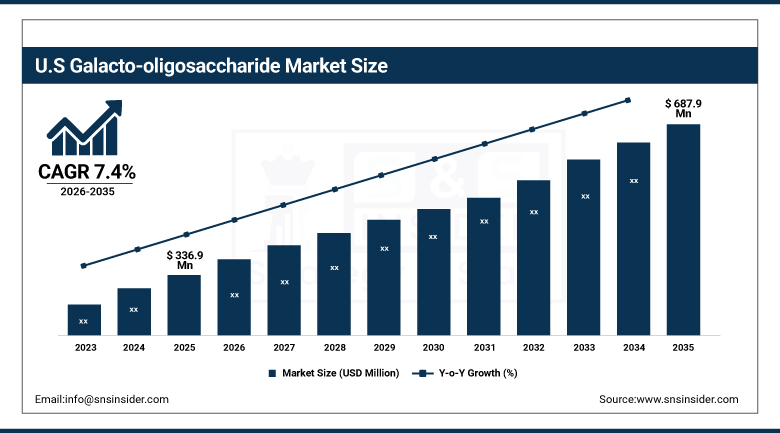
The US Galacto-oligosaccharide Market was valued at approximately USD 336.9 Million in 2025 and is projected to reach approximately USD 687.9 Million by 2035, registering a CAGR of approximately 7.4% from 2026 to 2035.
The region maintained its dominant regional standing during the year due to heightened awareness about the health benefits of the digestive system in the local consumers. Higher awareness about gut health benefits, higher demand for prebiotics in functional foods, and wider usage in infant nutrition fueled the growth of the domestic market. Research & Development spending on health supplements in tandem with increasing preference for natural and clean label ingredients kept reinforcing the dominance of the country as the leading market for galacto-oligosaccharides during the year.
Ingredion continued expanding its prebiotic fiber and functional ingredient portfolio throughout 2025, targeting American food, beverage, and dietary supplement manufacturers seeking clean-label, digestive-health-supporting ingredients capable of meeting increasingly sophisticated consumer demand for functional nutrition products.
Galacto-oligosaccharide Market Segment Analysis
-
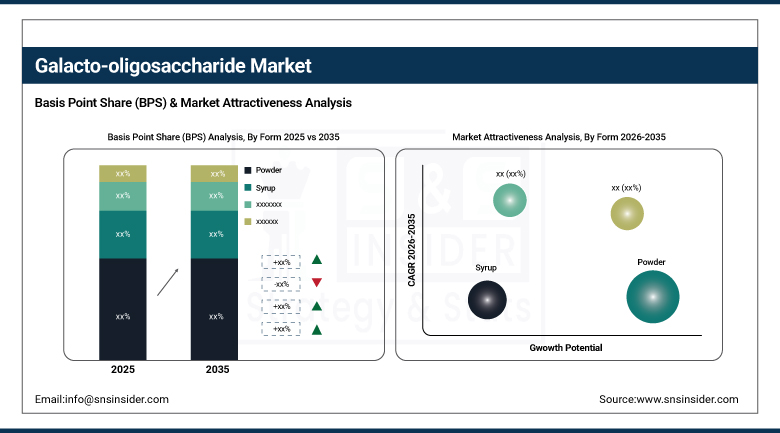
By Form, powder led the market with an estimated 69.8% share in 2025.
-
By Application, food and beverage led the market with an estimated 77.6% share in 2025, while cosmetics was the fastest-growing application, tracking a projected 10.9% CAGR.
By Form, Powder led the market
The powder segment dominated the galacto-oligosaccharide market with a revenue share of up to 69.8%, reflecting this form's genuine formulation versatility and established compatibility with a wide range of dry and semi-solid food, beverage, and supplement applications. That combination of broad formulation flexibility and established manufacturing infrastructure kept powder the dominant form category by a considerable margin over syrup and liquid alternatives.
The syrup segment continued representing a genuinely significant complementary category beyond the dominant powder segment, with GOS syrup products delivering the same functional capabilities as powder forms, including promoting mineral absorption and providing prebiotic support for gut biota. As syrup forms remain particularly well-suited to infant formula, dairy products, and beverage applications given their solubility and ease of proportion into liquid-enabled formulations, this form category continued capturing sustained manufacturer preference alongside the dominant powder segment.
By Application, Food and Beverage led the market, Cosmetics grew fastest
The food and beverage segment dominated the galacto-oligosaccharide market with a revenue share of up to 87.5%, witnessing robust growth as it finds wide-ranging applications across multiple sub-segments within the food and beverage industry. Functional drinks and foods have experienced rising demand as consumers continue to prioritize health and wellness, keeping this application category the market's largest by a considerable margin over dietary supplements, infant nutrition, and cosmetics alternatives.
The cosmetics segment is expected to emerge as one of the fastest-growing applications, registering a CAGR of 10.9% during the forecast period. Growth is driven by the increasing use of prebiotic ingredients in skincare and personal care formulations aimed at supporting skin microbiome balance and barrier function, keeping this application category's growth rate climbing well ahead of the broader, still-dominant food and beverage segment as this genuinely emerging application continues gaining formulator interest.
Regional Analysis
|
Region |
Major Country |
Share within Region, 2025 (%) |
|---|---|---|
|
North America |
United States |
80.60% |
|
Europe |
Germany |
24.10% |
|
Asia Pacific |
China |
31.25% |
|
Middle East and Africa |
UAE |
26.50% |
|
Latin America |
Brazil |
34.15% |
North America Galacto-oligosaccharide Market Insights
North America acquired more than 41.7% revenue share, led by high awareness of digestive health benefits across the continent's consumer base. That combination of established functional food and dietary supplement industry infrastructure and genuine consumer health consciousness kept the continent firmly positioned as the market's clear leader by a considerable margin over every other region tracked in this report.
The United States accounted for roughly 80.60% of regional revenue, anchored by strong consumer awareness of prebiotic health benefits and an established functional food and dietary supplement manufacturing base. Canada added further regional demand through its own growing functional nutrition sector, and that combined strength kept North America the largest addressable market for galacto-oligosaccharide vendors through the forecast period.
Get Customized Report as per Your Business Requirement - Enquiry Now
Europe Galacto-oligosaccharide Market Insights
Europe held a meaningful share of global revenue, supported by increasing public awareness of chronic diseases and rising intake of ready-to-eat meals across the region's major economies. Supportive regulatory recognition from the European Food Safety Authority continued encouraging manufacturers to incorporate GOS into their product portfolios throughout the year.
Germany was witnessing notable growth within the broader European market, supported by its substantial functional food and beverage manufacturing base. The UK and France contributed substantial additional demand, and continued European regulatory support for prebiotic ingredient recognition should keep regional demand climbing through the forecast period.
Asia Pacific Galacto-oligosaccharide Market Insights
Asia Pacific region will register more than 9.8% CAGR during the forecast period, driven by growing infant formula and functional food demand across the region's largest economies. The increase in disposable income and ample ratio of infants requiring dietary supplements in countries including China and Japan continued driving regional growth well ahead of every other region tracked in this report.
China led the pack, supported by its massive infant nutrition market and rapidly growing domestic functional food and beverage sector. Japan and India contributed meaningful additional demand, with rising disposable income and expanding infant formula manufacturing continuing to reinforce Asia Pacific's position as the fastest-growing market tracked in this report.
MEA and Latin America Galacto-oligosaccharide Market Insights
The Middle East and Africa and Latin America both showed steady growth, driven by expanding functional food and beverage manufacturing investment, growing infant nutrition demand, and rising consumer awareness of digestive health across both areas. As these markets continued developing modern functional nutrition infrastructure, galacto-oligosaccharide adoption grew correspondingly from a considerably smaller base than in more mature markets.
The UAE led Middle East and Africa demand, supported by growing functional food and beverage manufacturing investment and rising consumer health awareness. Saudi Arabia contributed further demand through its own food industry modernization programs. In Latin America, Brazil accounted for the largest share of regional revenue, with growing functional nutrition and infant formula manufacturing continuing to anchor regional demand for galacto-oligosaccharides.
Market Dynamics
Growth Drivers: Gut Health Awareness and Infant Nutrition Expansion
Growth in the forecast period can be attributed to increasing consumer awareness of gut health benefits, rising demand for prebiotics in functional foods, expanding applications in infant nutrition, and heightened investment in research and development for health supplements. GOS is a type of prebiotic fiber recognized for its positive impact on gut health, as it favors the growth of beneficial bacteria, with consumers and an older demographic globally becoming increasingly aware of and interested in digestive health.
Growing preference for natural and clean-label ingredients, along with the increasing prevalence of digestive disorders, continues reinforcing this driver. That combination of genuine consumer health consciousness and expanding functional nutrition application scope is exactly what keeps demand climbing at such a sustained pace across virtually every major consuming region this market serves.
Restraints: Raw Material Price Volatility and Competition from Other Prebiotics
Fluctuations in the price and availability of raw materials, particularly lactose, can impact production costs, posing a genuine restraint on stable margin planning across the GOS supply chain. That price sensitivity keeps long-term supply and pricing agreements genuinely complicated to negotiate given lactose's exposure to broader dairy commodity market fluctuations.
Competition from other prebiotics continues posing a further restraint, as GOS manufacturers must differentiate their products against alternative prebiotic fiber categories including inulin, fructo-oligosaccharides, and other functional fiber ingredients competing for the same formulation applications. That competitive dynamic keeps GOS producers genuinely focused on demonstrating unique functional and health benefit differentiation.
Opportunities: Cosmetic Application Expansion and Cognitive Health Research Development
The increasing use of prebiotic ingredients in skincare and personal care formulations represents a genuinely significant opportunity, as this cosmetics application category's fastest-growing status among all segments tracked in this market reflects genuine formulator interest in supporting skin microbiome balance and barrier function. Vendors offering genuinely proven, cosmetic-grade GOS ingredients stand to capture meaningful share as this application category continues expanding well beyond the market's traditional food and beverage stronghold.
GOS being studied for its potential neuroprotective properties and gut-brain axis implications offers a second substantial opportunity, as this research trajectory continues improving the possibilities of GOS for cognitive and brain health products. Vendors that can deliver genuinely validated, clinically supported GOS formulations stand to capture meaningful share as this emerging application category continues developing beyond current early-stage research.
Recent Developments:
-
2025: FrieslandCampina continued expanding its GOS ingredient production capability, targeting infant nutrition and dairy manufacturers seeking clean-label, digestive-health-supporting prebiotic fiber ingredients.
-
2025: Yakult Honsha continued advancing its prebiotic fiber research and development program, targeting functional food and beverage manufacturers seeking scientifically validated gut health ingredient solutions.
-
2024: Clasado Biosciences continued expanding its Bimuno-branded GOS product portfolio, targeting dietary supplement and functional food customers seeking clinically supported prebiotic fiber formulations.
Galacto-oligosaccharide Market Key Players are:
-
Royal FrieslandCampina N.V.
-
Yakult Honsha Co., Ltd.
-
Nissin Sugar Co., Ltd.
-
Clasado Biosciences Ltd.
-
Ingredion Incorporated
-
Royal DSM N.V.
-
Baolingbao Biology Co., Ltd.
-
Kerry Group plc
-
Südzucker AG
-
GTC Nutrition
-
Samyang Corporation
-
QHT Bio-Technology Co., Ltd.
-
New Francisco Biotechnology Corporation
-
Bioneutra Global Corporation
-
Dextra Ingredients Company Limited
-
Nagase Viita Co., Ltd.
-
Saputo Inc.
-
Meiji Holdings Co., Ltd.
-
Beghin-Say S.A.
-
Sensus B.V.
Galacto-oligosaccharide Market Report Scope:
| Report Attributes | Details |
|---|---|
| Market Size in 2025 | USD 950.0 Million |
| Market Size by 2035 | USD 1,958.0 Million |
| CAGR | CAGR of 7.5% From 2026 to 2035 |
| Base Year | 2025 |
| Forecast Period | 2026-2035 |
| Historical Data | 2022-2024 |
| Report Scope & Coverage | Market Size, Segments Analysis, Competitive Landscape, Regional Analysis, DROC & SWOT Analysis, Forecast Outlook |
| Key Segments | • By Form (Powder, Syrup) • By Application (Food and Beverage, Dietary Supplements, Infant Nutrition, Cosmetics) |
| Regional Analysis/Coverage | North America (US, Canada), Europe (Germany, UK, France, Italy, Spain, Russia, Poland, Rest of Europe), Asia Pacific (China, India, Japan, South Korea, Australia, ASEAN Countries, Rest of Asia Pacific), Middle East & Africa (UAE, Saudi Arabia, Qatar, South Africa, Rest of Middle East & Africa), Latin America (Brazil, Argentina, Mexico, Colombia, Rest of Latin America). |
| Company Profiles | Royal FrieslandCampina N.V., Yakult Honsha Co., Ltd., Nissin Sugar Co., Ltd., Clasado Biosciences Ltd., Ingredion Incorporated, Royal DSM N.V., Baolingbao Biology Co., Ltd., Kerry Group plc, Südzucker AG, GTC Nutrition, Samyang Corporation, QHT Bio-Technology Co., Ltd., New Francisco Biotechnology Corporation, Bioneutra Global Corporation, Dextra Ingredients Company Limited, Nagase Viita Co., Ltd., Saputo Inc., Meiji Holdings Co., Ltd., Beghin-Say S.A., and Sensus B.V. |

Frequently Asked Questions
The Galacto-oligosaccharide Market is expected to grow at a CAGR of approximately 7.5% from 2026 to 2035, based on triangulated secondary research estimates.
The Galacto-oligosaccharide Market was valued at approximately USD 950.0 Million in 2025, based on triangulation across multiple independent research sources.
The major growth factor is increasing consumer awareness of gut health benefits combined with rising demand for prebiotics in functional foods and expanding applications in infant nutrition.
The Powder segment dominated the Galacto-oligosaccharide Market by form, representing an estimated 69.8% of revenue in 2025.
North America dominated the Galacto-oligosaccharide Market in 2025, holding an estimated 41.7% share of total global market revenue.
