
Geopolitical Risk Analytics Platform Market Report Scope & Overview:
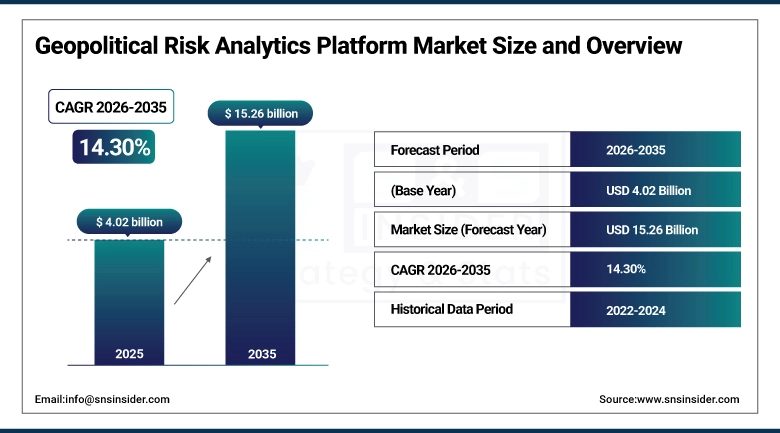
The Geopolitical Risk Analytics Platform Market size was valued at USD 4.02 Billion in 2025 and is projected to reach USD 15.26 Billion by 2035, growing at a CAGR of 14.30% during the forecast period of 2026-2035.
The Geopolitical Risk Analytics Platform market is growing because of the increasing global uncertainties, cross-border investments, and need for real-time risk analysis. Organizations are increasingly relying on advanced analytics and AI-based tools to track and analyze political instabilities, changes in regulations, and supply chain risks. Moreover, the increasing concerns regarding economic volatilities, trade wars, and security risks are fueling the demand for predictive analytics, helping organizations make strategic business decisions and mitigate potential risks effectively
To Get more information on Geopolitical Risk Analytics Platform Market - Request Free Sample Report
Key Geopolitical Risk Analytics Platform Market Trends
-
Platforms are increasingly leveraging AI and machine learning to forecast geopolitical events and assess cascading impacts across markets, supply chains, and investments.
-
Solutions now combine geopolitical data with climate, cyber, economic, and regulatory risks to provide holistic, interconnected risk insights.
-
Organizations demand real-time dashboards and continuous monitoring tools to respond quickly to political instability, conflicts, and policy changes.
-
Banks, asset managers, and multinational companies are increasingly adopting these platforms for investment decisions, compliance, and strategic planning.
-
With increasing global tensions and trade disruptions, platforms emphasize supply chain mapping and scenario analysis to mitigate operational risks.
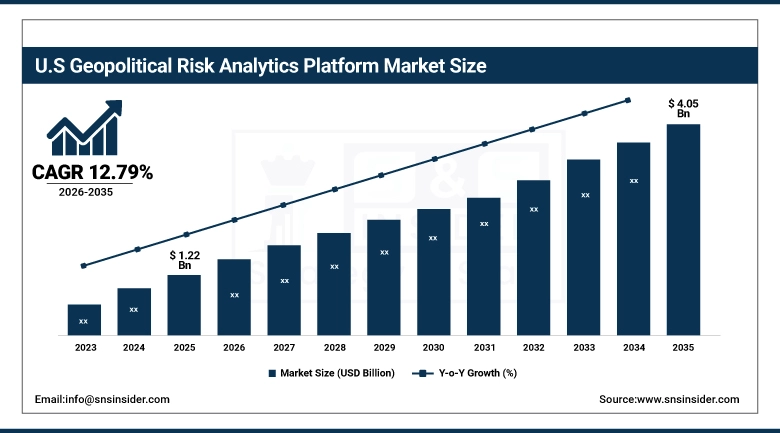
The U.S. Geopolitical Risk Analytics Platform Market was valued at USD 1.22 Billion in 2025 and is projected to reach USD 4.05 Billion by 2035, growing at a CAGR of 12.79% from 2026 to 2035. The U.S. holds an 87.64% share within North America, a concentration that reflects where the bulk of global institutional capital, multinational corporate headquarters, and government intelligence demand is based.
Geopolitical Risk Analytics Platform Market Growth Drivers:
- Rising Global Instability, AI Adoption, and Supply Chain Risks Driving Growth in Geopolitical Risk Analytics Platforms
The driving factors for the Geopolitical Risk Analytics Platform are the increasing levels of global political volatility, trade disputes, and cross-border investments. Organizations need to use advanced technology to analyze risks associated with changes in regulations, sanctions, and geopolitical risks. The use of AI, big data, and predictive analytics technologies is improving decision-making capabilities. Moreover, the increasing number of supply chain disruptions is also adding to the factors that are driving the market. The increasing number of financial institutions, governments, and multinational corporations, and the need to strategically mitigate risks, are also driving the market.
A 2024 survey by the Global Risk Institute found that 73% of North American financial institutions planned to increase spending on geopolitical risk analytics tools over the following 18 months, with AI-enhanced scenario modeling cited as the primary capability gap driving new platform procurement.
Geopolitical Risk Analytics Platform Market Restraints:
-
High Costs, Data Challenges, and Integration Complexities Restraining Adoption of Geopolitical Risk Analytics Platforms Globally
The Geopolitical Risk Analytics Platform market has limitations, such as implementation and subscription costs, which are inhibitory for small and medium-sized organizations. Data reliability and accuracy problems, especially in dynamic countries, might influence the result of decisions made through such platforms. Another limitation might be related to integrating such platforms with existing enterprise infrastructures, along with a lack of standardization in data structures. Data privacy, security, and regulatory compliance are also limitations for such platforms. Lack of awareness and availability of skilled resources to interpret complex analytics are also limitations for such markets, while dynamic geopolitical scenarios make it difficult for platform providers to predict and validate results.
Geopolitical Risk Analytics Platform Market Opportunities:
-
Rising AI-Driven Insights and Emerging Market Demand Unlock New Growth Opportunities in Geopolitical Risk Analytics Platforms
The Geopolitical Risk Analytics Platform market is a highly lucrative one, driven by the increasing need for predictive intelligence among businesses across the world. The rising trend in the emerging economies, in which the level of political and economic volatility is high, is another area in which the platform can grow. In addition, the platform can be integrated with other technologies, including AI, big data, and cloud computing, which would make the platform highly scalable. The need for supply chain, ESG, and investment risks is another new area in which the platform can grow, while the partnership with the government and financial institutions, as well as the development of a highly cost-effective platform, are other areas in which the platform can grow.
Geopolitical Risk Analytics Platform Market Segment Analysis
-
By Offering / Component, Geopolitical Risk Analytics Software Platforms dominated with 38.46% in 2025, and AI & Predictive Analytics Engines are expected to grow at the fastest CAGR of 17.42% from 2026 to 2035.
-
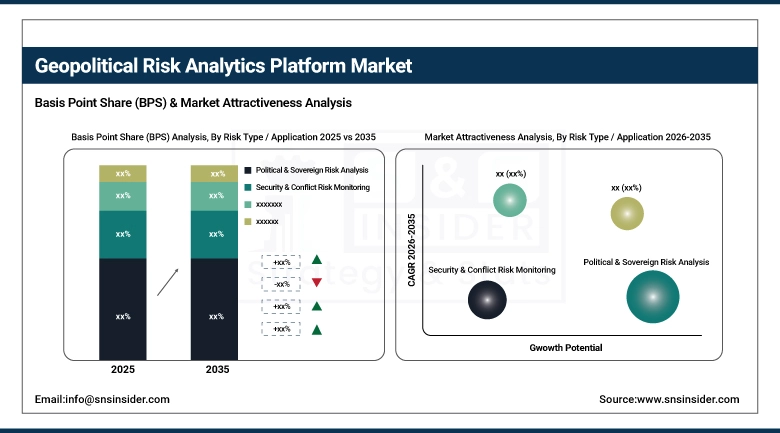
By Risk Type / Application, Political & Sovereign Risk Analysis dominated with 29.84% in 2025, and Supply Chain & Geoeconomic Risk Analysis is expected to grow at the fastest CAGR of 17.88% from 2026 to 2035.
-
By Deployment Mode, Cloud-Based Platforms dominated with 62.84% in 2025, and Cloud-Based Platforms are expected to grow at the fastest CAGR of 16.23% from 2026 to 2035.
-
By End-User / Industry, BFSI & Investment Firms dominated with 31.72% in 2025, and Multinational Corporations & Supply Chain Operators are expected to grow at the fastest CAGR of 17.05% from 2026 to 2035.
By Offering / Component, Software Platforms Lead the Market While AI & Predictive Analytics Engines Register Fastest Growth 2026 to 2035
The market is mainly dominated by integrated geopolitical risk analysis software platforms that offer a centralized platform with dashboards and visualization tools. On the other hand, AI and predictive analysis engines are increasingly being adopted in the market due to the growing need to use predictive analysis tools for anticipating geopolitical events and making appropriate decisions.
By Risk Type / Application, Political & Sovereign Risk Analysis Leads While Supply Chain & Geoeconomic Risk Analysis Posts Fastest Growth Through 2035
While political and sovereign risk analysis remains the most popular use case, organizations are keenly interested in understanding government policies, regulatory shifts, and political stability. Supply chain and geoeconomic risk analysis has now emerged as a major risk analysis domain. With organizations taking proactive measures to address risks arising out of global disruptions, trade wars, and economic shifts, there has been an increased demand for ensuring business continuity.
By Deployment Mode, Cloud-Based Platforms Dominate and Continue to Widen Lead Over On-Premises Solutions Through 2035
Cloud-based platforms have emerged as the most dominant form, given their scalability, flexibility, and capacity to ensure real-time access to critical data. Cloud-based platforms are preferred by organizations because they offer cost savings and integration capabilities. Moreover, cloud-based deployment is witnessing high growth, given the increasing adoption of digital transformation strategies by organizations, thereby requiring geopolitical risk analysis tools.
By End-User / Industry, BFSI Leads Geopolitical Risk Analytics Market While Multinational Corporations and Supply Chain Operators Post Fastest Growth 2026 to 2035
The BFSI and investment segment is the leader in adoption, driven by the need to accurately assess risks in global investments. Multinational corporations and supply chain operators are the new emerging segments, driven by the need to utilize geopolitical risk analytics in handling complex global operations in an uncertain world.
Geopolitical Risk Analytics Platform Market Report Analysis
North America Geopolitical Risk Analytics Platform Market Insights
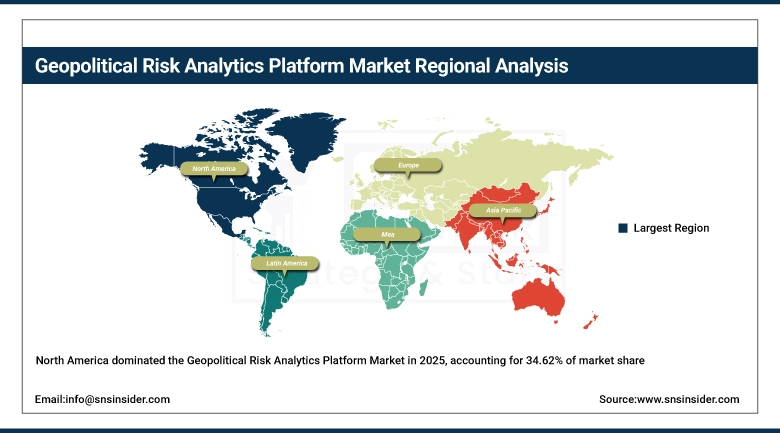
North America held the largest regional share at 34.62% in 2025, valued at USD 1.39 Billion, growing at a CAGR of 13.11% through 2035. The region is home to the bulk of global institutional capital, the headquarters of the world's largest multinational corporations, and the government agencies that set the sanctions and export control frameworks that drive compliance-related procurement across the rest of the world. Wall Street's concentration in New York, the defense and intelligence community's anchor in Washington DC, and Silicon Valley's role as the technology development hub for AI-driven analytics platforms collectively explain why North America leads by share despite the fact that the geopolitical risks that these platforms monitor are concentrated in other regions.
Get Customized Report as per Your Business Requirement - Enquiry Now
U.S. Geopolitical Risk Analytics Platform Market Insights
The US Geopolitical Risk Analytics Platform market has tremendous growth opportunities, and this is due to the fact that the US plays a vital role in international politics, finance, and security. The growing geopolitical risks, changing foreign policy, and growing cyber and trade risks are compelling organizations to use analytics platforms for strategic decision-making
Europe Geopolitical Risk Analytics Platform Market Insights
Europe held a 27.48% share in 2025 at USD 1.10 Billion with a CAGR of 13.39% through 2035. The region's market is shaped differently from North America's. Regulatory compliance is the primary procurement driver the EU's CSDD, the EU Taxonomy Regulation, and country-by-country reporting requirements under the Pillar 2 global minimum tax framework are all generating demand for supply chain and country-level political risk data among European multinationals that had previously operated with lighter risk infrastructure than their American counterparts. European banks under ECB supervision are also receiving more explicit guidance on quantifying geopolitical risk concentrations in their loan books, credit portfolios, and correspondent banking relationships.
Germany Geopolitical Risk Analytics Platform Market Insights
In 2025, Germany held a dominant share in the European Geopolitical Risk Analytics Platform market, considering its robust economic status, international trade activities, and technological advancements. The presence of a large number of multinational corporations and financial institutions in Germany creates a huge market for risk intelligence tools, and a growing emphasis on supply chain risk, regulatory compliance, and geopolitical risk also contributes to its widespread adoption in the country.
Asia Pacific Geopolitical Risk Analytics Platform Market Insights
Asia Pacific is growing at the fastest CAGR of 16.85% from 2026 to 2035, valued at USD 0.93 Billion in 2025. The region's own political risk landscape is generating domestic demand. Taiwan Strait tension, South China Sea territorial disputes, North Korean nuclear program developments, India-Pakistan friction, and the sheer complexity of Southeast Asia's regulatory patchwork all give regional companies and financial institutions strong reasons to invest in analytical tools rather than relying on informal monitoring. Japan's Financial Services Agency published guidelines in 2024 on geopolitical risk management for financial institutions, effectively signaling that the regulator expects major banks to have formal analytical processes rather than ad hoc assessments.
China Geopolitical Risk Analytics Platform Market Insights
China held the largest share in the Asia Geopolitical Risk Analytics Platform market in 2025 due to the sheer size of its economy, expanding global trade networks, and rising geopolitical influence. The need to address rising levels of regulatory complexity and international investments has fueled the need for high-end risk intelligence platforms. Moreover, the high level of focus on data analytics, digitalization, and supply chain security by the government has also fueled the market.
Latin America (LATAM) and Middle East & Africa (MEA) Geopolitical Risk Analytics Platform Market Insights
Latin America held a 7.21% share in 2025 at USD 0.29 Billion with a CAGR of 15.29%, the second-highest regional growth rate. Brazil's financial sector, the largest in Latin America, is the primary demand anchor Banco do Brasil, Itau, and Bradesco all operate sophisticated risk management functions, and the region's history of currency crises, political reversals, and commodity dependence makes political risk analysis a standard rather than optional practice among its institutional investors. Mexico's near-shoring boom, driven by U.S. companies relocating supply chains from Asia, is pulling in geopolitical risk platform adoption from the foreign direct investors assessing Mexican security, regulatory, and labor risk. The Middle East & Africa region held 7.53% in 2025 at USD 0.30 Billion with a CAGR of 12.90%. Gulf sovereign wealth funds ADIA, PIF, QIA are significant institutional buyers of geopolitical risk analytics as they diversify into African infrastructure, Asian technology, and European real estate.
Competitive Landscape for Geopolitical Risk Analytics Platform Market:
Bloomberg L.P., headquartered in New York, operates the world's most widely deployed financial data terminal with embedded geopolitical and country risk analytics functions used by over 325,000 subscribers globally across banks, asset managers, hedge funds, and government treasuries. Its Country Risk module, integrated directly into the Terminal workflow, provides political risk scores, sovereign debt analytics, and geopolitical event feeds that financial professionals access alongside market data without switching platforms.
-
In 2024, Bloomberg expanded its geopolitical risk dashboard with AI-generated country-level scenario narratives, integrating NLP analysis of thousands of local-language news sources into English-language risk summaries accessible directly from the Terminal, broadening its capabilities beyond quantitative data feeds into AI-assisted qualitative political risk assessment.
Palantir Technologies, headquartered in Denver, Colorado, has built one of the most technically sophisticated geopolitical risk analytics capabilities in the commercial market, crossing over from its deep roots in U.S. intelligence and defense community work. Its Gotham platform, originally built for CIA and NSA use cases, and its commercial Foundry platform share an underlying data integration and graph analytics architecture that is purpose-built for connecting disparate political, economic, and security datasets into entity-linked risk pictures.
- In 2025, Palantir announced an expansion of its AIP (Artificial Intelligence Platform) commercial offering with dedicated geopolitical risk workflow modules targeting financial services clients, integrating LLM-based document analysis with its existing graph data models to generate supply chain and sanctions exposure reports at the counterparty and subsidiary level.
Geopolitical Risk Analytics Platform Market Key Players:
-
S&P Global
-
Moody's Analytics
-
Palantir Technologies
-
IBM
-
SAS Institute
-
Oracle
-
SAP
-
Accenture
-
LexisNexis Risk Solutions
-
Dun & Bradstreet
-
FICO
-
FIS
-
Adenza
-
Riskonnect
-
PRS Group
-
Maplecroft
-
Seerist
-
Control Risks
| Report Attributes | Details |
|---|---|
| Market Size in 2025 | USD 4.02 Billion |
| Market Size by 2035 | USD 15.26 Million |
| CAGR | CAGR of 14.30% From 2026 to 2035 |
| Base Year | 2025 |
| Forecast Period | 2026-2035 |
| Historical Data | 2022-2024 |
| Report Scope & Coverage | Market Size, Segments Analysis, Competitive Landscape, Regional Analysis, DROC & SWOT Analysis, Forecast Outlook |
| Key Segments | • By Offering / Component (Geopolitical Risk Analytics Software Platforms, AI & Predictive Analytics Engines, Data & Intelligence Feeds (Country Risk, Political Data, OSINT), and Consulting & Advisory Services) • By Risk Type / Application (Political & Sovereign Risk Analysis, Economic & Trade Risk Assessment, Security & Conflict Risk Monitoring, and Supply Chain & Geoeconomic Risk Analysis) • By Deployment Mode (Cloud-Based Platforms and On-Premises Solutions) • By End-User / Industry (BFSI & Investment Firms, Government & Defense Agencies, Energy, Oil & Gas, and Utilities, and Multinational Corporations & Supply Chain Operators) |
| Regional Analysis/Coverage | North America (US, Canada), Europe (Germany, UK, France, Italy, Spain, Russia, Poland, Rest of Europe), Asia Pacific (China, India, Japan, South Korea, Australia, ASEAN Countries, Rest of Asia Pacific), Middle East & Africa (UAE, Saudi Arabia, Qatar, South Africa, Rest of Middle East & Africa), Latin America (Brazil, Argentina, Mexico, Colombia, Rest of Latin America). |
| Company Profiles | Bloomberg, S&P Global, Moody’s Analytics, Palantir Technologies, IBM, SAS Institute, Oracle, SAP, Accenture, Verisk Analytics, LexisNexis Risk Solutions, Dun & Bradstreet, FICO, FIS, Adenza, Riskonnect, PRS Group, Maplecroft, Seerist, Control Risks. |

Frequently Asked Questions
North America dominated the market in 2025 with a 34.62% share.
Geopolitical Risk Analytics Software Platforms dominated with a 38.46% share in 2025.
Key drivers include the proliferation of sanctions regimes requiring real-time compliance monitoring, new ESG and supply chain disclosure legislation in the EU and U.S., corporate losses from geopolitical events elevating boardroom demand for quantified political risk, and the maturation of AI-based scenario modeling that allows analytical output at speeds and scales not previously possible.
The Geopolitical Risk Analytics Platform Market size was USD 4.02 Billion in 2025 and is expected to reach USD 15.26 Billion by 2035.
The Geopolitical Risk Analytics Platform Market is expected to grow at a CAGR of 14.30% from 2026-2035.
