
Ambient Intelligence Market Report Scope & Overview:
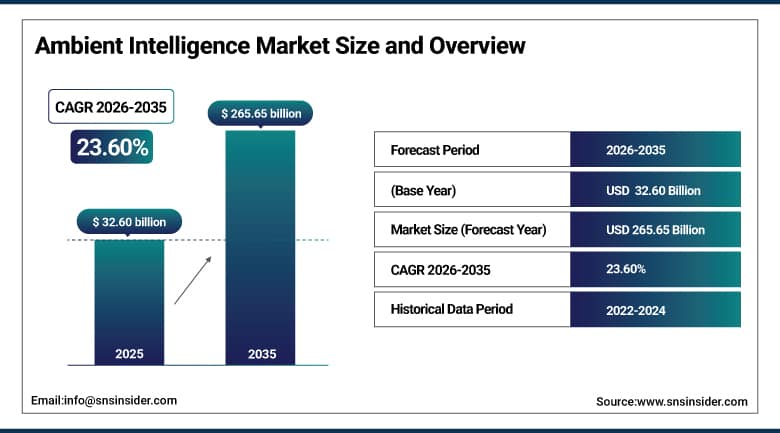
The Ambient Intelligence Market size was estimated to be valued at 32.60 Billion in 2025. It is anticipated to grow to 265.65 Billion by 2035 at a CAGR of 23.60% during the forecast period 2026–2035.
The Ambient Intelligence Market analysis report includes an overview of the Ambient Intelligence Market dynamics, technology advancements, and applications. Factors like the rising adoption of artificial intelligence and IoT technologies, the rising demand for smart homes and smart healthcare systems, investments in smart cities, and advancements in edge computing are propelling the Ambient Intelligence Market to grow at a strong rate during the forecast period 2026–2035.
The Ambient Intelligence Market size crossed billions of connected devices and intelligent systems in 2025 due to the rising digital transformation pace, the rising automation of industries, and the rising demand for context-aware user experiences.
Ambient Intelligence Market Size and Forecast:
-
Market Size in 2025: USD 32.60 Billion
-
Market Size by 2035: USD 265.65 Billion
-
CAGR: 23.60% from 2026 to 2035
-
Base Year: 2025
-
Forecast Period: 2026–2035
-
Historical Data: 2022–2024
To Get More Information On Ambient Intelligence Market - Request Free Sample Report
Ambient Intelligence Market Trends:
-
Increased usage of artificial intelligence and Internet of Things technology is contributing to the development of context-aware and intelligent environments.
-
Increased demand for smart homes and smart devices is contributing to the increased adoption of ambient intelligence solutions for convenience, security, and energy savings.
-
Increased investments in smart city development and smart city infrastructure are contributing to the large-scale deployment of ambient intelligence solutions.
-
Improved edge computing and real-time data processing capabilities of systems are contributing to increased responsiveness of systems, allowing for fast and efficient decision-making.
-
Increased usage of ambient intelligence in healthcare for patient monitoring, elderly care, and smart hospitals is significantly contributing to market growth.
-
Increased personalization of user experiences and automation in various industries is contributing to the adoption of intelligent and adaptive systems
U.S. Ambient Intelligence Market Insights:
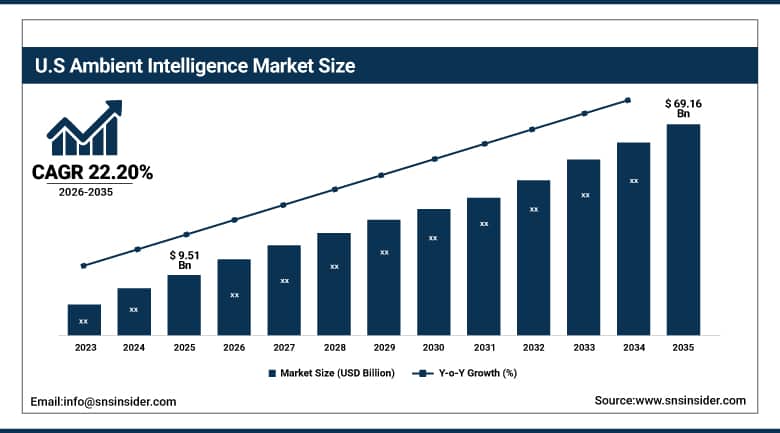
The U.S. Ambient Intelligence Market is expected to grow at a CAGR of 22.20% during the forecast period 2025-2035, growing from 9.51 billion US dollars in 2025 to 69.16 billion US dollars by 2035.
Ambient Intelligence Market Growth Drivers:
-
Growing adoption of AI-powered IoT ecosystems driving demand for ambient intelligence solutions.
The rapid development and integration of artificial intelligence and connected devices is one of the primary contributors to the development and expansion of the Ambient Intelligence market. Enterprises, homes, and infrastructure projects are increasingly adopting context-aware technologies to facilitate real-time decision-making and user experiences. Furthermore, advancements in edge computing, sensor technologies, and data analytics are enabling the development of efficient and scalable ambient intelligence solutions. The development and integration of artificial intelligence and connected devices are significantly contributing to the development and expansion of the Ambient Intelligence market.
More than 60% of the enterprises, infrastructure projects, and connected devices implemented AI-enabled IoT-based ambient intelligence solutions in 2025.
Ambient Intelligence Market Restraints:
-
Data privacy concerns and high implementation costs are restraining widespread adoption of ambient intelligence solutions.
Data security risks and high deployment costs are major deterrents for the Ambient Intelligence Market growth. The need for integrating AI, IoT, and connected devices also requires huge investment in infrastructure, sensors, and analytics tools, which is a major restraint for small and mid-sized enterprises and industries looking for cost-effective solutions. Data Security vulnerabilities, privacy concerns, and the surveillance of user actions present significant obstacles to the widespread adoption of Ambient Intelligence Systems, particularly within sectors like healthcare and infrastructure. Furthermore, interoperability issues and the absence of standardized protocols introduce additional risks during system integration, consequently impeding the expansion of the Ambient Intelligence Market, notwithstanding the escalating demand for intelligent and interconnected environments.
Ambient Intelligence Market Opportunities:
-
Expansion of smart cities and intelligent infrastructure presents significant market expansion opportunities.
The rapid development of smart cities is providing strong growth opportunities for the Ambient Intelligence Market. Governments, planners, and organizations are increasingly using ambient intelligence systems for various applications. The integration of ambient intelligence systems with 5G technology, digital twins, and sensor systems is providing strong growth opportunities. Technology players providing integrated ambient intelligence systems are expected to benefit from the growth of the Ambient Intelligence Market.
More than 50% of smart city projects have integrated ambient intelligence systems into the smart city infrastructure to enhance operational efficiencies by 2025.
Ambient Intelligence Market Segmentation Analysis:
-
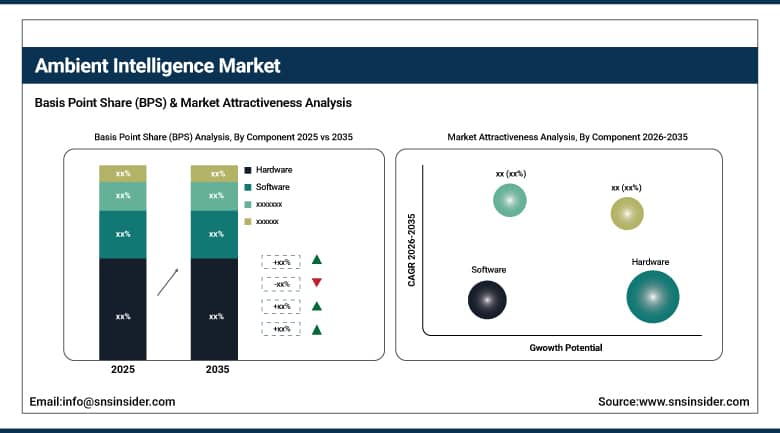
By Component, Hardware segment held the maximum share of 43.25% in 2025, whereas Software segment is expected to register the fastest CAGR of 21.45% during 2026-2035.
-
By Technology, Internet of Things (IoT) segment held the maximum share of 36.41% in 2025, whereas Artificial Intelligence (AI/ML) segment is expected to register the fastest CAGR of 23.54% during 2026-2035.
-
By Application, Smart Homes & Buildings segment held the maximum share of 29.47% in 2025, whereas Healthcare segment is expected to register the fastest CAGR of 22.34% during the forecast period.
-
By End User, Consumer segment held the maximum share of 33.14% in 2025, whereas Commercial segment is expected to register the fastest CAGR of 22.54% during 2026-2035.
-
By Deployment Environment, Indoor environments held the maximum share of 60.14% in 2025, whereas Edge-based deployment is expected to register the fastest CAGR of 21.24% during the forecast period.
By Component, Hardware Dominates While Software Grows Rapidly:
Hardware segment is dominant in this market due to its widespread use of sensors, connected devices, and smart infrastructure in various environments such as homes, commercial spaces, and industries. Billions of IoT-enabled devices and sensor units were deployed in 2025, reflecting its strong reliance on physical infrastructure for supporting ambient intelligence systems and real-time data collection.
Software is the fastest-growing segment of this market, attributed to its increased adoption of artificial intelligence, machine learning, and advanced analytics for context-aware decision-making and automation. Its deployment has increased significantly in 2025, and AI-powered platforms and applications have been integrated into smart homes, healthcare systems, and industries.
By Technology, Internet of Things (IoT) Dominates While Artificial Intelligence (AI/ML) Grows Rapidly:
Internet of Things (IoT) segment was the dominant segment for the market, acting as the primary backbone for all ambient intelligence connectivity. In 2025, tens of billions of connected devices were actively facilitating the exchange of data within smart homes, smart cities, and smart business environments, indicating a high degree of reliance on IoT connectivity.
The fastest-growing segment for ambient intelligence is Artificial Intelligence (AI/ML). This segment has witnessed a high degree of adoption in 2025 for real-time analytics and contextual automation.
By Application, Smart Homes & Buildings Dominate While Healthcare Grows Rapidly:
Smart Homes & Buildings segment accounted for the largest share of the market due to the popularity of connected devices, home automation systems, and energy management systems. In 2025, hundreds of millions of smart home systems and devices are currently being actively deployed, indicating the popularity of smart home systems among consumers.
Healthcare is the fastest-growing segment of the smart home systems market due to the rising popularity of remote patient monitoring systems, smart hospitals, and elderly care systems. In 2025, the deployment of smart home systems increased significantly.
By End-Use Industry, the Consumer Segment Reigns Supreme, Though Commercial is Expanding Quickly:
The consumer segment held the lion's share of the market, fueled by widespread adoption of smart home gadgets, wearables, and personal automation systems. By 2025, hundreds of millions of consumer devices were in active use, a clear sign of robust demand for personal automation solutions.
Commercial segment is growing at the fastest rate due to increasing adoption in offices, retail environments, and smart buildings. Adoption of commercial automation systems increased substantially in 2025, indicating high demand for personal automation devices.
By Deployment, Indoor Segment Dominates While Edge-based Deployment Grows Rapidly:
The indoor segment had the largest market share due to the extensive use of indoor areas such as homes, offices, hospitals, and buildings, where a controlled environment allows for the efficient use of sensors and connected devices. In 2025, the majority of ambient intelligence solutions are implemented in indoor areas, showing a high acceptance rate for indoor applications such as automation, security, and energy management.
The edge segment is growing the fastest in ambient intelligence deployment. This is due to the increasing need for real-time data processing and decision-making. There was a significant increase in the use of edge-based ambient intelligence in 2025.
Ambient Intelligence Market Regional Analysis:
North America Ambient Intelligence Market Insights:
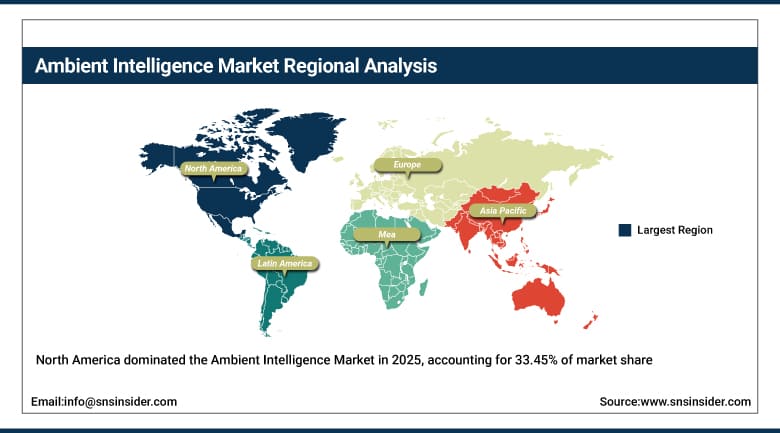
The North America ambient intelligence market holds the highest share at 33.45% in 2025, driven by the strong digital infrastructure in the region and the increasing adoption of AI and IoT solutions in the US and Canada. High adoption of smart homes, smart buildings, and smart enterprises are the factors that drive the ambient intelligence market in North America. In addition, increasing investments in smart cities, edge computing, and the use of real-time analytics are also contributing factors. Moreover, the region has major technology providers, good R&D capabilities, and high consumer awareness, making the ambient intelligence market highly advanced and mature in North America.
Get Customized Report as Per Your Business Requirement - Enquiry Now
U.S. Ambient Intelligence Market Insights:
The U.S. Ambient Intelligence Market is driven by factors such as high usage of connected devices, robust enterprise digital transformation, and high adoption of AI-based platforms. The market is further boosted by high deployments in smart homes, healthcare, and business environments. Continuous innovation, cloud and edge growth, and personalization needs will continue to make the U.S. key regional contributor.
Asia-Pacific Ambient Intelligence Market Insights:
The Asia-Pacific Ambient Intelligence Market holds the highest growth rate among all the regions, with a CAGR of 26.31% from 2026 to 2035. This can be attributed to the high rate of urbanization in the region, increasing smart city initiatives, and the increasing adoption of AI and IoT solutions in China, India, Japan, and Southeast Asia. In addition, the increasing demand for smart homes, industry automation, and infrastructure, along with government initiatives and digital transformation strategies, are significantly promoting the adoption of AI solutions in the region. Moreover, investments in 5G infrastructure, edge computing, and smart solutions are promoting the adoption of AI solutions at a large scale, thus providing a boost to the growth of the Ambient Intelligence Market.
China Ambient Intelligence Market Insights:
The China Ambient Intelligence Market is fueled by factors such as rapid urbanization, massive smart city development initiatives, and significant government support for digital transformation. In addition, the increasing adoption of AI, IoT, and edge computing in industrial automation, smart infrastructure, and smart cities are major factors fueling the China Ambient Intelligence Market. Moreover, the increasing need for smart transportation systems, smart energy management systems, smart surveillance systems, and the development of 5G infrastructure, along with domestic technology advancements in China, are major factors propelling the China Ambient Intelligence Market.
Europe Ambient Intelligence Market Insights:
The Europe Ambient Intelligence Market is being driven by a strong focus on sustainability, smart infrastructure, and energy-efficient buildings. Countries such as Germany, France, and the UK are significantly influencing the market in Europe. They are doing so by increasing their uptake of intelligent building infrastructure, industrial automation, and connected health. Favorable regulations, investment in smart cities, and a focus on data privacy and security are all helping to drive the market. Ongoing advancements in AI integration, industrial automation, and digital transformation are further reinforcing Europe's position in the ambient intelligence market.
Germany Ambient Intelligence Market Insights:
Germany is a major contributor to the overall Ambient Intelligence Market in Europe, owing to its advanced industrial infrastructure and high adoption of Industry 4.0 technologies. It is also driven by the increasing deployment of smart manufacturing systems, smart building systems, and energy management systems. The region has a high focus on automation, engineering excellence, and government initiatives on digitalization, along with investments in AI and IoT technologies.
Latin America Ambient Intelligence Market Insights:
Latin America Ambient Intelligence Market is expanding owing to the increasing adoption of smart infrastructure and digitalization initiatives in the region. The region is also driven by the increasing deployment of connected devices, smart home systems, and smart building systems in countries such as Brazil, Mexico, and Argentina. Investments in urban development, retail automation, and energy management systems, along with increasing internet penetration and advancements in technology, are also driving the Ambient Intelligence Market in Latin America.
Middle East and Africa Ambient Intelligence Market Insights:
The Middle East & Africa Ambient Intelligence Market is witnessing growth due to increasing investment in smart cities. The Middle East & Africa Ambient Intelligence Market is witnessing growth due to increasing investment in smart cities. The Middle East & Africa Ambient Intelligence Market is witnessing growth due to increasing investment in smart cities. The Middle East & Africa Ambient Intelligence Market is witnessing growth due to increasing investment in smart cities.
Ambient Intelligence Market Competitive Landscape:
Microsoft is a prominent technology firm in the world that has a strong footprint in the Ambient Intelligence market, providing AI-based solutions such as Azure AI and IoT solutions for smart environments in various industries. The firm has consistently invested in artificial intelligence, digital twin technology, and enterprise solutions, making it more competitive in the market. Strategic partnerships and infrastructure development globally have made Microsoft a leader in deploying smart environments.
-
In November 2025, Microsoft strengthened its Azure AI and IoT solutions by improving real-time analytics and edge integration for smart environments.
Siemens is another prominent firm in the Ambient Intelligence market, recognized for its smart infrastructure solutions, industrial automation solutions, and smart buildings solutions. The firm provides integrated solutions for smart environments using IoT, AI, and digital twin technologies. Its strong footprint in infrastructure development, its innovative solutions in industrial automation systems, and its sustainable development strategies make it more competitive in the market.
-
In October 2025, Siemens enhanced its smart infrastructure solutions by integrating AI-based analytics and digital twin technologies for smart buildings and smart cities.
Another major player in the Ambient Intelligence market is IBM, which uses its strengths in AI, cloud computing, and analytics through its platforms such as IBM Watson AI. IBM specializes in delivering enterprise-class ambient intelligence solutions in the areas of healthcare, smart cities, and industry. IBM’s focus on delivering hybrid cloud, AI governance, and advanced analytics capabilities gives IBM a competitive edge in the Ambient Intelligence market.
-
Enhancements were made to IBM’s Watson AI platform in December 2025, which provided advanced automation and real-time data processing capabilities to aid in better decision-making and intelligent system development for enterprise and public sector use cases.
Ambient Intelligence Market Key Players:
-
Microsoft
-
IBM
-
Google
-
Intel
-
Cisco Systems
-
Siemens
-
Schneider Electric
-
Honeywell
-
Johnson Controls
-
Philips
-
ABB
-
Apple
-
Samsung Electronics
-
Bosch
-
Legrand
-
Tunstall Healthcare
-
Xiaomi
-
Huawei Technologies
| Report Attributes | Details |
|---|---|
| Market Size in 2025 | USD 32.60 Billion |
| Market Size by 2035 | USD 265.65 Billion |
| CAGR | CAGR of 23.60% From 2026 to 2035 |
| Base Year | 2025 |
| Forecast Period | 2026-2035 |
| Historical Data | 2022-2024 |
| Report Scope & Coverage | Market Size, Segments Analysis, Competitive Landscape, Regional Analysis, DROC & SWOT Analysis, Forecast Outlook |
| Key Segments | • By Component (Hardware, Software, Services) • By Application (Healthcare, Smart Homes & Buildings, Automotive, Retail, Enterprise / Offices, Smart Cities, Others) • By Technology (Artificial Intelligence (AI/ML), Internet of Things (IoT), Edge Computing, Natural User Interfaces (Voice, Gesture, Emotion Recognition), Ubiquitous / Pervasive Computing) • By End-User (Consumer, Commercial, Industrial, Government / Public Sector) • By Deployment Environment (Indoor, Outdoor, Cloud-based, Edge-based) |
| Regional Analysis/Coverage | North America (US, Canada), Europe (Germany, UK, France, Italy, Spain, Russia, Poland, Rest of Europe), Asia Pacific (China, India, Japan, South Korea, Australia, ASEAN Countries, Rest of Asia Pacific), Middle East & Africa (UAE, Saudi Arabia, Qatar, South Africa, Rest of Middle East & Africa), Latin America (Brazil, Argentina, Mexico, Colombia, Rest of Latin America). |
| Company Profiles | IBM, Intel, Microsoft, Google, Amazon Web Services, Cisco Systems, Siemens, Schneider Electric, Honeywell, Johnson Controls, Philips, ABB, Apple, Samsung Electronics, Bosch, LG Electronics, Legrand, Tunstall Healthcare, CareTech, Xiaomi |

Frequently Asked Questions
North America dominates and is growing in the market by 33% in 2025, and Asia-Pacific is growing in the market by 26.31%.
Hardware dominates and is expected to grow in the market by 43.47%, and software is expected to grow at a high CAGR of 19.36% during 2026-2035.
The key factors driving the market are the increased adoption of AI and IoT, smart homes and smart cities, edge computing, and automation and personalization.
The size of the market is valued at 32.60 Billion in 2025 and is expected to reach 265.65 Billion by 2035.
The CAGR of the Ambient Intelligence Market is 23.60%.
