
Green Tea Market Report Scope & Overview:
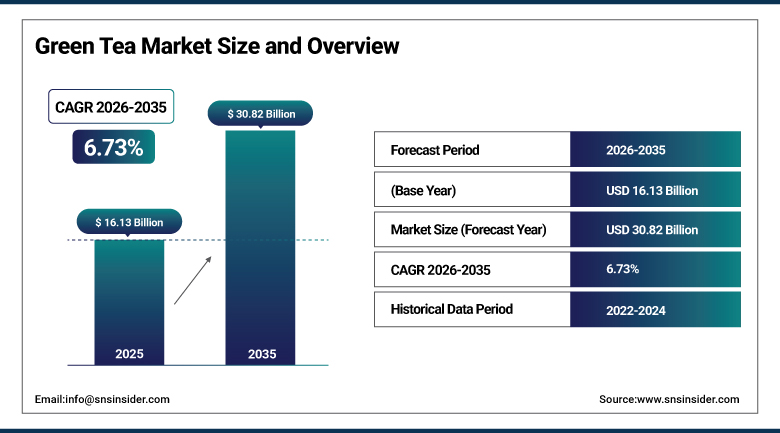
The Green Tea Market was valued at USD 16.13 billion in 2025 and is expected to reach USD 30.82 billion by 2035, growing at a CAGR of 6.73% from 2026–2035.
Green tea occupies a uniquely privileged position within the global beverage and functional food landscape, combining the world's most extensively documented scientific evidence of health-promoting biological activity among commercially consumed beverages with the deep cultural resonance of a drink whose preparation and consumption rituals span centuries of tradition across East Asian civilizations that have recognized its health and spiritual significance long before modern nutritional science could characterised the polyphenol chemistry underlying its bioactive properties. Produced from the leaves of Camellia sinensis through minimal oxidation processing that preserves the leaf's catechin antioxidant content that would otherwise be enzymatically oxidized during the fermentation used to produce black tea, green tea's characteristic flavour profile, color, and health functional properties all derive from this minimal processing approach that keeps the freshly harvested leaf's biochemistry largely intact through the steaming or pan-firing treatments that inactivate the polyphenol oxidase enzymes responsible for catechin oxidation.
The Harvard T.H. Chan School of Public Health's 2025 longitudinal health study confirming that regular green tea consumption of three or more cups daily was associated with 23% lower risk of cardiovascular disease mortality, 17% lower risk of all-cause mortality, and meaningful associations with reduced risk of type 2 diabetes and specific cancer types across the combined analysis of 18 prospective cohort studies provides the most comprehensive scientific validation of green tea's health benefits that has yet been assembled and validates the functional beverage positioning that sustains premium pricing across the global green tea market.
Market Size and Forecast
-
Market Size in 2026E: USD 17.22 Billion
-
Market Size by 2035: USD 30.82 Billion
-
CAGR: 6.73% from 2026 to 2035
-
Fastest Growing Region: Asia Pacific
-
Largest Region: Asia Pacific
To Get more information Green Tea Market - Request Free Sample Report
Green Tea Market Trends
-
Matcha green tea is rapidly globalizing as a premium product used in lattes, desserts, and supplements due to its unique flavor, color, and cultural appeal.
-
Cold brew green tea is gaining popularity for its smoother taste, lower bitterness, and higher retention of L-theanine and antioxidants.
-
Green tea is increasingly used in skincare and cosmetics due to its antioxidant and anti-inflammatory properties supporting the clean beauty trend.
-
Demand is rising for organic and single-origin green tea driven by health-conscious consumers seeking purity, traceability, and premium quality.
-
Functional green tea beverages are expanding with added ingredients like probiotics, adaptogens, and proteins for enhanced wellness benefits.
The U.S. Green Tea Market Outlook
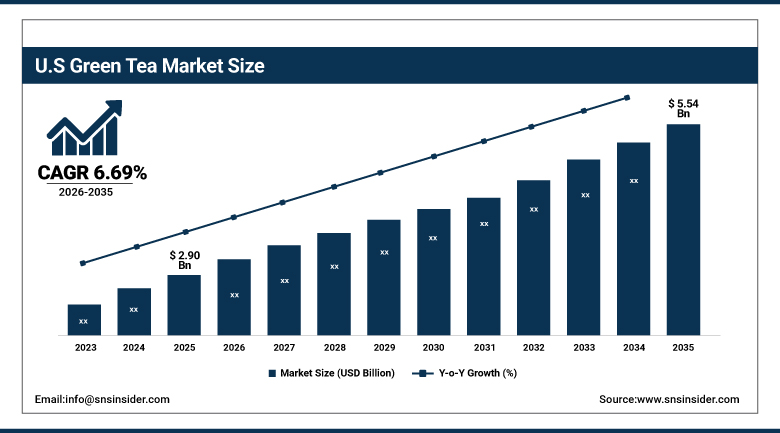
The U.S. Green Tea Market was valued at approximately USD 2.90 billion in 2025 and is expected to reach approximately USD 5.54 billion by 2035, growing at a CAGR of 6.69%.
The United States has emerged as one of the world's most commercially important green tea markets outside Asia, where the combination of the world's most health-conscious premium beverage consumer base, the extraordinary success of Starbucks' matcha latte programme that has introduced matcha to millions of mainstream American coffee consumers, and the proliferation of premium loose leaf tea retailers including DavidsTea, Harney & Sons, and Japanese import specialists has created a multi-tier green tea market serving casual convenience purchasers and dedicated tea connoisseurs simultaneously. The U.S. green tea market benefits from the growing Asian-American demographic whose cultural familiarity with green tea creates both a loyal traditional consumer base and an education and authenticity reference that influences broader consumer market perception of green tea quality.
Nielsen's 2025 U.S. beverage market analysis confirming that green tea and matcha represented the fastest-growing hot beverage category by dollar sales for the third consecutive year, with matcha-specific product sales growing at 34% year-over-year, validates the structural demand shift toward premium functional tea beverages that is creating the fastest growth within the established green tea market from the premium and specialty tier.
Green Tea Market Segment Analysis
-
By Type, Unflavored Green Tea led the market with approximately 55.28% in 2025; Matcha Green Tea is the fastest-growing type at a CAGR of 7.20%.
-
By Form, Tea Bags accounted for approximately 42.58% in 2025; Ready-to-Drink (RTD) is the fastest-growing form at a CAGR of 8.50%.
-
By Application, Beverages dominated with approximately 75.10% in 2025; Dietary Supplements are the fastest-growing application at a CAGR of 7.51%.
-
By Distribution Channel, Supermarkets & Hypermarkets held the largest share of 48.34% in 2025; Online Retail is the fastest-growing channel at a CAGR of 12.40%.
By Form, Tea Bags dominate, RTD is expected to grow fastest
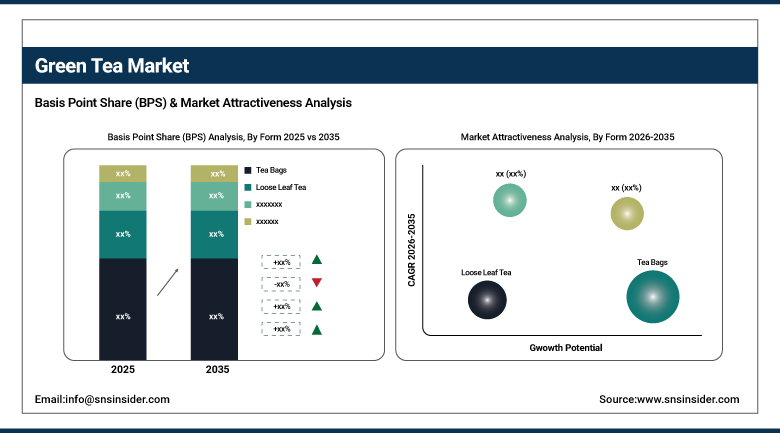
Tea Bags retained the dominant form position with approximately 42.58% of the Green Tea Market in 2025, as the tea bag format's combination of preparation convenience, consistent brewing dosing, wide retail distribution across mainstream grocery channels, and price accessibility at every quality tier from value commodity bags through single-estate premium sachets makes it the default green tea format for the largest mass-market consumer population who priorities ease of preparation over the superior cup quality that loose leaf brewing provides.
Ready-to-Drink green tea is the fastest-growing form at a CAGR of 8.50% through 2035, as the expansion of premium chilled beverage category in retail and food service creates growing shelf space and consumer discovery opportunities for the RTD green tea category whose growth is being driven by both the traditional Asian RTD green tea market expanding its distribution reach beyond ethnic specialty retail and the new generation of Western premium RTD matcha latte, cold brew green tea, and functional green tea beverages that are positioning as premium alternatives to conventional soft drinks and coffee beverages in the growing functional beverage segment.
By Application, Beverages dominate, Dietary Supplements are expected to grow fastest
Beverages retained the dominant application position with approximately 75.10% of the Green Tea Market in 2025, encompassing the complete spectrum of green tea beverage preparation and consumption occasions from the traditional daily multiple-cup green tea consumption of Asian populations through the occasional premium specialty tea preparation of Western connoisseurs and the convenience grab-and-go RTD purchase of on-the-move consumers who value the health benefit association of green tea in a convenient ready-to-consume format.
Dietary Supplements are the fastest-growing application at a CAGR of 7.51% through 2035, driven by the growing consumer segment that seeks to capture green tea's documented health benefits in standardized, high-dose supplement form that delivers specific catechin concentrations beyond what even multiple daily cups of brewed tea reliably provide. EGCG standardized extract capsules, green tea catechin powders marketed for weight management support, and thermogenic fat-burning supplements incorporating green tea extract represent the primary dietary supplement product categories whose growth is sustained by both the documented scientific evidence for green tea catechin biological activity and the consumer preference for convenient once-daily supplement formats over the habit formation required for regular beverage preparation.
Regional Analysis
|
Region |
Major Country |
Share within Region, 2025 (%) |
|---|---|---|
|
North America |
United States |
83.6% |
|
Europe |
Germany |
24.3% |
|
Asia Pacific |
China |
48.7% |
|
Middle East & Africa |
Morocco |
29.4% |
|
Latin America |
Brazil |
43.8% |
North America Green Tea Market Insights
North America is the second-largest green tea market by revenue, with the United States accounting for approximately 83.6% of North American revenues as the largest Western market for green tea driven by health-motivated consumer adoption, matcha's extraordinary mainstream penetration through coffeehouse and food service applications, and the growing Asian-American demographic whose cultural green tea familiarity sustains authentic traditional product demand alongside the mainstream market's more food-service influenced consumption patterns. The region's market growth outpaces overall category growth through the premium tier expansion driven by matcha, single-origin loose leaf, and functional RTD green tea products whose average selling prices substantially exceed the commodity tea bag baseline.
Europe Green Tea Market Insights
Europe is a growing green tea market characterised by strong health-motivated adoption particularly in the United Kingdom, Germany, France, and the Netherlands where consumer awareness of green tea's antioxidant properties and wellness credentials has driven above-average per-capita green tea consumption growth relative to traditional black tea markets in these countries. Germany accounts for approximately 24.3% of European green tea revenues through its combination of Europe's most health-conscious food consumer base, strong organic product preference that creates premium organic green tea demand, and the established specialty tea retail infrastructure in major German cities that supports premium loose leaf adoption. The matcha trend has reached European food service with significant penetration in premium coffeehouse chains and health-focused café concepts that are introducing matcha to mainstream European consumers through familiar beverage formats.
Asia Pacific Green Tea Market Insights
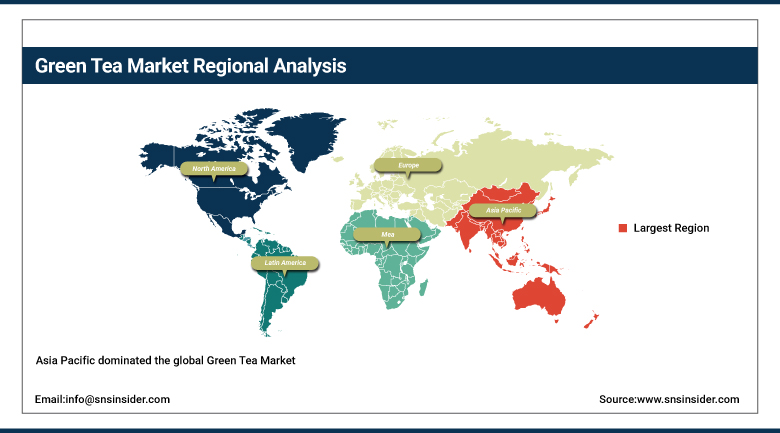
Asia Pacific dominated the global Green Tea Market as both the largest producing and consuming region, anchored by China and Japan as the world's primary green tea cultivation, processing, and export centers whose combined production includes the full spectrum from mass-market commodity green tea through the world's most prestigious specialty grades. China accounts for approximately 48.7% of Asia Pacific green tea revenues through its position as the world's largest green tea producer and consumer market where green tea consumption is embedded in daily cultural practice across demographic groups that sustain consistent per-capita consumption above any other region. Japan's position as the origin of the global matcha trend, the source of the world's premium Gyokuro and premium Sencha grades, and the home of an extraordinary living tea ceremony tradition that continues to inspire global premium tea culture makes it a disproportionately influential market relative to its population size.
Get Customized Report as per Your Business Requirement - Enquiry Now
MEA & Latin America Green Tea Market Insights
The Middle East and Africa and Latin America are growing green tea markets where health consciousness expansion, rising disposable incomes among urban middle-class populations, and growing availability of green tea products through expanding modern trade retail are creating new consumer bases for green tea adoption. Morocco leads MEA green tea revenues at approximately 29.4% through the country's extraordinary per-capita green tea consumption culture where mint green tea is the national beverage consumed across all social occasions, making Morocco the world's highest per-capita green tea consuming country outside East Asia by some measures. Brazil leads Latin American revenues at approximately 43.8% through its large urban health-conscious consumer population and the growing functional beverage market in major Brazilian cities where green tea RTD and premium loose leaf products are expanding beyond specialty health food channels into mainstream retail.
Market Dynamics
Growth Drivers: Rising health consciousness, strong global adoption of matcha, and expansion of ready-to-drink (RTD) green tea formats.
The primary structural growth drivers for the Green Tea Market are the sustained escalation of consumer health consciousness that is directing discretionary food and beverage spending toward products with the most credible and extensively researched health benefit claims, where green tea's extraordinary breadth and depth of academic scientific evidence across cardiovascular disease, metabolic syndrome, neurodegenerative disease, and cancer risk provides the most comprehensively documented health case of any widely consumed beverage category, combined with the matcha phenomenon whose social media virality, food service mainstream adoption through coffeehouse chains globally, and visual distinctiveness have created unprecedented mainstream consumer awareness of and preference for premium Japanese green tea products across demographics that had not previously engaged with specialty tea culture.
Restraints: Caffeine limitations, acquired taste barrier in non-traditional markets, and high cost of premium Japanese grades.
A significant restraint on the Green Tea Market is the bitter astringency of lower-quality and over-extracted green tea that creates a negative first consumption experience for consumers without brewing technique knowledge, generating trial without repeat purchase in the mainstream consumer segments where tea bag convenience format adoption is highest and brewing expertise lowest. The caffeine content of green tea, while lower than coffee, restricts consumption among caffeine-sensitive individuals and limits evening consumption occasions where the combination of caffeine stimulation and time-of-day creates a functional consumption barrier that herbal tea alternatives without caffeine do not face, particularly for the growing consumer segment seeking the antioxidant benefits of green tea without the stimulant effects of its caffeine content.
Opportunities: Growth of decaffeinated variants, wider use in food/cosmetics/supplements, and precision agriculture improving functional compound content.
The development of carbon dioxide decaffeination processes that remove caffeine from green tea without significantly diminishing the catechin antioxidant content that makes green tea nutritionally valuable represents a major commercial opportunity to extend green tea's addressable market to the estimated 15 to 20% of consumers who actively avoid caffeine in beverages they consume regularly, as current decaffeination methods typically reduce catechin content significantly in addition to caffeine removal, creating a product whose health proposition is compromised relative to the full-catechin conventional green tea it is intended to replace.
Recent Developments:
-
September 2025: Nestlé launched green tea extract-based nutraceuticals for metabolic health and skincare in Asia-Pacific, extending its green tea portfolio beyond beverages into the supplement and cosmetic ingredient applications whose growth is outpacing conventional green tea beverage market expansion.
-
2025: Ito En expanded its Oi Ocha premium Japanese green tea RTD distribution in North American markets, investing in cold chain distribution infrastructure that ensures product quality parity with Japanese market standards for the premium RTD green tea segment where product freshness significantly affects taste quality.
-
2025: Unilever's Lipton green tea range expanded with new matcha-blended variants and functional fortified green tea products incorporating vitamin and mineral additions, positioning the mass-market brand's green tea portfolio for the health-conscious mainstream consumer who seeks functional beverage convenience at accessible price points.
Green Tea Market Key Players are:
-
Unilever plc (Lipton)
-
Tata Consumer Products Ltd.
-
Ito En Ltd.
-
Associated British Foods plc (Twinings)
-
Nestlé S.A.
-
Coca-Cola Company (Ayataka)
-
PepsiCo Inc. (Lipton RTD)
-
Hain Celestial Group
-
Bigelow Tea Company
-
Harney & Sons Fine Teas
-
The Republic of Tea
-
Tazo Tea Company (Unilever)
-
Yogi Tea (TPAK)
-
Stash Tea Company
-
Rishi Tea & Botanicals
-
DavidsTea Inc.
-
Marukyu Koyamaen
-
Ippodo Tea Co. Ltd.
-
DoMatcha
-
Encha Organic Matcha
Green Tea Market Report Scope:
| Report Attributes | Details |
|---|---|
| Market Size in 2025 | USD 16.13 Billion |
| Market Size by 2035 | USD 30.82 Billion |
| CAGR | CAGR of 6.73% From 2026 to 2035 |
| Base Year | 2025 |
| Forecast Period | 2026-2035 |
| Historical Data | 2022-2024 |
| Report Scope & Coverage | Market Size, Segments Analysis, Competitive Landscape, Regional Analysis, DROC & SWOT Analysis, Forecast Outlook |
| Key Segments | • By Type (Unflavored Green Tea, Flavored Green Tea, Matcha Green Tea, Organic Green Tea, Others) • By Form (Tea Bags, Loose Leaf Tea, Instant Tea, Ready-to-Drink (RTD), Green Tea Capsules/Supplements) • By Application (Beverages, Dietary Supplements, Food Ingredients, Cosmetics & Personal Care, Others) • By Distribution Channel (Supermarkets & Hypermarkets, Specialty Stores, Online Retail, Others) |
| Regional Analysis/Coverage | North America (US, Canada), Europe (Germany, UK, France, Italy, Spain, Russia, Poland, Rest of Europe), Asia Pacific (China, India, Japan, South Korea, Australia, ASEAN Countries, Rest of Asia Pacific), Middle East & Africa (UAE, Saudi Arabia, Qatar, South Africa, Rest of Middle East & Africa), Latin America (Brazil, Argentina, Mexico, Colombia, Rest of Latin America). |
| Company Profiles | Unilever plc, Tata Consumer Products Ltd., Ito En Ltd., Associated British Foods plc, Nestlé S.A., The Coca-Cola Company, PepsiCo Inc., Hain Celestial Group, Bigelow Tea Company, Harney & Sons, The Republic of Tea, Tazo Tea Company, Yogi Tea, Stash Tea Company, Rishi Tea & Botanicals, DAVIDsTEA Inc., Marukyu Koyamaen, Ippodo Tea Co. Ltd., DoMatcha, and Encha Organic Matcha. |

Frequently Asked Questions
The Green Tea Market is expected to grow at a CAGR of 6.73% from 2026 to 2035.
The Green Tea Market was valued at USD 16.13 billion in 2025.
Escalating consumer health consciousness directing beverage spending toward scientifically validated functional alternatives combined with matcha's extraordinary global mainstream penetration through food service adoption and RTD convenience format expansion reaching new consumption occasions beyond traditional hot brewed tea.
Tea Bags dominated with approximately 42.58% of revenues in 2025.
Asia Pacific dominated the Green Tea Market in 2025, anchored by China and Japan as the world's primary green tea cultivation and consumption markets.
