
Heat Meter Market Report Scope & Overview:
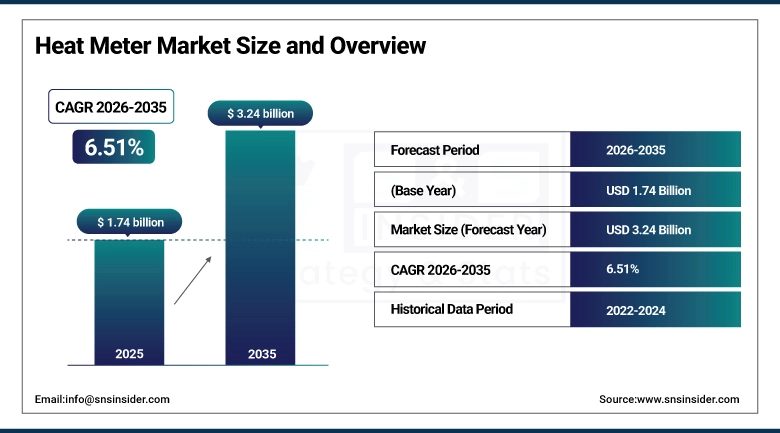
The Heat Meter Market was valued at USD 1.74 billion in 2025 and is expected to reach USD 3.24 billion by 2035, growing at a CAGR of 6.51% from 2026-2035.
The growth of the Heat Meter Market is mainly driven by the rising adoption of district heating systems, the focus on energy efficiency, and the rising need for accurate measurement of thermal energy in residential as well as commercial establishments. The governments of various countries are promoting the implementation of smart meters, as they reduce the wastage of energy. Also, the growth of smart building technology along with the implementation of wireless meters is boosting the growth of the Heat Meter Market.
The International Energy Agency states that the district heating system is meeting 8% of the world's final heat demand, with much growth expected under the clean energy transitions.
The agency also highlights that buildings account for nearly 30% of global final energy consumption, reinforcing the growing need for efficient energy monitoring solutions such as heat meters.
Heat Meter Market Size and Forecast
-
Market Size in 2025: USD 1.74 Billion
-
Market Size by 2035: USD 3.24 Billion
-
CAGR: 6.51% from 2026 to 2035
-
Base Year: 2025
-
Forecast Period: 2026–2035
-
Historical Data: 2022–2024
To Get more information on Heat Meter Market - Request Free Sample Report
Heat Meter Market Trends
-
Rising demand for energy efficiency and accurate consumption monitoring is driving the heat meter market.
-
Growing adoption across residential, commercial, and industrial sectors is boosting market growth.
-
Expansion of district heating systems and smart building initiatives is fueling deployment.
-
Increasing focus on real-time monitoring, automated billing, and regulatory compliance is shaping adoption trends.
-
Advancements in IoT-enabled, wireless, and ultrasonic heat meters are enhancing measurement accuracy and operational efficiency.
-
Rising government incentives and energy conservation mandates are supporting market expansion.
-
Collaborations between meter manufacturers, utility providers, and technology integrators are accelerating innovation and global adoption.
U.S. Heat Meter Market Size Outlook:
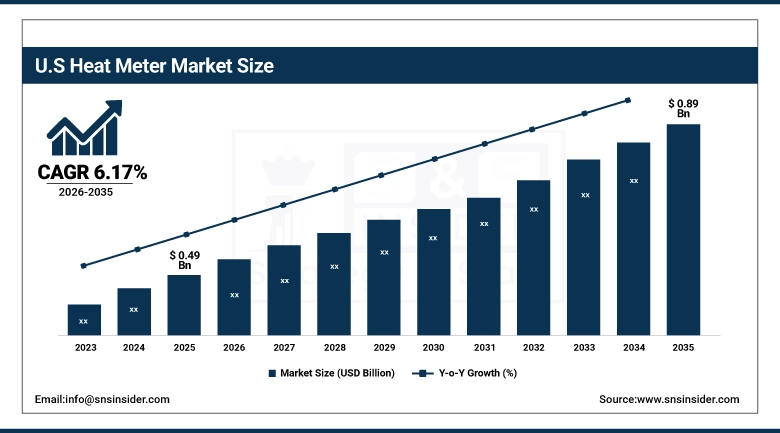
The U.S. Heat Meter Market was valued at USD 0.49 billion in 2025 and is expected to reach USD 0.89 billion by 2035, growing at a CAGR of 6.17% from 2026-2035. The growth of the U.S. Heat Meter Market is fueled by factors such as the increasing adoption of energy monitoring systems in commercial properties, the increasing emphasis on effective heating management, and the increasing use of smart meter technology in the U.S. Heat Meter Market for the purpose of increasing transparency in billing and optimizing energy consumption in properties.
The United States Department of Energy is enforcing the use of meters in federal buildings with the implementation of the Energy Policy Act, which includes the installation of meters that measure electricity, natural gas, and steam in an effective manner.
Additionally, smart meter penetration is expected to approach nearly 90% of U.S. customers by the end of the decade, reflecting the rapid deployment of advanced metering infrastructure and reinforcing the shift toward data-driven energy management.
Heat Meter Market Growth Drivers:
-
Rising district heating infrastructure and government energy efficiency regulations accelerating adoption of advanced heat metering systems across residential, commercial, and industrial buildings
The growing need to extend district heating networks rapidly, as well as energy efficiency standards that are becoming increasingly stringent, is creating a significant need for heat meters in new buildings. Governments are encouraging the monitoring of heat consumption through heat meters to ensure billing clarity as well as energy efficiency. The use of heat meters is becoming more prevalent as it is able to provide precise measurements of heat energy consumption, ensuring that costs are distributed appropriately. Governments are increasingly adopting standards that require heat meters to be installed in buildings connected to district heating networks.
Studies supported by the European Commission indicate that consumption-based billing using heat meters can reduce heating energy use by up to 20% in residential buildings.
Additionally, the U.S. Department of Energy confirms that advanced metering and monitoring systems enable measurable reductions in energy consumption through improved control and optimization.
Heat Meter Market Restraints:
-
Limited awareness and lack of standardized regulatory frameworks in several developing markets slowing the widespread adoption of heat metering technologies
Inadequate awareness of the benefits of using heat metering is also another challenge that has affected the adoption of this technology in some of these emerging markets. Some building owners and energy service providers may not be adequately aware of the benefits of using heat meters. Inconsistencies in regulatory policies and lack of mandatory metering standards also affect some of these markets. In some markets, building developers may not see the need for using heat meters since there is no strong support for this technology. This has led to inadequate adoption of this technology, especially in markets where district heating and smart buildings are still evolving.
Heat Meter Market Opportunities:
-
Integration of smart metering technologies with IoT platforms and digital building management systems creating new opportunities for real-time heat consumption monitoring
The rapid development of IoT technology and smart building technology is creating tremendous opportunities for the development of advanced heat metering technology. The latest technology in the form of remote monitoring and data collection using NB-IoT, LoRaWAN, and wireless M-Bus can be integrated with smart energy management systems to help energy management companies or organizations effectively monitor the real-time patterns of energy consumption and optimize the performance of the heating system. As smart city technology is expanding rapidly, the need for advanced heat metering technology is also likely to increase rapidly.
Kamstrup offers ultrasonic heat meters with remote reading and smart data analytics for accurate billing and optimization of energy consumption.
Danfoss claims that district energy systems with smart heat metering help improve efficiency and reduce losses. Siemens offers smart building solutions that include smart heat metering and automation solutions.
Heat Meter Market Segment Highlights
-
By Application, District Heating and Cooling dominated the Heat Meter Market with ~41% share in 2025; HVAC Sub-Metering fastest growing (CAGR).
-
By Measurement Principle, Electromagnetic dominated the Heat Meter Market with ~58% share in 2025; Ultrasonic fastest growing (CAGR).
-
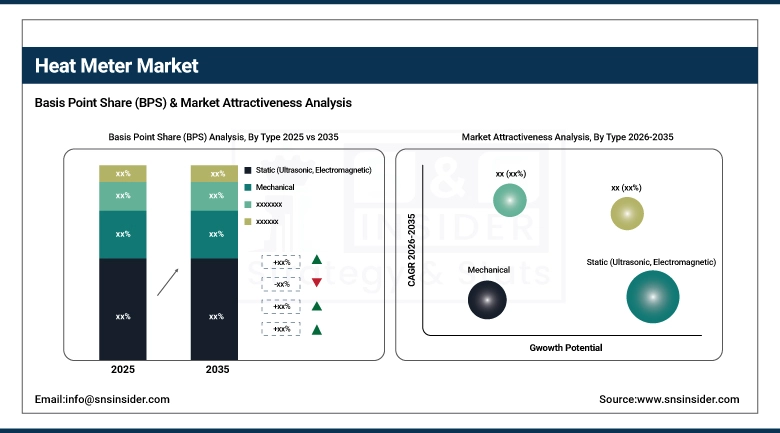
By Type, Static (Ultrasonic, Electromagnetic) dominated the Heat Meter Market with ~56% share in 2025; Static (Ultrasonic, Electromagnetic) fastest growing (CAGR).
-
By Connectivity, Wireless (NB-IoT, LoRaWAN, wM-Bus) dominated the Heat Meter Market with ~61% share in 2025; Wireless (NB-IoT, LoRaWAN, wM-Bus) fastest growing (CAGR).
By Type, Static (Ultrasonic, Electromagnetic) segment dominates and is expected to grow fastest in the Heat Meter Market
Static (Ultrasonic, Electromagnetic) segment dominated the Heat Meter Market with the highest revenue share in 2025 and is also projected to witness the fastest CAGR from 2026 to 2035 due to high accuracy, long life, and low maintenance requirements. These static heat meters are highly preferred as they are free from moving parts and provide long life with consistent performance in district heating applications. They are widely used by energy companies as well as building managers due to accurate thermal energy monitoring.
By Application, District Heating & Cooling segment dominates the Heat Meter Market, HVAC Sub-Metering expected to grow fastest
The District Heating and Cooling segment held the largest market share in the Heat Meter Market in terms of revenue in the year 2025 due to the increased adoption of the system in the residential sector across the globe. It is essential for the utility companies to accurately measure the consumption of heat energy to maintain the transparency of the billing system and to monitor the distribution of energy effectively.
The HVAC Sub-Metering segment is likely to witness the fastest CAGR from 2026 to 2035 due to the increased adoption of energy monitoring systems by the buildings to maximize the efficiency of the HVAC system. The increased interest in smart infrastructure and the need to monitor the energy consumption of the buildings are encouraging the adoption of HVAC sub-metering globally.
By Measurement Principle, Electromagnetic segment dominates the Heat Meter Market, Ultrasonic expected to grow fastest
Electromagnetic segment dominated the Heat Meter Market with the largest revenue share in the year 2025 due to its high accuracy and reliability in the measurement of conductive fluids without pressure loss. These meters are efficient in district heating systems and industrial environments where the accurate monitoring of the flow of thermal energy is essential.
The ultrasonic segment is expected to witness the highest CAGR from 2026 to 2035, as these meters provide highly accurate results for measuring heat with no moving parts. Low maintenance and long life of these meters are also contributing to the increased adoption of smart metering technologies.
By Connectivity, Wireless (NB-IoT, LoRaWAN, wM-Bus) segment dominates and is expected to grow fastest in the Heat Meter Market
Wireless (NB-IoT, LoRaWAN, wM-Bus) segment dominated the Heat Meter Market in terms of revenue share in 2025, with the highest CAGR during the forecast period of 2026–2035, as the utilities industry is increasingly adopting remote metering and data collection systems. Wireless connectivity helps in the real-time monitoring of heat consumption without the need for any wired connections, thereby reducing the overall installation and maintenance costs. The smart cities initiative is promoting the installation of wireless heat meters in residential as well as commercial spaces, along with digital energy management systems.
Heat Meter Market Regional Analysis
North America Heat Meter Market Insights
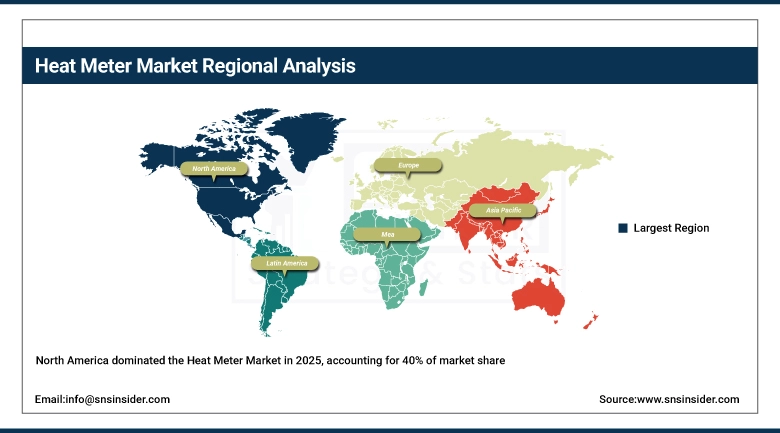
North America held the highest revenue share in the Heat Meter Market in 2025, accounting for 40%, owing to the development in energy management infrastructure and the adoption of smart meter technology in the region. Heat meters are being used by various utilities and operators in the region for billing and efficient utilization of energy. The region has witnessed the development of various policies for efficient energy utilization.
Get Customized Report as per Your Business Requirement - Enquiry Now
Asia Pacific Heat Meter Market Insights
The Asia Pacific segment is expected to grow at the fastest CAGR of 7.92% during 2026-2035 owing to the growing rate of urbanization, expansion in district heating infrastructure, and construction of large buildings. The governments of various countries in this segment are promoting energy efficiency and smart city development, thereby boosting the adoption of advanced metering technologies. The growing rate of industrialization is also boosting the demand for energy monitoring systems.
Europe Heat Meter Market Insights
Europe holds a significant position in the Heat Meter Market due to the presence of district heating infrastructure and the presence of regulatory policies favoring energy efficiency. It is observed that various countries in the region require the measurement of heat energy in multi-apartment buildings, thus promoting the demand for heat meters. Advanced heating infrastructure, the presence of smart metering technology, and the continuous investment in sustainable energy systems are expected to drive the demand for heat meters in the region.
Middle East & Africa and Latin America Heat Meter Market Insights
Middle East & Africa and Latin America are growing markets in the Heat Meter Market. This is because investments in the energy infrastructure of these regions are increasing, and smart building technology is gaining traction in the region. Moreover, there is an increased emphasis on energy efficiency and district energy in urban areas, which is driving the demand for advanced heat measurement solutions. Expanding infrastructure in urban areas and increased awareness about energy consumption are also driving the Heat Meter Market in these regions.
Heat Meter Market Competitive Landscape:
Siemens AG
Siemens AG is an engineering and technology company that focuses on automation, electrification, digitalization, and smart infrastructure solutions. Siemens specializes in the development of technologies that provide advanced solutions in the field of meters, building management, and efficiency in the field of energy. Siemens’ digital solutions in the field of energy provide automation, monitoring, and optimization of heating, cooling, and power networks. Siemens’ solutions provide efficiency, transparency, and sustainability in the field of modern energy systems through the integration of hardware and software solutions.
-
2025: Siemens implemented advanced smart-energy infrastructure and digital building technologies to modernize Berlin’s Staatsbibliothek facility, improving heating energy management and reducing energy consumption by more than 50%, supporting efficient thermal monitoring and metering solutions.
Kamstrup A/S
Kamstrup A/S is a company that offers intelligent metering solutions to water, electric, heat, and cooling utilities across the globe. The company primarily offers smart heat meters, advanced metering infrastructure, and data analytics solutions to energy distribution and consumption utilities worldwide. It focuses on delivering high accuracy metering solutions with the help of its data analytics technology to the energy sector. Smart metering solutions from Kamstrup are used by energy distribution and consumption utilities across the globe.
-
2024: Kamstrup partnered with Göteborg Energi and Noda to deploy intelligent heat-meter data solutions supporting demand-side management and enabling utilities to analyze building heat consumption patterns.
-
2023: Kamstrup secured a major smart-metering contract with BKW Energie, expanding advanced metering infrastructure solutions used by utilities managing electricity and district heating systems.
-
2024: Kamstrup announced continued investments in intelligent metering technologies, including advanced smart heat and cooling meters designed to improve measurement accuracy and energy-efficiency management.
Heat Meter Companies are:
-
Siemens AG
-
Landis+Gyr Group AG
-
Diehl Metering GmbH
-
Danfoss A/S
-
Itron Inc.
-
Zenner International GmbH & Co. KG
-
Sontex S.A.
-
QUNDIS GmbH
-
BMETERS Srl
-
Sensus
-
Engelman SIA
-
Techem GmbH
-
ISTA International GmbH
-
Secure Meters Limited
-
Axioma Metering UAB
-
Metrix Polska Sp. z o.o.
-
Minol Messtechnik W. Lehmann GmbH & Co. KG
-
LianLi Water Meter Co., Ltd.
| Report Attributes | Details |
|---|---|
| Market Size in 2025 | USD 1.74 Billion |
| Market Size by 2035 | USD 3.24 Billion |
| CAGR | CAGR of 6.51% From 2026 to 2035 |
| Base Year | 2025 |
| Forecast Period | 2026-2035 |
| Historical Data | 2022-2024 |
| Report Scope & Coverage | Market Size, Segments Analysis, Competitive Landscape, Regional Analysis, DROC & SWOT Analysis, Forecast Outlook |
| Key Segments | By Type (Mechanical, Static Ultrasonic, Electromagnetic)), By Connectivity (Wired (M-Bus, Modbus, BACnet), Wireless (NB-IoT, LoRaWAN, wM-Bus)), By Measurement Principle (Ultrasonic, Electromagnetic, Superstatic), By End-User (Residential, Commercial( Offices, Retail, Hospitals), Industrial (Chemicals, Food & Beverage, District Energy Plants)), By Application (District Heating & Cooling, HVAC Sub-Metering, Process Heat Monitoring) |
| Regional Analysis/Coverage | North America (US, Canada), Europe (Germany, UK, France, Italy, Spain, Russia, Poland, Rest of Europe), Asia Pacific (China, India, Japan, South Korea, Australia, ASEAN Countries, Rest of Asia Pacific), Middle East & Africa (UAE, Saudi Arabia, Qatar, South Africa, Rest of Middle East & Africa), Latin America (Brazil, Argentina, Mexico, Colombia, Rest of Latin America). |
| Company Profiles | Siemens AG, Kamstrup A/S, Landis+Gyr Group AG, Diehl Metering GmbH, Danfoss A/S, Itron Inc., Zenner International GmbH & Co. KG, Apator S.A., Sontex S.A., QUNDIS GmbH, BMETERS Srl, Sensus, Engelman SIA, Techem GmbH, ISTA International GmbH, Secure Meters Limited, Axioma Metering UAB, Metrix Polska Sp. z o.o., Minol Messtechnik W. Lehmann GmbH & Co. KG, LianLi Water Meter Co., Ltd. |
Frequently Asked Questions
North America dominated the Heat Meter Market in 2025.
The Static (Ultrasonic, Electromagnetic) segment dominated the Heat Meter Market in 2025.
Rising district heating infrastructure and government energy efficiency regulations accelerating adoption of advanced heat metering systems across residential, commercial, and industrial buildings.
The Heat Meter Market was valued at USD 1.74 billion in 2025.
The Heat Meter Market is expected to grow at a CAGR of 6.51% from 2026 to 2035.
