
High Power LED Market Report Scope & Overview:
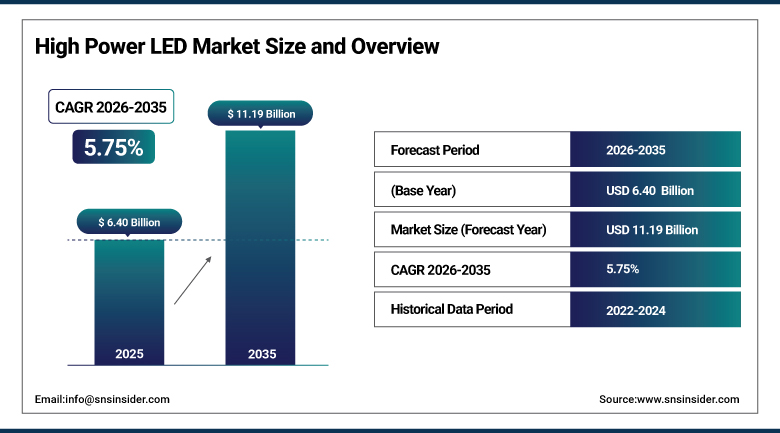
The High Power LED Market size was valued at USD 6.40 Billion in 2025 and is expected to reach USD 11.19 Billion by 2035, growing at a CAGR of 5.75% from 2026-2035.
The High Power LED Market is growing as lighting, automotive, display and industrial users replace older sources with brighter, more efficient semiconductor lamps. High power LEDs deliver hundreds of lumens from a single package and are used in street lights, stadiums, vehicle headlamps, projectors, plant growth lamps and disinfection systems. Flip-chip, chip-on-board and ceramic packages improve heat removal and allow smaller optics. Rules phasing out fluorescent and mercury lamps are pushing buyers toward LEDs. Price pressure in general lighting is shifting makers toward automotive, horticulture and ultraviolet products.
⮞In March 2026, the International Energy Agency reported that lighting accounted for about 8% of global electricity use in 2024, or roughly 2,200 terawatt-hours. Lighting is a large and efficient place to save energy, which keeps policy support for LEDs strong.
To Get more information High Power LED Market - Request Free Sample Report
High Power LED Market Trends
-
Flip-chip and chip-on-board packages for higher lumen density
-
Adaptive and pixelated LED headlamps in vehicles
-
Ultraviolet LEDs for disinfection and curing
-
Horticulture spectrums tuned for plant growth
-
Phase-out of fluorescent and mercury lamps
U.S. High Power LED Market Size Outlook
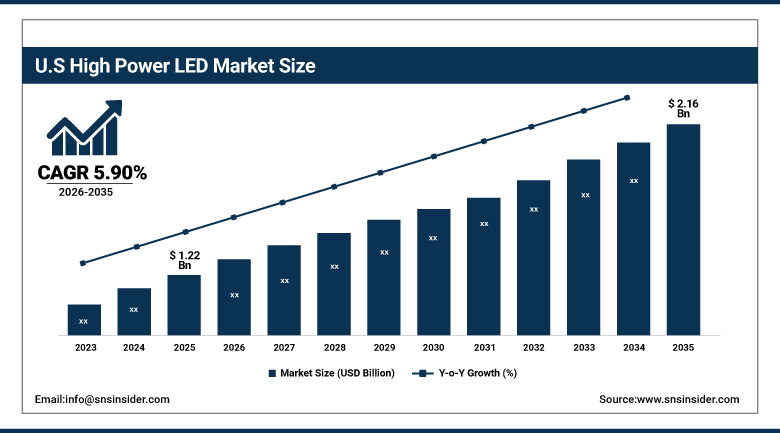
The U.S. High Power LED Market was valued at USD 1.22 Billion in 2025 and is expected to reach USD 2.16 Billion by 2035, growing at a CAGR of 5.90% from 2026-2035.
The U.S. High Power LED Market is the largest national market in North America, supported by wide LED adoption in homes, commercial buildings and street lights, utility rebate programs and a large automotive sector. Retrofit demand is steady as older LED installations reach end of life. Horticulture and ultraviolet uses are growing from a small base. Tariffs and supply chain rules affect sourcing of chips and packages. Energy efficiency standards guide product design.
⮞In March 2026, the U.S. Energy Information Administration reported from its 2024 survey that 90% of U.S. households used LED bulbs indoors and 37% used only LEDs. Adoption is already high, so growth will come more from replacement and specialty uses.
High Power LED Market Segment Analysis
-
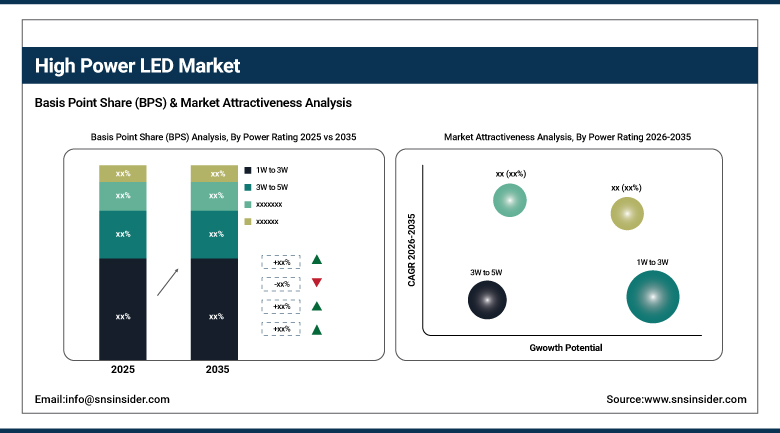
By Power Rating, the 1W to 3W segment dominated the High Power LED Market with approximately 47.80% share in 2025, while the Above 10W segment is the fastest growing with a CAGR of approximately 6.58%.
-
By Packaging Type, the Single-Die segment dominated the High Power LED Market with approximately 36.29% share in 2025, while the Chip-on-Board segment is the fastest growing with a CAGR of approximately 6.84%.
-
By Application, the General Lighting segment dominated the High Power LED Market with approximately 41.13% share in 2025, while the Automotive Lighting segment is the fastest growing with a CAGR of approximately 6.46%.
-
By Color, the White segment dominated the High Power LED Market with approximately 78.00% share in 2025, while the UV segment is the fastest growing with a CAGR of approximately 8.20%.
By Power Rating, 1W to 3W Dominates the High Power LED Market and Above 10W Grows Fastest
The 1W to 3W range leads because it suits the widest set of products, including downlights, bulbs, flashlights, signage and smaller automotive lamps. These parts are made in very large volumes on mature lines, offer a good balance of brightness and cost and need only simple heat sinks. Standard footprints make them easy to design in.
The above 10W range grows fastest as floodlights, street lights, high bays, stage lighting, projectors and vehicle headlamps need more light from compact sources. Better ceramic and metal substrates move heat away from the chip, allowing higher currents. Buyers pay more per part but save on optics and fixtures.
⮞For model year 2026, the Insurance Institute for Highway Safety found that 46% of headlight systems it tested earned a good rating, and glare affected 5% of systems, down from 21% for model year 2017. Better headlamp performance relies on brighter, better-controlled LED sources.
By Packaging Type, Single-Die Dominates the High Power LED Market and Chip-on-Board Grows Fastest
Single-die packages lead because they are simple, well understood and available from many suppliers. Each package holds one large chip on a ceramic or metal-core base, which makes thermal paths short and optics easy. Lighting makers use them in street lights, downlights and flashlights, and they can be sorted into narrow color bins.
Chip-on-board grows fastest as manufacturers place many chips directly on one substrate to create dense, uniform light sources. The format reduces assembly steps and heat resistance, and suits high bays, spotlights and horticulture fixtures. Flip-chip designs, which remove wire bonds, are also gaining share inside both formats.
⮞In March 2026, the International Energy Agency noted that average LED efficacy has roughly doubled since 2015 and that about 30% of residential lamps worldwide have still not been upgraded to LEDs. Better efficacy and a large remaining base support continued replacement.
By Application, General Lighting Dominates the High Power LED Market and Automotive Lighting Grows Fastest
General lighting takes the lead in this regard because of the huge number of lights required in streets, industrial places such as factories and warehouses, stadiums, and buildings. Street light conversion projects are supported by the government and electric utility companies, and regulations phasing out fluorescent and mercury lights make replacement necessary.
Automotive lighting is experiencing rapid growth with the movement from halogen to LED headlights, daytime running lights, and adaptive headlights. Designers use high-power LED arrays for lighting patterns and signaling other drivers. Electric cars require low-energy lighting, while style preferences make lights part of the car's design aesthetic.
⮞In November 2025, parties to the Minamata Convention agreed to phase out tri-band linear fluorescent lamps in 2027 and halophosphate linear fluorescent lamps in 2026. The decision accelerates replacement of mercury-based general lighting.
By Color, White Dominates the High Power LED Market and UV Grows Fastest
White LEDs lead because nearly all general, street, commercial and automotive lighting uses white light. Blue chips with phosphor coatings produce warm to cool tones at high efficiency, and makers offer tight color control and high color rendering. Volume production keeps prices falling.
UV LEDs grow fastest from a small base as water treatment, surface disinfection, curing, printing and sensing replace mercury lamps. Higher output and longer lifetimes at deep UV wavelengths are improving economics. Instant on and off operation, compact size and mercury-free construction suit portable and point-of-use systems.
⮞In May 2025, a Norwegian drinking water utility serving about 160,000 people advanced a UV-C LED pilot for a unit rated for up to about 22,712 cubic meters per day, using no mercury lamps. Large-scale water trials show the technology moving beyond small devices.
Regional Analysis
|
Region |
Major Country |
Share within Region, 2025 (%) |
|---|---|---|
|
North America |
U.S. |
85.00 |
|
Europe |
Germany |
25.00 |
|
Asia Pacific |
China |
45.00 |
|
Latin America |
Brazil |
45.00 |
|
Middle East & Africa |
Saudi Arabia |
28.00 |
North America High Power LED Market Insights
North America held about 22.40% of the High Power LED Market in 2025, led by the United States and followed by Canada. Utility programs, building codes and a large automotive sector support demand, and many LED fixtures reach the end of their first life, creating replacement orders.
Trade measures and rules on supply chain origin raise sourcing costs, and several chip makers have restructured. Horticulture, ultraviolet and automotive uses give suppliers higher-value segments outside general lighting.
⮞In February 2026, Natural Resources Canada updated its General Service Lamp regulation page, which sets a minimum efficacy of 45 lumens per watt that applies to LED lamps made from 1 January 2027. Efficiency rules continue to raise the quality bar for LED products.
Europe High Power LED Market Insights
Europe held about 21.60% of the High Power LED Market in 2025, led by Germany, the United Kingdom, France, Italy and the Netherlands. Strong automotive production, architectural lighting design and strict efficiency and mercury rules support high-value demand.
European lighting brands and chip makers focus on premium, tunable and automotive products, while competition from Asian suppliers keeps general lighting prices low. Energy costs make replacement of older lamps attractive, and circular economy rules are shaping product design.
⮞In May 2025, LightingEurope reported that RoHS exemptions for several mercury lamp types expired on 24 February 2025, and that the exemption for high pressure sodium lamps expires on 24 February 2027. Expiring exemptions steadily push buyers to LED.
Asia Pacific High Power LED Market Insights
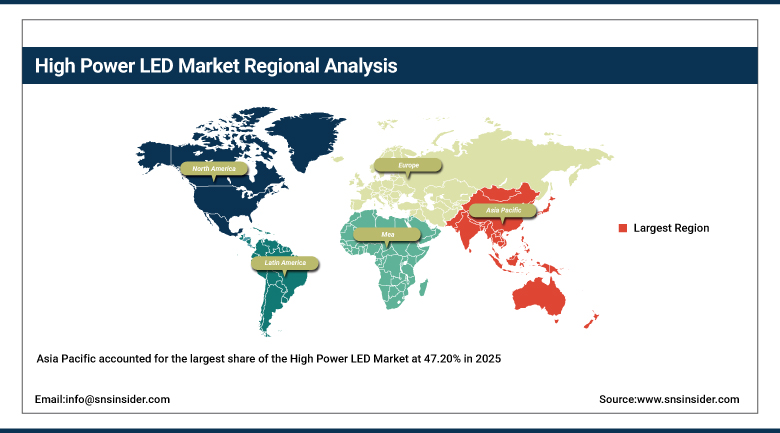
Asia Pacific accounted for the largest share of the High Power LED Market at 47.20% in 2025 and is projected to be the fastest growing region, at a CAGR of 6.73% over 2026-2035. China, Japan, South Korea, Taiwan and India lead. The region hosts most LED chip and package production and a large share of lighting demand.
The Chinese producers have increased their production levels and reduced prices, thereby squeezing profit margins. Japan and Taiwan are specialized in high performance and ultraviolet lightings. The Indian lighting schemes and vehicle production are adding to the demand.
⮞In January 2025, India's government reported that 36.87 crore LED bulbs, or about 369 million, had been distributed under the UJALA program and more than 1.34 crore LED street lights, or about 13.4 million, installed under the national street lighting program. Public programs create very large volumes.
Get Customized Report as per Your Business Requirement - Enquiry Now
MEA & Latin America High Power LED Market Insights
Latin America and the Middle East and Africa together hold about 8.80% of the High Power LED Market. In Latin America, Brazil, Mexico, Argentina and Colombia lead, with municipal street light conversions and public building retrofits.
In the Middle East and Africa, Saudi Arabia, the United Arab Emirates, Egypt and South Africa lead. Gulf states are converting street lighting to LED to cut energy use, while grid constraints and price sensitivity shape demand across Africa. Solar-powered LED street lights are common in off-grid areas.
⮞In July 2026, the State of Mexico government reported installing 2,986 LED and solar street lights across 103 works in more than 80 municipalities. Local public lighting projects keep demand steady across the region.
Market Dynamics
Growth Drivers: Fluorescent Phase-Outs and Automotive Lighting Upgrades Drive Growth in the High Power LED Market
Fluorescent phase-outs are the main driver. Governments are banning manufacture and sale of mercury-based lamps, and buyers of street, industrial and commercial lighting must replace them. High power LEDs save energy and reduce maintenance, so public programs and utility incentives support large conversions.
Automotive lighting upgrades add momentum. Cars are moving from halogen and xenon lamps to LED headlamps, signal lights and interior lighting, and premium models add adaptive beams made from many individually controlled sources. Electric vehicles and styling trends make efficient, compact lighting a feature.
⮞In October 2025, Japan's Ministry of Economy, Trade and Industry issued a notice on the end of fluorescent lamp manufacturing by the end of 2027, urging replacement with LED lighting. Government timetables are creating predictable demand.
Restraints: Price Erosion and Raw Material Concentration Restrain Growth in the High Power LED Market
Price erosion is a barrier to growth. Asia has experienced overcapacity in the general lighting LED market for years now due to stiff competition, resulting in price cuts. Buyers expect price reductions every year, and customers in major markets select products on the basis of cost.
Raw material concentration adds limits. Gallium used in LED chips comes almost entirely from one country, and price swings or export restrictions can disrupt supply. Rare earth phosphors and sapphire substrates add further dependencies. Makers hold buffer stocks and seek alternative sources, which raises cost.
⮞In February 2026, the U.S. Geological Survey reported that China produces 99% of primary gallium, that the 2025 import price averaged $580 per kilogram, up about 30%, and that optoelectronics including LEDs accounts for 26% of U.S. gallium use. Concentrated supply is a risk for chip makers.
Opportunities: Ultraviolet Disinfection and Horticulture Lighting Create Opportunities in the High Power LED Market
Ultraviolet disinfection offers a major opportunity. Mercury lamps are being phased out of water treatment, air purification and surface disinfection, and UV LEDs provide compact, instant and mercury-free alternatives. As output and lifetime improve, municipal utilities, hospitals and appliance makers are testing systems at larger scale.
Horticulture lighting is another area of opportunity. The indoor farms and greenhouses utilize LEDs that provide tailored light spectra to enhance production efficiency and reduce energy use; and high-power LEDs provide the necessary brightness. Vertical farming and cannabis cultivation, along with the trend toward locally grown produce, ensure stable order flow, even with the added service of lighting formulas.
⮞In November 2025, the University of Siena tested a 235 nanometer far-UVC LED in a biosafety level 3 laboratory and recorded viral reduction of up to 99.999% within seconds, as reported by the LED maker. Test results are building confidence in UV LED disinfection.
Recent Developments:
-
2026: Nichia introduced UV-B and UV-A LEDs at 308, 330 and 340 nanometers with about double the efficiency of earlier parts, launching in January 2027. The products target disinfection, phototherapy and sensing.
-
2026: Lumileds expanded its manufacturing operations in Penang, Malaysia, to accelerate advanced automotive lighting production. The expansion adds capacity for LED components used in vehicle headlamps and signal lights.
-
2026: Cree LED launched L2 PCBA solutions, fully assembled boards using its J Series 2835 and 5050 LEDs. The boards help luminaire makers speed up development for indoor and outdoor lighting.
High Power LED Companies are:
-
ams OSRAM AG
-
Lumileds Holding B.V.
-
Cree LED (Penguin Solutions, Inc.)
-
Seoul Semiconductor Co., Ltd.
-
Ennostar Inc. (Epistar)
-
Bridgelux, Inc.
-
Stanley Electric Co., Ltd.
-
San'an Optoelectronics Co., Ltd.
-
Nationstar Optoelectronics Co., Ltd.
-
MLS Co., Ltd.
-
Vishay Intertechnology, Inc.
-
Marktech Optoelectronics, Inc.
-
Epileds Technologies, Inc.
-
Edison Opto Corporation
-
Shenzhen Refond Optoelectronics Co., Ltd.
-
HC Semitek Corporation
-
Lite-On Technology Corporation
High Power LED Market Report Scope:
| Report Attributes | Details |
|---|---|
| Market Size in 2025 | USD 6.40 Billion |
| Market Size by 2035 | USD 11.19 Billion |
| CAGR | CAGR of 5.75% From 2026 to 2035 |
| Base Year | 2025 |
| Forecast Period | 2026-2035 |
| Historical Data | 2022-2024 |
| Report Scope & Coverage | Market Size, Segments Analysis, Competitive Landscape, Regional Analysis, DROC & SWOT Analysis, Forecast Outlook |
| Key Segments | • By Power Rating (Below 1W, 1W to 3W, 3W to 5W, 5W to 10W, and Above 10W) • By Packaging Type (Single-Die, Multi-Die, Chip-on-Board, Flip-Chip, and Others) • By Application (General Lighting, Automotive Lighting, Backlighting, Signs and Signals, Horticulture and UV, and Others) • By Color (White, Colored and RGB, and UV) |
| Regional Analysis/Coverage | North America (US, Canada), Europe (Germany, UK, France, Italy, Spain, Russia, Poland, Rest of Europe), Asia Pacific (China, India, Japan, South Korea, Australia, ASEAN Countries, Rest of Asia Pacific), Middle East & Africa (UAE, Saudi Arabia, Qatar, South Africa, Rest of Middle East & Africa), Latin America (Brazil, Argentina, Mexico, Colombia, Rest of Latin America). |
| Company Profiles | Nichia Corporation, ams OSRAM AG, Lumileds Holding B.V., Cree LED (Penguin Solutions, Inc.), Seoul Semiconductor Co., Ltd., Everlight Electronics Co., Ltd., Ennostar Inc. (Epistar), Bridgelux, Inc., Stanley Electric Co., Ltd., San'an Optoelectronics Co., Ltd., Nationstar Optoelectronics Co., Ltd., MLS Co., Ltd., Vishay Intertechnology, Inc., Marktech Optoelectronics, Inc., Epileds Technologies, Inc., Edison Opto Corporation, Shenzhen Refond Optoelectronics Co., Ltd., HC Semitek Corporation, Lite-On Technology Corporation |

Frequently Asked Questions
Key players include Nichia, ams OSRAM, Lumileds, Cree LED, Seoul Semiconductor, Everlight, Ennostar, Bridgelux, Stanley Electric, San'an Optoelectronics, Nationstar, MLS, Vishay, Marktech, Epileds, Edison Opto, Refond, HC Semitek and Lite-On.
Key opportunities include ultraviolet disinfection, horticulture lighting, adaptive automotive headlamps and fast-growing Asia Pacific demand.
Government phase-outs of fluorescent and mercury lamps, together with the shift to LED lighting in vehicles, is the main growth factor.
By Application, the General Lighting segment dominated the market in 2025 with an estimated 41.13% share, supported by street light conversions and building retrofits.
Asia Pacific dominated the market with a share of 47.20% in 2025, driven by LED chip and package production in China, Taiwan, Japan and South Korea.
