
Hospital-at-Home Equipment Market Report Scope & Overview:
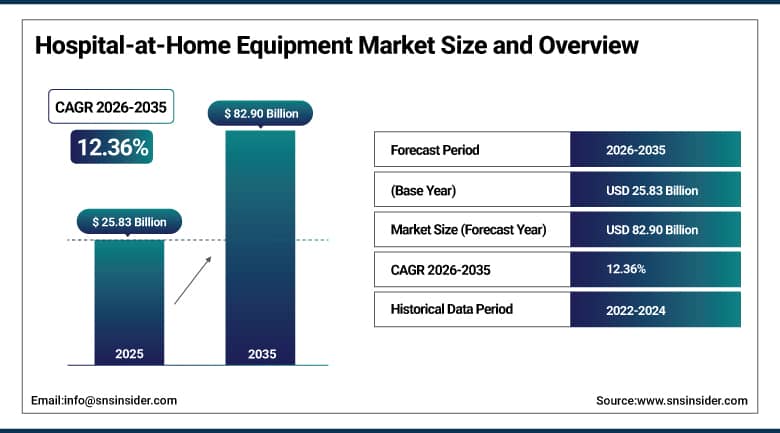
The Hospital-at-Home Equipment Market was valued at USD 25.83 Billion in 2025 and is expected to reach USD 82.90 Billion by 2035, growing at a CAGR of 12.36% from 2026 to 2035.
The hospital-at-home equipment market is experiencing steady growth due to increasing government funding for provision of acute-level care provided outside the four walls of a hospital. With increasing numbers of elderly and chronic patients embracing technology in the form of patient monitoring devices and due to rising demand for hospital beds, there has been increasing investment in remote clinical infrastructure. The hospital-at-home equipment industry includes patient monitoring devices, portable diagnostics, therapy devices, and telecommunication technologies. Using these technologies, hospitals can provide care that is equivalent to inpatient care in a patient’s home.
Baxter International and Philips both expanded their hospital-at-home patient monitoring and wearable biosensor portfolios in 2025-2026 to meet growing health system demand for continuous, multi-parameter remote vitals capture amid extended federal reimbursement support for acute-level home care programs.
To Get More Information On Hospital-at-Home Equipment Market - Request Free Sample Report
Hospital-at-Home Equipment Market Trends:
-
Extension of the CMS Acute Hospital Care at Home waiver through 2030 is accelerating equipment procurement across U.S. health systems.
-
Rising adoption of wearable biosensor patches is enabling continuous multi-parameter vitals monitoring beyond hospital walls.
-
Expanding integration of AI-enabled remote command center software is strengthening real-time clinical decision-making capability.
-
Increasing deployment of portable diagnostic and point-of-care testing devices is reducing dependency on centralized hospital laboratory infrastructure.
-
Growing strategic partnerships between device manufacturers and health systems are accelerating hospital-at-home equipment standardization and scale-up.
U.S. Hospital-at-Home Equipment Market Outlook:
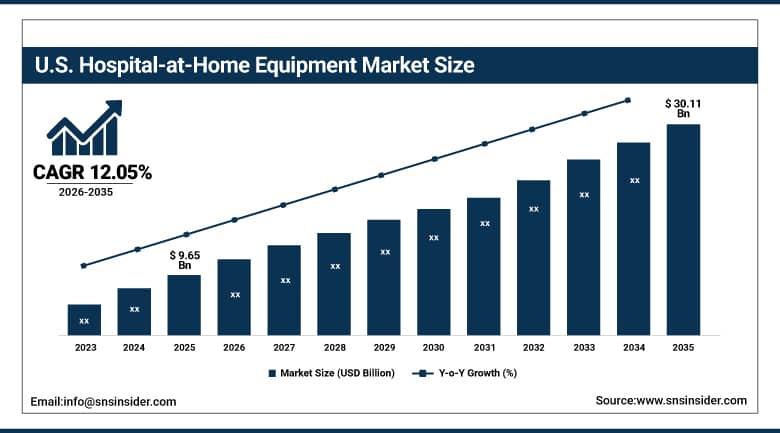
The U.S. Hospital-at-Home Equipment Market was valued at USD 9.65 Billion in 2025 and is projected to reach USD 30.11 Billion by 2035, growing at a CAGR of 12.05% during 2026-2035.
Leading U.S. health systems continue to expand hospital-at-home programs due to extended federal reimbursement support, growing clinician familiarity with remote acute-care delivery models, and increasing need to free up inpatient bed capacity for higher-acuity cases. The extension of the waiver program of Acute Hospital Care at Home by the Centers for Medicare & Medicaid Services up until September 2030 has enabled the many health systems that have signed up under this initiative to continue deploying their capital investments in the development of remote monitoring systems, command centers, and mobile diagnostics. The rise in demand for sophisticated equipment for acute and post-acute care services delivery will continue due to the increasing prevalence of chronic heart-related, lung-related, and metabolic disorders within an aging American population, as well as the rising comfort level of patients with technology-based health gadgets.
In 2026, GE HealthCare expanded its U.S. manufacturing capacity for its CARESCAPE-branded portable patient monitors, strengthening its ability to supply continuous vitals monitoring equipment to domestic hospital-at-home and post-acute care program operators.
Hospital-at-Home Equipment Market Segment Analysis:
-
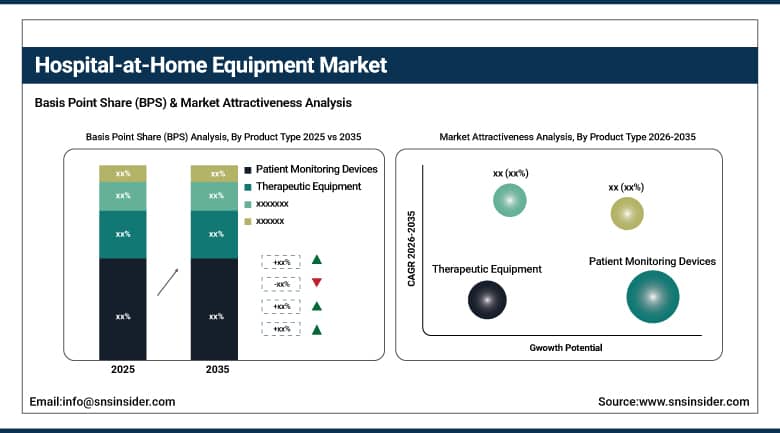
By Product Type, Patient Monitoring Devices dominated the Hospital-at-Home Equipment Market with a 36.20% share in 2025, while Therapeutic Equipment is the fastest-growing product segment with a CAGR of 14.85% from 2026-2035.
-
By Care Type, Acute Care at Home dominated the Hospital-at-Home Equipment Market with a 38.50% share in 2025, while Chronic Disease Management is the fastest-growing care segment with a CAGR of 15.40% from 2026-2035.
-
By End User, Hospitals & Health Systems dominated the Hospital-at-Home Equipment Market with a 58.70% share in 2025, while Home Healthcare Agencies is the fastest-growing end-user segment with a CAGR of 14.60% from 2026-2035.
-
By Distribution Channel, Direct Tender/Institutional Sales dominated the Hospital-at-Home Equipment Market with a 64.30% share in 2025, while Retail & Online Sales is the fastest-growing distribution segment with a CAGR of 13.95% from 2026-2035.
By Product Type, Patient Monitoring Devices led the market, while Therapeutic Equipment is the fastest-growing segment.
The Patient Monitoring Devices segment was the leading contributor in the Hospital-at-Home Equipment Market. This category, spanning multi-parameter vital sign monitors, continuous ECG telemetry units, wearable pulse oximetry sensors, and biosensor patches, accounts for the largest product share due to its foundational role in every hospital-at-home clinical protocol, established clinical trust among physicians and nursing staff, and well-defined reimbursement pathways that make monitoring equipment the first capital investment health systems make when launching a virtual ward program. Their proven interoperability with electronic health record systems and remote command center dashboards, combined with growing manufacturer focus on miniaturized, patient-friendly form factors, has ensured sustained dominance of this category across both established acute-care and expanding chronic-care hospital-at-home deployments.
The Therapeutic Equipment segment is expected to witness the highest CAGR during the forecast period 2026-2035. Adoption of home infusion pumps, portable oxygen concentrators, and compact home ventilators is accelerating as health systems extend hospital-at-home programs to progressively higher-acuity patients requiring active treatment rather than passive monitoring alone. Growing clinician confidence in administering intravenous therapy, respiratory support, and would-otherwise-inpatient interventions within a residential setting, together with manufacturer innovation in lightweight, battery-powered therapeutic devices designed specifically for non-clinical environments, is driving the above-average growth rate of this segment relative to the rest of the hospital-at-home equipment category.
By Care Type, Acute Care at Home led the market, while Chronic Disease Management is the fastest-growing segment.
The Acute care remains the dominant care type as hospital diversion and early-discharge programs targeting conditions such as pneumonia, congestive heart failure exacerbation, and cellulitis require the most intensive equipment footprint, including continuous monitoring, point-of-care diagnostics, and therapeutic devices, and because federal and private payer reimbursement frameworks continue to prioritize acute-level hospital-at-home episodes over lower-acuity alternatives.
The Chronic Disease Management segment is anticipated to grow at the fastest rate during the forecast period 2026-2035. The rising global burden of cardiovascular disease, diabetes, and chronic respiratory conditions is driving sustained demand for continuous remote monitoring equipment capable of tracking patients over extended periods rather than single discrete episodes, while expanding remote patient monitoring reimbursement codes and a broader payer shift toward preventive, value-based care models are further supporting equipment deployment across long-term home-based chronic care programs.
By End User, Hospitals & Health Systems led the market, while Home Healthcare Agencies is the fastest-growing segment.
The Hospitals & Health Systems segment dominated the Hospital-at-Home Equipment Market with a revenue share of 58.70% in 2025. Hospitals and integrated health systems remain the largest equipment purchasers as they directly operate hospital-at-home programs, maintain centralized clinical command centers, and control the capital budgets required to acquire and standardize monitoring, diagnostic, and therapeutic equipment fleets across multiple care sites and patient populations.
The Home Healthcare Agencies segment is expected to register the fastest CAGR during the forecast period 2026-2035. Growing partnerships between hospitals and licensed home health agencies to extend post-discharge and transitional care coverage are driving increased equipment procurement at the agency level, as these organizations expand their own remote monitoring and therapeutic device fleets to support hospital-at-home episodes on behalf of contracted health system partners across broader geographic service areas.
By Distribution Channel, Direct Tender/Institutional Sales led the market, while Retail & Online Sales is the fastest-growing segment.
The Direct Tender/Institutional Sales segment dominated the Hospital-at-Home Equipment Market. Direct institutional procurement remains the dominant channel as health systems and large home healthcare agencies typically negotiate long-term supply and service contracts directly with device manufacturers to secure standardized equipment fleets, bundled maintenance support, and integrated software licensing across their hospital-at-home programs.
The Retail & Online Sales segment is expected to witness the fastest CAGR during the forecast period 2026-2035. Growing availability of consumer-facing connected health devices, expanding e-commerce distribution of home monitoring accessories, and increasing patient and caregiver willingness to independently procure supplementary monitoring equipment are gradually broadening this channel's reach, particularly for lower-acuity chronic disease management and post-discharge recovery use cases.
Regional Analysis:
|
Region |
Major Country |
Share within Region, 2025 (%) |
|---|---|---|
|
North America |
United States |
84.50% |
|
Europe |
Germany |
23.60% |
|
Asia Pacific |
China |
36.80% |
|
Middle East & Africa |
Saudi Arabia |
27.40% |
|
Latin America |
Brazil |
34.60% |
North America Hospital-at-Home Equipment Market Insights
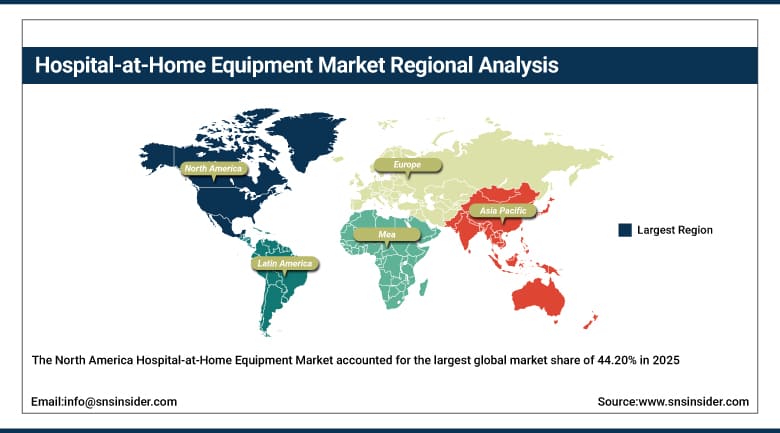
The North America Hospital-at-Home Equipment Market accounted for the largest global market share of 44.20% in 2025, owing to the region's extended federal reimbursement framework for acute-level home care, well-established remote patient monitoring infrastructure, and strong presence of leading medical device manufacturers actively developing hospital-at-home-specific equipment portfolios. With the sophistication of the digital health ecosystem in the region, combined with limited capacity of hospitals and the incentive by payers to shift the eligible patients from the conventional inpatient facilities, is expected to drive investment into medical equipment in the acute, post-acute and chronic hospital-at-home models.
For the year 2025, the United States led the North America Hospital-at-Home Equipment Market with 84.50% of the regional market share. This was driven by the CMS' extension of the Acute Hospital Care at Home Waiver till 2030 and the participation of big health systems, coupled with local manufacturing capabilities of the prominent medical devices. Canada is contributing to regional growth through its own expanding virtual ward initiatives and growing provincial healthcare investment in remote patient monitoring and home-based acute care infrastructure.
Get Customized Report as Per Your Business Requirement - Enquiry Now
Europe Hospital-at-Home Equipment Market Insights
The Europe region was a significant contributor to the Hospital-at-Home Equipment Market in 2025, expected to register comparatively higher growth for integrated remote monitoring and telehealth-enabled equipment bundles during the forecast period. This is attributed to the region's strong public healthcare system emphasis on reducing inpatient bed pressure, well-established national virtual ward and hospital-at-home pilot programs, and growing consumer and clinician acceptance of home-based acute and post-acute care delivery models across member states pursuing broader healthcare system efficiency objectives.
Germany is one of the major markets in Europe owing to its strong healthcare technology manufacturing base, favorable statutory health insurance reimbursement structures, and presence of leading connected-care device producers serving both domestic and international hospital-at-home program operators. Other countries such as the United Kingdom, France, and the Netherlands, home to several advanced national hospital-at-home and virtual ward initiatives, are also contributing to market growth through expanding remote monitoring infrastructure investment and national health service procurement programs.
Asia Pacific Hospital-at-Home Equipment Market Insights
The Asia Pacific Hospital-at-Home Equipment Market is expected to witness the fastest growth rate during the forecast period 2026-2035, registering a CAGR of 15.85%. The market growth is driven by rapidly expanding hospital infrastructure investment, growing healthcare digitization initiatives, and increasing government focus on reducing inpatient bed shortages across the region's largest and fastest-aging manufacturing and consumer economies pursuing broader universal healthcare access strategies.
China is one of the main growth drivers in the Asia Pacific Hospital-at-Home Equipment Market, owing to its large aging population base and rapidly growing domestic medical device manufacturing capability supporting both local hospital-at-home pilot programs and export-oriented equipment production. India and Japan, both facing significant hospital bed capacity constraints and rapidly aging populations respectively, are also contributing to regional growth through expanding remote patient monitoring adoption and increasing government healthcare digitization funding.
Middle East & Africa and Latin America Hospital-at-Home Equipment Market Insights
Middle East & Africa and Latin American regions are gradually expanding hospital-at-home equipment adoption as healthcare infrastructure investment grows across both regions, supported by increasing government focus on reducing hospital overcrowding and growing private healthcare sector interest in home-based acute and chronic care delivery models.
Brazil is set to be a prominent Latin American market fueled by its large chronically ill patient population requiring continuous home-based monitoring and growing private hospital investment in virtual ward infrastructure. The Middle East & Africa region has Saudi Arabia and the UAE investing in modern digital healthcare infrastructure as part of broader national healthcare transformation strategies, gradually increasing demand for hospital-at-home monitoring and therapeutic equipment across their expanding private and public hospital networks.
Market Dynamics:
Growth Drivers: Extended federal reimbursement and rising hospital bed capacity pressure driving market growth
The extension of favorable reimbursement frameworks for acute-level home care, combined with mounting pressure on inpatient bed capacity across aging healthcare systems, is among the primary drivers of the Hospital-at-Home Equipment Market. Hospital-at-home equipment provides health systems with a clinically validated, cost-effective alternative to traditional inpatient admission, improving bed availability for higher-acuity cases while maintaining comparable clinical outcomes and significantly improving patient satisfaction across virtually every major acute and chronic care application requiring continuous monitoring or active therapeutic intervention.
Technological advancements in wearable biosensor and remote monitoring engineering have significantly increased device accuracy and battery life, with recent innovations improving continuous multi-parameter vitals capture and clinical alarm reliability across commercial hospital-at-home deployments. Rising integration of AI-enabled remote command center software, growing clinician familiarity with virtual ward workflows, and continued capital investment by both established medical device manufacturers and digital health start-ups expanding hospital-at-home equipment portfolios are further supporting demand across the forecast period, as health systems continue scaling virtual acute-care capacity in response to structural bed shortages.
Restraints: High upfront capital costs and clinical workflow integration challenges limiting market expansion
One of the most critical obstacles to market growth is the substantial upfront capital investment required to deploy hospital-at-home equipment fleets, including monitoring devices, command center software, and logistics infrastructure, at a scale sufficient to support meaningful patient volume. This is compounded by the fact that many smaller and rural health systems lack the administrative and clinical staffing capacity to manage remote command centers effectively, limiting broader equipment adoption outside of large, well-resourced health system networks.
Moreover, inconsistent reimbursement policies across different payers and geographies directly impact the long-term economics of hospital-at-home equipment investment, creating uncertainty for health systems evaluating multi-year capital deployment plans. Besides, the technical complexity of ensuring reliable device connectivity, data security, and interoperability with existing electronic health record systems across varied home environments requires considerable ongoing information technology and clinical engineering investment.
Opportunities: Expansion into emerging markets and AI-enabled remote monitoring innovation creating new growth avenues
The increasing need for scalable hospital-at-home programs to address structural bed shortages, the rise of AI-enabled predictive monitoring platforms capable of flagging clinical deterioration before it becomes critical, and greater emphasis on interoperable device ecosystems due to increased digital health funding will provide ample growth opportunities in the Hospital-at-Home Equipment Market. The need for cost-effective, high-acuity home care delivery models that reduce hospital readmissions will ensure future growth as payers worldwide continue shifting toward value-based reimbursement frameworks.
There are huge opportunities for growth within small devices with multiple capabilities that integrate multiple functionalities within one wearable product form. These kinds of devices are able to reduce costs of per patient equipment, as well as make the life of healthcare workers easier. In addition, with growing infrastructure investment in hospitals and implementation of virtual wards trials in emerging countries within Asia Pacific and Latin America, demand will only increase.
Recent Developments:
-
2025: Baxter International launched its next-generation Hillrom Connex Spot Monitor extension purpose-built for hospital-at-home vitals capture, integrating multi-parameter dashboards for remote acute-care command centers.
-
2025: Philips introduced its Biosensor BX100 wearable patch, enabling continuous multi-parameter vitals monitoring for hospital-at-home and post-acute recovery patients across participating health system programs.
-
2026: Masimo expanded its Radius PPG tetherless pulse oximetry platform with dedicated hospital-at-home alarm management and clinician command center dashboard software.
-
2026: Medtronic launched an enhanced LINQ II insertable cardiac monitor pathway tailored for continuous cardiac telemetry within hospital-at-home cardiac recovery programs.
Hospital-At-Home Equipment Market Key Players are:
-
Baxter International Inc.
-
Medtronic plc
-
GE HealthCare Technologies Inc.
-
Koninklijke Philips N.V.
-
Masimo Corporation
-
ResMed Inc.
-
Becton, Dickinson and Company
-
Cardinal Health, Inc.
-
Abbott Laboratories
-
Stryker Corporation
-
Teladoc Health, Inc.
-
Omron Healthcare, Inc.
-
Current Health (a Best Buy Health company)
-
Biofourmis, Inc.
-
Health Recovery Solutions, Inc.
-
Medically Home Group, Inc.
-
Vivalink, Inc.
-
Biobeat Technologies Ltd.
-
Withings
-
AMD Global Telemedicine, Inc.
Hospital-at-Home Equipment Market Report Scope:
| Report Attributes | Details |
|---|---|
| Market Size in 2025 | USD 25.83 Billion |
| Market Size by 2035 | USD 82.90 Billion |
| CAGR | CAGR of 12.36% From 2026 to 2035 |
| Base Year | 2025 |
| Forecast Period | 2026-2035 |
| Historical Data | 2022-2024 |
| Report Scope & Coverage | Market Size, Segments Analysis, Competitive Landscape, Regional Analysis, DROC & SWOT Analysis, Forecast Outlook |
| Key Segments | • By Product Type (Patient Monitoring Devices, Diagnostic Equipment, Therapeutic Equipment, Telehealth & Communication Devices) • By Care Type (Acute Care at Home, Post-Acute & Transitional Care, Chronic Disease Management, Rehabilitation & Palliative Care) • By End User (Hospitals & Health Systems, Home Healthcare Agencies, Ambulatory Care Providers & Others) • By Distribution Channel (Direct Tender/Institutional Sales, Retail & Online Sales) |
| Regional Analysis/Coverage | North America (US, Canada, Mexico), Europe (Germany, France, UK, Italy, Spain, Russia, Poland, Rest of Europe), Asia Pacific (China, India, Japan, South Korea, Australia, ASEAN Countries, Rest of Asia Pacific), Latin America (Brazil, Argentina, Mexico, Colombia, Rest of Latin America), Middle East & Africa (UAE, Saudi Arabia, Qatar, South Africa, Rest of Middle East & Africa) |
| Company Profiles | Baxter International Inc., Medtronic plc, GE HealthCare Technologies Inc., Koninklijke Philips N.V., Masimo Corporation, ResMed Inc., Becton, Dickinson and Company, Cardinal Health, Inc., Abbott Laboratories, Stryker Corporation, Teladoc Health, Inc., Omron Healthcare, Inc., Current Health (a Best Buy Health company), Biofourmis, Inc., Health Recovery Solutions, Inc., Medically Home Group, Inc., Vivalink, Inc., Biobeat Technologies Ltd., Withings, AMD Global Telemedicine, Inc. |

Frequently Asked Questions
Key Players include Baxter International Inc., Medtronic plc, GE HealthCare Technologies Inc., Koninklijke Philips N.V., Masimo Corporation, among others.
Key opportunities include rising adoption of home-based care, remote patient monitoring, connected medical devices, aging populations, healthcare cost reduction initiatives, and expanding telehealth infrastructure.
The market is driven by extended federal reimbursement support for acute-level home care, rising hospital bed capacity pressure, and continued advancement in wearable remote monitoring technology.
The Hospitals & Health Systems segment dominated the Hospital-at-Home Equipment Market in 2025, accounting for approximately 58.70% market share.
The North America region dominated the Hospital-at-Home Equipment Market in 2025 with a 44.20% market share, driven by extended federal reimbursement support and strong remote monitoring infrastructure.
