
Hospital Command Center Market Report Scope & Overview:
The Hospital Command Center Market was valued at USD 2.14 Billion in 2025 and is expected to reach USD 8.15 Billion by 2035, growing at a CAGR of 14.50% from 2026 to 2035.
Hospital command center market are central, technology-enabled control rooms where real-time information from electronic health records, bed management systems, patient monitoring equipment, workforce scheduling and transportation systems are integrated into dashboard solutions. This allows hospital administrators and healthcare providers to quickly and effectively make informed decisions on patient throughput, capacity planning, and emergency response. The demand for such a solution is steadily increasing due to increased pressure on bed utilization, the growing complexity of multi-facility health system management, and increased implementation of AI technologies to reduce emergency department waiting time, discharge time, and nurse staff optimization.
In 2026, GE HealthCare and Oracle Health extended their AI-powered command centers for use by large health systems to help reduce ED boarding times and increase bed capacity management in the face of increased inpatient volume and workforce shortages in the U.S. and Europe.
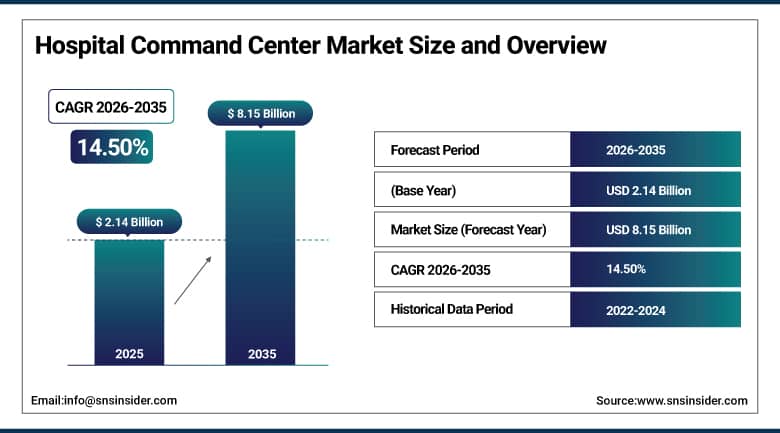
To Get More Information On Hospital Command Center Market - Request Free Sample Report
Hospital Command Center Market Trends:
-
Rising integration of generative AI and natural language processing into command center dashboards is enabling predictive bed forecasting and automated clinical documentation support.
-
Growing adoption of hospital-at-home and virtual care coordination hubs is expanding command center functionality beyond traditional inpatient capacity management.
-
Increasing deployment of real-time locating systems and IoT-enabled asset tracking is strengthening equipment and staff visibility within command center dashboards.
-
Expanding shift toward cloud-based and hybrid command center architectures is enabling multi-hospital health systems to centralize operations across dispersed facilities.
-
Strategic partnerships between electronic health record vendors and command center technology providers are accelerating development of interoperable, enterprise-wide operational platforms.
U.S. Hospital Command Center Market Outlook:
The U.S. Hospital Command Center Market was valued at USD 0.72 Billion in 2025 and is projected to reach USD 2.70 Billion by 2035, growing at a CAGR of 14.30% during 2026–2035.
Leading U.S. health systems continue to expand adoption of centralized command center platforms as hospitals face persistent capacity constraints, nursing workforce shortages, and rising emergency department boarding rates that strain patient throughput across large multi-facility networks. Strong existing investment in electronic health record infrastructure among domestic hospital systems, combined with growing willingness among academic medical centers and integrated delivery networks to fund enterprise-wide operational technology, continues to support command center adoption across the country. The increasing prevalence of value-based care contracts that reward hospitals for reducing length of stay and readmission rates is further reinforcing demand for real-time visibility tools that help clinical and administrative teams identify discharge barriers and capacity bottlenecks earlier in the care pathway.
In 2026, Johns Hopkins Health System expanded its capacity command center to additional regional hospitals within its network, integrating predictive analytics and AI-driven discharge planning tools to strengthen patient flow coordination across its growing multi-facility footprint.
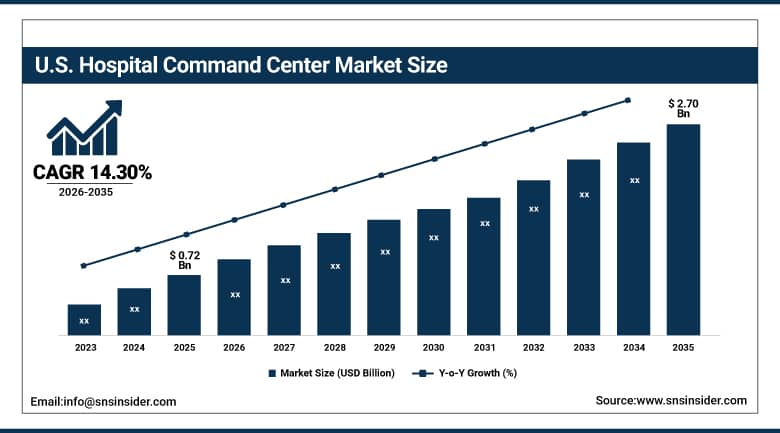
Hospital Command Center Market Segment Analysis:
-
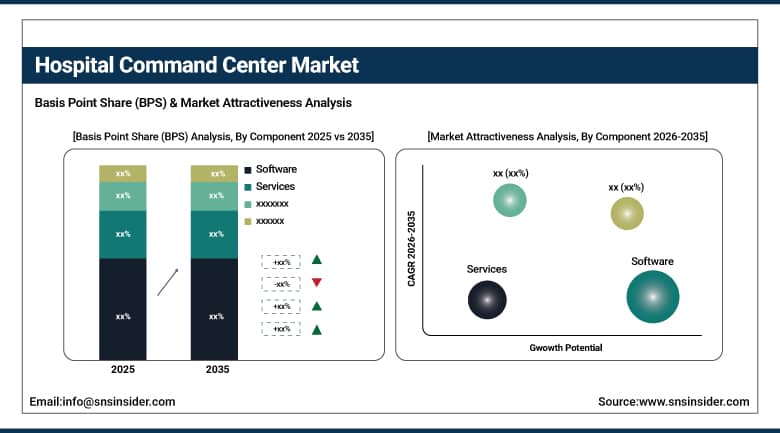
By Component, Software dominated the Hospital Command Center Market with a 46.20% share in 2025, while Services is the fastest-growing component segment with a CAGR of 17.10% from 2026–2035.
-
By Deployment Mode, Cloud-Based dominated the Hospital Command Center Market with a 55.30% share in 2025, while Hybrid is the fastest-growing deployment segment with a CAGR of 18.20% from 2026–2035.
-
By Command Center Type, Patient Flow & Capacity Management dominated the Hospital Command Center Market with a 38.40% share in 2025, while Emergency & Disaster Response Management is the fastest-growing type segment with a CAGR of 16.50% from 2026–2035.
-
By End Use, Hospitals dominated the Hospital Command Center Market with a 68.10% share in 2025, while Ambulatory Care Centers is the fastest-growing end-use segment with a CAGR of 17.80% from 2026–2035.
By Component, Software dominated the Hospital Command Center Market, while Services is the fastest-growing segment.
The Software Segment Dominated the Hospital Command Center Market in 2025, accounting for 46.20% of the total market revenue. In hospital command centers, software solutions comprising patient flow dashboards, predictive analytics platforms, capacity management applications, and workflow orchestration platforms enable administrators to monitor the availability of beds, staff, and acuity levels of patients in real-time within various units of a hospital and across various hospital facilities. Continuous research and development by vendors in artificial intelligence and machine learning enhances the position of the segment through increasing accuracy of forecasting admission, discharge, and transfer rates.
The Services segment is expected to witness the highest CAGR of 17.10% during the forecast period 2026-2035. Growing hospital reliance on implementation consulting, workflow redesign, systems integration, and ongoing technical support services to successfully deploy and optimize command center platforms across complex, multi-site health system environments is propelling above-average growth in this segment. As hospital administrators look at increasingly customized dashboards and integration with existing legacy systems, along with clinical staff training on the new workflow process, the need for specialist advisory and managed services by the vendor of the command center and health care IT consultants increases. The same is true for mid-sized hospital chains that do not have an internal informatics group that can manage their command center independently.
By Deployment Mode, Cloud-Based dominated the Hospital Command Center Market, while Hybrid is the fastest-growing segment.
The Cloud-Based segment held a market share of 55.30% of the Hospital Command Center Market in 2025. Cloud-based command center deployments continue to lead adoption as they allow multi-hospital health systems to centralize data from geographically dispersed facilities onto a single accessible platform without the capital expenditure and ongoing maintenance burden associated with on-premise server infrastructure, while also enabling faster software updates, easier scalability as networks add new facilities, and remote accessibility for administrators and clinical leadership overseeing operations across an entire health system rather than a single hospital campus.
The Hybrid segment is anticipated to grow at the fastest rate during the forecast period 2026-2035, at a CAGR of 18.20%. Increasing hospital demand for deployment models that combine the scalability of cloud infrastructure with the data security and regulatory compliance assurances of on-premise systems, particularly for sensitive patient data and disaster response coordination functions, is driving accelerated adoption of hybrid architectures among academic medical centers, government hospitals, and health systems operating under stringent data residency and cybersecurity requirements.
By Command Center Type, Patient Flow & Capacity Management dominated the Hospital Command Center Market, while Emergency & Disaster Response Management is the fastest-growing segment.
In terms of market share, the Patient Flow & Capacity Management segment was the largest, garnering 38.40% of revenues in 2025. The patient flow & capacity management segment leads the Hospital Command Center market because the objective of hospitals is to gain real-time visibility regarding bed availability, patient transfers, and discharge management to deal with problems such as overcrowding, ED boarding, and admission delays in the developed and emerging healthcare settings. Capacity management usually acts as the first module for hospitals when implementing a command center.
Emergency & Disaster Response Management Segment is expected to register the highest growth rate with a CAGR of 16.50%. Rising incidences of public health emergencies, natural disasters, and mass casualty incidents, coupled with the regulatory focus on hospitals' preparedness for such incidences in the form of command center modules, will drive growth in this market. Such command center modules help with the fast mobilization of resources, situational awareness, and communications across multiple stakeholders involved in the incident management process.
By End Use, Hospitals dominated the Hospital Command Center Market, while Ambulatory Care Centers is the fastest-growing segment.
The Hospitals segment dominated the Hospital Command Center Market with a revenue share of 68.10% in 2025. Hospitals, particularly large tertiary and quaternary care facilities and multi-hospital health systems, remain the primary end users of command center platforms given their high patient volumes, complex multi-department coordination requirements, and substantial financial resources available to invest in enterprise-wide operational technology capable of centralizing bed management, staffing, and patient flow decisions across dozens of clinical units simultaneously.
The Ambulatory Care Centers segment is expected to witness the fastest CAGR of 17.80% during the forecast period 2026-2035. Growing shift of procedural and diagnostic volume toward outpatient and ambulatory settings, combined with rising need to coordinate scheduling, staffing, and equipment utilization across multi-site ambulatory networks, is driving increasing adoption of scaled-down command center solutions tailored to the operational needs of ambulatory surgery centers and outpatient care networks.
Regional Analysis:
|
Region |
Major Country |
Share within Region, 2025 (%) |
|---|---|---|
|
North America |
United States |
85.00% |
|
Europe |
Germany |
22.50% |
|
Asia Pacific |
China |
38.20% |
|
Middle East & Africa |
UAE |
24.10% |
|
Latin America |
Brazil |
36.50% |
North America Hospital Command Center Market Insights
The North America Hospital Command Center Market commanded the largest regional share, at 40.20%, in 2025 due to the established IT infrastructure at hospitals in the region, the adoption of EHR, and the heavy investments made by large integrated delivery networks in operational analytics and digital capacity management technology. The ongoing hospital capacity issues, high rates of boarding of patients at emergency departments, and severe shortages of nursing personnel in the U.S. and Canada are continuing to drive health system administrators towards centralized command center platforms. The need for these platforms in the region stems from the desire to increase patient throughput and streamline discharges while optimizing staffing at large hospital networks.
In North America, the United States accounted for the largest market in 2025, commanding 85.00% of the regional market. The market leadership of the United States is attributed to the broad implementation of command center solutions at academic medical centers and large health systems, the established presence of key players of command center technology in the region, and the growing adoption of AI predictive analytics solutions by established hospital networks. Canada helps with the growth of the regional market by investing in centralized bed management and patient flow coordination solutions in order to solve issues related to overcrowded hospitals and long wait times at emergency departments.
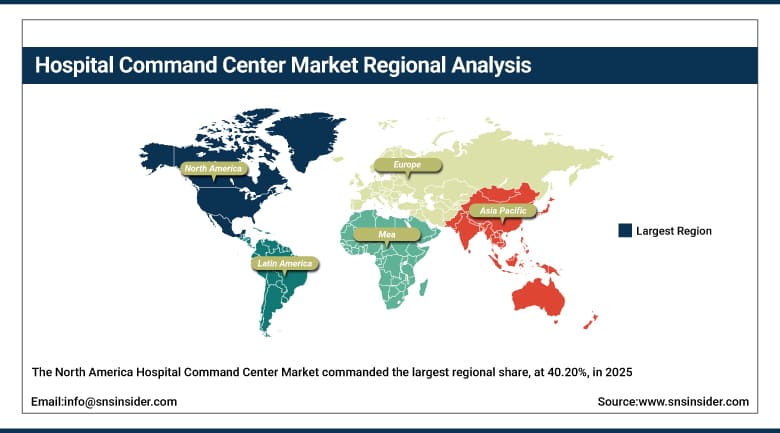
Get Customized Report as Per Your Business Requirement - Enquiry Now
Europe Hospital Command Center Market Insights
The Europe region was a significant contributor to the Hospital Command Center Market in 2025, supported by growing national health service investment in digital hospital transformation initiatives, rising government emphasis on reducing hospital bed occupancy pressures, and expanding adoption of centralized operational technology among large public hospital networks across major Western European economies pursuing broader healthcare system modernization and efficiency improvement objectives.
Germany is one of the major markets in Europe owing to its well-funded hospital infrastructure, strong presence of leading healthcare technology vendors headquartered within the country, and growing federal government support for digital hospital investment programs. Other countries such as the United Kingdom, France, and Italy, each pursuing national health service modernization and hospital capacity management reform initiatives, are also contributing to regional market growth through expanding public and private hospital investment in command center technology.
Asia Pacific Hospital Command Center Market Insights
The Asia Pacific Hospital Command Center Market is expected to witness the fastest growth rate during the forecast period 2026-2035, registering a CAGR of 17.40%. Regional market growth is driven by rapidly expanding hospital infrastructure investment, rising government healthcare digitalization initiatives, and growing awareness among hospital administrators of the operational efficiency benefits offered by centralized command center platforms across the region's major and emerging healthcare markets pursuing hospital modernization strategies to accommodate expanding patient populations.
China is one of the main growth drivers in the Asia Pacific Hospital Command Center Market, owing to its large-scale hospital construction pipeline, growing central and provincial government investment in smart hospital infrastructure, and rapidly expanding domestic health technology ecosystem supporting both public and private hospital operators. India and Japan, both pursuing extensive hospital capacity expansion and digital health modernization programs, are also contributing to regional growth through increasing adoption of centralized patient flow and capacity management technology across their respective public and private hospital networks.
Middle East & Africa and Latin America Hospital Command Center Market Insights
Middle East & Africa and Latin American regions are gradually expanding hospital command center adoption as government and private hospital investment in digital healthcare infrastructure grows across both regions, supported by rising hospital construction activity and increasing regional focus on improving patient flow efficiency and emergency preparedness across expanding public and private hospital networks.
Brazil is set to be a prominent Latin American market fueled by its large public hospital network requiring improved capacity coordination and growing private hospital investment in operational technology to support rising patient volumes. The Middle East & Africa region has the UAE and Saudi Arabia investing heavily in state-of-the-art hospital infrastructure as part of broader national healthcare transformation strategies, gradually increasing demand for hospital command center platforms across their expanding tertiary care and specialty hospital networks.
Market Dynamics:
Growth Drivers: Rising hospital capacity pressures and AI-driven operational efficiency demand driving market growth
Persistent hospital bed capacity constraints, rising emergency department boarding times, and chronic nursing workforce shortages across major healthcare markets are among the primary drivers of the Hospital Command Center Market. Hospital command centers provide health system administrators with real-time, unified visibility into patient flow, bed availability, and staffing levels across multiple facilities, enabling faster decision-making that reduces discharge delays, improves emergency department throughput, and optimizes resource allocation across increasingly complex multi-hospital health system networks facing growing patient volumes and constrained operational capacity.
Technological advancements in artificial intelligence and predictive analytics have significantly enhanced command center forecasting capabilities, with modern platforms now capable of predicting patient admission surges, anticipated discharge timing, and staffing requirements days in advance of actual events. Growing adoption of value-based care reimbursement models that financially reward hospitals for reducing length of stay and readmission rates, expanding rollout of hospital-at-home programs requiring centralized virtual care coordination, and continued vendor investment in interoperable, enterprise-wide command center software are further supporting demand across the forecast period as hospitals increasingly treat operational coordination as a strategic priority equal to clinical care delivery.
Restraints: High implementation costs and integration complexity limiting market expansion
One of the most critical obstacles to market growth is the substantial capital investment required to implement enterprise-wide command center platforms, including software licensing, hardware infrastructure, systems integration, and extensive staff training costs that can strain budgets at smaller community hospitals and resource-constrained health systems, particularly in emerging markets where healthcare capital expenditure remains limited relative to the scale of investment required for comprehensive command center deployment.
Moreover, the technical complexity of integrating command center platforms with legacy electronic health record systems, disparate bed management tools, and fragmented clinical data sources across multi-hospital networks continues to pose significant implementation challenges, often requiring extended deployment timelines and ongoing technical support. Additionally, data privacy and cybersecurity concerns associated with centralizing sensitive patient information onto unified digital dashboards require considerable ongoing investment in security infrastructure and regulatory compliance measures that add to the total cost of ownership for hospital command center adoption.
Opportunities: Expansion of AI-enabled predictive analytics and hospital-at-home coordination creating new growth avenues
The Hospital Command Center market has the potential to experience impressive growth due to the rise in the adoption of AI-based functionalities which would predict the patient admission patterns as well as identify any capacity gaps before they occur. This trend will be boosted by hospitals’ willingness to adopt generative AI technologies for their documentation and communication purposes. Besides, rising government spending on the development of emergency response and disaster readiness systems in developed and developing healthcare market segments will be key growth drivers throughout the forecast period.
Rapid hospital investments in command center systems aimed at hospital-at-home and virtual care coordination is a significant upside. Such solutions are needed in order to allow health facilities to provide patients with acute level care outside of their physical location yet maintain centralized control over patient safety and performance. Expanding hospitals’ infrastructure investments in the emerging economies of Asia-Pacific and Latin America as well as rising government initiatives towards the digitization and modernization of the healthcare sector will drive the demand even further.
Recent Developments:
-
2025: GE HealthCare launched an expanded version of its Command Center software suite incorporating generative AI-powered clinical summarization tools, enabling hospital care teams to generate real-time patient handoff briefs directly within centralized operational dashboards.
-
2025: LeanTaaS completed its acquisition of Hospital IQ, integrating predictive capacity forecasting and operating room scheduling optimization capabilities into its iQueue command center platform to strengthen enterprise-wide hospital operations management.
-
2026: Oracle Health introduced new AI-driven bed management modules within its command center offering, enabling multi-hospital health systems to automate discharge readiness scoring and reduce average patient length of stay.
-
2026: Qventus expanded its autonomous hospital operations platform with new emergency department throughput optimization capabilities, helping health systems reduce boarding times through real-time predictive staffing recommendations.
Hospital Command Center Market Key Players are:
-
GE HealthCare Technologies Inc.
-
Koninklijke Philips N.V.
-
Siemens Healthineers AG
-
Oracle Corporation (Oracle Health)
-
Epic Systems Corporation
-
TeleTracking Technologies, Inc.
-
LeanTaaS Inc.
-
Qventus, Inc.
-
Dedalus Group
-
ABOUT Healthcare, Inc.
-
Central Logic, Inc.
-
care.ai
-
Honeywell International Inc.
-
Microsoft Corporation
-
Health Catalyst, Inc.
-
CenTrak, Inc.
-
Alcidion Group Limited
-
Ascom Holding AG
-
Spok Holdings, Inc.
-
Stryker Corporation
Hospital Command Center Market Report Scope:
| Report Attributes | Details |
|---|---|
| Market Size in 2025 | USD 2.14 Billion |
| Market Size by 2035 | USD 8.15 Billion |
| CAGR | CAGR of 14.50% From 2026 to 2035 |
| Base Year | 2025 |
| Forecast Period | 2026-2035 |
| Historical Data | 2022-2024 |
| Report Scope & Coverage | Market Size, Segments Analysis, Competitive Landscape, Regional Analysis, DROC & SWOT Analysis, Forecast Outlook |
| Key Segments | • By Component (Software, Hardware, Services) • By Deployment Mode (On-Premise, Cloud-Based, Hybrid) • By Command Center Type (Patient Flow & Capacity Management, Clinical Workflow Management, Emergency & Disaster Response Management, Asset & Resource Management) • By End Use (Hospitals, Ambulatory Care Centers, Emergency Operations Centers, Others) |
| Regional Analysis/Coverage | North America (US, Canada, Mexico), Europe (Eastern Europe [Poland, Romania, Hungary, Turkey, Rest of Eastern Europe] Western Europe] Germany, France, UK, Italy, Spain, Netherlands, Switzerland, Austria, Rest of Western Europe]), Asia Pacific (China, India, Japan, South Korea, Vietnam, Singapore, Australia, Rest of Asia Pacific), Middle East & Africa (Middle East [UAE, Egypt, Saudi Arabia, Qatar, Rest of Middle East], Africa [Nigeria, South Africa, Rest of Africa], Latin America (Brazil, Argentina, Colombia, Rest of Latin America) |
| Company Profiles | GE HealthCare Technologies Inc., Koninklijke Philips N.V., Siemens Healthineers AG, Oracle Corporation (Oracle Health), Epic Systems Corporation, TeleTracking Technologies, Inc., LeanTaaS Inc., Qventus, Inc., Dedalus Group, ABOUT Healthcare, Inc., Central Logic, Inc., care.ai, Honeywell International Inc., Microsoft Corporation, Health Catalyst, Inc., CenTrak, Inc., Alcidion Group Limited, Ascom Holding AG, Spok Holdings, Inc., Stryker Corporation. |

Frequently Asked Questions
Key players in the Hospital Command Center Market include GE HealthCare Technologies Inc., Koninklijke Philips N.V., Siemens Healthineers AG, Oracle Corporation (Oracle Health), and Epic Systems Corporation, among others.
Key opportunities in the Hospital Command Center Market include expansion of AI-enabled predictive analytics, hospital-at-home coordination, emergency preparedness, and healthcare digitalization initiatives.
The market is driven by rising hospital capacity pressures, emergency department boarding, nursing workforce shortages, and growing demand for AI-driven operational efficiency.
The Software segment dominated the Hospital Command Center Market, accounting for approximately 46.20% market share in 2025.
The North America region dominated the Hospital Command Center Market in 2025 with a 40.20% share, supported by mature hospital IT infrastructure, EHR adoption, and strong investment in digital capacity management.
