
HVDC Converter Station Market Report Scope & Overview:
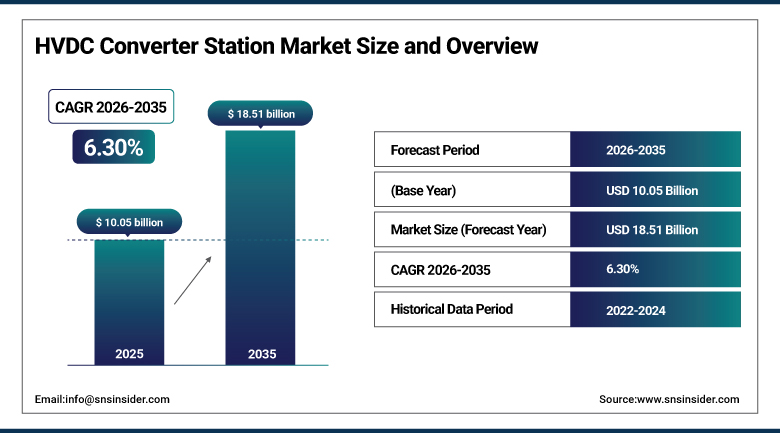
The HVDC Converter Station Market was valued at USD 10.05 Billion in 2025 and is expected to reach USD 18.51 Billion by 2035, growing at a CAGR of 6.30% from 2026 to 2035.
High-voltage direct current converter stations perform the critical power conversion function between the alternating current networks at each end of an HVDC link and the direct current transmission system that carries bulk power between them. Each HVDC project requires at least two converter stations whose combined cost represents 30 to 40% of total project capital expenditure. The commercial case for HVDC over HVAC transmission rests on three advantages. HVDC losses are substantially lower over distances above 600 kilometers on overhead lines and above 50 kilometers on submarine cables. HVDC enables asynchronous grid interconnections between networks at different frequencies without phase synchronization requirements. HVDC converter stations provide full rapid controllability over power magnitude and direction that passive HVAC cannot offer.
Hitachi Energy received the award for the Gansu-Zhejiang UHVDC project in China in 2024, which will be the world's first plus or minus 800 kV voltage-source converter scheme, merging grid-forming control capabilities with ultra-high-voltage power density in a 10 GW link spanning over 2,000 kilometers.
Market Size and Forecast
-
Market Size in 2026E: USD 10.68 Billion
-
Market Size by 2035: USD 18.51 Billion
-
CAGR: 6.30% from 2026 to 2035
-
Fastest Growing Region: Asia Pacific
-
Largest Region: Asia Pacific
To Get more information HVDC Converter Station Market - Request Free Sample Report
HVDC Converter Station Market Trends
-
Voltage-source converter (VSC) technology is increasingly replacing line-commutated converters in offshore wind and urban HVDC applications due to better grid flexibility and reactive power control.
-
Ultra-high-voltage DC transmission systems above ±800 kV are expanding globally for efficient long-distance power transmission across large regions.
-
Advances in modular multilevel converter technology are enabling compact, efficient, and reliable HVDC converter station designs for offshore and urban installations.
-
Development of multi-terminal HVDC networks is accelerating to support offshore wind integration and inter-regional power transmission systems.
-
AI-based monitoring, digital twins, and advanced digital control systems are improving HVDC converter station reliability, efficiency, and outage management.
U.S. HVDC Converter Station Market Size Outlook
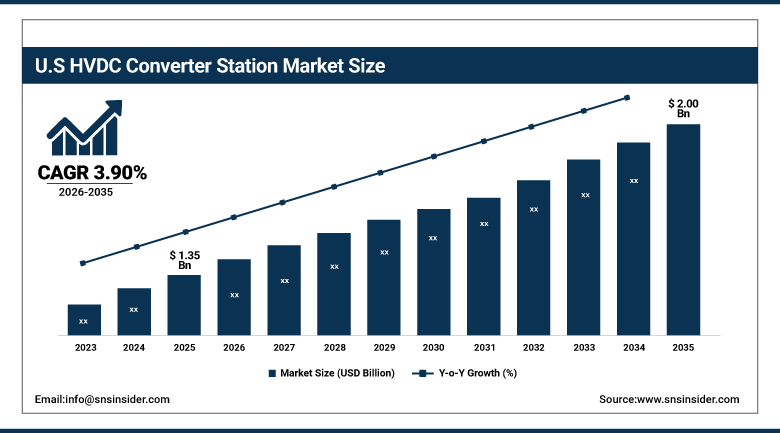
The U.S. HVDC Converter Station Market was valued at approximately USD 1.35 Billion in 2025 and is expected to reach approximately USD 2.00 Billion by 2035, growing at a CAGR of approximately 3.90%.
The US HVDC market has traditionally grown at a slower rate compared to that of China and Europe because of the predominance of the AC system within the US interstate transmission network, as well as because of the challenges of building long-distance transmission lines in the US due to jurisdictional issues. Nevertheless, the creation of the Biden administration's Transmission Facilitation Program, infrastructure investment from the Grid Deployment Office of the Department of Energy, as well as the construction of extensive renewable energy installations across the Midwest and Southwest whose production will require transmission to the coastal regions creates opportunities for HVDC project development. Examples of such potential HVDC investments include North America Super grid projects as well as various offshore wind collector HVDC networks across the Atlantic and Gulf coasts.
GE Vernova and its consortium partners received the engineering, procurement, and construction contract for a major HVDC transmission project in the United States in 2025, marking a significant addition to the domestic HVDC project pipeline that had historically been limited to a small number of installed long-distance transmission links including the Pacific DC Intertie and the Intermountain Power Project.
HVDC Converter Station Market Segment Analysis
-
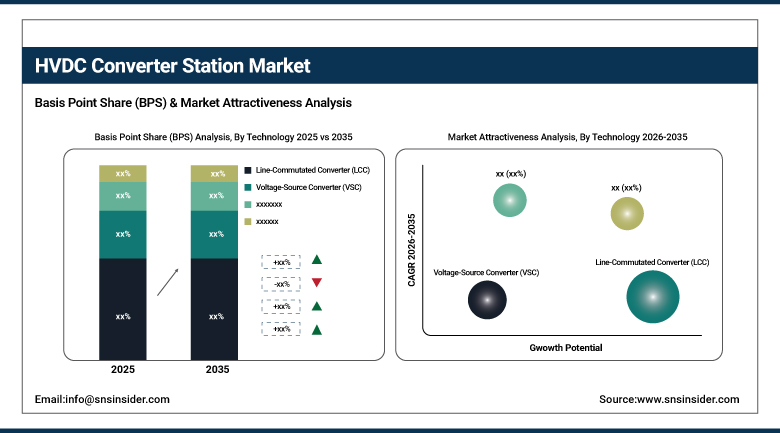
By Technology, the line-commutated converter segment dominated the HVDC converter station market with 62.84% share in 2025, while the voltage-source converter segment is the fastest growing technology during 2026 to 2035.
-
By Configuration, the bipolar segment dominated the HVDC converter station market with 54.20% share in 2025, while the multi-terminal segment is the fastest growing configuration during 2026 to 2035.
-
By Power Rating, the 1000 MW to 3000 MW segment dominated the HVDC converter station market with 35.80% share in 2025, while the above 3000 mw segment is the fastest growing power rating during 2026 to 2035.
-
By Application, the long-distance power transmission segment dominated the HVDC converter station market with 42.84% share in 2025, while the offshore wind farm grid integration segment is the fastest growing application during 2026 to 2035.
By Technology, LCC dominates, VSC grows fastest
Line-commutated converter technology generated 62.84% of HVDC converter station market revenue in 2025. LCC's commercial dominance reflects its established technology heritage spanning over five decades of commercial deployment, its demonstrated capability at ultra-high power ratings and voltage levels including China's plus or minus 1100 kV Changji-Guquan UHVDC link whose 12 GW rating remains the world's most powerful HVDC project, and its cost efficiency at high power ratings that makes it the economically preferred technology for bulk power transmission at gigawatt scale over long distances.
Voltage-source converter technology is growing fastest, driven by its compelling technical advantages for offshore wind farm grid integration, urban cable infeed projects, and multi-terminal network applications whose requirements for reactive power control independence, black-start capability, and operation into passive networks cannot be satisfied by LCC technology. The progressive cost reduction of IGBT power semiconductor modules that underpin VSC converter station construction is improving VSC economic competitiveness relative to LCC at progressively higher power ratings.
By Application, long-distance transmission dominates, offshore wind integration grows fastest
Long-distance power transmission accounted for 42.84% of HVDC converter station market revenue in 2025, driven by the large-scale inter-regional transmission projects of China's State Grid whose programme of ultra-high-voltage DC links connecting renewable energy and hydropower resources in western and northern China with coastal load centers in the east represents the world's most ambitious HVDC transmission infrastructure development.
Offshore wind farm grid integration is growing fastest as Europe, the United Kingdom, the United States, and Asia Pacific scale their offshore wind deployment programmes whose distance from shore progressively exceeds the economic break-even distance for HVAC submarine cables, making HVDC the necessary technical and economic solution for grid connection. Europe's North Sea Wind Power Hub concept and the proposed offshore grid framework for U.S. Atlantic coast wind zones each envision HVDC collector networks that would require multiple converter stations per offshore wind cluster.
Regional Insights
|
Region |
Major Country |
Share within Region, 2025 (%) |
|---|---|---|
|
North America |
United States |
83.47% |
|
Europe |
Germany |
28.47% |
|
Asia Pacific |
China |
46.28% |
|
Middle East & Africa |
UAE |
22.84% |
|
Latin America |
Brazil |
46.28% |
Asia Pacific HVDC Converter Station Market Insights
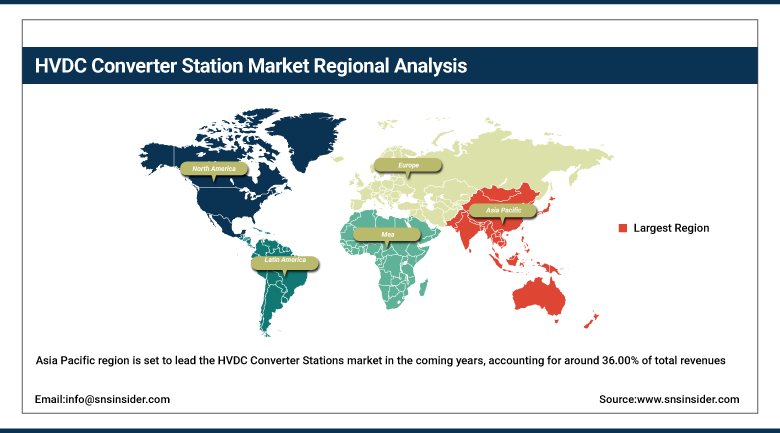
The Asia Pacific region is set to lead the HVDC Converter Stations market in the coming years, accounting for around 36.00% of total revenues. China constitutes around 46.28% of the revenue shares of the Asia Pacific market through its ultra-high-voltage (UHV) DC transmission project via the State Grid Corporation of China and the Southern Power Grid, which has the largest HVDC expenditure in the world. The country installed 45 UHV connections until the end of 2024, including the 2,290-kilometre HVDC line between Hami and Chongqing delivering 36 TWh of green electricity annually, replacing coal-fired electricity production in coastal areas. In 2025, India announced an 800 kV ±, 6 GW bi-polar HVDC connection from Rajasthan to Tamil Nadu, transmitting solar and wind energy from northern areas to southern power-starved regions.
Get Customized Report as per Your Business Requirement - Enquiry Now
Europe HVDC Converter Station Market Insights
Europe represented 27.00% share of total worldwide revenue generated in the market of HVDC converter stations, owing to its leading position in the expansion of offshore wind energy installations across the globe, investments in cross-border interconnections of electricity markets, and construction of long distance HVDC corridors for harnessing North Sea offshore wind power into Central and Southern Europe. The idea of the creation of North Sea Wind Power Hub, where artificial islands will house converters for aggregating offshore wind power from national wind areas and transferring it to European mainland via HVDC cables, is among the most advanced HVDC systems proposals to date. Germany accounted for 28.47% revenue generated in Europe, thanks to the domestic internal HVDC network of SuedLink and SuedOstLink for transmitting northern wind power to industrial centers in the south.
North America HVDC Converter Station Market Insights
In 2025, North America had a share of about 22.00% of global HVDC Converter Station revenues, and the USA was responsible for a share of around 83.47% of regional revenue. The USA is at the dawn of its era of fast HVDC project development as a result of the need to integrate renewable sources of power, ensure reliable electricity distribution, and make infrastructure investments under federally funded programs. The Champlain Hudson Power Express HVDC connection between hydroelectricity in Quebec and New York City as well as the SunZia Transmission HVDC connection between New Mexico and Arizona & California are examples of projects already implemented or nearing completion in the USA.
MEA & Latin America HVDC Converter Station Market Insights
HVDC is experiencing growth in markets such as Middle East and Latin America where needs for long-distance power transmission, cross border connections, and grid expansion programs have led to the creation of HVDC projects. Brazil is at the top of the pack within Latin America in terms of revenue with about 46.28% of the region’s total coming from two main HVDC projects. One is the Belo Monte HVDC project which carries hydroelectric power from the Amazon to southeast load centers, while the other is the Rio Madeira HVDC project which boasts the record length of 2,375 kilometers before being overtaken by China’s projects. The GCC is exploring opportunities to connect across borders to connect renewable generation in Saudi Arabia with the load areas of the UAE and others in Gulf countries.
Market Dynamics
Growth Drivers: Rising renewable energy integration and expanding offshore wind projects are driving strong demand for HVDC converter stations for long-distance and submarine power transmission.
The basic physics behind the ideal geography of renewable energy sources results in the inescapable need for long-distance transmission that is perfectly suited to HVDC technology. The solar energy sources in the desert must be transported to coastal cities. Wind energy sources from the Arctic and North Sea have to connect to industries in Central and Southern Europe. Hydropower sources located in the Himalayas and Amazonas have to serve coastal urban areas. All three cases of energy transport need a transmission distance, sub-marine connections, or asynchronous network links where the advantages of HVDC over HVAC are not marginal but critical. According to the net zero pathway of the International Energy Agency (IEA), grids with low emissions will more than double their current transmission capacity in 2050.
Restraints: Long project approval timelines, complex regulations, and limited HVDC equipment supply chains are creating cost and delivery challenges for the HVDC converter station market.
From the time of conducting initial studies on feasibility through obtaining regulatory approvals, reaching agreements on the connection to the grid, buying out the land rights, equipment procurement, and construction of the projects, it normally takes 8-12 years to complete HVDC transmission projects, posing serious risks in terms of planning horizon to the project developers, since their financial models need to forecast equipment cost, interest rate, and power generation income over many years into the future. Due to the small number of HVDC equipment suppliers around the world such as Hitachi Energy, Siemens Energy, and GE Vernova, it is likely that the production capacity of their key products will become a limiting factor as the number of HVDC projects increases rapidly worldwide.
Opportunities: Expansion of multi-terminal HVDC networks and future HVDC supergrid projects are creating major long-term growth opportunities beyond traditional point-to-point transmission systems.
HVDC grids that link at least three converter stations to one DC bus have been moving out of the conceptual phase into commercial application as European offshore wind farms are implementing plans for connecting to grids while national-level transmission planners realize the redundancy and flexibility benefits offered by a meshed DC grid compared to multiple point-to-point connections. Examples of progress toward the implementation of multi-terminal HVDC grid include the North Sea Offshore HVDC Grid, ASEAN Power Grid HVDC Interconnection concepts, and China’s growing UHV DC grid system, which all involve substantial commercial investments exceeding the total value of separate point-to-point linkages. Commercial development of DC circuit breakers, DC voltage regulation devices, and multi-terminal HVDC grid control technology is generating new commercial opportunities in products adjacent to converter station equipment.
Recent Developments:
-
2025: GE Vernova received a major HVDC transmission project EPC contract award in the United States, advancing the domestic HVDC project pipeline and demonstrating growing utility confidence in deploying HVDC technology for renewable energy integration and long-distance bulk power transmission within the U.S. transmission grid.
-
2024: Hitachi Energy received the engineering and equipment contract for the Gansu-Zhejiang UHVDC project in China, the world's first plus or minus 800 kV VSC scheme integrating grid-forming control capabilities with ultra-high-voltage power density in a 10 GW, 2,000 kilometer renewable energy transmission corridor.
HVDC Converter Station Market Key Players are:
-
Hitachi Energy Ltd. (ABB Power Grids)
-
Siemens Energy AG
-
GE Vernova Inc.
-
Mitsubishi Electric Corporation
-
Toshiba Corporation
-
NR Electric Co. Ltd.
-
C-EPRI Electric Power Engineering Co. Ltd.
-
XJ Group Corporation
-
Bharat Heavy Electricals Ltd. (BHEL)
-
Hyosung Heavy Industries Corp.
-
Alstom SA (GE Grid)
-
Nissin Electric Co. Ltd.
-
Prysmian Group
-
Nexans SA
-
LS Electric Co. Ltd.
-
Crompton Greaves Power (CG Power)
-
TBEA Co. Ltd.
-
China Electric Equipment Group
-
Nari Technology Co. Ltd.
-
Eaton Corporation PLC
HVDC Converter Station Market Report Scope:
| Report Attributes | Details |
|---|---|
| Market Size in 2025 | USD 10.05 Billion |
| Market Size by 2035 | USD 18.51 Billion |
| CAGR | CAGR of 6.30% From 2026 to 2035 |
| Base Year | 2025 |
| Forecast Period | 2026-2035 |
| Historical Data | 2022-2024 |
| Report Scope & Coverage | Market Size, Segments Analysis, Competitive Landscape, Regional Analysis, DROC & SWOT Analysis, Forecast Outlook |
| Key Segments | • By Technology (Line-Commutated Converter (LCC), Voltage-Source Converter (VSC)) • By Configuration (Monopolar, Bipolar, Back-to-Back, Multi-Terminal) • By Power Rating (Up to 500 MW, 500 MW to 1000 MW, 1000 MW to 3000 MW, above 3000 MW) • By Application (Long-Distance Power Transmission, Offshore Wind Farm Grid Integration, Cross-Border Interconnection, Renewable Energy Integration, Others) |
| Regional Analysis/Coverage | North America (US, Canada), Europe (Germany, UK, France, Italy, Spain, Russia, Poland, Rest of Europe), Asia Pacific (China, India, Japan, South Korea, Australia, ASEAN Countries, Rest of Asia Pacific), Middle East & Africa (UAE, Saudi Arabia, Qatar, South Africa, Rest of Middle East & Africa), Latin America (Brazil, Argentina, Mexico, Colombia, Rest of Latin America). |
| Company Profiles | Hitachi Energy Ltd. (ABB Power Grids), Siemens Energy AG, GE Vernova Inc., Mitsubishi Electric Corporation, Toshiba Corporation, NR Electric Co. Ltd., C-EPRI Electric Power Engineering Co. Ltd., XJ Group Corporation, Bharat Heavy Electricals Ltd. (BHEL), Hyosung Heavy Industries Corp., Alstom SA (GE Grid), Nissin Electric Co. Ltd., Prysmian Group, Nexans SA, LS Electric Co. Ltd., Crompton Greaves Power (CG Power), TBEA Co. Ltd., China Electric Equipment Group, Nari Technology Co. Ltd., Eaton Corporation PLC |

Frequently Asked Questions
Asia Pacific dominated the HVDC Converter Station Market in 2025, holding approximately 36.00% of global revenues.
The long-distance power transmission segment dominated the HVDC Converter Station Market with 42.84% share in 2025.
The primary growth factors are the global energy transition creating geographic mismatches between optimal renewable energy resource locations and major load centers that require long-distance HVDC transmission.
The HVDC Converter Station Market was valued at USD 10.05 Billion in 2025.
The HVDC Converter Station Market is expected to grow at a CAGR of 6.30% from 2026 to 2035.
