
Iron and Steel Casting Market Report Scope & Overview:
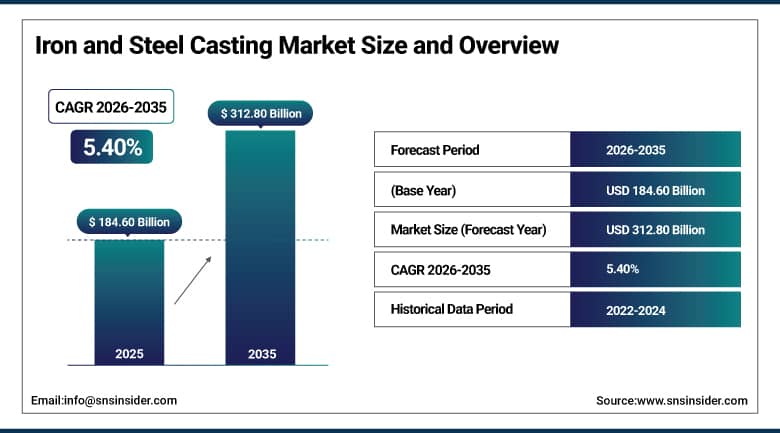
The Iron and Steel Casting Market was valued at USD 184.60 Billion in 2025 and is expected to reach USD 312.80 Billion by 2035, growing at a CAGR of 5.40% from 2026 to 2035.
The Iron & Steel Castings Market exhibits consistent growth owing to growth in infrastructure development, rise in worldwide automotive production, and increased requirement for heavy duty cast parts in the construction, energy, and heavy machinery industries. Iron and steel cast parts are formed when liquid metal is poured into sand, die, or investment molds where the metal solidifies in predetermined shapes which are renowned for their ability to be machined easily, absorb vibrations, and have high tensile strength. Iron and steel cast parts are extensively used in engine blocks, structures, railway parts, pipes, and industrial machinery.
ArcelorMittal S.A. and Tata Steel Limited both expanded their foundry casting capacity in 2026 to meet growing OEM and infrastructure demand for high-strength iron and steel components amid rising construction megaproject activity across North America, Asia Pacific, and Middle East markets.
To Get More Information On Iron and Steel Casting Market - Request Free Sample Report
Iron and Steel Casting Market Trends
-
Rising adoption of ductile iron castings is improving strength-to-weight ratios in automotive and machinery components.
-
Growing investment in automated pouring and machining processes is improving foundry efficiency and casting consistency.
-
Increasing use of casting process simulation software is reducing defects and material waste in production.
-
Expanding electric vehicle lightweighting programs are driving demand for advanced high-strength casting technology.
-
Strategic capacity expansions by major foundries are strengthening supply reliability for automotive and infrastructure customers.
U.S. Iron and Steel Casting Market Outlook
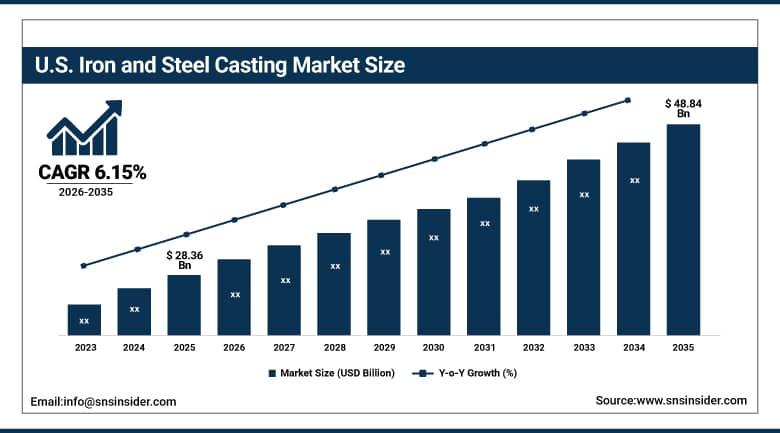
The U.S. Iron and Steel Casting Market was valued at USD 28.36 Billion in 2025 and is projected to reach USD 48.84 Billion by 2035, growing at a CAGR of 6.15% during 2026-2035.
The U.S. Iron and Steel Casting Market will be driven by major automotive OEMs, construction contractors, and industrial machinery companies that have been increasing their demand for castings due to increased production of vehicles within the nation, increased government investments in infrastructure, and increased focus on decreasing their dependence on foreign castings. The increasing importance being laid on the expansion of domestic foundries with increasing production of electric vehicles from Michigan and other major centers for automotive production guarantees the continued demand for iron and steel castings. Increasing investments in the private sector in automated foundry technologies ensures the leadership of the country in the North America Iron and Steel Casting Market.
In 2026, Waupaca Foundry expanded its U.S. production capacity for precision ductile iron castings through the addition of a new automated molding line, strengthening its ability to supply domestic automotive and industrial equipment manufacturers seeking lightweight, high-strength components.
Iron and Steel Casting Market Segment Analysis
-
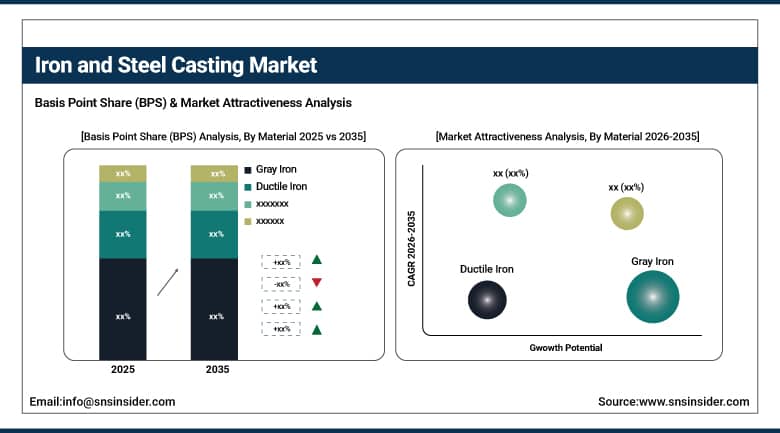
By Material, Gray Iron dominated the Iron and Steel Casting Market with a 55.20% share in 2025, while Ductile Iron is the fastest-growing material segment with a CAGR of 6.80% from 2026-2035.
-
By Process, Sand Casting dominated the Iron and Steel Casting Market with a 63.70% share in 2025, while Die Casting is the fastest-growing process segment with a CAGR of 8.10% from 2026-2035.
-
By Application, Automotive dominated the Iron and Steel Casting Market with a 38.60% share in 2025, while Industrial Machinery is the fastest-growing application segment with a CAGR of 6.90% from 2026-2035.
-
By Sales Channel, Direct Sales dominated the Iron and Steel Casting Market with a 64.80% share in 2025, while Distributors is the fastest-growing sales channel segment with a CAGR of 6.50% from 2026-2035.
By Material, Gray Iron dominated the market, while Ductile Iron is the fastest-growing segment.
The Gray Iron segment was the leading contributor with 55.20% revenue share in the Iron and Steel Casting Market. This material classification is responsible for being the largest share of the market by virtue of having the best machinability, vibration damping capabilities, and economic value in terms of manufacture of engine blocks, piping, and other parts for heavy machinery equipment. Its success story through decades of industrial usage along with its well-developed foundry facilities designed for making gray iron has ensured continued success of this material in traditional and new manufacturing zones as well.
The Ductile Iron segment is expected to witness the highest CAGR of 6.80% during the forecast period 2026-2035. Rising demand for higher-strength, more ductile casting materials capable of withstanding greater mechanical stress in automotive and industrial machinery applications is propelling ductile iron consumption at an accelerated pace. Growing electric vehicle lightweighting programs requiring improved strength-to-weight ratios, combined with expanding infrastructure applications requiring pipe and structural component durability, is adding further impetus to segment demand. Continuous innovation in nodular graphite formation technology is driving the above-average growth rate of this segment relative to the broader iron and steel casting category.
By Process, Sand Casting dominated the market, while Die Casting is the fastest-growing segment.
The Sand Casting category held a market share of 63.70% of the Iron and Steel Casting Market in 2025. Sand Casting is still prevalent owing to its flexibility in forming complex shapes, its suitability with various types of alloy materials, and lower cost of tooling when compared to other casting methods. The reason behind the popularity of sand casting lies in its suitability for small and large batch production, as well as its ability to manufacture large parts that are suitable for use in automobiles, construction equipment, and heavy machinery industry. The recent developments in sand binder technology, mold manufacturing, and material handling have further enhanced accuracy and quality of castings.
The Die Casting segment is anticipated to grow at the fastest rate during the forecast period 2026-2035, at a CAGR of 8.10%. Rising demand for parts that require high precision and dimensional accuracy and which can be used in mass production in the manufacturing of automobiles and electric cars is fueling the use of this casting process. The increasing use of high pressure die casting process in making lightweight structural parts along with the rising automotive gigacasting use is further propelling the growth of this market segment.
By Application, Automotive dominated the market, while Industrial Machinery is the fastest-growing segment.
The Automotive segment dominated the Iron and Steel Casting Market with a revenue share of 38.60% in 2025. Automotive applications remain the largest category owing to the extensive use of cast components across engine blocks, transmission housings, brake components, and structural parts, where iron and steel castings provide the durability, strength, and cost-efficiency required for high-volume vehicle production, driving sustained procurement by automotive OEMs and tier-one suppliers across major vehicle manufacturing hubs including the United States, China, Germany, and India.
The Industrial Machinery segment is expected to register the fastest CAGR of 6.90% during the forecast period 2026-2035. Increasing investments in automation in manufacturing, mining machinery, and heavy construction equipment, which requires durable and wear-resistant cast components, have resulted in increasing demands for cast iron and steel in the market by manufacturers of industrial equipment. Increased activities in megaprojects in infrastructure in developing countries, along with increasing applications of industrial automation, are boosting segment growth.
By Sales Channel, Direct Sales dominated the market, while Distributors is the fastest-growing segment.
The Direct Sales channel dominated the Iron and Steel Casting Market with a revenue share of 64.80% in 2025. Large-volume automotive and industrial buyers continue to favor direct procurement arrangements with foundries owing to the need for custom pattern development, technical collaboration on component specifications, and long-term supply contracts, reinforcing direct sales as the preferred channel among major OEMs and industrial equipment manufacturers requiring predictable, large-scale casting supply.
The Distributors segment is expected to register the fastest CAGR of 6.50% during the forecast period 2026-2035. Increasing requirements from small and medium-size manufacturers and regional customers who do not have enough size to buy from foundries directly are leading to increasing sales through the distribution channel due to flexible quantities, availability of local stock, and logistics value addition services that distributors provide, especially in the case of new market customers in Southeast Asia, Latin America, and Africa.
Regional Insights
|
Region |
Major Country |
Share within Region, 2025 (%) |
|---|---|---|
|
North America |
United States |
82.60% |
|
Europe |
Germany |
24.80% |
|
Asia Pacific |
China |
48.60% |
|
Middle East & Africa |
Saudi Arabia |
26.40% |
|
Latin America |
Brazil |
41.80% |
Asia Pacific Iron and Steel Casting Market Insights
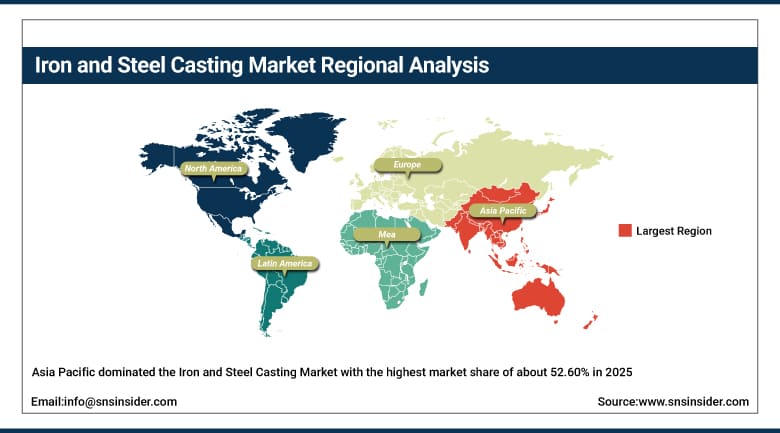
Asia Pacific dominated the Iron and Steel Casting Market with the highest market share of about 52.60% in 2025, owing to the region's extensive foundry infrastructure, dominant position in global automotive and industrial equipment manufacturing, and rapidly expanding construction and infrastructure investment across China, India, and Southeast Asia. A manufacturing environment that is cost-competitive along with considerable government spending on automation and automobile manufacturing has ensured high usage of cast iron and steel in domestic as well as export-focused manufacturing firms in the area.
China was the leading country within the Asia Pacific Iron and Steel Casting Market in 2025 with a market share of 48.60% of the regional market, driven by its position as the world's largest automotive and industrial equipment producer and dense foundry manufacturing clusters. India is contributing to regional growth through its own expanding automotive production base under government-backed manufacturing incentive schemes and growing infrastructure investment supporting sustained demand for cast components.
Get Customized Report as Per Your Business Requirement - Enquiry Now
North America Iron and Steel Casting Market Insights
The North America Iron and Steel Casting Market is expected to witness the fastest growth rate during the forecast period 2026-2035, registering a CAGR of 6.20%. The market growth is driven by expanding domestic automotive manufacturing, particularly electric vehicle production requiring advanced lightweight casting technology, rising federal infrastructure investment, and growing focus on reshoring domestic foundry capacity to reduce reliance on imported cast components amid tightening trade policy.
The United States is one of the main growth drivers in the North America Iron and Steel Casting Market, owing to its expanding electric vehicle manufacturing base and rapidly growing domestic foundry production capability supporting both established and newly developed automotive and industrial applications. Canada is also contributing to regional growth through rising investment in industrial machinery manufacturing and growing adoption of advanced casting technologies across its expanding automotive and infrastructure sectors.
Europe Iron and Steel Casting Market Insights
The Europe region was a major contributor to the Iron and Steel Casting Market in 2025, expected to register comparatively steady demand for precision, high-quality casting technologies during the forecast period. This is attributed to the region's strong industrial base, advanced manufacturing technologies and significant presence in automotive, construction, and machinery end-use industries, with stringent quality standards and environmental regulations driving adoption of cleaner and more efficient casting techniques across member states.
Germany is one of the major markets in Europe owing to its extensive automotive and engineering manufacturing base, along with the presence of leading producers such as ThyssenKrupp AG and Georg Fischer Ltd. serving both domestic and international customers. Other countries such as Italy, France and the United Kingdom, home to significant industrial and automotive manufacturing infrastructure, are also contributing to market growth through continued investment in precision casting technology and process automation.
Middle East & Africa and Latin America Iron and Steel Casting Market Insights
Middle East & Africa and Latin American regions are gradually expanding iron and steel casting adoption as infrastructure megaproject investment and industrial manufacturing capacity grow across both regions, supported by increasing construction activity and growing government focus on strengthening domestic foundry manufacturing capability.
Brazil is set to be a prominent Latin American market fueled by its substantial automotive and industrial machinery manufacturing base requiring extensive cast component supply and growing domestic foundry investment. The Middle East & Africa region has Saudi Arabia investing heavily in infrastructure megaprojects requiring substantial casting volumes, with over 230,000 metric tons of castings used in NEOM-related construction alone, positioning the country as a growing contributor to regional demand.
Growth Drivers: Expanding infrastructure development and automotive production driving market growth
The increasing infrastructural and industrial growth, the rise in automobile production, and the demand for heavy-duty cast products in construction, energy, and machine industries constitute some of the key factors driving the market for Iron and Steel Castings. Iron and Steel Castings offer the durability and cost-effectiveness needed for the manufacture of such components to automobile manufacturers, industrial firms, and constructors. These castings are applicable in most automobiles, constructions, and industrial machinery applications needing cast components.
Technological improvements in cast simulation and automation have greatly enhanced the efficiency of production, and recent developments have enhanced precision and lowered the number of defects.Rising private-sector investment in dedicated automotive and industrial casting capacity, growing integration of robotics and digital quality inspection into foundry workflows, and continued expansion of electric vehicle lightweighting programs are further supporting demand across the forecast period, as manufacturers continue strengthening capability against increasingly stringent performance and efficiency requirements.
Restraints: Raw material price volatility and environmental compliance costs limiting market expansion
One of the most critical obstacles in terms of market growth comes in the form of the volatility of iron ore, scrap metal, and energy pricing, which directly impacts foundry production costs and complicates long-term procurement planning for both manufacturers and downstream buyers. This comes down to the fact that casting operations are highly energy-intensive and raw-material-dependent, which limits smaller regional foundries from offering consistently competitive pricing without substantial supply chain management investment.
In addition to this, the strict environmental policies on emissions, energy use, and disposal of hazardous materials affect manufacturing costs in that there is a need for capital expenditure to ensure compliance. Besides, the high technical requirements in terms of maintaining consistent casting quality and dimensional accuracy across varying alloy compositions and component geometries require considerable ongoing research and development investment from iron and steel casting producers.
Opportunities: Expansion of EV lightweighting and digital foundry technology creating new growth avenues
The increasing need for lightweight, high-strength casting materials across expanding electric vehicle production, the rise of digital foundry technology and automation, and greater emphasis on sustainable, energy-efficient production innovation due to tightening environmental regulation will provide ample growth opportunities in the Iron and Steel Casting Market. The need for compliance-driven, high-quality casting capability across automotive, construction, and industrial operations will ensure future growth due to strict performance and environmental policies worldwide.
There is immense potential for growth in the area of recycled metal utilization and energy-efficient melting technology that reduces environmental impact for foundries and environmentally conscious buyers. The rising infrastructure development and industrial manufacturing investments in Asia Pacific, the Middle East, and Latin American economies, coupled with the initiatives by manufacturers to enhance their automation capabilities in foundries, are expected to create a rise in demand for sophisticated iron and steel castings.
Recent Developments
-
2025: Waupaca Foundry launched its new EcoFlow automated molding line, offering improved casting consistency and reduced energy consumption for automotive ductile iron component production.
-
2025: Georg Fischer expanded its GF Casting Solutions lightweight structural casting platform, targeting electric vehicle manufacturers seeking gigacasting-compatible aluminum-iron hybrid components.
-
2026: ArcelorMittal commissioned a new steel casting production line at its European facility, strengthening its ability to supply high-strength components to infrastructure and rail customers.
-
2026: Tata Steel partnered with a leading automotive OEM to co-develop a high-strength ductile iron casting formulation for next-generation lightweight commercial vehicle components.
Iron and Steel Casting Companies are:
-
ArcelorMittal S.A.
-
Tata Steel Limited
-
Nippon Steel Corporation
-
POSCO Holdings Inc.
-
Kobe Steel, Ltd.
-
Hyundai Steel Company
-
Amsted Rail Company, Inc.
-
Evraz plc
-
Proterial, Ltd.
-
Waupaca Foundry, Inc.
-
Georg Fischer Ltd.
-
ThyssenKrupp AG
-
JFE Holdings, Inc.
-
Calmet, Inc.
-
Nelcast Limited
-
OSCO Industries, Inc.
-
Ferralloy, Inc.
-
Goodwin PLC
Iron and Steel Casting Market Report Scope:
| Report Attributes | Details |
|---|---|
| Market Size in 2025 | USD 184.60 Billion |
| Market Size by 2035 | USD 312.80 Billion |
| CAGR | CAGR of 5.40% From 2026 to 2035 |
| Base Year | 2025 |
| Forecast Period | 2026-2035 |
| Historical Data | 2022-2024 |
| Report Scope & Coverage | Market Size, Segments Analysis, Competitive Landscape, Regional Analysis, DROC & SWOT Analysis, Forecast Outlook |
| Key Segments | • By Material (Gray Iron, Ductile Iron, Steel & Others) • By Process (Sand Casting, Die Casting & Others) • By Application (Automotive, Construction, Industrial Machinery, Oil & Gas & Others) • By Sales Channel (Direct Sales, Distributors) |
| Regional Analysis/Coverage | North America (US, Canada), Europe (Germany, UK, France, Italy, Spain, Russia, Poland, Rest of Europe), Asia Pacific (China, India, Japan, South Korea, Australia, ASEAN Countries, Rest of Asia Pacific), Middle East & Africa (UAE, Saudi Arabia, Qatar, South Africa, Rest of Middle East & Africa), Latin America (Brazil, Argentina, Mexico, Colombia, Rest of Latin America). |
| Company Profiles | ArcelorMittal S.A., Tata Steel Limited, Nippon Steel Corporation, POSCO Holdings Inc., Nucor Corporation, Kobe Steel, Ltd., Hyundai Steel Company, Amsted Rail Company, Inc., Evraz plc, Proterial, Ltd., Waupaca Foundry, Inc., Georg Fischer Ltd., ThyssenKrupp AG, JFE Holdings, Inc., ESCO Corporation, Calmet, Inc., Nelcast Limited, OSCO Industries, Inc., Ferralloy, Inc., Goodwin PLC. |

Frequently Asked Questions
Key players in the Iron and Steel Casting Market include ArcelorMittal S.A., Tata Steel Limited, Nippon Steel Corporation, Nucor Corporation, and Kobe Steel, Ltd., among others.
Key opportunities in the Iron and Steel Casting Market include expansion of electric vehicle lightweighting programs and growing infrastructure megaproject investment across emerging economies.
The market is driven by expanding infrastructure and industrial development, rising automotive production, and growing demand for heavy-duty cast components across construction, energy, and machinery sectors.
The Gray Iron segment dominated the Iron and Steel Casting Market, accounting for approximately 55.20% market share.
The Asia Pacific region dominated the Iron and Steel Casting Market in 2025 with a 52.60% share, driven by extensive foundry infrastructure and rising automotive and construction demand.
