
Neodymium Iron Boron Magnet Market Report Scope & Overview:
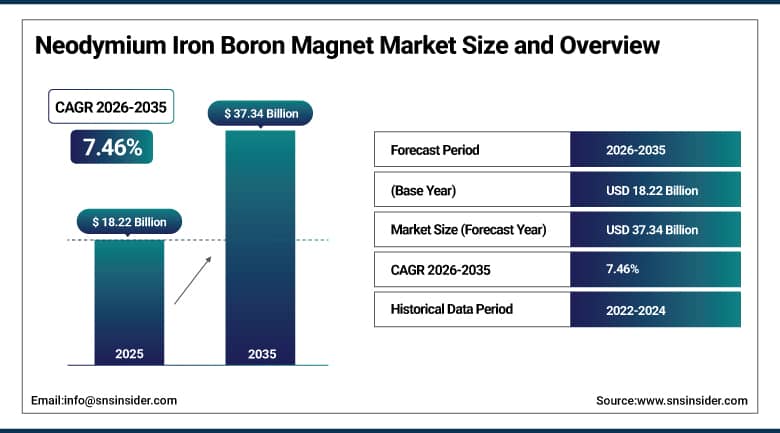
The Neodymium Iron Boron Magnet Market was valued at USD 18.22 billion in 2025 and is expected to reach USD 37.34 billion by 2035, growing at a CAGR of 7.46% from 2026–2035.
The neodymium iron boron magnet market is witnessing strong growth in the global market owing to rising demand from electric vehicles and renewable energy systems. Expanding adoption in consumer electronics is driving strong utilization of high-performance magnets. Growing deployment in industrial automation and robotics is improving efficiency and precision. Rising investments in wind energy generation are supporting market expansion. Increasing demand for miniaturized and lightweight components is accelerating technological innovation. Governments are focusing on clean energy transition and EV adoption, further boosting market growth.
As per USGS Mineral Commodity Summaries 2025, production of rare earths is very much centralized, with about 70% production from China and more than 85% rare earth oxides production capacity from China affecting the supply chain of neodymium in NdFeB magnets.
In accordance with the International Energy Agency's Global Critical Minerals Outlook, the demand for rare earths employed in electric vehicle and wind turbine components will increase more than 3-fold by 2040, assuming various clean energy transition scenarios. As mentioned by the U.S. Department of Energy, over 90% of the highest-grade permanent magnets employed in electric traction motors utilize neodymium-iron-boron alloy.
To Get More Information On Neodymium Iron Boron Magnet Market - Request Free Sample Report
Neodymium Iron Boron Magnet Market Trends:
-
Growth in wind energy initiatives resulting in increasing global demand for superior quality NdFeB permanent magnets.
-
Increase in the use of offshore wind farms leading to large scale usage of rare earth magnetic systems.
-
Enhanced use of smart grids making energy transmission and distribution more efficient.
-
Growth in energy storage technologies making it easier to integrate renewable energy with magnetic systems.
-
Improved technology for designing wind turbines leading to increased efficiencies and higher usage of NdFeB magnets.
-
Global move towards carbon neutrality causing rapid growth in renewable energy and magnets industry.
The U.S. Neodymium Iron Boron Magnet Market Report Scope & Overview:
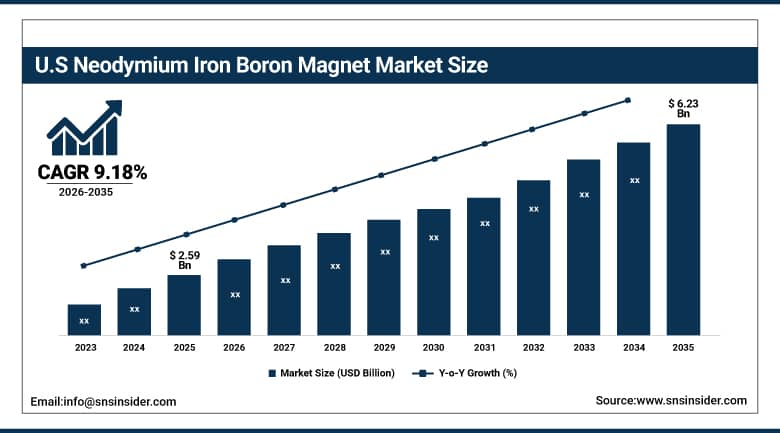
The U.S. Neodymium Iron Boron Magnet Market was valued at USD 2.59 billion in 2025 and is expected to reach around USD 6.23 billion by 2035, growing at a CAGR of 9.18% from 2026–2035.
The U.S. neodymium iron boron magnet market is growing steadily owing to rising demand from electric vehicles and renewable energy applications. Increasing deployment in advanced manufacturing and aerospace systems is enhancing performance efficiency. Expansion of defense and military technologies is supporting strong demand for high-performance magnets. Strong adoption in consumer electronics is driving miniaturization and energy efficiency. Growing investments in domestic rare-earth supply chains are accelerating market expansion. Technological advancements in magnet recycling and processing are further supporting long-term growth.
According to the International Energy Agency Critical Minerals Market Review 2025, increasing demand for permanent magnets is fueled by electric vehicles which use up to 1-2 kilograms of rare earth magnets per vehicle based on the type of motor used. It is also mentioned in the report that more than 50% of global rare earth demand is associated with clean energy applications such as wind turbine generators and electric vehicles.
Neodymium Iron Boron Magnet Market Segment Analysis:
-
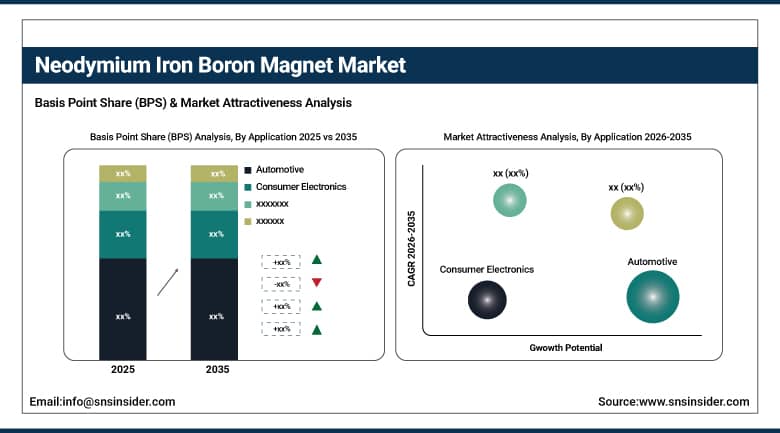
By Application, automotive dominated the market with 41.78% share in 2025; while consumer electronics are the fastest growing segment with CAGR of 9.92% during 2026 to 2035.
-
By Material, NdFeB (Sintered) dominated the market with 69.84% share in 2025; while NdFeB (Bonded) are the fastest growing segment with CAGR of 10.53% during 2026 to 2035.
-
By Shape, block dominated the market with 44.62% share in 2025; while arc is the fastest growing segment with CAGR of 10.08% during 2026 to 2035.
-
By Coating, nickel dominated the market with 47.86% share in 2025; while epoxy is the fastest growing segment with CAGR of 9.94% during 2026 to 2035.
By Application, automotive dominate, while consumer electronics grow fastest
The automotive application accounted for the dominated market share with maximum revenues in the Neodymium Iron Boron Magnets Market in 2025. The growth is attributed to growing electric vehicle production and rising demand for high-performance traction motors. Neodymium Iron Boron Magnets find their use in electric vehicles and hybrid technology applications. Growing automotive electrification and stringent emission norms increase the usage of NdFeB magnets in vehicle manufacturing sectors around the globe.
The consumer electronics application is expected to witness the fastest CAGR during 2026 to 2035. The growth can be attributed to growing demand for energy-efficient and smaller devices. Neodymium Iron Boron Magnets are used in various consumer electronic applications including smartphones, speakers, wearables, and others. Growing trend of miniaturization and rapid innovation in smart devices is driving the demand. Increasing production of consumer electronics in the Asia Pacific region drives the demand.
By Material, NdFeB (Sintered) dominate, while NdFeB (Bonded) grow fastest
NdFeB (Sintered) segment accounted for the dominated revenue share of the neodymium iron boron magnet market in 2025. Factors supporting its dominance include the strong magnetic strength and energy density. It is used for electric vehicles, wind turbines, and industrial motors. In addition, it provides robust mechanical stability along with the extended life cycle. The presence of matured manufacturing facility and cost-effectiveness in mass production have been instrumental in sustaining its dominant position.
NdFeB (Bonded) segment is estimated to register the fastest CAGR during the forecast period from 2026 to 2035. The growing demand for miniaturization in the field of electronics has fueled the demand for NdFeB (bonded). Its capability of design flexibility and forming complex shapes has been instrumental in driving the demand for NdFeB (bonded) magnets. It has become more popular in the use of automotive sensors and consumer electronics.
By Shape, block dominate, while arc grow fastest
Block segment accounted for the dominated revenue share in the neodymium iron boron magnet market in 2025. This is attributed to the use of block magnets in motors for industrial machinery, electric vehicles, and in heavy machinery. Block magnets offer powerful magnetic pull strength, high durability, and are easy to assemble in large units.
Arc segment is projected to be the segment that will record the highest CAGR from 2026 to 2035 owing to increasing usage in electric vehicle traction motors and wind turbine generators. The application of arc shaped magnets in rotating machinery enhances torque efficiency in these machines. Increasing focus on energy efficiency and compact motor designs is boosting adoption. Advanced manufacturing techniques and increased investment in renewable energy is fueling growth of the arc-shaped magnets segment.
By Coating, nickel dominate, while epoxy grow fastest
The nickel coating held the dominated share in the neodymium iron boron magnet market with the largest revenue share in 2025. Nickel coatings are highly popular owing to their superior resistance towards corrosion and durability. The coatings offer good protection against oxidation even in tough environments. The use of nickel provides enhanced mechanical strength and low costs in large-scale production. Moreover, its applicability in automotive and industrial applications adds to its dominance in the global market.
The epoxy coating segment is expected to witness the highest CAGR during 2026 to 2035 owing to the rising requirement for high-performance coatings. The epoxy coating provides excellent resistance to moisture, chemicals, and temperature. The coating extends the life span of the magnets under tough environmental conditions. In addition, the rising application of epoxy coatings in the renewable energy sector and electronics is contributing to the demand.
Regional Analysis:
|
Region |
Major Country |
Share within Region, 2025(%) |
|---|---|---|
|
North America |
United States |
74.36% |
|
Europe |
Germany |
28.10% |
|
Asia Pacific |
China |
44.30% |
|
Middle East & Africa |
UAE |
18.40% |
|
Latin America |
Brazil |
48.20% |
North America Neodymium Iron Boron Magnet Market Insights.
North America is expected to be the fastest growing region in the neodymium iron boron magnet market with a CAGR of about 8.91% during 2026–2035 owing to rapid EV expansion. The region benefits from strong investments in clean energy infrastructure and advanced automotive manufacturing. Increasing adoption of NdFeB magnets in aerospace and defense applications is supporting demand growth. Rising deployment of wind energy systems is accelerating market expansion. Continuous technological advancements in high performance magnetic materials are further strengthening regional market growth across key industries.
According to the US Geological Survey Mineral Commodity Summaries 2025 report, the USA is still over 90% reliant on imports for rare earth materials needed in the production of permanent magnets, which include neodymium-iron-boron permanent magnet types. In addition, critical material assessments conducted by the USA Department of Energy show that more than 50% of electric vehicle drivetrain designs around the world use NdFeB permanent magnets.
Europe Neodymium Iron Boron Magnet Market Insights.
Europe neodymium iron boron magnet market is characterized by steady growth in 2025 owing to strict decarbonization policies. Key countries include Germany, France, United Kingdom, and Italy. Rising EV penetration and wind energy deployment are driving strong demand for NdFeB magnets. Increasing focus on industrial automation is supporting adoption across manufacturing sectors. Expansion of renewable energy infrastructure is further strengthening regional market growth across Europe.
In accordance with the European Commission’s Critical Raw Material Act, the rare earth metals are seen as strategic minerals, having the aim of securing extraction of not less than 10% of annual consumption within the EU, processing 40%, and recycling 15% within the union by 2030. In terms of the US Geological Survey Mineral Commodity Summaries 2025, the major producer of rare earth oxides of the neodymium iron boron magnet chain is China.
Asia Pacific Neodymium Iron Boron Magnet Market Insights.
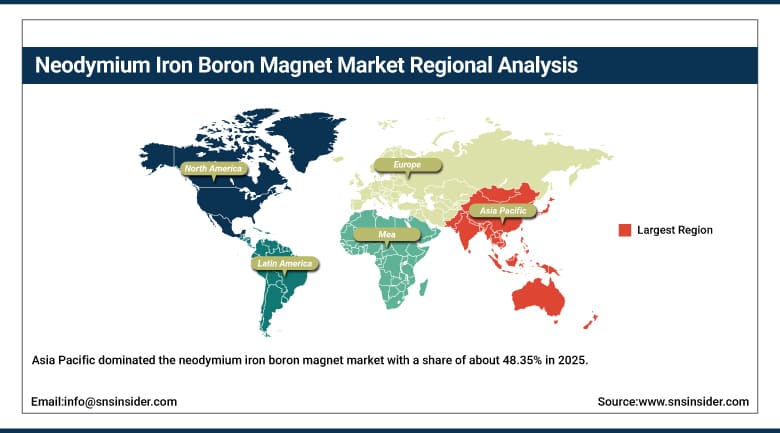
Asia Pacific dominated the neodymium iron boron magnet market with a share of about 48.35% in 2025 due to strong manufacturing dominance. The region benefits from large scale EV production and electronics manufacturing across China, Japan, South Korea, and India. Increasing renewable energy investments are driving significant demand for NdFeB magnets. Expanding industrial automation and robotics adoption is further supporting market growth. Strong supply chain integration and rare earth processing capabilities are reinforcing Asia Pacific’s leadership position across global applications.
As per the USGS Mineral Commodity Summaries 2025, the rare earth mine production for the year was about 350,000 metric tons, where China holds more than 60% of the production and has a dominant position in midstream separation and magnet fabrication. The critical minerals outlook 2025 of the International Energy Agency estimates that there will be an increase in the use of rare earth permanent magnets in electric vehicles and wind turbines, with the former using 1-2 kg per vehicle.
Get Customized Report as Per Your Business Requirement - Enquiry Now
Middle East & Africa and Latin America Neodymium Iron Boron Magnet Market Insights.
The Middle East & Africa along with Latin America regions are experiencing steady growth due to increasing infrastructure development. Key contributing countries include Brazil, Mexico, UAE, Saudi Arabia, and South Africa. Rising investments in renewable energy projects are driving demand for NdFeB magnets. Expanding industrialization and automotive assembly activities are supporting market penetration. Increasing focus on energy diversification is further boosting regional demand across emerging economies.
According to USGS Mineral Commodity Summaries 2025, the production of rare earth oxides is still very concentrated, whereby China produces 69% of total rare earth oxides globally while Brazil and South Africa are emerging producers but in small quantities in Latin America and Africa respectively. According to IEA Global Critical Minerals Outlook 2025, the sale of electric vehicles surpassed 14 million units with an adoption rate that exceeds 20% of the total new car sales, thereby increasing the demand for neodymium iron boron magnets for traction motors.
Market Dynamics:
Growth Drivers: Expansion of renewable energy systems and wind turbine installations driving large scale usage of NdFeB magnets.
The quick development of the wind energy sector has led to an increase in demand for high performance permanent magnets. High performance magnets are crucial components of direct drive wind turbines due to high efficiency and reliability. The governments have started to spend a lot of money in the clean energy transition initiatives. Off shore wind farm installations are also contributing to the increase in magnet consumption. Increased attention towards sustainable power production is positively affecting market dynamics.
According to IEA’s clean energy technology tracking, the permanent magnet direct-drive wind turbines, which depend significantly on neodymium iron boron magnets, represent about 30-40% of all newly installed offshore wind power generation systems. According to the U.S. Geological Survey Mineral Commodity Summaries 2025, more than 85% of rare earth minerals are supplied by China.
Restraints: Volatility in rare earth raw material supply and high dependency on limited geographic production regions restricting market stability.
Supply risks have been created due to high concentration of neodymium and rare earth elements in particular countries. The prices of raw materials fluctuate, thereby affecting the cost of production. Other factors that may lead to supply risks include export bans and geopolitical issues, which result into disruptions in global supply chains. There have been difficulties for the manufacturers in securing the supply of the required materials. There is low diversification of mining operations.
Opportunities:Advancements in renewable energy technologies and smart grid infrastructure enhancing integration of high-performance magnetic systems.
The development of high-performance wind turbines and energy storage devices is opening up new applications for these magnets. The use of NdFeB magnets is necessary in order to achieve effective energy production in modern energy production facilities. Development of the smart grid is enhancing the efficiency of energy distribution. Governments are spending on sustainable energy infrastructure projects. The use of offshore wind energy and hybrid renewable energy sources is increasing the demand for magnets. Technology improvements in energy conversion systems are enhancing the demand for these magnets.
As per U.S. Department of Energy’s Critical Materials Assessment 2025, neodymium is a part of the group of risky materials because of the nature of its supply chain, as almost 90% of rare earth processing capacity is available in a single country. As per Global Wind Energy Council, total installed capacity of wind power around the world exceeded 1,000 GW, out of which over 90% of modern offshore direct drive wind turbines utilize NdFeB magnet generators.
Recent Developments:
-
2026: Vacuumschmelze GmbH & Co. KG acquired by Energy Fuels in USD 1.9 billion deal, expanding non-Chinese rare earth magnet supply chain capacity globally.
-
2025: JL Mag Rare-Earth Co., Ltd. unveiled plans for significant expansion with approximately 48,000 ton per year production capacity of NdFeB magnets from advanced factories.
-
2025: Ningbo Yunsheng Co., Ltd. completed first stage of its project to produce 5,000 tons of high-efficiency NdFeB magnets via intelligent manufacturing techniques.
-
2024: TDK Corporation completed Hungary NdFeB magnet facility enabling European automotive supply and integrated recycling-based production system rollout.
Neodymium Iron Boron Magnet Market Key Players are:
-
Proterial Ltd.
-
Shin-Etsu Chemical Co., Ltd.
-
Vacuumschmelze GmbH & Co. KG
-
Daido Steel Co., Ltd.
-
TDK Corporation
-
Neo Performance Materials Inc.
-
Arnold Magnetic Technologies
-
Dexter Magnetic Technologies
-
Adams Magnetic Products Co.
-
Electron Energy Corporation
-
Integrated Magnetics
-
Advanced Technology & Materials Co., Ltd.
-
Ningbo Yunsheng Co., Ltd.
-
JL Mag Rare-Earth Co., Ltd.
-
Beijing Zhong Ke San Huan High-Tech Co., Ltd.
-
Yantai Zhenghai Magnetic Material Co., Ltd.
-
Ningbo Ketian Magnet Co., Ltd.
-
Innuovo Technology Co., Ltd.
-
Guangdong JPMF New Materials Group Co., Ltd.
-
GKN Powder Metallurgy
Neodymium Iron Boron Magnet Market Report Scope:
| Report Attributes | Details |
|---|---|
| Market Size in 2025 | USD 18.22 Billion |
| Market Size by 2035 | USD 37.34 Billion |
| CAGR | CAGR of 7.46% From 2026 to 2035 |
| Base Year | 2025 |
| Forecast Period | 2026-2035 |
| Historical Data | 2022-2024 |
| Report Scope & Coverage | Market Size, Segments Analysis, Competitive Landscape, Regional Analysis, DROC & SWOT Analysis, Forecast Outlook |
| Key Segments | • By Application (Automotive, Consumer Electronics, Medical, Industrial, Energy) • By Material (NdFeB (Sintered), NdFeB (Bonded), SmCo, Alnico, Ceramic) • By Shape (Block, Cylinder, Ring, Arc, Sphere) • By Coating (Nickel, Gold, Zinc, Epoxy, Polymer) |
| Regional Analysis/Coverage | North America (US, Canada), Europe (Germany, UK, France, Italy, Spain, Russia, Poland, Rest of Europe), Asia Pacific (China, India, Japan, South Korea, Australia, ASEAN Countries, Rest of Asia Pacific), Middle East & Africa (UAE, Saudi Arabia, Qatar, South Africa, Rest of Middle East & Africa), Latin America (Brazil, Argentina, Mexico, Colombia, Rest of Latin America). |
| Company Profiles | Proterial Ltd, Shin-Etsu Chemical Co., Ltd., Vacuumschmelze GmbH & Co. KG, Daido Steel Co., Ltd., TDK Corporation, Neo Performance Materials Inc., Arnold Magnetic Technologies, Dexter Magnetic Technologies, Adams Magnetic Products Co., Electron Energy Corporation, Integrated Magnetics, Advanced Technology & Materials Co., Ltd., Ningbo Yunsheng Co., Ltd., JL Mag Rare-Earth Co., Ltd., Beijing Zhong Ke San Huan High-Tech Co., Ltd., Yantai Zhenghai Magnetic Material Co., Ltd., Ningbo Ketian Magnet Co., Ltd., Innuovo Technology Co., Ltd., Guangdong JPMF New Materials Group Co., Ltd., GKN Powder Metallurgy (Magnet Solutions Division) |
Frequently Asked Questions
The Major growth factors include rising EV and renewable demand, consumer electronics adoption, industrial automation expansion, wind energy growth, and increasing focus on lightweight high performance magnetic components supporting clean energy transition.
Asia Pacific dominated due to strong manufacturing, EV production, rare earth processing, and high demand from electronics and renewable energy sectors.
Automotive dominated due to strong EV production, rising traction motor demand, and increasing adoption in hybrid and electric vehicles globally.
The neodymium iron boron magnet market was valued at USD 18.22 billion in 2025.
The neodymium iron boron magnet market is expected to grow at a CAGR of 7.46% from 2026 to 2035.
