
Controlled Environment Agriculture (CEA) Market Report Scope & Overview:
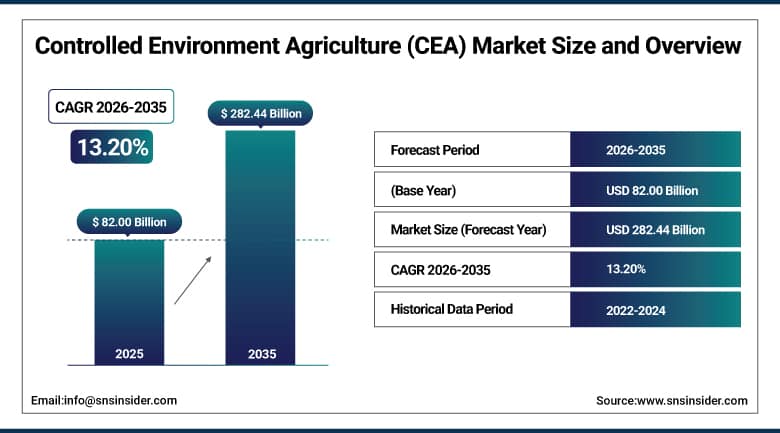
The Controlled Environment Agriculture (CEA) Market was valued at USD 82.00 billion in 2025 and is projected to reach USD 282.44 billion by 2035, growing at a CAGR of 13.20% during 2026–2035.
Increasing demand for high-quality crops year-round production, rising concerns over food security and the need for sustainable farming practices are driving the market growth. Fast urbanisation, decreasing arable land and uncertain climate conditions are encouraging investments into greenhouse farming, vertical farming, hydroponics and aeroponics. Automation, artificial intelligence, IoT-based monitoring, LED lighting and climate control technologies are being used to increase and improve crop productivity while reducing water and energy consumption. The controlled environment agriculture market is also witnessing growth owing to government support for modern agriculture, increasing investments in indoor farming infrastructure and rising consumer demand for pesticide-free and locally grown produce.
In 2025, Saudi Arabia’s Public Investment Fund (PIF) announced a joint venture with AeroFarms to develop the MENA region’s largest indoor vertical farm, near Riyadh. The farm will use state-of-the-art aeroponic technology, reducing water use by as much as 95%, and increasing food security in the region, while lowering reliance on imported food products.
To Get More Information On Controlled Environment Agriculture (CEA) Market - Request Free Sample Report
Controlled Environment Agriculture (CEA) Market Trends:
-
Increasing adoption of vertical farming, hydroponics, and aeroponics technologies is improving crop productivity, reducing water consumption, and enabling year-round cultivation in controlled environments.
-
Rising investments in AI, IoT, robotics, and automated climate control systems are enhancing operational efficiency, optimizing resource utilization, and improving crop quality across CEA facilities.
-
Growing concerns over food security, climate change, and declining arable land are accelerating government and private investments in controlled environment agriculture infrastructure worldwide.
-
Expansion of smart greenhouses and indoor farming facilities is supporting the production of pesticide-free, locally grown, and premium-quality fruits, vegetables, herbs, and leafy greens.
-
Increasing integration of renewable energy, precision irrigation, and energy-efficient LED lighting technologies is strengthening the sustainability and commercial viability of controlled environment agriculture operations.
U.S. Controlled Environment Agriculture (CEA) Market Outlook:
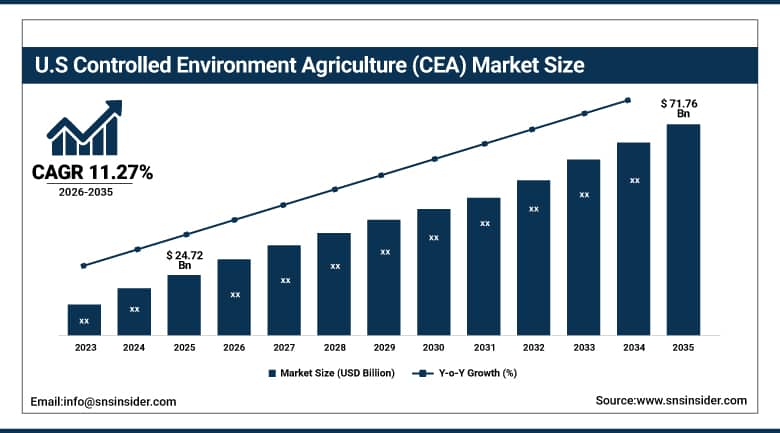
The U.S. Controlled Environment Agriculture (CEA) Market was valued at USD 24.72 billion in 2025 and is projected to reach USD 71.76 billion by 2035, growing at a CAGR of 11.27% during 2026–2035.
The market in the U.S. is growing owing to heavy investments made by players in the areas of smart farming, automation, artificial intelligence, and precision agriculture to increase the efficiency of yield and resource utilization. Increasing demands for round-the-year production, less dependency on conventional practices of farming, and greater focus on conserving water resources are prompting farmers and other firms to switch to indoor farming techniques. Furthermore, the presence of dominant players in the field of CEA, venture capitalists, and more collaboration among technology providers and agri-firms is also contributing towards market development. Advancement in genetics, LEDs, climate-controlled systems, and robots are further aiding scalability of CEA operations in the country.
In 2025, Ohio-based firm, 80 Acres Farms raised USD 115 million in funding and purchased an Israeli biotechnology company Plantae Biosciences for the development of crops suitable for indoor farming practices.
Controlled Environment Agriculture (CEA) Market Segment Analysis:
-
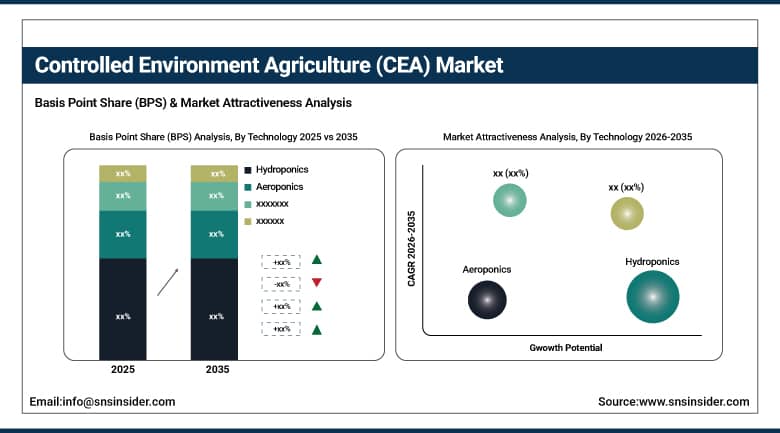
By Technology, Hydroponics dominated the controlled environment agriculture (cea) market with 42.60% share in 2025, while Aeroponics is the fastest-growing technology segment with a CAGR of 14.34% from 2026–2035.
-
By Component, Hardware dominated the controlled environment agriculture (cea) market with 45.20% share in 2025, while Software is the fastest-growing component segment with a CAGR of 15.19% from 2026–2035.
-
By Crop Type, Vegetables/Leafy Greens dominated the controlled environment agriculture (cea) market with 50.80% share in 2025, while Herbs & Berries are the fastest-growing crop type segment with a CAGR of 16.61% from 2026–2035.
-
By Facility Type, Greenhouses dominated the controlled environment agriculture (cea) market with 54.30% share in 2025, while Hybrid Models are the fastest-growing facility type segment with a CAGR of 14.45% from 2026–2035.
By Technology, Hydroponics dominated the Controlled Environment Agriculture (CEA) Market, while Aeroponics is expected to register the fastest CAGR during the forecast period 2026–2035
Hydroponics held the dominating share of the controlled environment agriculture (CEA) market in 2025, accounting for 42.60% of the revenue. This segment still remains at the top due to its wide use, efficient use of water and large-scale production of commercial crops. Hydroponic systems allow precise control of nutrients, optimum growth environments and increased production over conventional agricultural methods. The segment growth is attributed to the increased adoption of controlled environment agriculture (CEA) practices by commercial growers, urban farming operators, and greenhouse facilities. The growing demand for sustainable agriculture solutions, the decreasing reliance on arable land, and the increasing investments in controlled farming infrastructure are further driving the adoption of hydroponic cultivation systems globally.
The Aeroponics market is expected to register the fastest CAGR of 14.34% during the forecast period of 2026-2035. Segment growth is driven by improved resource efficiency, lower water use and enhanced crop productivity capabilities. Aeroponic systems grow plants without soil, feeding nutrients through mist-based systems. The result is better root development and more rapid growth cycles. The rising investments in vertical farming, food security projects and sophisticated indoor agriculture projects also fast-track the adoption. Improvements in automation, sensors and climate monitoring systems are driving increased scalability and commercial potential of aeroponic farming solutions.
By Component, Hardware dominated the Controlled Environment Agriculture (CEA) Market, while Software is expected to register the fastest CAGR during the forecast period 2026–2035
Hardware dominated the controlled environment agriculture (CEA) market with a 45.20% share of revenue in 2025. This segment is being driven by the critical need for physical infrastructure for controlled farming operations such as LED lighting systems, climate control equipment, irrigation systems, environmental sensors and growing structures. The growing use of greenhouses and indoor farming facilities is driving demand for advanced hardware solutions. More support for the adoption of hardware is coming from increasing investments in automation, resource-efficient cultivation technologies and large-scale commercial farming projects. The increasing popularity of vertical farms and smart agriculture facilities continues to generate strong demand for reliable CEA hardware systems around the world.
Software is expected to register the highest CAGR of 15.19% during the forecast period 2026-2035. The growth is fuelled by the surging adoption of farm management platforms, artificial intelligence-based monitoring systems, and IoT-enabled agricultural solutions. They are also equipped with software platforms that enable real-time tracking of temperature, humidity, nutrient levels and crop conditions for better operational efficiency and decision making. Relevant findings from predictive analytics, automation controls and cloud-based farm management solutions are being adopted by growers. With increasing focus on data driven farming and optimisation of resource allocation, software adoption for controlled environment agriculture facilities is expected to grow.
By Crop Type, Vegetables/Leafy Greens dominated the Controlled Environment Agriculture (CEA) Market, while Herbs & Berries are expected to register the fastest CAGR during the forecast period 2026–2035
Vegetables/Leafy Greens dominated the controlled environment agriculture (CEA) market with a revenue share of 50.80% in 2025. Fresh, local, pesticide-free produce is in strong demand and continues to drive the sector. Lettuce, spinach, and kale are examples of vegetables frequently cultivated in vertical farms and hydroponic systems because they have short growth cycles and are well suited to controlled environments. The segment’s growth is backed by rising urbanisation, a growing consumer preference for healthy food choices and increasing adoption of indoor farming technologies. Year-round availability of vegetables and leafy greens from CEA systems increases the demand for these products.
Herbs & Berries is projected to register the fastest CAGR of 16.61% in the forecast period 2026 – 2035. The segment is gaining on the back of rising consumer preference for premium, nutrient-rich and locally grown speciality crops. Herbs and berries are more profitable and are increasingly cultivated in controlled conditions to preserve quality, increase shelf life and increase productivity. Investments in vertical farming facilities, high-end lighting technologies, and precision cultivation systems are helping with adoption. The segment is expected to provide lucrative growth prospects due to rising popularity of fresh herbs, strawberries and other high-value crops among consumers.
By Facility Type, Greenhouses dominated the Controlled Environment Agriculture (CEA) Market, while Hybrid Models are expected to register the fastest CAGR during the forecast period 2026–2035
The Greenhouses segment dominated the controlled environment agriculture (CEA) market, with a revenue share of 54.30% in 2025. The segment is projected to maintain its dominance owing to wide acceptance in commercial agriculture, existing infrastructure, and low-cost cultivation capabilities. Greenhouses are used to increase the productivity of crops to protect against external environmental risks by providing controlled temperature, humidity and light conditions. The market is witnessing growth due to increasing adoption of smart greenhouse technologies, automated climate control systems and sustainable farming practices. The growing demand for year-round crop production and effective resource management is driving the adoption of greenhouses in both developed and emerging agricultural markets.
The Hybrid Models segment is projected to grow at the fastest CAGR of 14.45% during the forecast period 2026-2035. The growth is attributed to growing popularity of integrated farming practices such as greenhouse and indoor farming technologies. The hybrid facilities offer more flexibility, higher energy efficiency and optimal conditions for production of different varieties of crops. Hybrid CEA models are emerging with increasing investments in advanced agricultural infrastructure, food security projects and technology-based farming solutions. The combination of multiple cultivation techniques while maximising productivity and minimising the operational limitations, hybrid farming facilities are expected to be adopted globally.
Regional Insights:
|
Region |
Major Country |
Share within Region, 2025 (%) |
|---|---|---|
|
North America |
United States |
82.11% |
|
Europe |
Netherlands |
28.40% |
|
Asia Pacific |
China |
34.50% |
|
Middle East & Africa |
Saudi Arabia |
32.60% |
|
Latin America |
Brazil |
45.80% |
North America Controlled Environment Agriculture (CEA) Market Insights
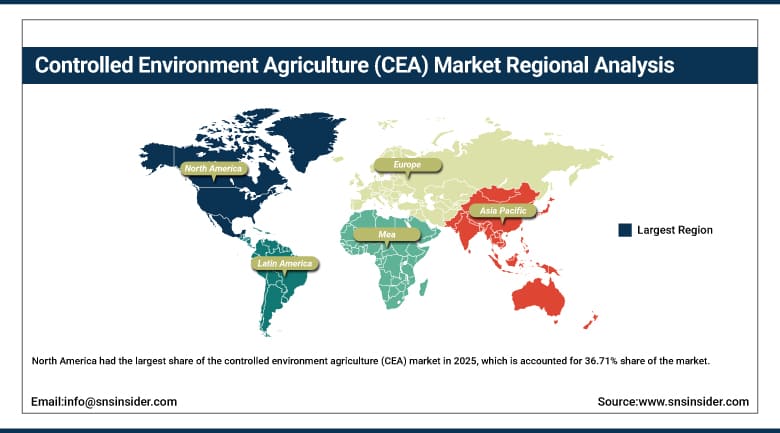
North America had the largest share of the controlled environment agriculture (CEA) market in 2025, which is accounted for 36.71% share of the market. The increasing investments in vertical farming, smart greenhouses, hydroponics and automated agricultural technologies form the basis for the region’s leadership. AI-driven farming systems, IoT-based monitoring solutions and precision cultivation techniques are being incorporated to enhance productivity and resource efficiency. Leading CEA companies, advanced agricultural infrastructure and increasing demand for locally produced fresh food also support the region’s growth. The U.S. accounted for the largest market share of about 82.11% in 2025. That’s thanks to big bucks flowing into indoor farming facilities, venture capital and sustainable farming efforts.
The U.S. market is growing continuously due to increasing demand for the year-round crop production and less water consumption along with advanced cultivation techniques. Meanwhile, controlled farming systems are also gaining traction in Canada due to climate challenges, food security concerns and government support for sustainable agriculture. North America is projected to hold the dominant position throughout the forecast period owing to increased emphasis on supply chain resilience, resource-efficient agriculture, and innovation in technology.
Get Customized Report as Per Your Business Requirement - Enquiry Now
Europe Controlled Environment Agriculture (CEA) Market Insights
Europe has emerged as one of the largest markets for controlled environment agriculture (CEA) owing to increased efforts towards sustainability, unavailability of arable land, and high consumption of locally grown crops. High adoption of innovative greenhouses, vertical farm facilities, automation equipment, and AI crop monitoring software have been witnessed across Europe. The Netherlands forms one of the major contributors in the region owing to a well-established ecosystem for greenhouse farming, innovations in horticulture technology, and sustainable cultivation techniques.
The other three major markets in Europe are Germany, the United Kingdom, and France owing to increased investments in smart farming equipment and solutions, food security measures, and sustainable agricultural solutions. Higher efficiency and reduction in operational costs through innovations such as LED lighting, climate control, and precision farming technology can be witnessed. Increasing preferences for organic products and supportive government policies have resulted in a high growth potential for CEA in Europe.
Asia Pacific Controlled Environment Agriculture (CEA) Market Insights
Asia Pacific is the fastest-growing region for the controlled environment agriculture (cea) market with a CAGR of around 15.76% during 2026-2035. The region is experiencing growth due to rising investments in state-of-art agricultural technology, limited arable land, rapid urbanisation, and increasing concerns for food security. The increasing adoption of vertical farming, hydroponics and aeroponics systems is helping countries increase crop production with lower consumption of water. China is an important player in the Asia Pacific region with government support for smart agriculture and large investments in indoor farming.
India, Japan, South Korea and Singapore are also adding to regional growth through investments in urban agriculture, food security programmes and technology-enabled farming solutions. Increasing adoption of AI, robotics, automated climate control and precision agriculture platforms is enhancing the commercial potential of CEA systems. The Asia Pacific market is expected to be the fastest-growing regional market during the forecast period owing to the increasing demand for locally produced fresh food and sustainable farming methods.
Middle East & Africa and Latin America Controlled Environment Agriculture (CEA) Market Insights
The Middle East & Africa and Latin America controlled environment agriculture (cea) market is experiencing more adoption with the increasing concerns regarding food security climate conditions and sustainable agriculture. Countries like Saudi Arabia and UAE are investing huge amounts on vertical farms and controlled cultivation centres to be self-reliant in their food requirements. Saudi Arabia can be considered a major contributor for reasons such as government intervention, sovereign funds and large-scale indoor farm projects to improve food production in the country.
Latin America is also witnessing growth due to the increasing greenhouse farming practices, agricultural exports and adoption of advanced farming technology. Brazil could be considered a major contributor given its advanced agricultural industry and investment in sustainable agricultural solutions. However, high installation costs, lack of expertise, and other operational difficulties may impede the adoption process in some emerging countries. Moreover, partnerships among technology vendors, governments and agriculture organisations are likely to create more opportunities for both these regions.
Growth Drivers: Increasing food security concerns and adoption of advanced farming technologies driving market expansion
Driven by increasing urbanisation, concerns over food security and a rising demand for sustainable food production, controlled environment agriculture (CEA) solutions are being adopted across the globe. The limited resource of agricultural land, climate change and water shortages are prompting farmers and agricultural companies to look at vertical farming, hydroponics, aeroponics and sophisticated greenhouse systems. CEA technologies enable crops to be grown year-round, use resources more efficiently and out-produce traditional farming methods. Also driving market growth are government policies promoting sustainable agriculture, local food production and smart farming development in developed and emerging economies.
Controlled environment is using Artificial intelligence, IoT based monitoring systems, robotics, automated climate control and data analytics for improving operational efficiency and crop management. The technologies allow growers to track temperature, humidity, nutrients and plant growth conditions in real time, which leads to increased productivity and the use of fewer resources. Increasing investments in indoor farming facilities by venture capital firms, agricultural technology companies and food producers are also supporting market growth. The growing demand for fresh, pesticide-free and locally produced food by consumers is expected to continue to drive demand for advanced Controlled Environment Agriculture solutions over the forecast period.
Restraints: High installation costs and operational complexities limiting market adoption
Controlled environment. 2. High initial investment requirements Agricultural systems are a significant barrier to market growth. Such huge investments in vertical farm installations, automated greenhouse structures, LED lighting systems, climate control equipment and sophisticated monitoring technologies requires huge capital expenditure and adoption becomes difficult for small and medium scale growers. Indoor farms also use a lot of energy to run, especially for lighting and climate control. This means increased cost of operations and in certain geographies profitability is impacted.
Adoption is hampered by complex system management and dependence on advanced technologies. Competent people will be required to grow crops, analyse data, maintain equipment, and integrate technology in CEA operations. Scalability could also be impacted by challenges regarding availability of electricity, supply chain limitations and lack of standardised farming practices. “Demand for sustainable agriculture solutions is growing, but limited awareness of the benefits of controlled farming and restricted access to financing continue to hinder adoption in developing markets.
Opportunities: Expansion of smart farming technologies and sustainable food production solutions
Growing adoption of smart farming solutions and increased automation and digital agriculture platforms has provided many opportunities for growth within the controlled environment agriculture (cea) market. Application of Artificial Intelligence, machine learning, robotics and IoT enabled monitoring systems is making way for very efficient models of farming with better yields and lower resource utilisation. Businesses are coming up with highly advanced hydroponics, aeroponics, and vertical farms which use less water, electricity, and produce crops at shorter intervals.
The Asia Pacific region, Middle East, and Latin America regions have been identified as emerging markets providing a lot of opportunities due to the increase in initiatives towards improving food security, rising urban populations and investments in agriculture modernization. Initiatives by governments and organizations towards promoting CEA along with sustainable agriculture initiatives and cooperation with technology companies has been taking place. In addition, the growing cooperation between agricultural technology companies, food retailers, and farming companies has accelerated the process of building large scale indoor farms.
Recent Developments:
-
2026: Dubai GigaFarm secured over USD 327 million investment to develop a large-scale CEA facility producing 3,000 metric tons of fresh produce annually using closed-loop water systems to enhance food security.
-
2025: Signify launched the Philips GrowWise Smart Spectrum platform, using automated lighting controls to optimize indoor farming efficiency and achieve up to 6% energy savings.
-
2026: China’s Central Document No. 1 promoted AI, IoT, robotics, and drone integration in facility agriculture to accelerate smart farming development and improve food security.
-
2025: Signify expanded its GrowWise Smart Spectrum technology to improve vertical farming energy efficiency through automated lighting optimization and enhanced crop performance.
Controlled Environment Agriculture (CEA) Market Key Players:
-
AeroFarms
-
Bowery Farming
-
80 Acres Farms
-
BrightFarms
-
AppHarvest
-
Infarm
-
Freight Farms
-
Crop One Holdings
-
Spread Co., Ltd.
-
Signify N.V.
-
Heliospectra AB
-
Plantech Control Systems
-
Priva
-
Argus Control Systems
-
Lufa Farms
-
Kalera
-
Jones Food Company
-
Agrilution
Controlled Environment Agriculture (CEA) Market Report Scope:
| Report Attributes | Details |
|---|---|
| Market Size in 2025 | USD 82.00 Billion |
| Market Size by 2035 | USD 282.44 Billion |
| CAGR | CAGR of 13.20% From 2026 to 2035 |
| Base Year | 2025 |
| Forecast Period | 2026-2035 |
| Historical Data | 2022-2024 |
| Report Scope & Coverage | Market Size, Segments Analysis, Competitive Landscape, Regional Analysis, DROC & SWOT Analysis, Forecast Outlook |
| Key Segments | • By Technology (Hydroponics, Aeroponics, Other Substrate/Soil-Based Systems) • By Component (Hardware, Software, Services) • By Crop Type (Vegetables/Leafy Greens, Herbs & Berries, Vine Crops, Other Crops) • By Facility Type (Greenhouses, Vertical/Indoor Farms, Hybrid Models) |
| Regional Analysis/Coverage | North America (US, Canada), Europe (Germany, UK, France, Italy, Spain, Russia, Poland, Rest of Europe), Asia Pacific (China, India, Japan, South Korea, Australia, ASEAN Countries, Rest of Asia Pacific), Middle East & Africa (UAE, Saudi Arabia, Qatar, South Africa, Rest of Middle East & Africa), Latin America (Brazil, Argentina, Mexico, Colombia, Rest of Latin America). |
| Company Profiles | AeroFarms, Plenty Unlimited Inc., Bowery Farming, 80 Acres Farms, BrightFarms, AppHarvest, Infarm, Freight Farms, Crop One Holdings, Spread Co., Ltd., Netafim, Signify N.V., Heliospectra AB, Plantech Control Systems, Priva, Argus Control Systems, Lufa Farms, Kalera, Jones Food Company, Agrilution. |

Frequently Asked Questions
North America dominated the Controlled Environment Agriculture (CEA) Market in 2025, accounting for approximately 36.71% market share.
The major growth factor driving the Controlled Environment Agriculture (CEA) Market is increasing food security concerns, rising adoption of vertical farming and hydroponics systems, limited agricultural land availability, and advancements in AI, IoT, automation, and smart farming technologies.
The Hydroponics segment dominated the Controlled Environment Agriculture (CEA) Market in 2025, accounting for approximately 42.60% market share.
