
Iron-Air Energy Storage Market Report Scope and Overview:
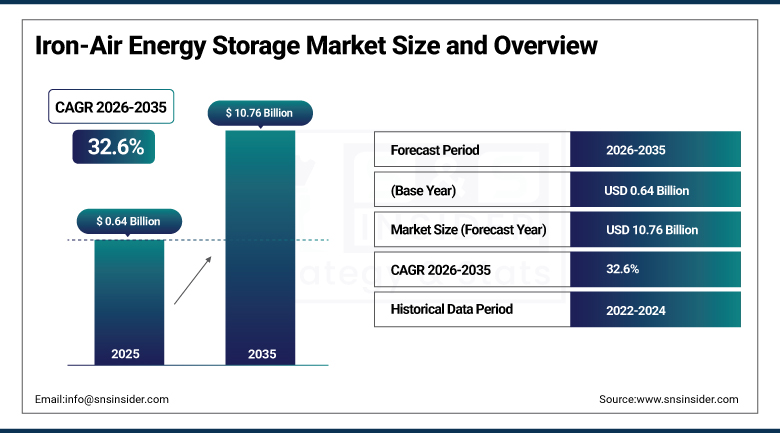
The Iron-Air Energy Storage Market was valued at USD 0.64 Billion in 2025 and is projected to reach USD 10.76 Billion by 2035, registering a CAGR of 32.6% from 2026 to 2035.
The Iron-Air Energy Storage Market is set to transform the way that we see grid resilience in the next few days, using one of the cheapest and most plentiful materials on Earth and iron, to provide multi-day energy storage at a fraction of the cost of lithium-ion technologies. The market has been categorized based on the increase in demand from utility companies for renewable energy firming, growth in reversible iron oxidation battery technology, increase in manufacturing capabilities of domestic iron-air batteries, and applications in grid resilience, peaker-plant replacement, and multi-day back-up.
There has been an increase in the construction of commercial scale manufacturing facilities, strategic offtake agreements, and pilot projects from utility companies since there has been significant investment in scaling up the production capability of iron-air batteries.
To Get more information On Iron-Air Energy Storage Market - Request Free Sample Report
Iron-Air Energy Storage Market Trends
-
Expanding commercial-scale manufacturing capacity continues easing pilot-to-production bottlenecks for iron-air developers.
-
Growing hyperscale data center power demand continues accelerating multi-day storage offtake agreements with utilities.
-
Rising government long-duration energy storage incentives continue de-risking early commercial deployment economics.
-
Increasing curtailment of wind and solar generation continues strengthening the case for 100-hour iron-air discharge duration.
-
Growing investment in domestic iron electrode and air cathode supply chains continues reducing dependence on critical minerals.
U.S. Iron-Air Energy Storage Market Outlook
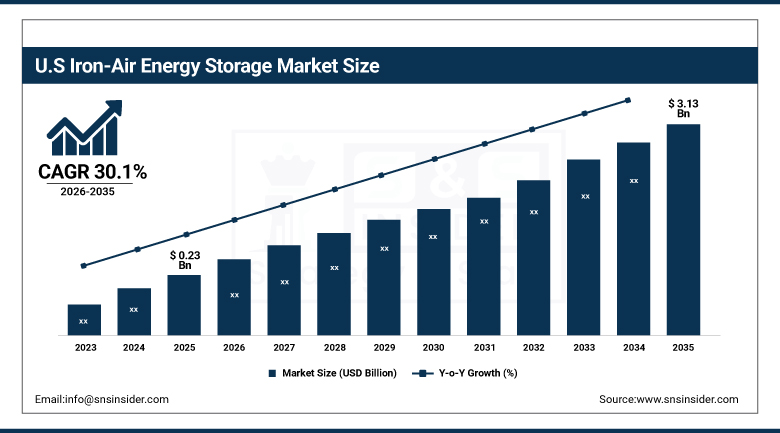
The U.S. Iron-Air Energy Storage Market was valued at approximately USD 0.23 Billion in 2025 and is projected to reach approximately USD 3.13 Billion by 2035, registering a CAGR of approximately 30.1% from 2026 to 2035.
The U.S. demand was also driven significantly by the high levels of Department of Energy funding of long-duration storage technology, large scale of investments in domestic manufacturing of iron-air cells, and the demand for multi-day reliable power backup from the utilities and hyperscale data centers.
Rapid development of the manufacturing capacity of iron-air cells and increasing deployment of utility-scale projects in the Midwest further solidified the position of the US both as a major manufacturer and the largest addressable market for iron-air battery systems worldwide. In addition, the use of iron-air battery systems for improving grid resilience, replacing peaker plants, and data centers' reliable power backup ensured sustained demand for this type of energy storage in the country.
Iron-Air Energy Storage Market Segment Analysis
-
By Battery Type, Rechargeable Iron-Air Batteries segment dominated the Iron-Air Energy Storage Market in 2025 with 46% share; Hybrid Iron-Air Systems segment is the fastest growing segment.
-
By Storage Duration, Long-Duration (24-100+ Hours) segment dominated the market in 2025 with 51% share; Medium-Duration (10-24 Hours) segment is the fastest growing segment.
-
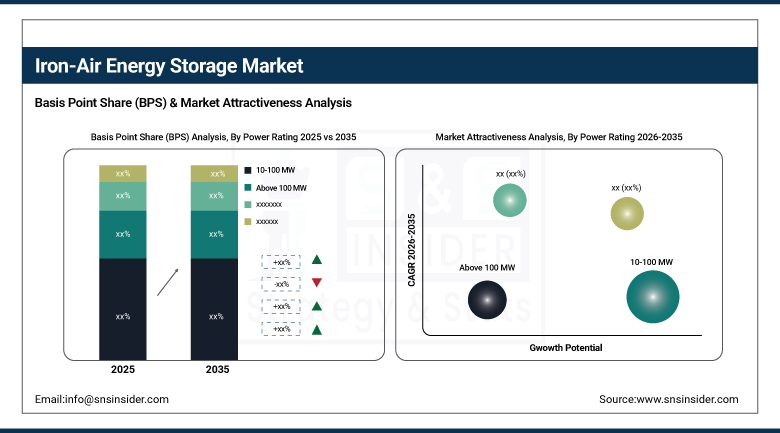
By Power Rating, 10-100 MW segment dominated the market in 2025 with 41% share; Above 100 MW segment is the fastest growing segment.
-
By Application, Grid & Utility-Scale Storage segment dominated the market in 2025 with 44% share; Renewable Energy Integration & Firming segment is the fastest growing segment.
-
By End User, Utilities segment dominated the market in 2025 with 58% share; Independent Power Producers & Energy Storage Developers segment is the fastest growing segment.
By Battery Type, Rechargeable Iron-Air Batteries Lead, While Hybrid Systems Grow Fastest
Rechargeable Iron-Air Batteries dominated the Iron-Air Energy Storage Market in 2025 due to the capacity for thousands of cycles where iron undergoes reversible oxidation without any fading in its capacity that often affects alternative battery types for long-duration storage. Rechargeable battery design was preferred among utilities and hyperscale data centers because such batteries could work from 24 to 100+ hours with iron, water, and air as the only components required, and not depend on supplies of lithium, cobalt, and nickel. The efforts of the companies developing rechargeable cell production, such as Form Energy and Ore Energy, helped make rechargeable batteries become the go-to choice for grid-scale multi-day storage despite lower round-trip efficiency compared to lithium-ion battery systems, which still poses some engineering challenges.
Hybrid Iron-Air Systems will show the highest growth rate among batteries used in the Iron-Air Energy Storage Market due to developers’ ability to combine iron-air batteries with shorter duration lithium-ion or supercapacitor batteries. Hybrid batteries are able to participate in multi-day energy storage market due to their low-cost long-duration capacity as well as ancillary services markets owing to faster reaction speed. It is expected that growing utilities’ interest in dispatchable and blended storage portfolio that decreases the need in fossil peaker plants will accelerate the adoption of hybrid iron-air battery systems in new grid-scale projects.
By Storage Duration, Long-Duration Systems Dominate, Medium-Duration Segment Leads Growth
Long-Duration (24 – 100+ Hours) were the most dominant in the Iron-Air Energy Storage market in 2025 since this range represents the time during which the chemistry beats lithium-ion in cost-effectiveness for covering days without wind or sunshine that shorter-duration batteries do not cover. This was why Ore Energy 100-Hour Iron-Air Systems, and Form Energy Iron-Air Battery were developed for this class of batteries, thereby presenting long-duration systems as the main commercial offering in utility and hyperscale projects. The increase in curtailment of renewables from wind-rich grids in Europe and North America has further emphasized the dominance of long-duration systems among revenues generated by iron-air energy storage technologies.
On the other hand, Medium-Duration (10-24 Hours) systems are expected to be the fastest growing storage duration category owing to their ability to offer overnight and next-day power backup for commercial and industrial customers which are in between conventional lithium-ion systems and long-duration iron-air energy storage systems. Utilities are currently testing the use of medium-duration systems and have established that 10-to-24-hour iron-air systems are more cost-effective than lithium-ion batteries of shorter duration and 100-hour iron-air batteries.
By Power Rating, 10-100 MW Projects Lead, Above 100 MW Segment Posts Fastest Growth
The Power Rating of 10-100 MW was the largest share in the Iron-Air Energy Storage Market in 2025 as this power rating aligns with the scale of initial pilots for the commercial utility procurement as well as grid resilience projects. This particular power rating has been chosen by the developers due to its cost-effective approach that allows for validation of performance and interconnection needs in smaller capacities, and is thus the most widely used size for initial iron-air projects.
The segment above 100 MW is anticipated to show the fastest growth due to the transition of the hyperscale technology buyers and large utilities from piloting to gigawatt-hour sized orders. For example, the 30 GWh order placed by Form Energy to Xcel Energy for supporting a Google data center campus in Minnesota demonstrates the fast-growing demand for dispatchable power on the scale of data centers.
By Application, Grid & Utility-Scale Storage Leads, Renewable Integration Posts Fastest Growth
Grid & Utility-Scale Storage has been the leading segment of Iron-Air Energy Storage Market in 2025 due to increasing acquisition of long duration energy storage by utilities in order to retire aged fossil fueled peaker power plants and delay investment in transmission infrastructure. The utilities see iron-air energy storage technology as a bankable solution compared to gas-fired peaker plants since it can be installed near existing substations and provide consistent power output over days of supply/demand imbalance, thus making it a major revenue stream for iron-air energy storage companies both in North America and Europe.
Renewable Energy Integration & Firming is the fastest-growing segment of Iron-Air Energy Storage Market, mainly due to increased renewable curtailment rates in grids with high levels of renewables. Pilot projects from Ore Energy with co-location of iron-air storage and wind turbines in the Netherlands and France show how this technology can be used for curtailed wind energy storage and subsequent delivery to the grid during lulls.
By End User, Utilities Dominate, Independent Power Producers Gain Fastest Traction
The Utilities were the largest end-user segment in the Iron-Air Energy Storage Market in 2025, as the regulated grid operator was increasingly demanding long-duration storage to help meet resource adequacy needs and Renewable Portfolio Standards. The multi-day storage contract that Xcel Energy has made with Form Energy highlights the fact that the utilities are increasingly integrating the iron-air technology into their long-term energy storage planning processes, thereby further cementing the position of the utilities as the primary end-users driving the market.
Independent Power Producers & Energy Storage Developers are anticipated to be the fastest-growing end-user segment in the Iron-Air Energy Storage Market, as the merchant developers increasingly integrate the iron-air technology with wind and solar energy sources to generate dispatchable energy storage capacity under long-term offtake arrangements. The rising hyperscale data centers' demand for constant electricity is driving the merchant developers to procure the iron-air capacity before utility developers, helping the end-user category achieve faster growth in the forecast period.
Regional Analysis:
|
Region |
Major Country |
Share within Region, 2025 (%) |
|---|---|---|
|
North America |
United States |
88.40% |
|
Europe |
Germany |
26.20% |
|
Asia Pacific |
China |
41.60% |
|
Middle East and Africa |
Saudi Arabia |
29.30% |
|
Latin America |
Brazil |
31.70% |
North America Iron-Air Energy Storage Market Insights
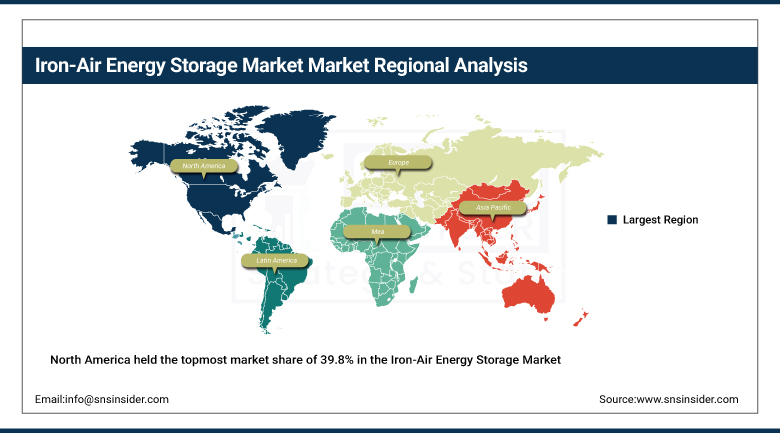
North America held the topmost market share of 39.8% in the Iron-Air Energy Storage Market in 2025. North America retained its leadership position due to robust government funding for Department of Energy long-duration storage, proactive initiatives for grid modernization, and existing infrastructure of utilities and hyperscale customers purchasing firm multi-day storage capacity. In addition to that, deep partnerships between homegrown iron-air suppliers and utility planning for resource adequacy ensured North America's leadership as the largest regional market in terms of iron-air energy storage consumption.
The U.S. accounted for a revenue share of around 88.40% in North America due to Form Energy's domestic manufacturing and Xcel Energy's multi-day storage procurement in Minnesota along with investments in gigafactories in the Midwest and Appalachian regions. Canada helped boost the strength of North America as a region through increased funding for grid modernization that is being considered by regional utilities as the way to achieve a firm grid with high renewable generation capacity.
Get Customized Report as per Your Business Requirement - Enquiry Now
Europe Iron-Air Energy Storage Market Insights
Europe held a sustainable share of global revenue in the Iron-Air Energy Storage Market, owing to almost USD 390 Billion of annual investments in clean energy, curtailments in wind and solar energy, and increasing security needs of the region, resulting from decreased dependence on foreign fossil fuel imports. The increasing push towards long-duration energy storage research programs in Europe, including StoRIES, also made European companies to pay more attention to domestically produced and critically mineral-free storage systems, thus solidifying their leadership position in pilot projects for iron-air chemistry.
The largest country in terms of demand was Germany, generating around 26.20% of revenues in Europe, owing to strong mitigation goals for renewable curtailments and high grid modernization spending as part of Energiewende program. France was an important player in the region, based on pilot implementation of Ore Energy project by utility EDF in EDF Lab les Renardieres as part of StoRIES program of the EU, and future increase in demand of Europe is assured by regional efforts to establish domestic and lithium-free storage supply chains.
Asia Pacific Iron-Air Energy Storage Market Insights
The Asia-Pacific region will be growing at the fastest pace amongst all the regions mentioned in this study, posting a CAGR of around 36.4% until 2035 due to the dominance of China in battery manufacturing facilities, increasing government mandates for long-duration energy storage, and fast adoption of renewable energy in this region. The synergistic effect of affordable cell manufacturing facilities and high demand for grid-scale storage facilities made the region grow faster than any other region in this study.
China had the highest share in the market due to the presence of large battery manufacturing facilities and an increasing requirement of renewable energy installation within the domestic boundaries of the country. Countries other than China, which contributed largely towards making the region the fastest-growing one in this study, included Japan and South Korea.
MEA and Latin America Iron-Air Energy Storage Market Insights
The Middle East and Africa and Latin America regions both saw consistent growth in the Iron-Air Energy Storage Market owing to increasing investments into renewable energy infrastructure that will be worth over USD 75 Billion by 2030 in the ME&A region alone, growing government spending on grid modernization programs, and collaboration among regional utility companies and international storage companies. Firm renewable energy became a practical necessity for grid stability projects that were traditionally using gas peaker plants only as a source of backup generation.
Saudi Arabia was the largest country-level market in the ME&A region due to its increasing renewable energy infrastructure projects, while the grid resilience efforts of the UAE also made a contribution in the region. In LATAM, Brazil emerged as the largest revenue country in the region due to its substantial wind and solar power generation capabilities.
Market Dynamics:
Growth Drivers: Rising Demand for Multi-Day Grid Resilience and Expanding Manufacturing Capacity
The iron air energy storage market growth is driven by the growing need for the availability of long-duration storage solutions from the utility sector, enhanced manufacturing capabilities for commercial-scale iron-air cells, growing demand for power from the hyperscale data centers, and application in grid resiliency, peaker plant replacement, and renewable curtailment management. The growing number of utilities and technology buyers setting up goals in terms of resource adequacy and decarbonization would keep the consistent need for low-cost and long-duration storage capacity as a key factor for investment in production capacity.
The growing number of offtake and co-development agreements between the utilities and iron-air developers would further validate the growing trend, where the hyperscale technology buyers have been getting more interested in securing multi-day storage capacity before the rise in their power requirement in the data centers. Venture and governmental investment into manufacturing capacity has helped in further growing the baseline production capacity, and these are the factors making the demand rise continuously during the forecast pe
Restraints: Low Round-Trip Efficiency and Long Commercial Deployment Timelines
The fact of relatively low round-trip efficiency compared to lithium-ion batteries is a legitimate barrier that prevents faster growth in the total market size, even if iron-air technology trades off low costs for lower energy density and low round-trip efficiency. The aforementioned barrier means that iron-air battery applications are limited to long-duration, cost-sensitive use cases where other technologies such as lithium-ion batteries excel in providing fast response times and higher efficiencies.
A further challenge is the fact of persisting commercial implementation timelines, as developers have to go through the process of pilot demonstrations, construction of a gigafactory, and interconnection approvals with utilities that may take multiple years to come to fruition. In order to bridge the deployment gap, it is necessary to continue investing in the manufacturing capabilities, and such a task still remains a complex process for developers in their race to gigawatt-hour level production against other long-duration battery solutions.
Opportunities: Hyperscale Data Center Demand and Domestic Manufacturing Expansion
The increased demand by hyperscale data centers for firm, 24/7 clean energy presents an excellent business opportunity since technology buyers will be ready to enter into long-term offtake agreements, hence mitigating risks involved in investing in iron-air gigafactories for the developer. A developer with early anchor tenants, such as utilities supplying power to data center facilities can secure a significant portion of the market as the industry transitions from pilot-scale production to full-scale production of iron-air batteries.
Another excellent opportunity exists in the expansion of domestic manufacturing supply chain which is free from critical minerals. This is because the governments in North America and Europe are funding construction of iron-air gigafactories to reduce their dependence on lithium, cobalt, and nickel imported from other countries. Developers capable of showing consistent domestic manufacturing capacity at reasonable cost can take advantage of the increasing opportunities in the market
Recent Developments:
-
2026: Form Energy advanced construction of its Weirton, West Virginia iron-air battery manufacturing plant while progressing its 30 GWh multi-day storage supply agreement with Xcel Energy, developed to back a Google data center campus in Minnesota with the company's Iron-Air Battery System.
-
2026: Ore Energy raised USD 43 Million in Series A funding to build Europe's first dedicated iron-air battery manufacturing facility, backed by its 1 GWh offtake agreement with Dutch energy supplier Budget Thuis and a completed 100-hour pilot at EDF Lab les Renardieres in France.
Iron-Air Energy Storage Market key players are:
-
Form Energy, Inc.
-
Ore Energy B.V.
-
ESS Tech, Inc.
-
Hoganas AB
-
Panasonic Energy Co., Ltd.
-
GP Batteries International Limited
-
Johnson Matthey plc
-
Umicore N.V.
-
W. L. Gore & Associates, Inc.
-
Sumitomo Electric Industries, Ltd.
-
Toray Industries, Inc.
-
De Nora S.p.A.
-
Freudenberg Group
-
3M Company
-
BASF SE
-
Nanografi Nano Technology
-
Log9 Materials Scientific Pvt. Ltd.
-
Treadstone Technologies, Inc.
-
voestalpine AG
-
Kobe Steel, Ltd.
Iron-Air Energy Storage Market Report Scope:
| Report Attributes | Details |
|---|---|
| Market Size in 2025 | USD 0.64 Billion |
| Market Size by 2035 | USD 10.76 Billion |
| CAGR | 32.6% from 2026 to 2035 |
| Base Year | 2025 |
| Forecast Period | 2026-2035 |
| Historical Data | 2022-2024 |
| Report Scope & Coverage | Market Size, Segments Analysis, Competitive Landscape, Regional Analysis, DROC & SWOT Analysis, Forecast Outlook |
| Key Segments | •By Battery Type, Rechargeable Iron-Air Batteries segment dominated the Iron-Air Energy Storage Market in 2025 with 46% share; Hybrid Iron-Air Systems segment is the fastest growing segment. •By Storage Duration, Long-Duration (24-100+ Hours) segment dominated the market in 2025 with 51% share; Medium-Duration (10-24 Hours) segment is the fastest growing segment. •By Power Rating, 10-100 MW segment dominated the market in 2025 with 41% share; Above 100 MW segment is the fastest growing segment. •By Application, Grid & Utility-Scale Storage segment dominated the market in 2025 with 44% share; Renewable Energy Integration & Firming segment is the fastest growing segment. • By End User, Utilities segment dominated the market in 2025 with 58% share; Independent Power Producers & Energy Storage Developers segment is the fastest growing segment. |
| Regional Analysis/Coverage | North America (US, Canada), Europe (Germany, UK, France, Italy, Spain, Russia, Poland, Rest of Europe), Asia Pacific (China, India, Japan, South Korea, Australia, ASEAN Countries, Rest of Asia Pacific), Middle East & Africa (UAE, Saudi Arabia, Qatar, South Africa, Rest of Middle East & Africa), Latin America (Brazil, Argentina, Mexico, Colombia, Rest of Latin America). |
| Company Profiles | Form Energy, Inc., Ore Energy B.V., ESS Tech, Inc., Hoganas AB, Panasonic Energy Co., Ltd., GP Batteries International Limited, Johnson Matthey plc, Umicore N.V., W. L. Gore & Associates, Inc., Sumitomo Electric Industries, Ltd., Toray Industries, Inc., De Nora S.p.A., Freudenberg Group, 3M Company, BASF SE, Nanografi Nano Technology, Log9 Materials Scientific Pvt. Ltd., Treadstone Technologies, Inc., voestalpine AG, and Kobe Steel, Ltd. |

Frequently Asked Questions
The Iron-Air Energy Storage Market is expected to grow at a CAGR of approximately 32.6% from 2026 to 2035, based on triangulated secondary research estimates.
The Iron-Air Energy Storage Market was valued at approximately USD 0.64 Billion in 2025, based on triangulation across multiple independent research sources.
The major growth factor is rising demand for multi-day grid resilience and hyperscale data center backup power, expanding commercial-scale manufacturing capacity, and growing government long-duration energy storage incentives.
The Rechargeable Iron-Air Batteries segment dominated the Iron-Air Energy Storage Market by battery type, representing the largest share of revenue in 2025.
North America dominated the Iron-Air Energy Storage Market in 2025, holding an estimated 39.8% share of total global market revenue.
