
Laser Headlight Market Report Scope & Overview:
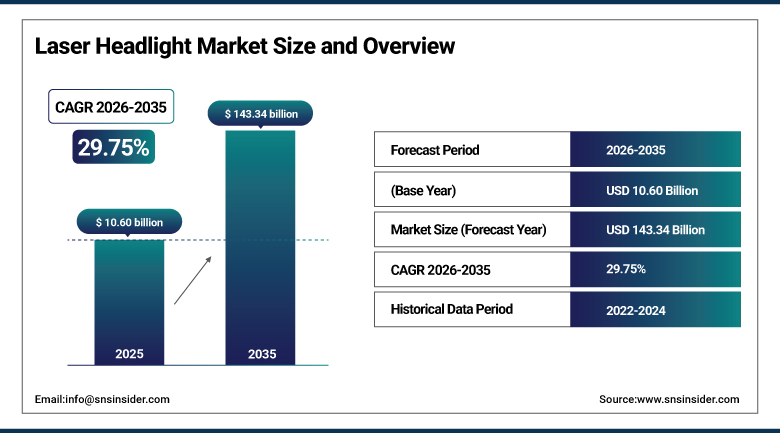
The Laser Headlight Market was valued at USD 10.60 Billion in 2025 and is expected to reach USD 143.34 Billion by 2035, growing at a CAGR of 29.75% from 2026 to 2035.
Laser headlights represent the most advanced illumination technology. A laser headlight operates on the principle of producing visible light in a manner quite distinct from the normal one. The powerful blue laser diode produces a beam that is projected on a phosphor element to produce a highly intense beam of white light. Through this process, beam ranges greater than 600 meters are made possible during the high beam operation mode.
The commercial trajectory of laser headlight technology follows the LED adoption path of the previous decade, beginning in ultra-premium flagship models at BMW, Audi, Porsche, and Ferrari before progressively migrating into upper-premium and eventually mid-premium segments as production scale reduces unit cost. The convergence with ADAS camera and radar data to create intelligent laser headlight systems will define the market's next commercial growth phase.
OSRAM introduced the PLPT9 450 series blue laser diode for automotive headlight applications in the year 2025. This product offers an output power of 3.5W with a wall-plug efficiency of 85%. This is a marked improvement from the last generation products in terms of energy efficiency as the current product has achieved an increase of 15% over the earlier ones.
Market Size and Forecast
-
Market Size in 2026E: USD 13.76 Billion
-
Market Size by 2035: USD 143.34 Billion
-
CAGR: 29.75% from 2026 to 2035
-
Fastest Growing Region: Asia Pacific
-
Largest Region: Europe
To Get more information Laser Headlight Market - Request Free Sample Report
Laser Headlight Market Trends
-
Intelligent laser headlight systems using real-time camera and radar inputs are enabling adaptive beam control and premium vehicle differentiation.
-
Falling blue laser diode production costs are expanding laser headlight adoption beyond ultra-luxury vehicles into upper-mid-premium segments.
-
Electric vehicle architectures support laser headlights due to higher electrical capacity and fewer alternator-related power constraints.
-
Regulatory alignment across Europe, North America, and Asia is expanding legal deployment of adaptive laser headlight systems.
-
Consolidation among tier-one automotive lighting suppliers is concentrating R&D capability for advanced laser headlight technologies.
The U.S. Laser Headlight Market Outlook
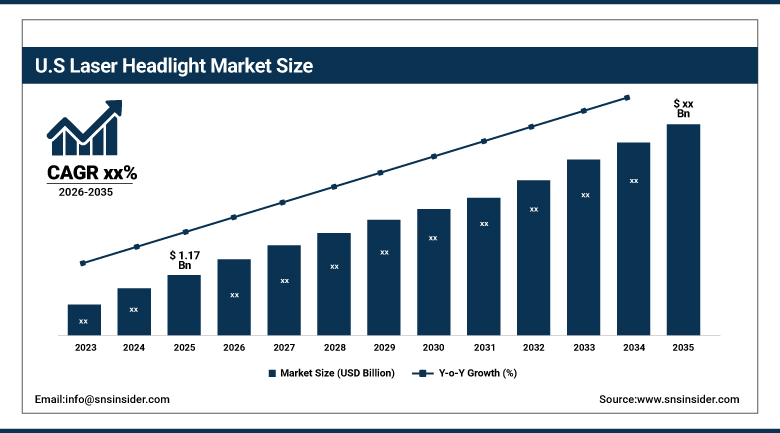
The U.S. laser headlight market was valued at approximately USD 1.17 Billion in 2025 and is expected to grow significantly through 2035, with North America projected to hold approximately 27% of global market revenues.
The National Highway Traffic Safety Administration’s 2022 rule under FMVSS 108 enabled adaptive driving beam headlights in the United States. This opened the market for adaptive laser headlight systems. Earlier restrictions limited deployment to fixed beam configurations. Automakers and suppliers are now developing adaptive laser headlight programs. Model year 2026 and 2027 launches are expected to increase adoption. The U.S. premium vehicle segment supports growth, including BMW, Mercedes-Benz, Audi, Porsche, and luxury SUVs.
Valeo SA obtained the agreement to supply its laser headlight system to a luxury German automobile producer that is going to be launched in the North American market in 2025. The agreement was for producing laser headlights, the largest volume of which was set to be produced starting in 2026. It demonstrated increasing significance of the US market for auto lights from Europe.
Laser Headlight Market Segment Analysis
-
By Vehicle Type, the passenger vehicles segment dominated the market with the largest share in 2025, while medium & heavy commercial vehicles are the fastest growing vehicle type with a CAGR of 28.59% during 2026 to 2035.
-
By Technology, the conventional laser headlights segment dominated the market in 2025, while intelligent laser headlights are the fastest growing technology with a CAGR of 28.65% during the forecast period.
-
By Power Output, the 60W segment dominated the market in 2025 due to its superior illumination performance, while the 35W segment serves compact premium vehicle applications.
-
By Sales Channel, the OEM segment dominated the market with 86.13% share in 2025, while the aftermarket segment is the fastest growing channel during 2026 to 2035.
-
By Application, the high beam segment dominated the market with 47.28% share in 2025, while the cornering light segment is the fastest growing application during 2026 to 2035.
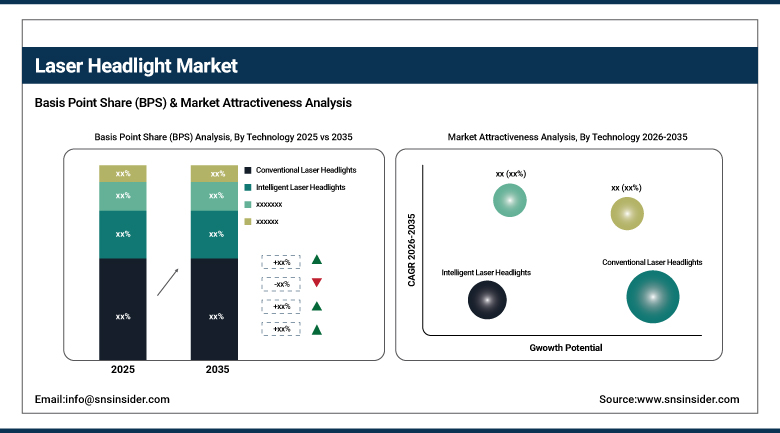
By Technology, conventional laser headlights dominate, intelligent systems grow fastest
Conventional laser headlights generated 67.56% of market revenue in 2025, reflecting their deployment primarily as a high-beam range extension technology within broader LED headlight architectures. Their maturity in ultra-premium BMW, Audi, and Porsche models has established beam range advantage as a clearly valued premium brand claim.
Laser heads with intelligent features have shown the highest growth rate of 28.65% CAGR due to the belief that the complete use of laser technology is possible only by combining sensor processing information with laser technology. The high-end performance of intelligent systems that keep adjusting the beam according to camera-sensed road geometry is the new benchmark for automotive companies.
By Application, high beam dominates, cornering light grows fastest
High beam applications accounted for 47.28% of laser headlight market revenue in 2025, establishing the beam range extension function as the primary commercial value driver of laser headlight technology in production vehicle applications. The high beam application's dominance reflects the most immediately compelling technical advantage of laser illumination over LED alternatives: the ability to illuminate road hazards at sufficient distance ahead of the vehicle to enable an effective avoidance response at highway speeds where the 300-metre LED high beam range is insufficient.
Cornering lights are growing fastest, driven by the commercially significant driving experience improvement that laser-powered cornering illumination delivers in the urban and suburban driving environments where conventional fixed-axis headlights leave pedestrian zones and intersection corners poorly illuminated. Laser cornering lights that provide powerful, precisely aimed corner illumination without creating glare for approaching traffic represent an adaptive lighting application whose safety benefit is directly perceptible to drivers in everyday use and whose customer satisfaction contribution justifies the fitment cost premium.
Regional Analysis
|
Region |
Major Country |
Share within Region, 2025 (%) |
|---|---|---|
|
Europe |
Germany |
36.84% |
|
Asia Pacific |
China |
38.47% |
|
North America |
United States |
82.47% |
|
Middle East & Africa |
UAE |
22.84% |
|
Latin America |
Brazil |
43.84% |
North America Laser Headlight Market Insights
North America held approximately 27.00% of global Laser Headlight revenues in 2025, with the United States accounting for approximately 82.47% of regional revenue. The region's market development has been accelerated by NHTSA's 2022 adaptive beam headlight regulatory update that removed the function restrictions that had limited laser headlight deployment to fixed-beam configurations. North American premium vehicle consumers, particularly BMW, Mercedes-Benz, Audi, Cadillac, and Lincoln buyers whose brand positioning and discretionary vehicle investment make them natural laser headlight adopters, are progressively gaining access to laser-equipped model variants as the regulatory environment now supports their full adaptive function capability.
Europe Laser Headlight Market Insights
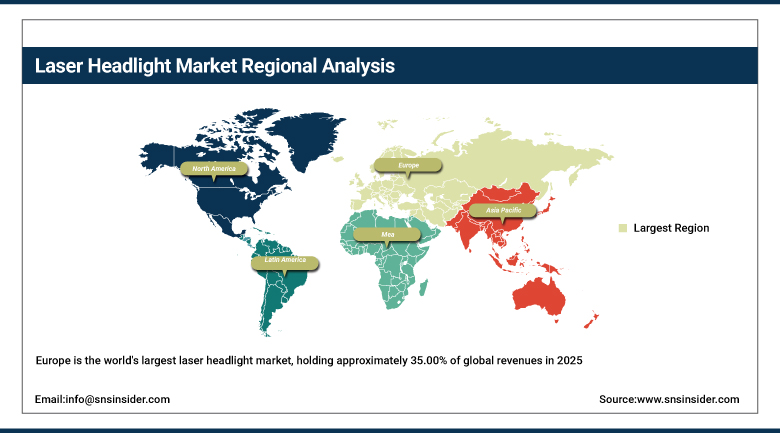
Europe is the world's largest laser headlight market, holding approximately 35.00% of global revenues in 2025. The continent's leadership reflects its unmatched concentration of premium and luxury automotive brand headquarters in Germany, Italy, Sweden, and the United Kingdom whose engineering culture embraces regulatory framework under UNECE R123 and R149.
Germany accounts for approximately 36.84% of European revenues through BMW, Audi, Mercedes-Benz, and Porsche whose laser headlight programmes define global technology standards and whose volume production in Germany makes the country the world's largest single national laser headlight production hub. The density of tier-one lighting system suppliers including HELLA, Continental, and Marelli in Germany and their technical partnership with laser diode suppliers creates a laser headlight technology ecosystem that sustains European market leadership.
Get Customized Report as per Your Business Requirement - Enquiry Now
Asia Pacific Laser Headlight Market Insights
Asia Pacific is the fastest-growing laser headlight market, expected to expand at the highest CAGR through 2035. China dominates regional revenues with around 38.47% share, driven by rapid premium vehicle growth and strong domestic EV brands such as BYD, NIO, Li Auto, and XPENG. European luxury automakers also support demand through joint venture production in China. Japan and South Korea contribute through Lexus, Toyota Crown, and Genesis models with advanced lighting systems. India is emerging as a high-growth market supported by rising affluent consumer demand and expanding premium vehicle sales.
MEA & Latin America Laser Headlight Market Insights
Middle East and Latin America are growing laser headlight markets where expanding premium vehicle markets, and safety are creating commercial adoption momentum. The UAE leads MEA revenues at approximately 22.84% of the regional total through its high-income consumer base, strong preference for premium and luxury vehicle brands whose flagship models include laser headlight fitment, and the cultural importance of vehicle specification as a status expression in Gulf state automotive markets.
Brazil leads Latin American revenues at approximately 43.84% of the regional total through its premium vehicle market and the growing presence of European luxury brand dealerships in major urban centres.
Market Dynamics
Growth Drivers: Superior illumination performance and growing premium vehicle demand are driving strong laser headlight market expansion globally.
The laser headlight market's growth is driven by the convergence of genuine technical performance advantages with the automotive industry's intensifying technology-based product differentiation competition. Laser headlights provide brands with a visible, easily communicated safety benefit directly perceptible in nighttime driving that premium customers evaluate during vehicle comparison. The global premium vehicle market's sustained volume growth, particularly in China and North America, is expanding the addressable customer base at rates that compound the technology's commercial momentum.
Restraints: High system costs and limited blue laser diode supply restrict laser headlight adoption to premium vehicles and slow broader market penetration.
A complete laser headlight module incorporating the laser diode assembly, phosphor element, collimating optics, heat management system, and electronic control unit represents a manufacturing cost premium of USD 800 to USD 2,000 per headlight over equivalent LED units whose production scale and supply chain maturity provides significant cost efficiency advantages. This cost premium restricts laser headlight commercial viability to vehicle price points above approximately USD 50,000 where premium feature content spending justifies the fitment cost within the vehicle's broader pricing architecture. The blue laser diode supply chain, concentrated among a small number of qualified manufacturers including OSRAM, Nichia, and ams OSRAM, represents a potential capacity constraint as demand from growing laser headlight programmes competes with laser diode supply also consumed by industrial, medical, and data communication applications.
Opportunities: Adaptive laser systems and EV integration create growth opportunities by expanding applications and increasing the functional value of laser headlights.
Laser headlights with artificial intelligence change the paradigm of lights from range to intelligent adaptive lighting based on the actual conditions. The technology uses cameras, radar, and maps to focus the light properly without causing glare to any approaching vehicle. The ability to reduce accidents in terms of potential makes the technology more favorable under regulatory policies. Electric vehicles offer an easier way to incorporate laser headlights because of their high electrical capability and advanced computing system onboard.
Recent Developments:
-
2025: OSRAM Opto Semiconductors launched its PLPT9 450 series next-generation blue laser diode delivering 3.5W optical output at 85% wall-plug efficiency, a 15% improvement over the previous generation, with AEC-Q101 automotive qualification enabling deployment in both ultra-luxury and emerging mid-premium laser headlight programmes.
-
2025: Valeo secured a laser headlight supply contract for a major German premium vehicle manufacturer's North American market model launch targeting model year 2026 production, representing one of the first large-scale laser headlight OEM supply commitments specifically designed to the post-NHTSA adaptive beam headlight regulatory framework.
-
2024: BMW launched the updated 7 Series with its second-generation laser spotlight headlight integrating improved laser diode efficiency and expanded adaptive function capability, extending laser illumination range to over 650 meters under highway conditions and incorporating the model's connectivity-enhanced predictive beam management system that uses navigation data to pre-position the laser spot beam ahead of curves.
Laser Headlight Market key players are:
-
OSRAM GmbH (ams OSRAM)
-
Valeo SA
-
Robert Bosch GmbH
-
ZKW Group GmbH (LG Electronics)
-
Koito Manufacturing Co. Ltd.
-
HELLA GmbH & Co. KGaA (Forvia)
-
Marelli Holdings Co. Ltd.
-
Stanley Electric Co. Ltd.
-
Nichia Corporation
-
Continental AG
-
Mitsubishi Electric Corporation
-
Lumileds Holding BV
-
Magna International Inc.
-
SL Corporation
-
Ichikoh Industries Ltd.
-
Hyundai Mobis
-
Infineon Technologies AG
-
Denso Corporation
-
Panasonic Corporation
-
Varroc Engineering Limited
Laser Headlight Market Report Scope:
| Report Attributes | Details |
|---|---|
| Market Size in 2025 | USD 10.60 Billion |
| Market Size by 2035 | USD 143.34 Billion |
| CAGR | CAGR of 29.75% From 2026 to 2035 |
| Base Year | 2025 |
| Forecast Period | 2026-2035 |
| Historical Data | 2022-2024 |
| Report Scope & Coverage | Market Size, Segments Analysis, Competitive Landscape, Regional Analysis, DROC & SWOT Analysis, Forecast Outlook |
| Key Segments | • By Vehicle Type (Passenger Vehicles, Light Commercial Vehicles, Medium & Heavy Commercial Vehicles) • By Technology (Conventional Laser Headlights, Intelligent Laser Headlights) • By Power Output (35W, 40W, 60W, Others) • By Sales Channel (OEM, Aftermarket) • By Application (High Beam, Low Beam, Cornering Light, Daytime Running Light) |
| Regional Analysis/Coverage | North America (US, Canada), Europe (Germany, UK, France, Italy, Spain, Russia, Poland, Rest of Europe), Asia Pacific (China, India, Japan, South Korea, Australia, ASEAN Countries, Rest of Asia Pacific), Middle East & Africa (UAE, Saudi Arabia, Qatar, South Africa, Rest of Middle East & Africa), Latin America (Brazil, Argentina, Mexico, Colombia, Rest of Latin America). |
| Company Profiles | OSRAM GmbH (ams OSRAM), Valeo SA, Robert Bosch GmbH, ZKW Group GmbH (LG Electronics), Koito Manufacturing Co. Ltd., HELLA GmbH & Co. KGaA (Forvia), Marelli Holdings Co. Ltd., Stanley Electric Co. Ltd., Nichia Corporation, Continental AG, Mitsubishi Electric Corporation, Lumileds Holding BV, Magna International Inc., SL Corporation, Ichikoh Industries Ltd., Hyundai Mobis, Infineon Technologies AG, Denso Corporation, Panasonic Corporation, Varroc Engineering Limited |

Frequently Asked Questions
The laser headlight market is expected to grow at a CAGR of 29.75% from 2026 to 2035.
The laser headlight market was valued at USD 10.60 Billion in 2025.
Superior beam range performance, premium vehicle market growth, regulatory approval of adaptive systems, falling system costs, and AI-enabled intelligent beam control are driving laser headlight market expansion.
The high beam segment dominated the laser headlight market with 47.28% share in 2025.
Europe dominated the laser headlight market in 2025, holding approximately 35.00% of global revenues.
