
LoRaWAN Market Report Scope & Overview:
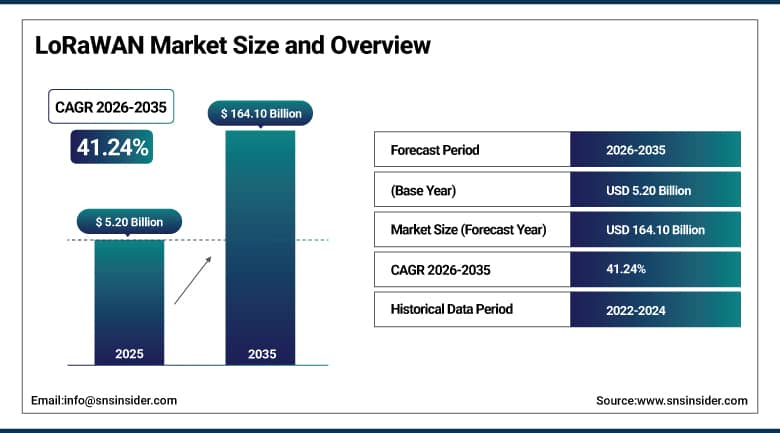
The LoRaWAN Market was valued at USD 5.20 Billion in 2025 and is expected to reach USD 164.10 Billion by 2035, growing at a CAGR of 41.24% from 2026–2035.
The global LoRaWAN market is entering a period of exceptional commercial acceleration as enterprises, municipalities, and utilities recognise low-power wide-area networking as the connectivity architecture uniquely suited to the scale and energy requirements of large IoT deployments. LoRaWAN’s ability to transmit small data packets over distances of 10 to 15 kilometres while operating on battery power for 5 to 10 years makes it technically superior to cellular, Wi-Fi, and Bluetooth alternatives for the sensor-dense, geographically dispersed deployment environments that smart city, precision agriculture, and industrial monitoring programmes represent. More than 200 million LoRaWAN devices were deployed globally in 2024, with network operators across 170 countries providing coverage through both public operator networks and private enterprise deployments. Smart metering, utilities management, and precision agriculture collectively represent the most commercially mature application segments, while industrial IoT asset tracking and smart city environmental monitoring are generating above-average demand growth as deployment economics improve with hardware cost reduction and network coverage expansion.
Semtech Corporation launched its new LoRa Edge LR1120 transceiver chip in 2024, extending LoRaWAN geolocation capabilities to include multi-band connectivity across 2.4 GHz, sub-GHz, and satellite bands. This product advance enables LoRaWAN devices to maintain global connectivity regardless of regional spectrum licensing, directly addressing the deployment flexibility limitation that had constrained LoRaWAN’s adoption in cross-border logistics, international asset tracking, and remote agricultural monitoring applications.
To Get More Information On LoRaWAN Market - Request Free Sample Report
LoRaWAN Market Trends
-
Rising adoption of LoRaWAN in smart metering is improving remote monitoring and utility management efficiency.
-
Growing deployment of private LoRaWAN networks is supporting cost-effective enterprise IoT connectivity.
-
Increasing integration with cloud IoT platforms is enhancing device management and data analytics capabilities.
-
Expanding use of LoRaWAN in precision agriculture is improving resource efficiency and crop monitoring.
-
Rising smart city investments are accelerating LoRaWAN deployment across connected urban infrastructure applications.
The U.S. LoRaWAN Market Outlook
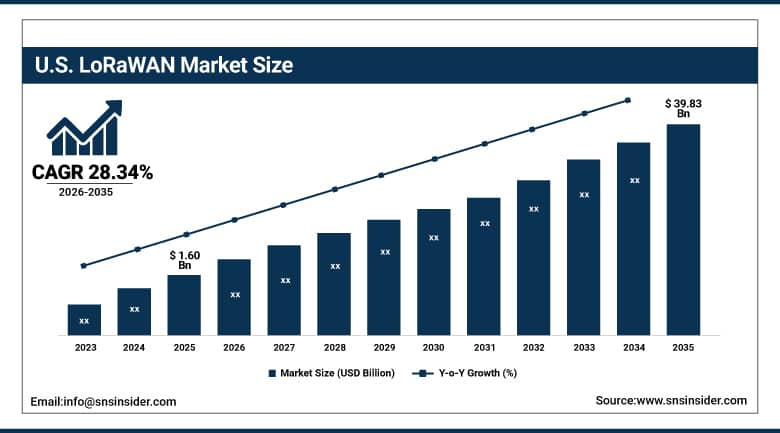
The U.S. LoRaWAN Market was valued at approximately USD 1.60 Billion in 2025 and is expected to reach approximately USD 39.83 Billion by 2035, growing at a CAGR of approximately 28.34%.
The United States is the world’s largest national LoRaWAN market by revenue, underpinned by substantial federal and municipal investment in smart city infrastructure, the commercial maturity of industrial IoT adoption across manufacturing and logistics, and the growing deployment of precision agriculture connectivity by the agri-tech sector serving the country’s vast farm belt. Helium Network’s decentralized LoRaWAN infrastructure, Senet’s public IoT network, and the private enterprise LoRaWAN deployments of utilities including Southern California Edison create a layered connectivity ecosystem that provides national coverage depth. The U.S. defense and homeland security sectors are evaluating LoRaWAN for long-range, low-observable sensor network applications whose operational requirements align precisely with the technology’s technical characteristics.
Actility expanded its ThingPark platform in 2025 to support enhanced AI-based device management and predictive maintenance analytics for enterprise LoRaWAN deployments. The upgrade directly addresses the operational management complexity that large-scale IoT deployments face when monitoring thousands of field devices, reducing network operations overhead by automating fault detection and maintenance scheduling for U.S. utilities and industrial customers managing distributed LoRaWAN sensor networks.
LoRaWAN Market Segment Analysis
-
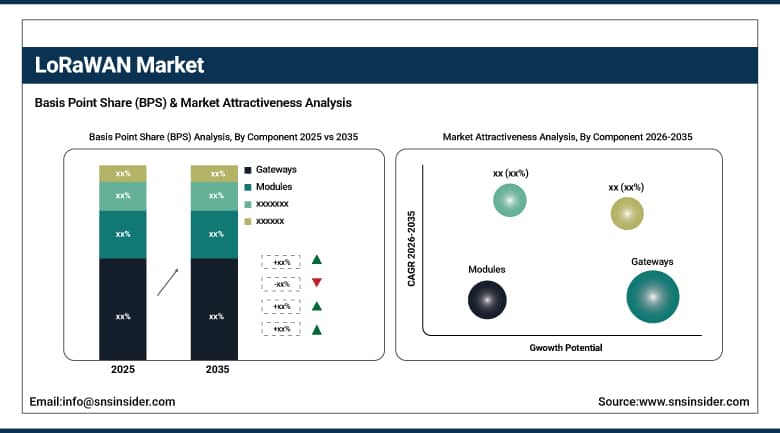
By Component, the gateways segment dominated the LoRaWAN market with 46% share in 2025, while the modules segment is the fastest growing as businesses and industries rapidly add specialized IoT devices to existing LoRaWAN network infrastructure during 2026–2035.
-
By Network Type, the public LoRaWAN networks segment dominated the LoRaWAN market in 2025, while the Private LoRaWAN networks segment is the fastest growing during 2026–2035 as enterprises deploy closed networks for mission-critical industrial and agricultural IoT applications.
-
By Application, the smart metering & utilities segment dominated the LoRaWAN market with 48% share in 2025, while the smart agriculture segment is the fastest growing during 2026–2035 as precision farming investment accelerates across water-scarce and remote agricultural regions globally.
-
By End User, the energy & utilities segment dominated the LoRaWAN Market in 2025, while the agriculture segment is the fastest growing during 2026–2035 as IoT-enabled crop and soil monitoring becomes commercially mainstream across large-scale farming operations.
By Component, gateways dominate, modules grow fastest
Gateways retained the dominant component position with 46% of the LoRaWAN market in 2025. Their commercial primacy reflects the gateway’s structural role as the network’s critical infrastructure node that receives signals from end devices across the coverage area and forwards data to the network server for processing and application delivery. Every LoRaWAN deployment, regardless of application or scale, requires gateways whose coverage density determines the network’s operational quality. Enterprise deployments typically require multiple gateways per site to achieve the redundancy and coverage overlap that mission-critical IoT monitoring demands. Each new network build-out or coverage extension generates gateway procurement that sustains the segment’s revenue leadership across the market’s rapid geographic expansion.
Modules are the fastest-growing component as the LoRaWAN ecosystem’s focus shifts from network infrastructure build-out toward the mass deployment of specialized end devices that connect across established networks. Each new IoT application case requires dedicated sensor and module configurations whose procurement volumes grow proportionally with the number of deployed devices. Smart meter modules, agricultural sensor modules, and industrial asset tracking tags each represent volume procurement categories whose aggregate demand compounds rapidly with IoT deployment scale. Module cost reduction driven by manufacturing economies of scale is simultaneously improving the economics of large-scale device deployment, accelerating adoption in price-sensitive applications including agricultural monitoring and smart city environmental sensing.
By Application, smart metering dominates, smart agriculture grows fastest
Smart Metering & Utilities retained the dominant application position with 48% of the LoRaWAN market in 2025. Utilities worldwide are under regulatory and commercial pressure to replace manual meter reading with automated remote monitoring that reduces operational costs, improves billing accuracy, and enables real-time consumption visibility that supports demand response programmes and grid balancing. LoRaWAN’s combination of deep building penetration, 10-year battery life, and nationwide network coverage through public operator infrastructure makes it the connectivity technology of choice for advanced metering infrastructure programmes across water, gas, and electricity distribution utilities. The application’s commercial scale reflects both the regulatory mandate that drives adoption and the proven return on investment that large-scale AMI deployments have demonstrated across European and North American utility programmes.
Smart agriculture is the fastest-growing application in the LoRaWAN market because precision farming’s commercial adoption is accelerating across both developed and emerging agricultural markets whose productivity and water efficiency imperatives are creating genuine economic justification for IoT sensor investment. LoRaWAN’s ability to provide connectivity across the large geographic areas that farm operations span, without the infrastructure cost of cellular coverage extension or the power supply complexity of wired alternatives, makes it the most commercially practical connectivity solution for the soil moisture, microclimate, irrigation control, and crop health monitoring applications that precision agriculture programmes deploy. Government agricultural productivity programmes in India, Brazil, and Southeast Asia are simultaneously funding the digital infrastructure that extends LoRaWAN connectivity into previously unconnected agricultural regions.
Regional Analysis
|
Region |
Major Country |
Share within Region, 2025 (%) |
|---|---|---|
|
North America |
United States |
87.4% |
|
Europe |
Germany |
22.3% |
|
Asia Pacific |
China |
55.2% |
|
Middle East & Africa |
UAE |
38.4% |
|
Latin America |
Brazil |
44.2% |
North America LoRaWAN Market Insights
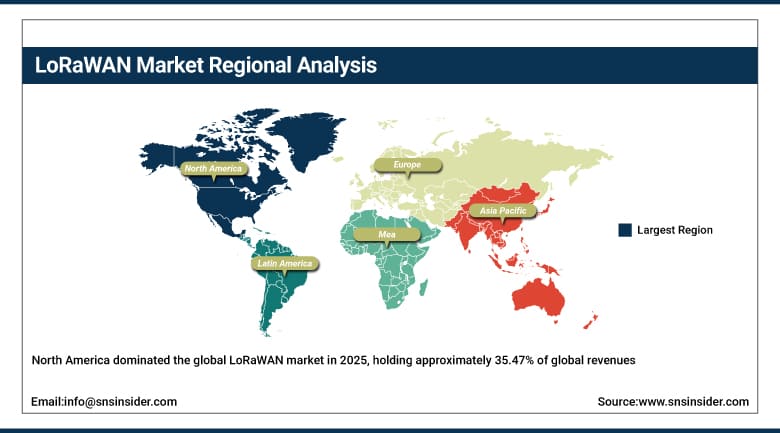
North America dominated the global LoRaWAN market in 2025, holding approximately 35.47% of global revenues, with the United States accounting for approximately 87.4% of North American revenues. The region’s leadership reflects its advanced smart city infrastructure investment, the commercial maturity of its utility sector’s advanced metering infrastructure programmes, and the concentration of industrial IoT technology adopters whose operational scale justifies private LoRaWAN network investment. Federal connectivity programmes including the USDA’s broadband and rural connectivity investment are simultaneously extending LoRaWAN network infrastructure into agricultural regions that previously lacked commercial IoT connectivity.
Canada contributes approximately 12.6% of North American revenues through its smart city initiatives in Toronto and Vancouver, natural resource sector IoT monitoring applications across mining and energy extraction operations, and the agricultural monitoring programmes of Prairie province farming operations whose geographic scale and remote location profile make LoRaWAN’s range and battery life characteristics particularly commercially valuable.
Get Customized Report as Per Your Business Requirement - Enquiry Now
Europe LoRaWAN Market Insights
Europe is the world’s second-largest LoRaWAN market where regulatory-mandated smart meter rollout across EU member states has created the most structurally certain large-scale deployment programme of any global region, with gas, water, and electricity utilities across France, Germany, the Netherlands, and Spain executing multi-million device AMI programmes that generate sustained LoRaWAN gateway and module procurement. Germany accounts for approximately 22.3% of European revenues through its combination of industrial IoT manufacturing sector adoption, municipal smart city investment, and the energy transition’s requirement for granular grid monitoring infrastructure across the country’s distributed renewable energy network.
The Things Industries, headquartered in the Netherlands, represents Europe’s most commercially significant LoRaWAN ecosystem developer whose open-source network server and cloud platform have defined the technical standards for enterprise private network deployment across European and global markets. Orange’s national LoRaWAN network in France and KPN’s Dutch coverage represent the most commercially developed public operator infrastructure in Europe, providing the coverage density that large-scale urban IoT deployments require without enterprise infrastructure investment.
Asia Pacific LoRaWAN Market Insights
Asia Pacific is the fastest-growing regional LoRaWAN market at a CAGR of 44.23% through 2035, driven by the extraordinary pace of smart city infrastructure investment across China, India, Japan, South Korea, and Southeast Asia whose government-funded programmes are creating the most commercially significant new LoRaWAN deployment volume of any region globally. China accounts for approximately 55.2% of Asia Pacific revenues through its national smart city initiative encompassing hundreds of urban deployments, the world’s largest smart meter rollout programme, and a domestic LoRaWAN hardware manufacturing ecosystem whose production scale is driving module and gateway cost reduction that benefits global deployments.
India and Southeast Asia represent the most commercially dynamic emerging market opportunities within Asia Pacific, where government digital agriculture programmes, smart city development along economic corridors, and the progressive extension of IoT connectivity infrastructure into previously unconnected rural regions are creating first-time LoRaWAN deployment demand at a scale whose commercial significance for global network server vendors, gateway manufacturers, and module suppliers is growing rapidly.
MEA & Latin America LoRaWAN Market Insights
Middle East and Africa and Latin America are growing LoRaWAN markets where smart city investment, utility modernization programmes, and agricultural productivity improvement initiatives are creating structured demand for low-power wide-area connectivity that LoRaWAN is well-positioned to serve. UAE leads MEA revenues at approximately 38.4% of the regional total through Dubai’s ambitious smart city programme, the UAE’s utility sector’s advanced metering investment, and the Abu Dhabi smart government infrastructure initiatives that collectively create one of the most commercially active IoT deployment environments in the Middle East.
Brazil leads Latin American revenues at approximately 44.2% of the regional total through its combination of large-scale agricultural precision farming investment, utility sector AMI modernization, and smart city programmes in São Paulo, Rio de Janeiro, and other major urban centres. LoRaWAN’s particular suitability for Brazil’s geographically extensive agricultural regions and the cost-effectiveness advantages of its deployment economics relative to cellular alternatives create a compelling adoption case across multiple vertical markets simultaneously.
Market Dynamics
Growth Drivers: Smart city and utility AMI programme investment creating large-scale network deployment demand.
The structural growth driver for the LoRaWAN market is the simultaneous expansion of smart city, smart metering, and smart agriculture IoT application deployment that collectively creates growing demand for the low-power, long-range connectivity that LoRaWAN uniquely delivers at commercially viable per-device economics. Government infrastructure investment programmes across North America, Europe, and Asia Pacific are accelerating network deployment timelines by funding the gateway infrastructure and device procurement that private market economics alone would develop more slowly. Each government-funded deployment creates a reference installation that commercial operators use to justify private network investment.
Hardware cost reduction is simultaneously expanding LoRaWAN’s addressable market by making deployment economics viable in application categories and geographies that were previously cost-constrained. Gateway prices have declined by approximately 40% over five years while module costs have fallen proportionally, improving the financial return on investment calculations that enterprise and municipal procurement teams use to justify LoRaWAN programmes. These improving economics are enabling new application categories including environmental monitoring, smart waste management, and supply chain track-and-trace to demonstrate commercially viable deployment cases.
Restraints: Network coverage gaps in rural and developing market regions limiting deployment viability
Network coverage remains the most operationally significant constraint on LoRaWAN adoption in developing markets and rural regions where public operator infrastructure does not yet exist and where the capital cost of private network gateway deployment is beyond the budget of small-scale farming operations or municipal authorities. While gateway range is superior to competing technologies, the economics of network build-out in geographically vast and sparsely populated regions creates a deployment bootstrapping challenge that requires either government subsidy or commercial operator network investment to overcome.
LoRaWAN’s limited data rate, typically 0.3 to 50 kbps, restricts its applicability to low-throughput sensor data transmission and excludes high-bandwidth applications including video surveillance, voice communication, and high-frequency industrial process monitoring that require the data capacity of cellular or Wi-Fi alternatives. This technical constraint is intrinsic to the technology’s low-power design and cannot be addressed through software optimisation, creating a fundamental market segmentation boundary that limits LoRaWAN to specific IoT use case categories.
Opportunities: Satellite LoRaWAN integration extending global coverage, AI-powered network management improving deployment performance
Satellite LoRaWAN integration, demonstrated by Semtech’s LR1120 chip and partnerships with satellite operators, represents the most commercially significant near-term capability expansion in the LoRaWAN market. By enabling LoRaWAN devices to communicate through both terrestrial gateways and low-earth-orbit satellites, the technology eliminates the coverage gap that has constrained adoption in oceans, remote wilderness areas, and developing regions without gateway infrastructure. This global coverage capability directly expands the addressable market for LoRaWAN to include maritime asset tracking, intercontinental logistics monitoring, and remote environmental sensing that previously required more expensive satellite-specific communication solutions.
Private enterprise LoRaWAN network expansion across manufacturing, warehousing, and logistics represents a commercially significant near-term growth opportunity as organizations with large operational footprints recognize the total cost of ownership advantages of owned network infrastructure over public network subscription models. A single private gateway deployment that serves thousands of devices creates per-device connectivity cost structures that justify LoRaWAN adoption in application categories where public network subscription economics are marginal.
Recent Developments:
-
2025: Actility expanded its ThingPark Enterprise platform in 2025 with AI-based device health monitoring, predictive maintenance analytics, and enhanced network performance management capabilities, directly addressing the operational management complexity that large-scale enterprise LoRaWAN deployments face when monitoring thousands of geographically dispersed sensor devices across utility, agricultural, and industrial applications.
-
2024: Semtech Corporation launched its LoRa Edge LR1120 transceiver chip in 2024, extending LoRaWAN connectivity to 2.4 GHz, sub-GHz, and satellite frequency bands within a single device, enabling geolocation and global connectivity for cross-border logistics, international asset tracking, and remote monitoring applications that previously required separate technology solutions for different geographic coverage requirements.
-
2024: The Things Industries expanded its global network server infrastructure in 2024, adding regional deployment nodes across Asia Pacific and Latin America to support the growing demand from enterprise private network operators who require low-latency data processing and regulatory-compliant data residency for their industrial and agricultural LoRaWAN deployments.
LoRaWAN Market Key Players are:
-
Semtech Corporation
-
Microchip Technology Inc.
-
MultiTech Systems Inc.
-
Murata Manufacturing Co., Ltd.
-
STMicroelectronics N.V.
-
Laird Connectivity (Ezurio)
-
Actility SAS
-
The Things Industries B.V.
-
Kerlink S.A.
-
RAK Wireless
-
Dragino Technologies Co., Ltd.
-
Advantech Co., Ltd.
-
Tektelic Communications Inc.
-
Everynet
-
Senet Inc.
-
Orbiwise SA
-
ELSYS Electronics AB
-
Pycom Ltd.
-
Ebyte Electronic Technology Co., Ltd.
-
HOPERF Microelectronics Co., Ltd.
LoRaWAN Market Report Scope:
| Report Attributes | Details |
|---|---|
| Market Size in 2025 | USD 5.20 Billion |
| Market Size by 2035 | USD 164.10 Billion |
| CAGR | CAGR of 41.24% From 2026 to 2035 |
| Base Year | 2025 |
| Forecast Period | 2026-2035 |
| Historical Data | 2022-2024 |
| Report Scope & Coverage | Market Size, Segments Analysis, Competitive Landscape, Regional Analysis, DROC & SWOT Analysis, Forecast Outlook |
| Key Segments | •By Component (Gateways, Modules, Chips/SoCs, Others) •By Network Type (Public LoRaWAN Networks, Private LoRaWAN Networks) •By Application (Smart Metering & Utilities, Smart Agriculture, Smart Cities, Industrial IoT & Asset Tracking, Healthcare, Others) •By End User (Energy & Utilities, Agriculture, Manufacturing, Transportation & Logistics, Healthcare, Others) |
| Regional Analysis/Coverage | North America (US, Canada), Europe (Germany, UK, France, Italy, Spain, Russia, Poland, Rest of Europe), Asia Pacific (China, India, Japan, South Korea, Australia, ASEAN Countries, Rest of Asia Pacific), Middle East & Africa (UAE, Saudi Arabia, Qatar, South Africa, Rest of Middle East & Africa), Latin America (Brazil, Argentina, Mexico, Colombia, Rest of Latin America). |
| Company Profiles | Semtech Corporation, Microchip Technology Inc., MultiTech Systems Inc., Murata Manufacturing Co., Ltd., STMicroelectronics N.V., Laird Connectivity (Ezurio), Actility SAS, The Things Industries B.V., Kerlink S.A., RAK Wireless, Dragino Technologies Co., Ltd., Advantech Co., Ltd., Tektelic Communications Inc., Everynet, Senet Inc., Orbiwise SA, ELSYS Electronics AB, Pycom Ltd., Ebyte Electronic Technology Co., Ltd., and HOPERF Microelectronics Co., Ltd. |
Frequently Asked Questions
The LoRaWAN Market is expected to grow at a CAGR of 41.24% during 2026-2035.
The market was valued at USD 5.20 Billion in 2025 and is projected to reach USD 164.10 Billion by 2035.
The key drivers of the LoRaWAN market are rising IoT adoption in smart cities, industrial automation, and agriculture, growing demand for low-power long-range connectivity, and expanding deployment of smart metering and asset tracking solutions.
The Component Type segment, particularly Gateways, dominated the LoRaWAN market due to their essential role in enabling long-range IoT connectivity and large-scale network deployments.
North-America dominated the LoRaWAN Market in 2025.
