
Marine Lighting Market Report Scope & Overview:
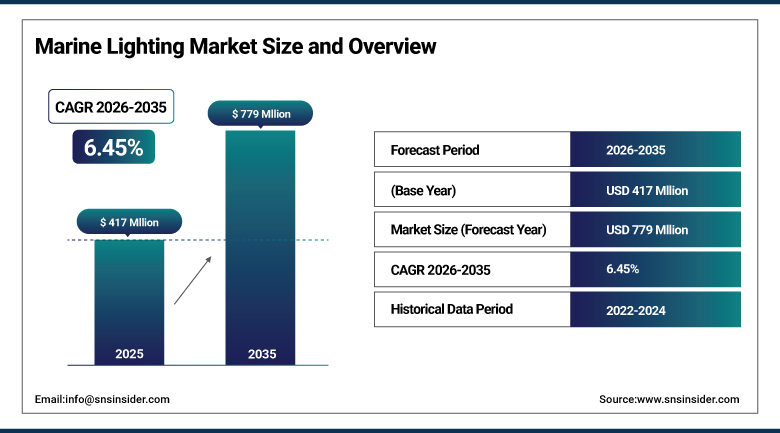
The Marine Lighting Market size was valued at USD 417 Million in 2025 and is expected to reach USD 779 Million by 2035, growing at a CAGR of 6.45% from 2026-2035.
The Marine Lighting Market is expanding as a result of the growth in maritime trade and commercial shipping fleets, along with investments in the upgrading of ships. The focus on energy efficiency and reduced costs is driving the use of LEDs in marine lighting that provide longer lifetime, less power consumption and low maintenance needs than traditional lighting solutions. Ship building, new ships orders, and offshore oil and gas exploration developments are also supporting the demand for marine lighting systems. Moreover, enhanced standards of maritime safety are motivating ship operators to modernize lighting equipment for navigation, emergency lighting, engine room, and passengers lighting. Increasing demand for cruise ships, yachts, and recreational ships is adding to the market growth, along with retrofitting projects on old fleets.
⮞In September 2025, Glamox secured contracts from electrical contractors working for three shipyards to provide connected marine lighting and light management systems for 11 offshore high-voltage direct current converter platforms being built for TenneT's 2GW Program. The company described the contracts, which will deliver more than 38,000 marine lights, as the largest offshore lighting project it has ever won.
To Get more information Marine Lighting Market - Request Free Sample Report
Marine Lighting Market Trends
-
Growing adoption of smart and connected LED lighting supporting automated control and remote monitoring.
-
Rising demand for customized underwater lights, accent lighting, and color-changing LED systems.
-
Expanding offshore platform and infrastructure lighting contracts tied to renewable energy grid projects.
-
Increasing vessel modernization activity driving replacement of legacy fluorescent and halogen fixtures.
-
Rising integration of IoT capabilities enabling better control and monitoring for marine operators.
U.S. Marine Lighting Market Size Outlook:
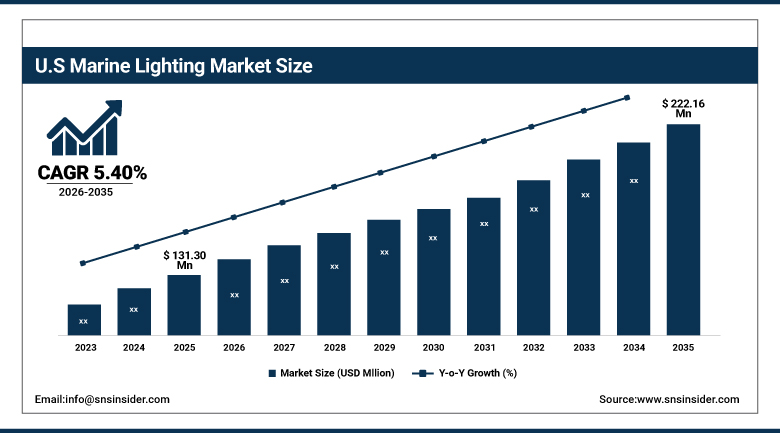
The U.S. Marine Lighting Market was valued at USD 131.30 Million in 2025 and is expected to reach USD 222.16 Million by 2035, growing at a CAGR of 5.40% from 2026-2035.
The domestic demand for such products will continue to be sustained by the strong recreational boating tradition, along with the considerable need for naval fleet modernization, in terms of both commercial and recreational vessels. Leading vendors will keep expanding the extreme environment LED lineup, as well as introducing small-size control modules to make it easier to manage lighting on board for boaters, while at the same time, continued domestic investment in warranty and reliability testing will bolster the competitive advantage. Increased need for custom-designed underwater and accent lighting will further foster the domestic market growth.
⮞In August 2024, Garmin introduced the Spectra LED Control Module, a compact device designed to simplify the management of onboard LED lighting for boaters. The company stated the launch reflects continued investment in accessible, user-friendly lighting control technology for the recreational boating market.
Marine Lighting Market Segment Analysis
-
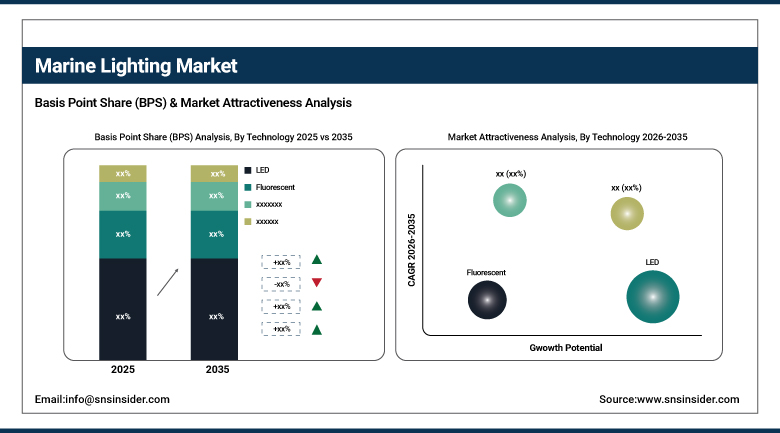
By Technology, LED segment dominated the Marine Lighting Market in 2025 with 58% share; LED segment is the fastest-growing segment.
-
By Type, Functional Light segment dominated the Marine Lighting Market in 2025 with 88% share; Functional Light segment is the fastest-growing segment.
-
By Ship Type, Commercial Ships segment dominated the Marine Lighting Market in 2025 with 61% share; Passenger Ships segment is the fastest-growing segment.
-
By Installation Type, OEM/New Build segment dominated the Marine Lighting Market in 2025 with 56% share; Aftermarket/Retrofit segment is the fastest-growing segment.
By Technology, LED dominated the Marine Lighting Market in 2025 and is also the fastest-growing segment
LED dominated the Marine Lighting Market in 2025 owing to its high energy efficiency, extended operation life span, low maintenance requirement, and ability to withstand vibrations and harsh marine environments. Shipowners are shifting towards LED-based lighting solutions because they help cut down the amount of electricity consumed and the need for replacements, thereby lowering their overall lifecycle cost. Increased adoption by commercial ships, offshore structures, and ships under construction has led to further adoption of LED lighting in this market. Moreover, advancements in terms of brightness, optical performance, and integration capabilities have increased the applicability of LED lighting solutions in marine operations.
LED is also the fastest-growing technology segment owing to the increasing efforts on part of shipping organizations to replace traditional lighting solutions with more energy efficient ones. Rising cost of fuel and electricity is forcing shipowners to deploy lighting solutions that minimize the consumption of onboard energy and reduce operating costs. Increasing environmental constraints and sustainability activities are driving the adoption of LED-based lighting systems because of their lower energy consumption and longer life cycle.
⮞In January 2025, HELLA marine announced new marine lighting products, including a Bluetooth Mesh-enabled Apelo Light Controller and RGB/W lighting fixtures. These products support customizable lighting control and energy-efficient LED adoption in recreational vessels.
By Type, Functional Light dominated the Marine Lighting Market in 2025 and is also the fastest-growing segment
Functional Light dominated the Marine Lighting Market in 2025 due to the importance of illumination for navigating, crew activities, loading/unloading of goods, machinery sections, passageways, and other tasks in the ship. Extensive functional light installation is needed for maintaining visibility and complying with maritime regulations in commercial and industrial ships. The segment enjoys stable replacement rates, obligatory light installation, and wide usage in various ship types. Focus on crew safety, efficient operations, and effective illumination in hard marine conditions continues to drive demand for functional lighting systems.
Functional Light is the fastest-growing segment as the need for safe operating conditions, proper visibility, and efficient illumination in all parts of the ship increases. Modern functional lights offer better lighting, higher resistance, and increased reliability while consuming less energy, especially when used with LED technology and smart controls. Growth in commercial shipping industry, offshore activities, and ship modernization creates more installation prospects. Requirements related to safe working conditions and good illumination also contribute to this trend. Technological advancements in functional lighting, which help decrease maintenance costs and improve onboard energy management, contribute to segment growth.
⮞In January 2026, the U.S. Coast Guard updated its guidance on lighting standards for small passenger vessels, expanding the range of acceptable fixtures for interior emergency, non-emergency, and navigation lighting. The change provides greater flexibility in selecting compliant marine lighting systems.
By Ship Type, Commercial Ships dominated the Marine Lighting Market in 2025, while Passenger Ships are the fastest-growing segment
Commercial Ships dominated the Marine Lighting Market in 2025 since the global commercial fleet constitutes a significant installed base that requires lighting in cargo, engine room, deck, accommodation areas, and operational zones. The lighting in container ships, bulk carriers, tankers, and commercial vessels is required for reliable and safe operations. Due to high usage of ships, there is an increased need for replacements and maintenance, while ship building activities increase the installation of marine lighting systems. With rising global maritime trade and investments in energy-efficient ships, the demand for advanced marine lighting systems has risen in the market.
Passenger Ships are the fastest-growing segment due to increasing investments in cruise ships, ferries, and other maritime passenger transportation means. There is a need for upgrade in lighting systems to make passengers comfortable with their stay onboard along with improving the aesthetic appeal of the ships. Advanced LED and digitally-controlled lighting systems have been adopted to improve the passenger experience. Ship refurbishing and new passenger shipbuilding activities are contributing to the growing demand for marine lighting systems.
⮞In September 2025, Princess Cruises officially took delivery of Star Princess, the second Sphere-Class cruise ship, from Italy's Fincantieri shipyard. The newbuild illustrates continued investment in passenger-vessel construction, which requires integrated lighting across cabins, public areas, and operational spaces.
By Installation Type, OEM/New Build dominated the Marine Lighting Market in 2025, while Aftermarket/Retrofit is the fastest-growing segment
OEM/New Build dominated the Marine Lighting Market in 2025 due to the need for extensive lighting systems installation in navigation, accommodation, machinery, deck, cargo, and safety sections when new boats are being built. Modern shipbuilding is increasingly focused on incorporating LED and other efficient lighting systems together with lighting controls in the early stages of ship construction to ensure maximum efficiency of their functioning and meet growing demands for ships. The expansion of commercial, offshore, passenger, and special vessels is driving the demand for new vessels.
Aftermarket/Retrofit is the fastest-growing installation segment because of the increasing necessity to update old marine fleets using energy-efficient and innovative lighting systems. Old fleets need updating of lighting equipment to increase reliability and efficiency and cut down maintenance costs. Retrofitting is a rather easy task without the need to reconstruct the entire ship which makes this option favorable for ship owners looking for ways to reduce costs. Growing demands for energy efficiency and sustainable development are fueling fleet renewal. Thus, increasing renovations in commercial and passenger ships create high demand for retrofit lights.
⮞In January 2025, HELLA marine introduced its Apelo Light Controller, designed to integrate with existing wiring and support both retrofit installations and new vessels. App-based control and customizable lighting modes provide an upgrade path for boat owners seeking more advanced lighting functionality.
Regional Analysis
|
Region |
Major Country |
Share within Region, 2025 |
|
North America |
United States |
91.00% |
|
Europe |
Germany |
30.60% |
|
Asia Pacific |
China |
42.60% |
|
Latin America |
Brazil |
38.60% |
|
Middle East & Africa |
United Arab Emirates |
32.60% |
North America Marine Lighting Market Insights
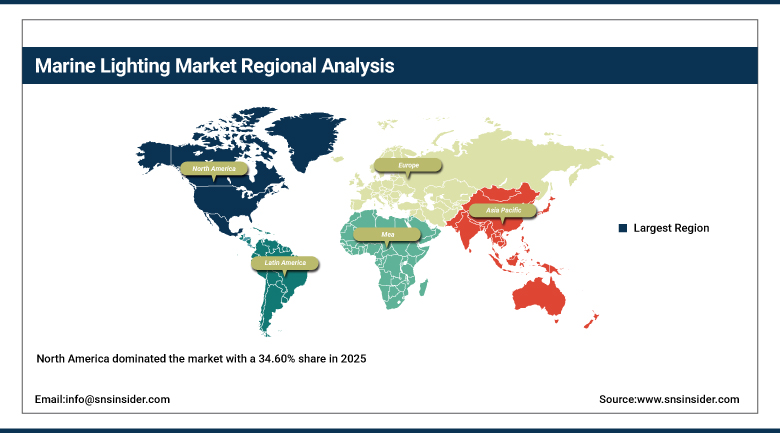
North America dominated the market with a 34.60% share in 2025. A robust recreational boating culture and extensive naval fleet modernization requirements continue to anchor this leadership position across both commercial and leisure vessel segments. The United States shapes regional demand through its mature and highly developed market, supported by a dense concentration of leading marine lighting manufacturers.
Canada contributes additional regional demand through its participation in North American maritime and recreational boating activity. Continued domestic investment in extreme-environment LED product development is expected to keep North America in the lead through the forecast period, even as growth in percentage terms trails faster-scaling Asia Pacific markets building out commercial fleet and offshore infrastructure from a considerably smaller existing base.
⮞In January 2026, the U.S. Coast Guard expanded its guidance on acceptable lighting standards for small passenger vessels. The update is relevant to marine lighting suppliers serving the U.S. passenger-vessel market, particularly manufacturers offering compliant emergency and navigation lighting.
Get Customized Report as per Your Business Requirement - Enquiry Now
Asia Pacific Marine Lighting Market Insights
Asia Pacific is projected to be the fastest-growing region, registering a CAGR of 8.60% during 2026-2035, supported by expanding commercial shipbuilding capacity and growing recreational boating interest across the region. China continues to anchor regional demand through its extensive shipbuilding industry and growing domestic fishing and commercial fleet base requiring durable marine lighting solutions.
Japan and South Korea contribute additional regional demand, anchored by established shipbuilding industries and growing passenger vessel construction activity. Continued regional investment in commercial fleet modernization further reinforces Asia Pacific's position as the fastest-growing global market for marine lighting.
⮞In February 2026, China's government reported that the country completed 53.69 million deadweight tonnes of shipbuilding output in 2025, representing 56.1% of global output. The scale of domestic shipbuilding provides a substantial potential installation base for marine lighting, although the figures do not directly measure lighting demand.
Europe Marine Lighting Market Insights
Europe holds a meaningful share of the global market, underpinned by a dense concentration of established marine lighting manufacturers and continued advancement in connected lighting technology developed for both commercial and offshore infrastructure applications. Germany's substantial industrial and maritime manufacturing base anchors regional demand, supported by strong enterprise adoption of smart lighting technology across the country and neighbouring markets.
Norway, the United Kingdom, and other major European maritime markets contribute consistent demand as regional shipbuilders and offshore energy operators continue extending advanced lighting technology into routine vessel and platform construction practice. Continued European investment in offshore renewable energy infrastructure supports steady regional demand for marine and platform lighting solutions.
⮞In September 2025, Glamox secured contracts to supply connected marine lighting and light-management systems for 11 offshore HVDC converter platforms being built for TenneT's 2GW Program. The project involves more than 38,000 marine lights for offshore energy infrastructure serving the Netherlands and Germany.
MEA & Latin America Marine Lighting Market Insights
Latin America's market is anchored by Brazil, which accounts for the majority of regional demand on the strength of its growing commercial shipping and fishing industry. Gradual growth in domestic maritime infrastructure continues to support steady regional market development.
The Middle East & Africa region continues to grow in strategic importance, with demand concentrated in Gulf Cooperation Council markets such as the United Arab Emirates, where expanding maritime trade and offshore energy investment is increasingly driving demand for durable marine lighting solutions. South Africa continues to anchor demand on the African continent, supported by its comparatively more developed maritime infrastructure.
⮞In September 2025, Brazil's Ministry of Ports and Airports approved BRL 4 billion in new projects through the Merchant Marine Fund, covering vessel construction, modernization, maintenance, and repair. The investment could support demand for marine lighting in newbuilds and vessel upgrades.
Market Dynamics
Growth Drivers: Marine Tourism Growth and Fleet Modernization
The increase in marine tourism and leisure boating represents the primary growth driver, as growing popularity of boating, yachting, and marine tourism continues to expand demand for both functional and decorative marine lighting solutions. This dynamic is reinforced by continued compliance with international maritime safety regulations, which remain critical for preventing accidents and ensuring the safe movement of vessels in both commercial and recreational contexts.
Vessel modernization and recurring replacement needs across commercial fleets provide an additional significant source of demand, as shipping logistics and fishing industry operators continue upgrading legacy fluorescent and halogen fixtures with more efficient, durable LED alternatives. Growing offshore platform and infrastructure lighting contracts tied to renewable energy grid projects further support market growth as energy operators increasingly specify connected marine lighting systems.
⮞In September 2025, Brazil approved BRL 4 billion in maritime projects that included vessel construction and modernization, while Glamox secured contracts for lighting across 11 offshore converter platforms.
Restraints: Tariff Complexity and High System Costs
Tariff complexity can constrain the marine lighting market by increasing uncertainty across international procurement, manufacturing, and distribution networks. Marine lighting manufacturers often source components and finished products across multiple countries, making changes in import duties and trade policies an important consideration for pricing and supply-chain planning. Smaller manufacturers and distributors may face greater difficulty absorbing additional costs while maintaining competitive pricing. High upfront costs for advanced marine lighting systems represent another restraint, particularly for smaller vessel operators and recreational boat owners with limited investment budgets.
Smart LED fixtures, connected lighting controls, and specialized marine-grade systems generally require higher initial expenditure than conventional lighting products. Although these technologies can provide longer service life, lower energy consumption, and reduced maintenance requirements, the initial investment may delay replacement decisions. Budget constraints can therefore slow adoption, especially in cost-sensitive segments.
Opportunities: Smart Lighting Integration and Offshore Infrastructure Expansion
The incorporation of intelligent technology and connected control is providing new opportunities for the marine lighting industry players. IoT-based lighting systems allow users to have a centrally controlled system along with automatic scheduling, remote monitoring, fault detection, and energy management, thus helping vessel owners to increase efficiency and minimize maintenance costs. Such features become very important for commercial vessels and offshore facilities where accessibility to the lighting equipment becomes a problem. More digitization in maritime operations is likely to promote the usage of connected lighting systems together with vessel automation.
There are also a lot of opportunities related to offshore infrastructure development including the construction of facilities producing renewable energy such as offshore wind facilities and converter platforms. All such facilities need a reliable corrosion-proof lighting for the operational, access, and safety purposes. Such type of lights is going to be provided by marine certified and energy-efficient lighting producers.
⮞In September 2025, Glamox announced its largest marine lighting project to date, supplying more than 38,000 connected lights and light-management systems for TenneT's offshore grid platforms. The project highlights opportunities for suppliers of remotely monitored, connected, and specialized lighting systems in offshore renewable-energy infrastructure.
Recent Developments:
-
2024: Garmin introduced the Spectra LED Control Module, a compact device designed to simplify the management of onboard LED lighting for recreational boaters.
-
2025: Hella Marine continued incorporating Internet of Things capabilities into its marine lighting solutions, facilitating improved control and monitoring systems for marine operators.
-
2025: Lumitec continued to reinforce its position as a leading US-based manufacturer of extreme-environment marine LED lighting, maintaining its five-year warranty across its complete product line.
Marine Lighting Companies are:
-
LGS Marine Lighting
-
Hella Marine
-
Lumitec Lighting
-
Garmin Switzerland GmbH
-
Aqualuma LED Lighting
-
Ocean-Led Ltd.
-
BluefinLED
-
Underwater Lights Limited
-
Lopolight Navigation Light Solutions
-
Archway Marine Lighting
-
Oxley Group
-
NaviSafe
-
OSRAM GmbH
-
Foresti & Suardi
-
Lumishore
-
Glamox ASA
-
Perko Inc.
-
Imtra Corporation
Marine Lighting Market Report Scope:
| Report Attributes | Details |
|---|---|
| Market Size in 2025 | USD 417 Million |
| Market Size by 2035 | USD 779 Million |
| CAGR | CAGR of 6.45% From 2026 to 2035 |
| Base Year | 2025 |
| Forecast Period | 2026-2035 |
| Historical Data | 2022-2024 |
| Report Scope & Coverage | Market Size, Segments Analysis, Competitive Landscape, Regional Analysis, DROC & SWOT Analysis, Forecast Outlook |
| Key Segments | • By Technology (LED, Fluorescent, Halogen, Others) • By Type (Functional Light, Decorative Light) • By Ship Type (Commercial Ships, Passenger Ships, Yachts) • By Installation Type (OEM/New Build, Aftermarket/Retrofit) |
| Regional Analysis/Coverage | North America (US, Canada), Europe (Germany, UK, France, Italy, Spain, Russia, Poland, Rest of Europe), Asia Pacific (China, India, Japan, South Korea, Australia, ASEAN Countries, Rest of Asia Pacific), Middle East & Africa (UAE, Saudi Arabia, Qatar, South Africa, Rest of Middle East & Africa), Latin America (Brazil, Argentina, Mexico, Colombia, Rest of Latin America). |
| Company Profiles | Phoenix Marine Lighting, LGS Marine Lighting, Hella Marine, Lumitec Lighting, Garmin Switzerland GmbH, Aqualuma LED Lighting, Ocean-Led Ltd., IRS Marine, BluefinLED, Underwater Lights Limited, Lopolight Navigation Light Solutions, Archway Marine Lighting, Oxley Group, NaviSafe, OSRAM GmbH, Foresti & Suardi, Lumishore, Glamox ASA, Perko Inc., Imtra Corporation |

Frequently Asked Questions
Key players include Phoenix Marine Lighting, LGS Marine Lighting, Hella Marine, Lumitec Lighting, Garmin, Aqualuma LED Lighting, Ocean-Led, Lopolight, Glamox, and Imtra Corporation, among others.
Continued integration of IoT capabilities into marine lighting systems and the continued expansion of offshore platform and infrastructure lighting contracts represent the two most significant opportunities shaping the market's next phase of growth.
Growth is primarily driven by the increase in marine tourism and leisure boating market, combined with continued compliance with international maritime safety regulations.
By Ship Type, Commercial Ships dominated the market in 2025.
North America dominated the market with a 34.60% share in 2025, supported by a robust recreational boating culture and extensive naval fleet modernization, led by the United States.
