
Maritime Information Market Report Scope & Overview:
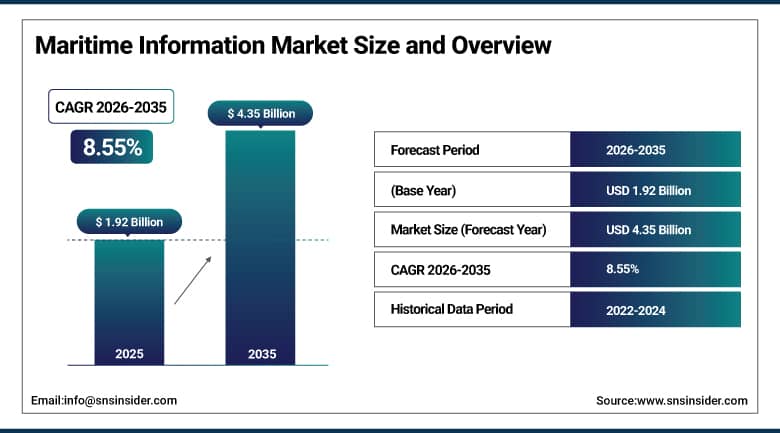
The Maritime Information Market was valued at USD 1.92 Billion in 2025 and is expected to reach USD 4.35 Billion by 2035, growing at a CAGR of 8.55% from 2026 to 2035.
The Maritime Information Market is experiencing steady growth as more and more shipping firms, port management organizations, insurers, and defense departments find the need to incorporate the use of data platforms that integrate satellite-based ship tracking technologies, automatic identification systems, weather information, and analytics in their operations to increase operational efficiencies. Increasing volumes of cargo transported via sea, growing numbers of ships plying international waters, and complexities of shipping routes used are making stakeholders look towards information systems that provide real-time consolidation of vessel position information, cargo status information, and weather information. Improvements in low-earth-orbit satellites have improved the ability of satellite-based technologies to track ships even when out of range of terrestrial networks. Pressure from regulatory authorities in relation to emissions monitoring, sanctions compliance, and crew safety continue to increase the number of applications of maritime information systems.
In April 2026, Windward partnered with satellite-imaging provider Vantor to combine AI-driven behavioral analytics with high-resolution satellite observation, strengthening its Windward Maritime AI platform's ability to detect dark vessels linked to shadow fleets and sanctions evasion.
To Get More Information On Maritime Information Market - Request Free Sample Report
Maritime Information Market Trends:
-
Rising deployment of satellite-based dark-vessel detection to counter sanctions evasion and shadow-fleet activity.
-
Growing consolidation among AIS and vessel-tracking data providers through targeted acquisitions.
-
Expanding integration of AI-driven predictive analytics for fuel efficiency and voyage optimization.
-
Increasing adoption of digital twin platforms for real-time vessel performance monitoring.
-
Rising demand for maritime cybersecurity solutions embedded within vessel information platforms.
U.S. Maritime Information Market Outlook:
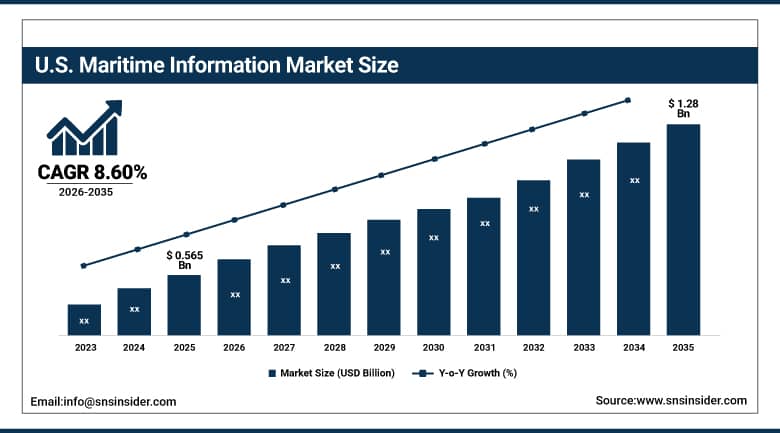
The U.S. Maritime Information Market was valued at USD 0.565 Billion in 2025 and is projected to reach USD 1.28 Billion by 2035, growing at a CAGR of 8.60% during 2026–2035.
The country's extensive commercial fleet operations, advanced coastal surveillance infrastructure, and significant defence-sector investment in maritime domain awareness continue to anchor its leading position within the region. Various federal organizations involved in homeland security, customs and border patrol, as well as naval operations, are increasingly making use of integrated vessel tracking and satellite intelligence systems to ensure surveillance of the territorial waters as well as detecting any illegal activities at sea, while commercial vessel operators and marine insurers are increasingly resorting to analytics-based platforms to facilitate effective risk management, voyage planning and comply with environmental reporting requirements. Ongoing efforts at improving port infrastructure in both coastal regions, together with rising private sector investments in autonomous vessel monitoring systems, will ensure the continued demand for maritime information solutions in the country.
In 2026, S&P Global completed its acquisition of ORBCOMM's Automatic Identification System business, integrating satellite-based vessel-tracking capabilities into S&P Global Market Intelligence's supply-chain and trade-analytics offerings for U.S. and global customers.
Maritime Information Market Segment Analysis:
-
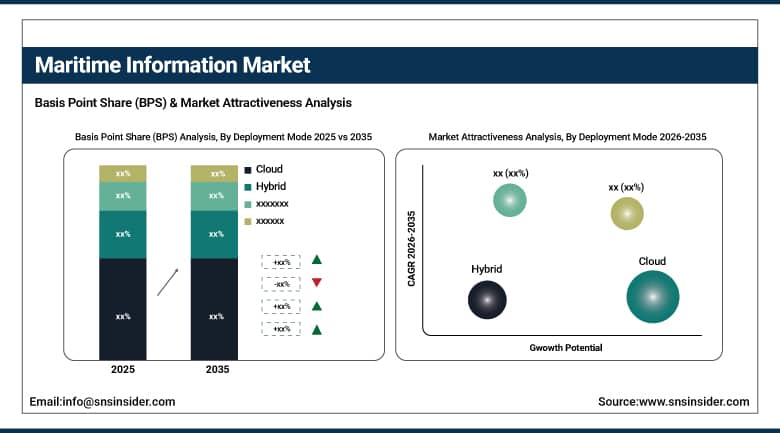
By Deployment Mode, Cloud dominated the Maritime Information Market with a 61.80% share in 2025, while Hybrid is the fastest-growing deployment segment with a CAGR of 10.20% from 2026–2035.
-
By Solution Type, Automatic Identification Systems dominated the Maritime Information Market with a 37.50% share in 2025, while Weather & Route Analytics is the fastest-growing solution segment with a CAGR of 9.80% from 2026–2035.
-
By End User, Government & Defence dominated the Maritime Information Market with a 44.20% share in 2025, while Insurance & Risk Management is the fastest-growing end-user segment with a CAGR of 9.90% from 2026–2035.
-
By Vessel Type, Commercial Vessels dominated the Maritime Information Market with a 52.40% share in 2025, while Offshore Support Vessels is the fastest-growing vessel-type segment with a CAGR of 9.40% from 2026–2035.
By Deployment Mode, Cloud leads while Hybrid grows fastest.
The Cloud segment held major share of the Maritime Information Market in 2025. Cloud-enabled maritime information solutions enable shipping firms, port authorities and governmental agencies to obtain constant updates on vessel tracking data, satellite images and analytics dashboarding without having substantial local infrastructure, which makes cloud deployment the ideal choice for businesses looking for scalable and hassle-free access to live maritime information.
The Hybrid segment is estimated to witness the highest CAGR over 2026-2035. Defence agencies as well as large-scale commercial fleets, dealing with confidential vessel tracking data, are increasingly preferring hybrid systems, where confidential intelligence analysis is performed by means of private infrastructure, and the cloud-based satellite feeds and analytics are used for non-confidential processes.
By Solution Type, AIS leads while Weather & Route Analytics grows fastest.
Automatic Identification Systems held the leading position in the Maritime Information Market in 2025. AIS continues to form the backbone of maritime domain awareness, which is mandatory under SOLAS regulations in the case of most commercial ships and continues to be used as the primary source of information for downstream analytical purposes, regulatory reporting, and fleet management systems by both commercial and government end users. The regulatory necessity of AIS transponders along with increased availability of satellite AIS coverage continues to maintain its dominance.
Weather & Route Analytics is expected to register the fastest CAGR during 2026-2035. Increasing cost of fuel and emissions regulations along with the need for voyage optimization in shipping companies have fueled the demand for the combination of meteorological and oceanographic data and performance of the ship to provide optimized routing. Advanced weather routing analytics is gaining rapid traction among all solution categories owing to the increasing necessity of reducing fuel consumption.
By End User, Government & Defence leads while Insurance & Risk Management grows fastest.
Government & Defence end users accounted for major share of the Maritime Information Market in 2025. National coastal surveillance systems, navy MDA efforts, and customs and border security departments continue to be the largest consumer of maritime information solutions, as there continues to be substantial investments from governments in terms of surveillance of territorial waters, illicit trafficking detection, and imposition of sanctions on any ships engaged in such activities.
Insurance & Risk Management is expected to post the fastest CAGR during the forecast period. Marine insurance companies are using vessel tracking and behavior analytics as well as voyage history information in their pricing and claims management process, which allows them to identify risks associated with specific ship/voyage better especially as there are new types of risks, like sanctions evasion and dark fleet activity.
By Vessel Type, Commercial Vessels lead while Offshore Support Vessels grow fastest.
Commercial Vessels contributed a major market share for the Maritime Information market in 2025. The highest demand for tracking, compliance, and route optimization comes from container ships, bulk carriers, and tankers working on frequent international trading routes, which makes commercial vessels the main source of revenue for providers of maritime information services for all solutions.
Offshore Support Vessels are expected to show the fastest CAGR through 2026-2035. Higher installation activity of offshore wind farms and ongoing offshore exploration of oil and gas require additional solutions for tracking, weather routing, and asset monitoring specific for the operations of support vessels working in challenging offshore conditions.
Regional Analysis:
|
Region |
Major Country |
Share within Region, 2025 (%) |
|
North America |
United States |
84.60% |
|
Europe |
United Kingdom |
26.80% |
|
Asia Pacific |
China |
36.90% |
|
Middle East & Africa |
UAE |
29.40% |
|
Latin America |
Brazil |
33.20% |
North America Maritime Information Market Insights
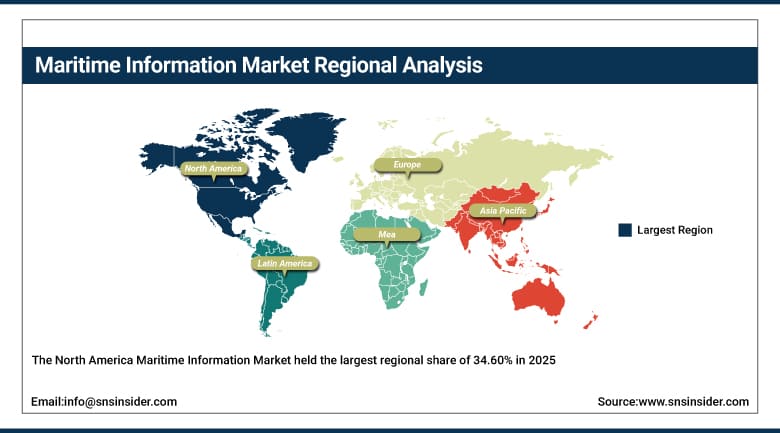
The North America Maritime Information Market held the largest regional share of 34.60% in 2025, due to the extensive commercial shipping operations, naval fleet operations in the region, advanced satellite and coastal radar infrastructure along with significant investments in government’s initiatives for maritime domain awareness and homeland security surveillance programs. Demand in the region is supplemented by the presence of major satellite AIS and maritime analytics companies in the region which develop their platforms consistently and keep their regional operators updated on vessel tracking, sanctions compliance and predictive analytics.
The United States accounted major share of the North America Maritime Information Market in 2025 due to the extensive commercial fleet operations, advanced maritime digital infrastructure, and government's investments in coastal surveillance and national defense maritime awareness programs. Canada is contributing to the regional growth due to increasing Arctic and coastal monitoring programs for sovereignty surveillance and safe navigation in northern shipping routes.
Get Customized Report as Per Your Business Requirement - Enquiry Now
Europe Maritime Information Market Insights
The Europe Maritime Information Market remained a significant contributor to global revenue in 2025, and it is likely to continue growing at a consistent pace throughout the forecast period due to a high number of classification societies, ship registry, and well-established maritime insurance and brokerage firms that consistently need precise and timely vessel information. The strict emissions monitoring regulations and expanding port state control regulations in the European Union are forcing shipping companies visiting European ports to implement integrated maritime information systems that will enable them to report to the regulators constantly.
The United Kingdom led the Europe Maritime Information Market with major share in 2025, reflecting its position as a global hub for maritime classification, insurance, and intelligence services, home to several leading vessel-tracking and risk-analytics providers. Other countries including Norway, Germany, and Greece, each home to substantial shipowning and maritime technology sectors, are also contributing meaningfully to regional demand through expanding fleet digitization and growing adoption of decarbonization-focused analytics platforms.
Asia Pacific Maritime Information Market Insights
The Asia Pacific Maritime Information Market is projected to register the fastest growth rate of 9.60% during 2026-2035, driven by the region's dominant share of global container throughput, rapidly expanding shipbuilding and port infrastructure, and rising government investment in coastal-surveillance systems amid growing maritime-security concerns across contested regional waters. Expanding regional trade volumes and continued modernization of port operations across major Asian economies are further accelerating adoption of integrated vessel-tracking and cargo-monitoring platforms.
China represented majority of the Asia Pacific Maritime Information Market in 2025, supported by its position as the world's largest port-throughput economy and sustained state investment in maritime surveillance and shipping-fleet digitization. Japan and India, both major shipbuilding and maritime-services hubs, are also contributing to regional growth through expanding domestic fleet-tracking adoption and rising investment in coastal-security infrastructure supporting safe navigation across busy regional shipping lanes.
Middle East & Africa and Latin America Maritime Information Market Insights
The Middle East & Africa and Latin America regions have been increasingly leveraging maritime information platforms due to increasing efforts made by regional governments in terms of modernizing ports and improving coastal security infrastructure owing to the increased realization of the strategic value of maritime trade routes in these two regions.
The UAE accounted for major share of the Middle East & Africa Maritime Information Market in 2025 due to its strategic position as one of the regional transshipment centers and efforts being made towards digitalizing ports and vessel tracking infrastructure around the Strait of Hormuz. Brazil accounted for major share of the Latin American Maritime Information Market due to its substantial offshore oil & gas industry and commercial shipping business.
Market Dynamics:
Growth Drivers: Rising seaborne trade and tightening safety-compliance mandates driving market growth
Sustained growth in global seaborne trade volume and commercial fleets, along with the complexity of their international shipping, has led them to seek out maritime information platforms that can aggregate information about vessel positions, cargoes, and environmental impact into one system. The International Maritime Organization, as well as regional entities, are imposing increased regulations regarding safety and security, as well as the reporting of emissions, and hence a demand for systems that can ensure regulatory compliance at all times.
Additionally, the increasing incidences of maritime security-related issues such as sanctions evasion, movement of unregistered vessels, and geopolitical tensions in shipping corridors have led to an increase in the demand for technologies that enable dark vessel detection and risk analytics by governments as well as businesses. In addition, the growing number of low-earth orbit satellite constellations not only increases coverage but also decreases update times for vessel-tracking satellites.
Restraints: High infrastructure costs and data-integration complexity limiting market expansion
The substantial cost of implementation and maintenance of a secure infrastructure of satellite data transfer is still one of the key reasons why the implementation of such solutions is still limited by many small port authorities and mid-sized shipping firms. It is quite difficult to integrate several data sources, including various onboard systems, different national AIS systems, and even satellites.
Moreover, the increasing dependence on satellite-based and cloud-based vessel tracking networks is posing cybersecurity risks in the maritime industry, and issues such as data falsification and interference in the signals of Automated Identification Systems, as well as security concerns in relation to sensitive ship and cargo data, have caused hesitation amongst some operators with regard to going completely digital. The use of varying standards for reporting data adds to this problem.
Opportunities: Autonomous vessel monitoring and decarbonization analytics creating new growth avenues
Rapid advances in the technologies behind autonomous and remotely controlled ships represent a significant growth opportunity for maritime information providers since such ships need constant, precise monitoring of vessel positioning, condition of machinery on board, and traffic around the ship in order to function safely without any people on board who monitor them. Providers of situational awareness and remote monitoring solutions designed specifically for autonomous operations have a great chance of satisfying the demand arising from this trend.
There is also significant opportunity for analytics platforms that would assist the shipping industry in measuring carbon intensity levels, routing vessels in a way that reduces carbon emissions, and complying with new emission-related regulations. Rapid digitization of ports that is occurring in many emerging economies of Asia Pacific, Latin America, and the Middle East adds to the addressable market of maritime information platforms.
Recent Developments:
-
2026: Windward partnered with satellite-imaging provider Vantor to fuse AI-driven behavioral analytics with high-resolution satellite observation, strengthening its Windward Maritime AI platform's ability to detect dark vessels tied to shadow fleets and sanctions evasion.
-
2025: Lloyd's List Intelligence introduced AIS SeaOrbis, a new AIS-based vessel-tracking service expanding its real-time maritime data offerings for compliance and risk assessment.
Maritime Information Market key players are:
-
Kongsberg Gruppen ASA
-
Windward Ltd.
-
Spire Global, Inc.
-
S&P Global Inc.
-
Kpler SAS
-
ORBCOMM Inc.
-
Wärtsilä Corporation
-
Viasat Inc. (Inmarsat)
-
Pole Star Global
-
DNV AS
-
Lloyd's Register Group Limited
-
Bureau Veritas SA
-
American Bureau of Shipping (ABS)
-
Hexagon AB
-
Saab AB
-
L3Harris Technologies, Inc.
-
Thales Group
-
Leidos Holdings, Inc.
-
Garmin Ltd.
-
Fugro N.V.
Maritime Information Market Report Scope:
| Report Attributes | Details |
|---|---|
| Market Size in 2025 | USD 1.92 Billion |
| Market Size by 2035 | USD 4.35 Billion |
| CAGR | CAGR of 4.35% From 2026 to 2035 |
| Base Year | 2025 |
| Forecast Period | 2026-2035 |
| Historical Data | 2022-2024 |
| Report Scope & Coverage | Market Size, Segments Analysis, Competitive Landscape, Regional Analysis, DROC & SWOT Analysis, Forecast Outlook |
| Key Segments | • By Solution Type (Automatic Identification Systems (AIS), Vessel Traffic Management Systems, Satellite Communication & Imaging, Weather & Route Analytics) • By Deployment Mode (Cloud, On-Premise, Hybrid) • By End User (Government & Defence, Commercial Shipping & Logistics, Insurance & Risk Management, Port Authorities) • By Vessel Type (Commercial Vessels, Naval & Defence Vessels, Fishing Vessels, Offshore Support Vessels) |
| Regional Analysis/Coverage | North America (US, Canada), Europe (Germany, UK, France, Italy, Spain, Russia, Poland, Rest of Europe), Asia Pacific (China, India, Japan, South Korea, Australia, ASEAN Countries, Rest of Asia Pacific), Middle East & Africa (UAE, Saudi Arabia, Qatar, South Africa, Rest of Middle East & Africa), Latin America (Brazil, Argentina, Mexico, Colombia, Rest of Latin America). |
| Company Profiles | Kongsberg Gruppen ASA, Windward Ltd., Spire Global, Inc., S&P Global Inc., Kpler SAS, ORBCOMM Inc., Wärtsilä Corporation, Viasat Inc. (Inmarsat), Pole Star Global, DNV AS, Lloyd's Register Group Limited, Bureau Veritas SA, American Bureau of Shipping (ABS), Hexagon AB, Saab AB, L3Harris Technologies, Inc., Thales Group, Leidos Holdings, Inc., Garmin Ltd., Fugro N.V. |

Frequently Asked Questions
The market is driven by rising global seaborne trade volumes, tightening safety and emissions-compliance mandates, and growing demand for satellite-enabled dark-vessel detection amid rising maritime-security concerns.
The Government & Defence segment dominated the Maritime Information Market in 2025, accounting for approximately 44.20% market share.
The North America region dominated the Maritime Information Market in 2025 with a 34.60% market share, supported by extensive commercial and naval fleet operations and strong satellite infrastructure.
