
Medical Van Market Report Scope & Overview:
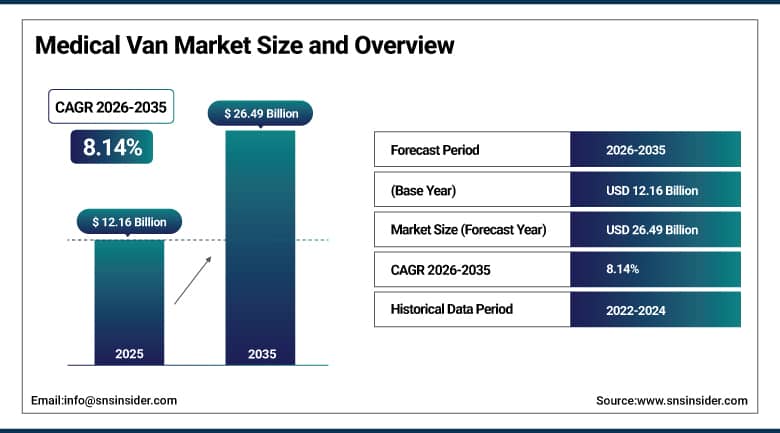
The Medical Van Market was valued at USD 12.16 billion in 2025 and is expected to reach USD 26.49 billion by 2035, growing at a CAGR of 8.14% from 2026–2035.
The medical van market is expected to grow because of increased demand for healthcare services, increased demands for emergency medical service, and expansion of mobile healthcare facilities into rural and underserved communities around the world. Governments, non-governmental organizations, and private health facilities are increasingly relying on the use of medical vans for emergency services, vaccinations, diagnosis, telemedicine, and patient transport. Increased demand for door-to-door healthcare provision, heightened health consciousness, and increased incidence of chronic diseases have been playing an important role in fueling the growth of this market around the world. The use of mobile clinics, installation of sophisticated equipment into medical vans, and increased use of electric and hybrid medical vans have contributed to the growth of this market during 2025-2026.
Governments and healthcare organizations are expanding emergency response fleets to improve “golden hour” treatment access during accidents, snakebites, cardiac emergencies, maternal complications, and trauma incidents. In 2025, Tamil Nadu deployed 25 specialized bike ambulances with oxygen cylinders, first-aid equipment, and emergency support systems to improve healthcare accessibility in hilly villages lacking rapid emergency transport infrastructure.
To Get More Information On Medical Van Market - Request Free Sample Report
Medical Van Market Trends
-
Rising deployment of mobile healthcare vans for diagnostics, vaccination drives, and emergency medical response is accelerating industry growth globally.
-
Governments and healthcare organizations are increasingly investing in telemedicine-enabled medical vans to improve rural and remote healthcare accessibility.
-
Growing adoption of AI-based patient monitoring systems and digital healthcare technologies is transforming mobile healthcare services worldwide.
-
Increasing demand for doorstep healthcare, chronic disease management, and preventive healthcare programs is boosting use of advanced medical vans.
-
Expansion of electric and hybrid-powered healthcare vans along with remote patient monitoring solutions is driving innovation in mobile healthcare infrastructure during 2025–2026.
The U.S. Medical Van Market Outlook
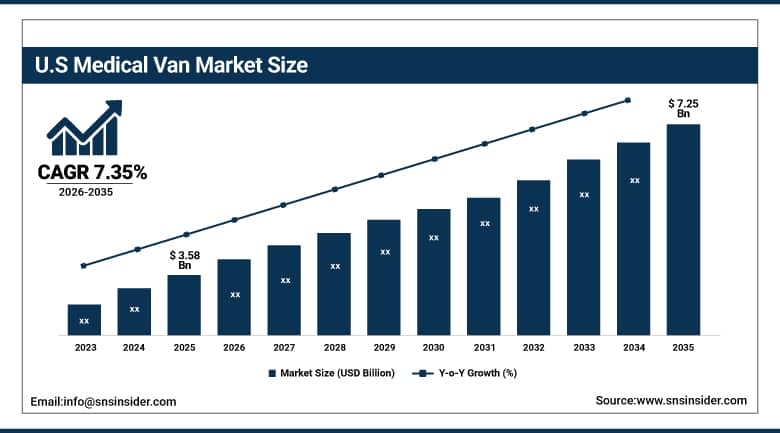
The U.S. Medical Van Market was valued at USD 3.58 billion in 2025 and is expected to reach USD 7.25 billion by 2035 at a CAGR of 7.35%, driven by its dominant position in hyperscale data center infrastructure and Rotary Drilling innovation.
The U.S. medical van market is experiencing growth on account of the rising number of investments in critical mineral exploration within the country, the increasing scale of underground mining operations, and increased demand for copper, lithium, and rare earth metals needed for the clean energy sector and industrial manufacturing. The use of innovative drilling technology by mining firms is also gaining momentum, driven by the need to enhance exploration, safety, and resource extraction efficiency. Investments made in domestic mineral production and the battery materials value chain are also playing a pivotal role in the market’s growth trajectory.
In April 2025, the U.S. Department of the Interior approved multiple new mineral exploration and mining expansion initiatives aimed at increasing domestic production of lithium, copper, and rare earth elements to support electric vehicle and clean energy manufacturing across the country. The government identified critical mineral supply security as a national priority because the U.S. currently imports a large portion of these materials from foreign markets.
Medical Van Market Segment Analysis
-
By Application, emergency medical services dominated with approximately 33.45% revenue share in 2025; mobile clinics is expected to be the fastest-growing type segment at approximately 9.60% CAGR from 2026 to 2035.
-
By End Use, ambulance vans dominated with approximately 32.21% revenue share in 2025; mobile clinics/healthcare vans are expected to be the fastest-growing type segment at approximately 8.66% CAGR from 2026 to 2035.
-
By Van Type, government healthcare services dominated with approximately 47.20% revenue share in 2025; private healthcare providers are expected to be the fastest-growing type segment at approximately 9.29% CAGR from 2026 to 2035.
-
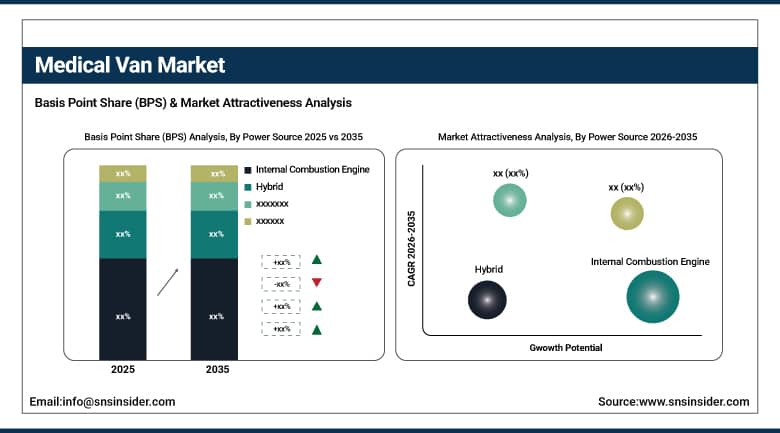
By Power Source, internal combustion engine dominated with approximately 50.80% revenue share in 2025; electric is expected to be the fastest-growing type segment at approximately 9.70% CAGR from 2026 to 2035.
By Power Source, internal combustion engine dominating while hybrid power systems emerging as the fastest-growing segment
However, the share of revenue generated by internal combustion engines was estimated to be around 50.80% in 2025 due to the popularity of such vehicles in travel over long distances, emergency services, and high-performing medical uses. The established fueling network and cost-effective solutions played an important role in maintaining their leadership across the global market in 2025.
Growth is anticipated to be the highest for the hybrid power category during the period of 2026-2035 owing to the rising emphasis on fuel efficiency, emissions, and sustainability in healthcare transportation systems. There is a growing investment in environmental vehicle technology, efficient fleet management system, and energy efficiency in healthcare transport systems around the world.
By Application, emergency medical services dominating while mobile clinics emerging as the fastest-growing application segment
In the year 2025, there was a 33.45% revenue contribution by the EMS segment due to an increase in the utilization of advanced medical vans for quick response and provision of trauma and emergency transport services. An increase in accidents, healthcare emergencies, disaster management activities, and healthcare infrastructure developments played a major role in increasing the usage of emergency medical service vans across the globe.
The mobile clinics market is anticipated to register the highest growth rate between 2026 and 2035 owing to rising demand for convenient access to healthcare services in rural and less developed areas. The use of mobile healthcare clinics for providing general healthcare, diagnosis facilities, vaccination campaigns, and telemedicine services is on the rise among governments, NGOs, and private health institutions, driving up growth rates.
By End-Use, ambulance vans dominating while mobile clinics/healthcare vans growing rapidly
Ambulance vans were responsible for around 32.21% of the revenue share in 2025 due to investments made by hospitals, emergency healthcare centers, and governmental organizations in fast response medical vehicles. Emergencies in the health sector, rising urbanization, and demand for modern ambulances played an important role in boosting the growth of the segment. Investment in emergency healthcare facilities and increased emphasis on safety led to increased use of technologically advanced ambulance vans.
The mobile clinics/health care vans market segment is anticipated to grow at the highest rate from 2026 through 2035 owing to rising healthcare outreach activities, rural health care efforts, and expanding mobile diagnostic services around the world. Increasing use of telemedicine solutions, portable medical devices, and preventive health care services has been driving the need for more advanced health care vans.
By Van Type, government healthcare services dominating while private healthcare providers expanding rapidly
In 2025, government healthcare services generated around 47.20% of the total revenues as many governments in various countries had been focusing on investing in their transportation systems for health care, vaccination activities, emergency response services, and rural areas health facilities. Improvement in the construction of healthcare facilities, awareness of health among people, and use of medical vans were some of the main contributors to the performance of the segment in 2025.
This segment is anticipated to register the highest growth rate between 2026 and 2035 owing to growing investments in mobile health care delivery solutions, telemedicine applications, and individualized patient care solutions. The growing demand for home healthcare services, mobile diagnostic tests, and special healthcare transportations has driven the growth of private medical van solutions globally.
Regional Analysis:
|
Region |
Major Country |
Share within Region, 2025 (%) |
|---|---|---|
|
North America |
United States |
83% |
|
Europe |
Germany |
31% |
|
Asia Pacific |
China |
48% |
|
Middle East & Africa |
UAE |
29% |
|
Latin America |
Brazil |
45% |
North America Medical Van Market Insights
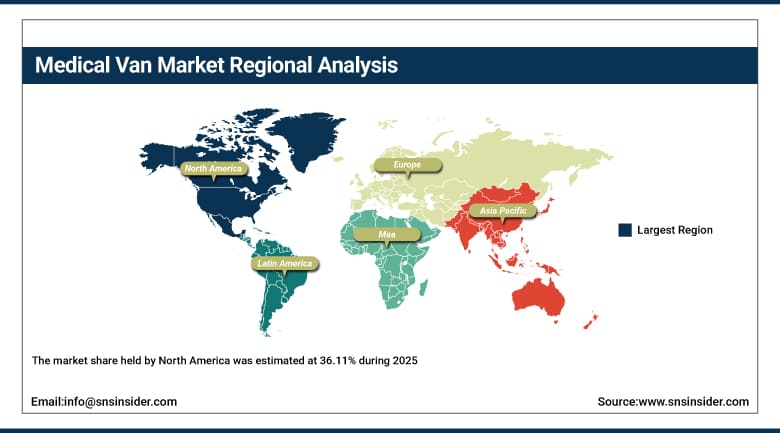
The market share held by North America was estimated at 36.11% during 2025 owing to investments made in emergency healthcare facilities, increased use of mobile health programs, and growing use of technologically advanced medical vans in North America. United States contributed largely to the growth of the market due to increasing use of ambulance vans, mobile diagnostics, vaccination vehicles, and telemedicine equipped healthcare vehicles. Increased awareness levels in healthcare, higher cases of chronic diseases, and increased demand for doorstep healthcare services also helped in the growth of the market.
Get Customized Report as Per Your Business Requirement - Enquiry Now
Europe Medical Van Market Insights
Market share for Europe was recorded the rising interest among healthcare service providers regarding preventive medicine, emergency medical response systems, and healthcare outreach efforts within the region. Countries like Germany, France, and the UK have greatly helped in contributing to market growth through the increased use of mobile clinics, ambulance vans, and healthcare testing vehicles. An aging population, digitization within the healthcare industry, and demand for mobile healthcare services have also played vital roles in market growth.
Asia Pacific Medical Van Market Insights
The region of Asia Pacific is projected to witness the highest growth rate of 9.70% CAGR over the forecast period due to the fast development of healthcare infrastructure, increase in healthcare initiatives in rural areas, and the adoption of mobile healthcare services in countries like China, India, Japan, and South Korea. In addition, governments and healthcare institutions have started using medical vans for vaccination programs, mother and child health care programs, diagnostics, emergency medical care, and telemedicine services in remote areas. Increasing population numbers, enhanced healthcare awareness, and rising demands for effective healthcare delivery methods have been some factors driving the market. The adoption of telemedicine systems, mobile healthcare devices, advanced diagnostics based on artificial intelligence, and other technologies by medical vans has boosted the growth of the medical vans market in Asia Pacific during 2025.
Middle East & Africa and Latin America Medical Van Market Insights
Market shares in Middle East & Africa and Latin America were recorded owing to high investments in improving healthcare accessibility, provision of medical transportation and rural healthcare facilities. The UAE and Brazil made significant contributions to regional growth due to increased efforts towards the extension of mobile health care services, vaccinations and diagnostic services within communities. Increased demand for mobile health care services especially within remote areas, increased cases of chronic diseases and increased use of mobile health technologies were some factors that promoted market growth in these regions.
Market Dynamics:
Growth Drivers: rising demand for accessible healthcare and mobile medical services accelerating industry growth
The escalating need for healthcare service accessibility, emergency medical service, and healthcare service on wheels is contributing to the growing industry. The deployment of medical vans for use in diagnostics, vaccination campaigns, transportation of patients, telemedicine, and healthcare in remote rural areas by governments, non-profit organizations, and healthcare facilities are contributing to the growth of the market. Escalating prevalence of chronic diseases, an increasing aging population, and a greater focus on doorstep healthcare are additional drivers fueling market growth.
Aging populations worldwide are contributing to rising adoption of mobile healthcare solutions. The United Nations reported that the global population aged 65 years and above is projected to more than double by 2050, increasing the need for accessible home-based healthcare, mobile clinics, and emergency transport services for elderly patients.
Restraints: high operational costs and limited healthcare infrastructure restricting market expansion
This sector experiences difficulties because of high vehicle maintenance costs, higher fuel costs, and high operational needs linked with advanced mobile healthcare services. Poor healthcare facilities in distant areas and a lack of qualified health care experts might impact healthcare accessibility and efficiency as well. Moreover, the inclusion of advanced diagnostic devices, telemedicine technologies, and advanced emergency medical equipment will add operational difficulties for the healthcare provider. The high cost of specialized vehicles and regulatory constraints might hamper growth in the market from 2025–2026 in developing nations worldwide.
Opportunities: expansion of telemedicine and smart mobile healthcare creating new opportunities
The growing trend of telemedicine, mobile diagnostics, and healthcare solutions powered by artificial intelligence will definitely bring about numerous growth prospects in the future. Indeed, more and more governments and healthcare organizations today focus on investing into sophisticated mobile clinics that utilize AI patient monitoring, digital health technology, and other types of healthcare solutions. Growing demand for healthcare services in rural settings, prevention-based healthcare initiatives, and emergency healthcare services definitely plays an important role in the global acceptance of medical vans. Growing demand for electricity-powered healthcare vans, remote patient monitoring solutions, and community outreach initiatives represents another major growth driver in the medical vans market.
Recent Developments:
-
February 2026: REV Group completed its merger with Terex, strengthening its specialty and emergency vehicle manufacturing operations, including ambulance and medical response vehicle production.
-
2025: Braun Ambulances announced participation at FDIC International 2025, showcasing the “Select by Braun Chief XL” ambulance platform designed to provide shorter delivery times and advanced customization for EMS providers.
-
February 2026: Demers expanded ambulance production capacity to support faster EMS fleet deliveries and rising demand for emergency healthcare transportation vehicles across North America.
Medical Van Market Key Players are:
-
REV Group, Inc.
-
Braun Industries, Inc.
-
Demers Ambulances
-
Osage Industries, Inc.
-
Horton Emergency Vehicles
-
Life Line Emergency Vehicles
-
Frazer, Ltd.
-
Leader Ambulance
-
Crestline Coach Ltd.
-
WAS Wietmarscher Ambulanz- und Sonderfahrzeug GmbH
-
Ambulnz Holdings LLC
-
Road Rescue, Inc.
-
Farber Specialty Vehicles
-
Odulair LLC
-
LDV, Inc.
-
Mobile Healthcare Facilities LLC
-
Matthews Specialty Vehicles
-
EMS Mobil Sistemler
-
BAUS AT d.o.o.
-
Allied Specialty Vehicles, Inc.
Medical Van Market Report Scope:
| Report Attributes | Details |
|---|---|
| Market Size in 2025 | USD 12.16 Billion |
| Market Size by 2035 | USD 26.49 Billion |
| CAGR | CAGR of 8.14% From 2026 to 2035 |
| Base Year | 2025 |
| Forecast Period | 2026-2035 |
| Historical Data | 2022-2024 |
| Report Scope & Coverage | Market Size, Segments Analysis, Competitive Landscape, Regional Analysis, DROC & SWOT Analysis, Forecast Outlook |
| Key Segments | • By Application (Emergency Medical Services, Patient Transport, Mobile Clinics, Vaccination Drives, Others) • By End Use (Ambulance Vans, Mobile Clinics/Healthcare Vans, Blood Donation Vans, Medical Transport Vans, Others) • By Van Type (Government Healthcare Services, Private Healthcare Providers, Non-Governmental Organizations) • By Power Source (Internal Combustion Engine, Electric, Hybrid) |
| Regional Analysis/Coverage | North America (US, Canada), Europe (Germany, UK, France, Italy, Spain, Russia, Poland, Rest of Europe), Asia Pacific (China, India, Japan, South Korea, Australia, ASEAN Countries, Rest of Asia Pacific), Middle East & Africa (UAE, Saudi Arabia, Qatar, South Africa, Rest of Middle East & Africa), Latin America (Brazil, Argentina, Mexico, Colombia, Rest of Latin America). |
| Company Profiles | REV Group, Inc., Braun Industries, Inc., Demers Ambulances, Osage Industries, Inc., Horton Emergency Vehicles, Life Line Emergency Vehicles, Frazer, Ltd., Leader Ambulance, Crestline Coach Ltd., WAS Wietmarscher Ambulanz- und Sonderfahrzeug GmbH, Ambulnz Holdings LLC, Road Rescue, Inc., Farber Specialty Vehicles, Odulair LLC, LDV, Inc., Mobile Healthcare Facilities LLC, Matthews Specialty Vehicles, EMS Mobil Sistemler, BAUS AT d.o.o., Allied Specialty Vehicles, Inc. |

Frequently Asked Questions
North America dominated the Medical Van Market in 2025 with approximately 36.11% of global revenues.
Emergency Medical Services dominated the market in 2025 with approximately 33.45% of revenues.
Ambulance Vans dominated the market in 2025 with approximately 33.21% of revenues.
The Medical Van Market was valued at USD 12.16 billion in 2025.
The Medical Van Market is expected to grow at a CAGR of 8.14% from 2026 to 2035.
