
Metamaterials Market Report Scope & Overview:
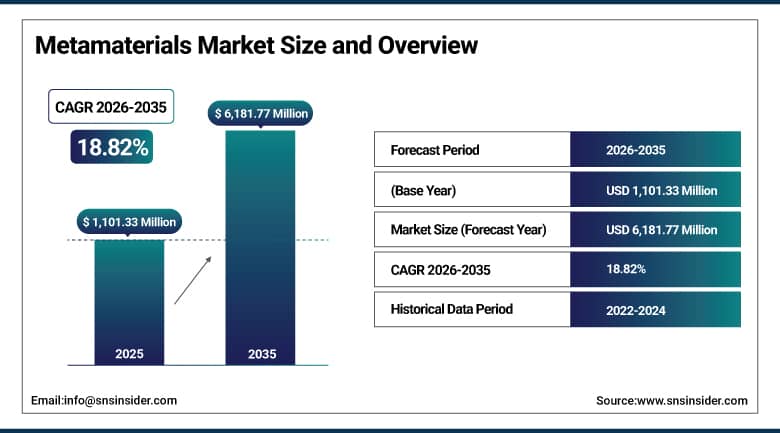
The Metamaterials Market was valued at USD 1,101.33 Million in 2025 and is expected to reach USD 6,181.77 Million by 2035, growing at a CAGR of 18.82% from 2026–2035.
The Metamaterials Market is seeing an impressive rate of growth owing to the growing need for innovative electromagnetic materials in the telecom, aerospace, defense, automotive, and medical industry segments. The emergence of the 5G networks and other next-generation wireless networks has fueled the use of metamaterials for building innovative antennas, beam-forming systems, and signal amplification devices. Investment in radar, satellite communication, stealth technology, and imaging systems is fueling market growth even further. Moreover, developments in the field of nanotechnology, photonics, and material science have enabled the creation of innovative metamaterials with better performance capabilities.
According to the International Telecommunication Union, global mobile broadband subscriptions have exceeded 7 billion connections, creating strong demand for advanced antenna technologies, beamforming systems, and signal-enhancement solutions that support next-generation wireless infrastructure. Furthermore, the GSMA estimates that 5G connections will surpass 5.5 billion globally by 2030, generating substantial opportunities for metamaterial-enabled antennas, radio-frequency components, and high-performance communication systems.
Metamaterials Market Size and Forecast:
-
Market Size in 2026E: USD 1,308.69 Million
-
Market Size by 2035: USD 6,181.77 Million
-
CAGR: 18.82% from 2026 to 2035
-
Fastest Growing Region: Asia Pacific
-
Largest Region: North America
To Get More Information On Metamaterials Market - Request Free Sample Report
Metamaterials Market Trends:
-
Rising demand for advanced electromagnetic wave manipulation technologies driving adoption of metamaterials in telecommunications, aerospace, and defense applications
-
Growing integration of metamaterials in next-generation antennas to enhance signal strength, bandwidth efficiency, and wireless communication performance
-
Increasing use in stealth technology and radar systems to improve electromagnetic absorption, detection avoidance, and defense capabilities
-
Expanding applications in medical imaging, sensing, and optical devices enabling higher precision, improved resolution, and enhanced device functionality
-
Continuous advancements in nanotechnology and material engineering supporting the development of lightweight, high-performance metamaterial-based products across industries
U.S. Metamaterials Market Outlook:
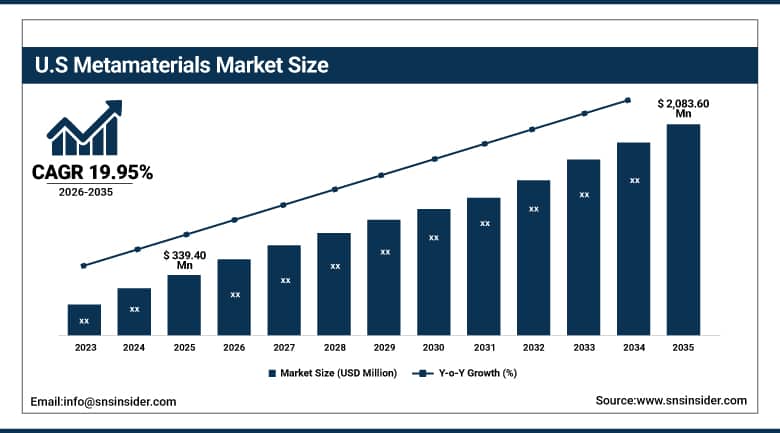
The U.S. Metamaterials Market is estimated to be USD 339.40 Million in 2025 and is projected to reach USD 2,083.60 Million by 2035, growing at a CAGR of 19.95% during 2026–2035.
The U.S. is the most commercially significant metamaterials market within North America’s dominant position. Kymeta Corporation, Echodyne Corp., Pivotal Commware, Lumotive, and MetaShield collectively define the domestic metamaterials commercial landscape spanning satellite communications, automotive radar, fixed wireless access, and LiDAR applications. DARPA’s metamaterial research programme, the DoD’s stealth and electronic warfare investment, and the FCC’s 5G/6G spectrum authorisation create structured government and commercial procurement motivation that sustains the U.S.’s global metamaterials market leadership.
Pivotal Commware launched its Echo 5G Series 2 repeater featuring holographic beamforming metamaterial technology in 2024, providing mobile network operators with a software-defined 5G signal amplification solution that deploys without cable or power infrastructure installation. The device’s metamaterial holographic beamforming creates electronically steerable 5G signal delivery whose programmable beam direction sustains coverage in building penetration and dead zone scenarios that conventional signal repeater alternatives cannot address with equivalent placement flexibility.
Metamaterials Market Segment Analysis:
-
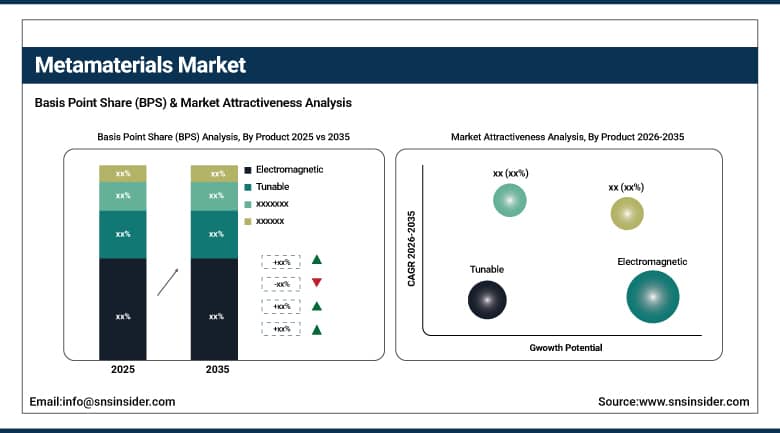
By Product, Electromagnetic segment dominated the Metamaterials Market in 2025 with 38% share; Tunable segment is the fastest growing segment.
-
By Application, Antenna segment dominated the market in 2025 with 34% share; Cloaking Devices segment is the fastest growing segment.
-
By End Use, Aerospace & Defense segment dominated the market in 2025 with 46% share; Consumer Electronics segment is the fastest growing segment.
By Product, Electromagnetic Metamaterials Dominate the Market While Tunable Metamaterials Emerge as the Fastest-Growing Segment
The Electromagnetic segment dominated the Metamaterials Market in 2025 because of the significant application of these materials in communication, radar, imaging, and sensing. The metamaterials used in this field are known for their electromagnetic properties that allow efficient manipulation of signals, antennas, and wave propagation. Demand for next-generation wireless networks, defense systems, and satellite communication systems has driven growth of this segment. Moreover, efforts made by researchers and companies to improve efficiency and functionality of electromagnetic devices have contributed to this trend.
The Tunable segment is the fastest growing in the Metamaterials Market owing to its capability to change the material properties under impact of various external influences like voltage, temperature, light, and magnetic field. Such characteristic makes tunable metamaterials very attractive for advanced communication solutions, adaptive optics, smart sensors, and reconfigurable electronics. The increasing demand for advanced technologies and intelligent devices drives the development of this product segment. Besides, advancements in material science and nanotechnology provide new application opportunities.
By Application, Antenna Applications Lead Owing to Expanding 5G and Communication Infrastructure While Cloaking Devices Witness Rapid Growth
The Antenna segment dominated the market in 2025 because of the incorporation of metamaterials in the communications equipment that needs small size, efficiency, and effective signals. The antennas that incorporate metamaterials have better bandwidths and gains and are more directional than other antenna technologies. The need for 5G infrastructure and satellite communications and connected devices has increased the demand for such products. Also, there is an increase in the requirement for smaller and efficient components of communications in aerospace, military, and telecommunication industries.
The Cloaking Devices segment is the fastest growing due to the increasing research and developments in the field of manipulating the electromagnetic waves for making things invisible. With the advances in the field of metamaterial engineering, there are innovative uses of such materials in defense, surveillance and other industrial applications. There is much spending by the governments and defense departments on the stealth technology for improving the efficiency of operations. Apart from this, there is the expansion in the field of the science of invisibility, which is resulting in growth of the market.
By End Use, Aerospace & Defense Sector Maintains Market Leadership While Consumer Electronics Records the Highest Growth Rate
The Aerospace & Defense segment dominated the Metamaterials Market in 2025 owing to the increasing demand for materials which can increase the effectiveness of radar systems, stealth systems, communication systems, and electromagnetic shielding. The defense agencies and aerospace firms are continuously focusing on technology innovations which will improve the performance, safety, and missions of the systems. Metamaterials provide significant benefits in signal control, lightweight construction, and efficiency of the systems. Moreover, increasing defense modernization initiatives and adoption of advanced sensing and communication systems have further strengthened the position of the segment in the market.
The Consumer Electronics segment is the fastest growing owing to the increasing use of metamaterials in mobile phones, wearables, wireless communication systems, imaging systems, and consumer electronics systems. The companies are using the material for improvement in the performance of the products and also miniaturizing their designs and enabling more connectivity. Moreover, the increased need for fast wireless communication products, advanced augmented reality devices, and sensing systems is also driving adoption in the segment.
Regional Analysis:
|
Region |
Major Country |
Share within Region, 2025 (%) |
|---|---|---|
|
North America |
United States |
87.4% |
|
Europe |
Germany |
22.3% |
|
Asia Pacific |
China |
44.8% |
|
Middle East & Africa |
Israel |
31.2% |
|
Latin America |
Brazil |
44.2% |
North America Metamaterials Market Insights
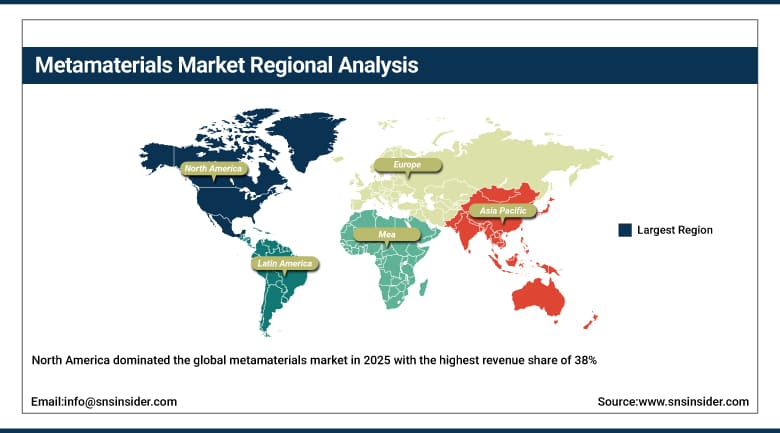
North America dominated the global metamaterials market in 2025 with the highest revenue share of 38%, driven by the robust aerospace and defence sector investment, 5G telecommunications infrastructure deployment, and the concentration of leading metamaterial technology companies. The United States accounts for approximately 87.4% of North American revenues through Kymeta, Echodyne, Pivotal Commware, Lumotive, and MetaShield’s commercial operations sustained by DoD and DARPA programme funding.
Canada contributes approximately 12.6% of North American revenues through its defence research community, the telecommunications sector’s 5G investment, and the academic research institution’s metamaterial innovation programme.
According to the United States Department of Defense, U.S. defense spending exceeds USD 840 billion annually, supporting the development of next-generation radar systems, stealth technologies, advanced sensors, satellite communications, and electromagnetic materials. These applications are key areas for metamaterial adoption due to their ability to enhance signal control, reduce detectability, and improve system performance.
Get Customized Report as Per Your Business Requirement - Enquiry Now
Europe Metamaterials Market Insights
Europe is a technically sophisticated metamaterials market where Airbus Defence’s stealth technology programme, Nokia and Ericsson’s 6G reconfigurable intelligent surface research, and the European Defence Fund’s metamaterial investment create structured institutional demand. Germany accounts for approximately 22.3% of European revenues through its automotive radar sensor industry, the aerospace sector’s metamaterial adoption, and the Fraunhofer Institute’s metamaterial research.
France, the United Kingdom, and Sweden are significant secondary markets where defence procurement, telecommunications infrastructure investment, and academic-commercial metamaterial development create consistent demand.
The European Commission has allocated approximately EUR 95.5 billion toward research and innovation programs, fostering advancements in advanced materials, photonics, nanotechnology, and next-generation electromagnetic technologies. These initiatives are accelerating the development and commercialization of metamaterial-based products across multiple industries.
Asia Pacific Metamaterials Market Insights
Asia Pacific is the fastest-growing regional metamaterials market, driven by China’s extraordinary 5G infrastructure investment, Japan’s advanced photonics research, South Korea’s Samsung and LG’s antenna technology, and India’s growing defence research programme. China accounts for approximately 44.8% of Asia Pacific revenues through its 5G base station deployment, the defence sector’s stealth technology investment, and the domestic metamaterial research programme’s commercial translation.
Japan’s advanced photonics and acoustic metamaterial research, South Korea’s telecommunications equipment manufacturer’s antenna investment, and Australia’s defence research create significant secondary markets.
According to the GSMA, the Asia-Pacific region is projected to account for more than 2.6 billion 5G connections by 2030, making it the world's largest regional 5G market. This expansion is creating significant demand for metamaterial-based antennas, beamforming systems, radio-frequency components, and signal-enhancement technologies that improve network performance and spectrum efficiency.
MEA & Latin America Metamaterials Market Insights
Israel leads the Middle East & Africa metamaterials market with approximately 31.2% revenue share, supported by its advanced defense technology ecosystem, strong research capabilities, and significant government investment in defense innovation. The adoption of metamaterials in stealth technologies, radar systems, and next-generation military applications continues to strengthen the country's leadership position.
Brazil leads the Latin American metamaterials market with approximately 44.2% revenue share, driven by expanding defense research programs, rapid 5G network deployment, and increasing investments in advanced materials research. Strong academic collaboration, growing telecommunications infrastructure, and rising interest in aerospace and electronics applications are supporting continued market growth.
Market Dynamics:
Growth Drivers: 5G and 6G wireless communication infrastructure and defence stealth technology investment driving premium adoption
Advancements in 5G wireless communication and increasing demand for radar and satellite systems are the metamaterials market’s most commercially certain growth drivers. The 5G network’s massive MIMO antenna array’s beam-steering performance requirement creates electromagnetic metamaterial adoption whose commercial scale compounds with global 5G network densification investment. Each new 5G base station installation that specifies metamaterial beam-forming antenna creates procurement whose aggregate across hundreds of thousands of global 5G sites creates commercial scale. The 6G research programme’s reconfigurable intelligent surface’s channel manipulation creates transformative metamaterial application whose research-to-deployment transition sustains market growth through the forecast period.
Government investments in defence and communications infrastructure as macroeconomic and geopolitical trends driving demand create non-discretionary metamaterial procurement whose national security motivation sustains investment independent of commercial ROI cycle variation. Each defence modernisation programme that creates stealth capability, electronic warfare, and secure communication requirement creates metamaterial procurement whose per-system value reflects the strategic asset’s mission profile.
Restraints: High manufacturing complexity and cost of sub-wavelength structure fabrication
Metamaterial’s sub-wavelength periodic structure fabrication requirement, whose nanofabrication precision at GHz application frequencies creates manufacturing cost substantially above conventional material alternatives, creates adoption barriers in cost-sensitive commercial applications. Each application environment whose performance requirement does not justify metamaterial’s premium manufacturing cost creates conventional material specification preference that moderates adoption below the technically optimal metamaterial deployment.
Scalable manufacturing process limitation, whose laboratory-to-production transition creates yield and uniformity challenges for complex 3D metamaterial structures, moderates commercial deployment pace below the technology’s theoretically demonstrated capability.
Opportunities: Reconfigurable intelligent surface for 6G and THz medical imaging
Reconfigurable intelligent surface (RIS) metamaterial’s 6G channel manipulation capability represents the most commercially transformative near-term metamaterial deployment whose programmable electromagnetic reflection creates wireless coverage extension, interference cancellation, and channel capacity improvement that passive infrastructure alternatives cannot achieve equivalently.
Terahertz medical imaging metamaterial’s non-ionising cancer detection, dental imaging, and wound assessment creates premium healthcare application whose clinical evidence development creates FDA approval pathway whose regulatory clearance creates structured hospital procurement.
Recent Developments:
-
2023: Kymeta Corporation secured a USD 20 million strategic investment from Toyota Tsusho Corporation in April 2023 to accelerate production and commercialisation of flat-panel metamaterial satellite communication antennas for mobile broadband connectivity on maritime, ground transportation, and commercial vehicle platforms.
-
2024: Pivotal Commware launched its Echo 5G Series 2 repeater in 2024 featuring holographic beamforming metamaterial technology for software-defined 5G signal amplification that deploys without cable or power infrastructure, providing mobile network operators with flexible 5G coverage extension capability.
-
2024: Echodyne Corp. expanded its EchoFlight drone detection metamaterial radar product line in 2024 with new long-range MESA (Metamaterial Electronically Scanning Array) configurations for critical infrastructure protection, airport perimeter monitoring, and military base security applications.
Metamaterials Market Key Players:
-
Meta Materials Inc.
-
Kymeta Corporation
-
Fractal Antenna Systems, Inc.
-
Echodyne Corp.
-
Metalenz, Inc.
-
Multiwave Technologies AG
-
Phoebus Optoelectronics LLC
-
NKT Photonics A/S
-
Applied EM, Inc.
-
Teraview Limited
-
JEM Engineering LLC
-
Evolv Technology Holdings, Inc.
-
Pivotal Commware, Inc.
-
Lumotive, Inc.
-
Radi-Cool Ltd.
-
Metamagnetics, Inc.
-
Alcan Systems GmbH
-
Greenerwave SAS
-
Swiss Terahertz AG
-
Nanohmics, Inc.
Metamaterials Market Report Scope:
| Report Attributes | Details |
|---|---|
| Market Size in 2025 | USD 1,101.33 Million |
| Market Size by 2035 | USD 6,181.77 Million |
| CAGR | CAGR of 18.82% From 2026 to 2035 |
| Base Year | 2025 |
| Forecast Period | 2026-2035 |
| Historical Data | 2022-2024 |
| Report Scope & Coverage | Market Size, Segments Analysis, Competitive Landscape, Regional Analysis, DROC & SWOT Analysis, Forecast Outlook |
| Key Segments | • By Product (Electromagnetic, Terahertz, Photonic, Tunable, Frequency Selective Surface, Non-linear) • By Application (Antenna, Absorber, Superlens, Cloaking Devices, Others) • By End Use (Aerospace & Defense, Medical, Automotive, Consumer Electronics, Energy & Power) |
| Regional Analysis/Coverage | North America (US, Canada), Europe (Germany, UK, France, Italy, Spain, Russia, Poland, Rest of Europe), Asia Pacific (China, India, Japan, South Korea, Australia, ASEAN Countries, Rest of Asia Pacific), Middle East & Africa (UAE, Saudi Arabia, Qatar, South Africa, Rest of Middle East & Africa), Latin America (Brazil, Argentina, Mexico, Colombia, Rest of Latin America). |
| Company Profiles | Meta Materials Inc., Kymeta Corporation, Fractal Antenna Systems, Inc., Echodyne Corp., Metalenz, Inc., Multiwave Technologies AG, Phoebus Optoelectronics LLC, NKT Photonics A/S, Applied EM, Inc., Teraview Limited, JEM Engineering LLC, Evolv Technology Holdings, Inc., Pivotal Commware, Inc., Lumotive, Inc., Radi-Cool Ltd., Metamagnetics, Inc., Alcan Systems GmbH, Greenerwave SAS, Swiss Terahertz AG, and Nanohmics, Inc. |
Frequently Asked Questions
The Metamaterials Market is expected to grow at a CAGR of 18.82% from 2026 to 2035.
The Metamaterials Market was valued at USD 1,101.33 Million in 2025.
Growing telecom, aerospace, healthcare, and automotive adoption, combined with defense investments and AI-driven metamaterial innovation, is accelerating market growth.
Electromagnetic Metamaterials dominated the Metamaterials Market.
North America dominated the Metamaterials Market.
