
Inertial Sensor Market Report Scope & Overview:
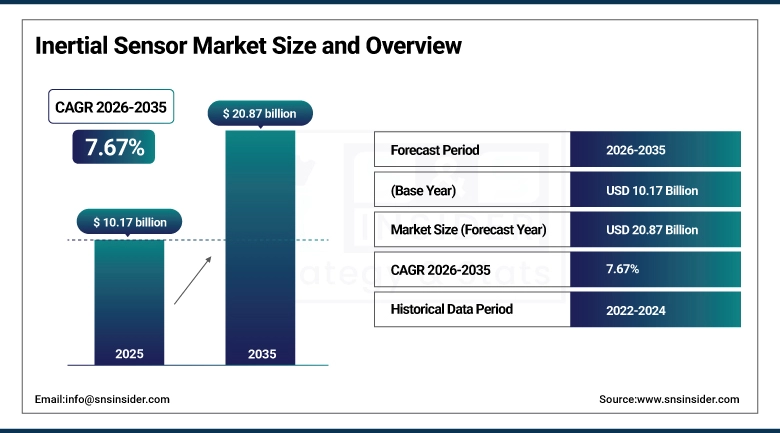
The Inertial Sensor Market Size is valued at USD 10.17 Billion in 2025 and is expected to reach USD 20.87 Billion in 2035, growing at a CAGR of 7.67% during the forecast period 2026-2035.
The Inertial Sensor Market analysis report offers a comprehensive analysis of market developments, technological developments, and key application areas. The increasing need for navigation and positioning systems, increasing use of inertial sensors in consumer electronics and automotive applications, increasing use of inertial sensors in aerospace and defense applications, and increasing developments in MEMS technology are contributing to strong growth in the Inertial Sensor Industry.
Inertial sensor shipments have crossed 5 billion units in 2025, owing to increasing demand in consumer applications, increasing use of inertial sensors in automotive safety and navigation systems, and increasing use of inertial sensors in aerospace and industrial applications.
Market Size and Growth Forecast:
-
Market Size in 2025: USD 10.17 Billion
-
Market Size by 2035: USD 20.87 Billion
-
CAGR: 7.67% from 2026 to 2035
-
Base Year: 2025
-
Forecast Period: 2026–2035
-
Historical Data: 2022–2024
To Get more information on Inertial Sensor Market - Request Free Sample Report
Inertial Sensor Market Trends:
-
The rising demand for sophisticated navigation and positioning technology is fueling the demand for inertial sensors in aerospace, defense, and automotive applications.
-
The rising trend of using inertial sensors in consumer electronics, including smartphones, wearables, and gaming devices, is fueling large-scale market penetration.
-
The rising trend of using inertial sensors in autonomous vehicles, ADAS, and robots is fueling the demand for precise sensing and safety features.
-
The development of compact and low-power inertial sensors using MEMS technology is fueling market penetration in terms of performance, cost-effectiveness, and device miniaturization.
-
The rising trend of using inertial sensors in industrial automation, IoT, and smart manufacturing is fueling market penetration.
-
The partnerships and collaborations between technology companies, semiconductor companies, and automotive companies are fueling market penetration.
U.S. Inertial Sensor Market Size Outlook:
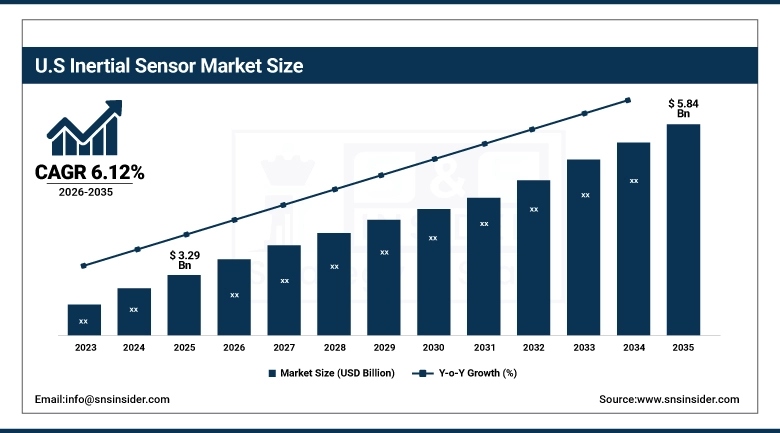
The U.S. Inertial Sensor Market is expected to grow from USD 3.29 Billion in 2025 to USD 5.84 Billion in 2035, at a CAGR of 6.12 %. The market is expected to grow owing to the increasing need for navigation and positioning systems, high adoption in the aerospace and defense industry and the automotive sector, increasing adoption in consumer electronics, and consistent investments in MEMS technology and inertial sensing.
Market Growth Drivers: Rising demand for navigation, autonomous systems, and smart devices driving adoption of inertial sensors.
The rise in demand for precise navigation and positioning in various industries, including aerospace, defense, automobiles, and consumer electronics, is also driving the Inertial Sensor Market. Various industries are increasingly using inertial sensors in applications such as self-driving cars, drones, and wearable technology for better motion tracking and control. Furthermore, the rise in demand for MEMS technology and its reduction in size and cost are also driving this market. In addition, the rise in demand for industrial automation, robots, and IoT is also contributing to market growth.
More than 70% of consumer electronic and advanced automotive applications used inertial sensors in 2025 for motion sensing, navigation, and stabilization.
Market Restraints: High cost of advanced sensors and performance limitations restraining adoption in price-sensitive markets.
The high cost involved in high-precision inertial sensors, particularly fiber optic and ring laser gyroscopes, has been one of the major restraining factors for this market. The complexity involved in manufacturing these devices has been one of the major drawbacks for this market, as it affects the cost of the overall system. In addition, performance issues, such as sensor drift, calibration, and accuracy in low-cost MEMS sensors, can be a major restraining factor for this market, as reliability is one of the critical factors in this market.
More than 45% of manufacturers faced challenges in cost, accuracy, and integration complexity in 2025.
Market Opportunities: Rapid expansion of autonomous systems, smart mobility, and IoT applications presents significant market growth opportunities.
The rising usage of autonomous vehicles, drones, robotics, and smart devices has created good growth opportunities for the Inertial Sensor Market. Industries are increasingly using smart sensors to provide real-time navigation, motion tracking, and stabilization of autonomous vehicles. The rising investments in ADAS, Industry 4.0, and smart ecosystems are accelerating the growth of the market. Moreover, the increasing advancements in MEMS technology, integration of inertial sensors with AI-based systems, and the development of cost-efficient, high-precision inertial sensors are creating growth opportunities.
More than 60% of the automotive and industrial technology industry invested more in the integration of inertial sensors in 2025.
Inertial Sensor Market Segmentation Analysis:
-
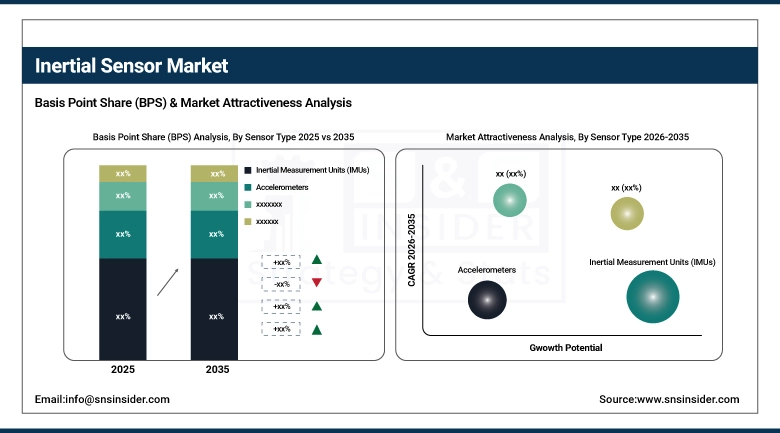
By Sensor Type, Inertial Measurement Units (IMUs) held the largest market share of 40.25% in 2025, while Gyroscopes are expected to grow at the fastest CAGR of 7.84% during 2025–2035.
-
By Technology, MEMS accounted for the highest market share of 69.43% in 2025, while Fiber Optic Gyroscopes (FOG) are projected to record the fastest CAGR of 8.24% through 2025–2035.
-
By Application, Navigation & Positioning dominated with a 35.41% share in 2025, whereas Motion Tracking is anticipated to expand at the fastest CAGR of 7.94% during the forecast period.
-
By End-Use Industry, Consumer Electronics held the largest share of 33.14% in 2025, while Automotive is expected to grow at the fastest CAGR of 8.04% during the forecast period.
By Sensor Type, Inertial Measurement Units (IMUs) Dominate While Accelerometers Grow Rapidly:
The Inertial Measurement Units (IMUs) segment dominated the market owing to the capability of IMUs to integrate accelerometers and gyroscopes into a single system. In 2025, the IMUs segment contributed to over 40% of the overall market share, owing to the high demand for compact sensing solutions.
The accelerometers segment is expected to witness the highest growth rate, owing to the increasing adoption of accelerometers in consumer electronics, wearable devices, and automotive safety systems. The adoption of accelerometers accelerated with the widespread adoption of IMUs in smartphones and IoT devices, with billions of units shipped in 2025.
By Technology, MEMS Dominate While Fiber Optic Gyroscopes (FOG) Grow Rapidly:
MEMS segment dominated the market as it is widely used in consumer products, automobiles, and industrial applications. The compactness and cost-effectiveness of MEMS make it popular. The market share of the total segment in 2025 is over 69%, which shows that there is high dependence on miniaturized sensor technology.
Fiber Optic Gyroscopes (FOG) segment is growing rapidly as the demand is increasing in aerospace and defense applications. The use of FOG is increasing in applications that need high accuracy and reliability.
By Application, Navigation & Positioning Dominate While Motion Tracking Grow Rapidly:
The Navigation & Positioning segment was the market leader, with widespread adoption in the aerospace, defense, and automotive industries owing to its importance in navigation, tracking, and positioning. In 2025, this segment contributed to over 35% of the market share, signifying the reliance on inertial sensors for navigation and tracking.
Motion Tracking is the fastest-growing segment, driven by the increasing adoption of inertial sensors in consumer electronics, gaming, AR/VR, and wearable technology. In 2025, billions of devices were enabled with motion sensing capabilities, signifying the widespread adoption and usage of inertial sensors.
By End-Use Industry, Consumer Electronics Dominate While Automotive Grow Rapidly:
Consumer Electronics segment had a dominant share in the market due to the widespread use of inertial sensors in smartphones, tablets, wearables, and gaming products. The segment had a significant market share of over 33% in 2025 due to the high volume of production and the introduction of new products in the field of small form factor and low power consumption sensors like MEMS technology.
The Automotive segment is expected to have the highest growth rate due to the increasing use of advanced driver assistance systems, autonomous vehicles, and safety systems in the automotive sector. The sensors are being increasingly used in modern vehicles, especially in the field of navigation, stability control, and motion sensors, which is a reflection of the huge growth potential in next-generation mobility solutions.
North America Inertial Sensor Market Insights:
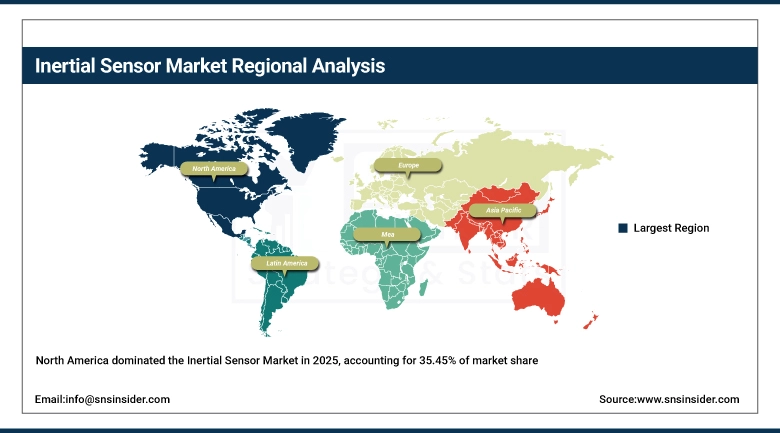
North America Inertial Sensor Market is dominated by this segment and accounts for a market share of 35.45% in 2025. The region is driven by high demand for inertial sensors in the aerospace & defense, automotive, and consumer electronics industries. High adoption of advanced inertial sensors in navigation systems and industrial automation is also contributing to the growth of this market. High investments in defense modernization programs and the early adoption of high-precision inertial sensors in the region have accelerated the growth of this market. The region is home to many leading companies and has high R&D capabilities.
Get Customized Report as per Your Business Requirement - Enquiry Now
U.S. Inertial Sensor Market Insights:
U.S. Inertial Sensor Market is driven by high demand for inertial sensors in the aerospace & defense, automotive, and consumer electronics industries. The region is home to many leading companies and has high R&D capabilities. High adoption of advanced inertial sensors in navigation systems and industrial automation is also contributing to the growth of this market. High investments in defense programs and the early adoption of high-precision inertial sensors have accelerated the growth of this market. The region is considered to have the most advanced technology and is considered to be the leading market.
Asia-Pacific Inertial Sensor Market Insights:
The Asia-Pacific Inertial Sensor Market is the fastest-growing market, with a predicted CAGR of 9.32% during 2025-2035. The market is driven by high-speed industrialization, increasing usage of consumer electronics, and escalating automotive manufacturing in countries such as China, India, Japan, and Southeast Asia. The high demand for MEMS-based sensors, coupled with escalating smart manufacturing initiatives, is boosting the market with high-speed growth.
China Inertial Sensor Market Insights:
China Inertial Sensor Market is driven by large-scale manufacturing capabilities, strong demand for inertial sensors in consumer electronics, and rapid growth of the automotive segment. The increasing use of inertial sensors in smartphones, wearables, electric vehicles, and industrial automation applications, and the increasing investment in semiconductor and sensor technologies, is contributing to the growth of the market.
Europe Inertial Sensor Market Insights:
Europe's Inertial Sensor Industry is driven by high demand from industries such as the automotive, aerospace & defense, and industrial sectors. The region is home to advanced manufacturing capabilities and regulatory standards. Countries such as Germany, France, and the UK are influencing the region's demand for inertial sensors. The region is witnessing growth in smart manufacturing, autonomous vehicles, and precision engineering. The region is also home to advanced research and development of inertial sensors. The region's focus on high-end manufacturing capabilities makes it a key region for the inertial sensor market.
Germany Inertial Sensor Market Insights:
Germany is another important market in the European Inertial Sensors market. The country is home to a strong automotive sector and is at the forefront of industrial automation and engineering. The growth of the German market is driven by the widespread use of inertial sensors in ADAS and autonomous driving systems and smart industrial systems. The German market is also benefiting from high investment in Industry 4.0 and strong regulatory focus on quality and innovation.
Latin America Inertial Sensor Market Insights:
The Latin America inertial sensor market is growing due to the increasing demand for consumer electronics and the gradual expansion of the automotive and industrial segments in the region. The market is driven by the increasing adoption of inertial sensors in smartphones, automobiles, and industrial equipment in countries like Brazil, Mexico, and Argentina.
Middle East and Africa Inertial Sensor Market Insights:
The Middle East & Africa inertial sensor industry is growing due to the increasing investments in the aerospace and defense industries, infrastructure development, and the adoption of advanced technology in the region. The Middle East & Africa inertial sensor industry is driven by the increasing adoption of inertial sensors in navigation systems, industrial automation, and smart devices in countries like Saudi Arabia, the UAE, and South Africa. The growing industrial sector, advancements in technology, and the focus on modernization are contributing to the growth of the market in the Middle East and Africa.
Inertial Sensor Market Competitive Landscape:
Honeywell International Inc. is a prominent American technology company with a strong presence in the Inertial Sensor industry. The company provides the best-in-class inertial measurement units, navigation systems, and aerospace sensors. Honeywell has a wide presence of its products, which are used in aerospace & defense, industrial, and navigation sectors. The company has a competitive advantage due to its high-precision inertial sensors, reliability, and ability to integrate with other high-end avionic systems.
-
Honeywell International has enhanced its next-generation inertial navigation solutions for the defense and aerospace industries in the month of March, 2025.
Another prominent manufacturer of inertial sensors is Bosch Sensortec GmbH. The organization is renowned for its accelerometers, gyroscopes, and sensor fusion products. The organization has been successful in popularizing its products in the global market because of its focus on miniaturization, low-power consumption, and high-volume production. The organization is committed to enhancing its products through innovations in MEMS technology and its global supply chain.
-
Bosch Sensortec announced advanced inertial sensors for wearables and smart devices in January 2025. The organization is committed to enhancing the efficiency of its products.
Another prominent organization in the global inertial sensor industry is Analog Devices, Inc. The organization is renowned for its high-end products and strong presence in the global market. The organization is committed to providing high-end inertial sensors that can help customers achieve their objectives. The organization is committed to providing high-accuracy products to its customers.
-
Analog Devices announced enhanced inertial sensing solutions for industrial automation and robotics in February 2025. The organization is committed to enhancing the efficiency of its products.
Inertial Sensor Companies are:
• Honeywell International Inc.
• Analog Devices, Inc.
• STMicroelectronics N.V.
• TDK Corporation
• Murata Manufacturing Co., Ltd.
• NXP Semiconductors N.V.
• TE Connectivity Ltd.
• Northrop Grumman Corporation
• Kearfott Corporation
• Thales Group
• Collins Aerospace (RTX Corporation)
• LORD Corporation (Parker Hannifin)
• InvenSense, Inc. (TDK Group)
• Epson (Seiko Epson Corporation)
• EMCORE Corporation
• KVH Industries, Inc.
• Silicon Sensing Systems Ltd.
• VectorNav Technologies, LLC
| Report Attributes | Details |
|---|---|
| Market Size in 2025 | USD 10.17 Billion |
| Market Size by 2035 | USD 20.87 Billion |
| CAGR | CAGR of 7.67% From 2026 to 2035 |
| Base Year | 2025 |
| Forecast Period | 2026-2035 |
| Historical Data | 2022-2024 |
| Report Scope & Coverage | Market Size, Segments Analysis, Competitive Landscape, Regional Analysis, DROC & SWOT Analysis, Forecast Outlook |
| Key Segments | • By Sensor Type (Accelerometers, Gyroscopes, Magnetometers, Inertial Measurement Units (IMUs), Others) • By Technology (MEMS, Fiber Optic Gyroscope (FOG), Ring Laser Gyroscope (RLG), Quartz, Others) • By Application (Navigation, Stabilization, Motion Tracking, Dead Reckoning, Platform Control, Others) • By End-User (Consumer Electronics, Automotive, Aerospace & Defense, Industrial, Healthcare, Others) |
| Regional Analysis/Coverage | North America (US, Canada), Europe (Germany, UK, France, Italy, Spain, Russia, Poland, Rest of Europe), Asia Pacific (China, India, Japan, South Korea, Australia, ASEAN Countries, Rest of Asia Pacific), Middle East & Africa (UAE, Saudi Arabia, Qatar, South Africa, Rest of Middle East & Africa), Latin America (Brazil, Argentina, Mexico, Colombia, Rest of Latin America). |
| Company Profiles | Honeywell International Inc., Bosch Sensortec GmbH, STMicroelectronics, Analog Devices, Inc., TDK Corporation (InvenSense), Murata Manufacturing Co., Ltd., Northrop Grumman Corporation, Safran Electronics & Defense, Collins Aerospace, Thales Group, Texas Instruments Incorporated, NXP Semiconductors, Trimble Inc., Teledyne Technologies Incorporated, Parker Hannifin Corporation, KVH Industries, Inc., Silicon Sensing Systems Ltd., ACEINNA Inc., VectorNav Technologies, Xsens Technologies B.V., Others. |

Frequently Asked Questions
North America dominated the market in 2025, holding a market share of 35.45%, while Asia-Pacific is growing at the highest rate and is projected to grow at a CAGR of 9.32% during 2025-2035.
Inertial Measurement Units dominated the market in 2025, holding a market share of 40.25%, while Accelerometer sensors are growing at the highest rate and are projected to grow at a CAGR of 7.84% during 2025-2035.
Key factors driving the market are the rise in demand for navigation and positioning sensors, increased penetration in consumer electronics and automotive markets, expansion in aerospace and defense markets, and technology advancements in MEMS sensors.
The market size is valued at USD 10.17 Billion in 2025 and is projected to grow to USD 20.87 Billion by 2035.
The Inertial Sensor Market is expected to grow at a CAGR of 7.67% during 2025-2035.
