
Military Helmet-Mounted Display Market Report Scope & Overview:
The Military Helmet-Mounted Display Market size is valued at USD 4.58 Billion in 2025 and is expected to reach USD 7.57 Billion by 2035 and grow at a CAGR of 5.17% over the forecast period 2026-2035.
Military Helmet-Mounted Display market is projected to grow in defense modernization, situational awareness, and soldier safety applications with increasing requirement for high-tech AR/MR-integrated helmets. Rising operational needs, such as the requirement for real-time targeting, navigation and mission-critical information and increasing focus on developing lightweight, user-friendly and sensor-based helmets; are expected to support this growth of helmet mounted displays. Enhancements in augmented reality, mixed reality, sensor fusion and modular helmet architectures are delivering superior operational stability and durability along with unsurpassed integration for aero-space and ground platforms combined with production scale-up capabilities to support global air force, army and naval deployments.
Industry research shows that around 50% of market demand is driven by advanced aviation and ground combat programs, indicating that Military Helmet-Mounted Display (HMD) technology is increasingly adopted for real-time situational awareness, targeting, and navigation, with significant usage across fighter aircraft, helicopters, and special operations forces.
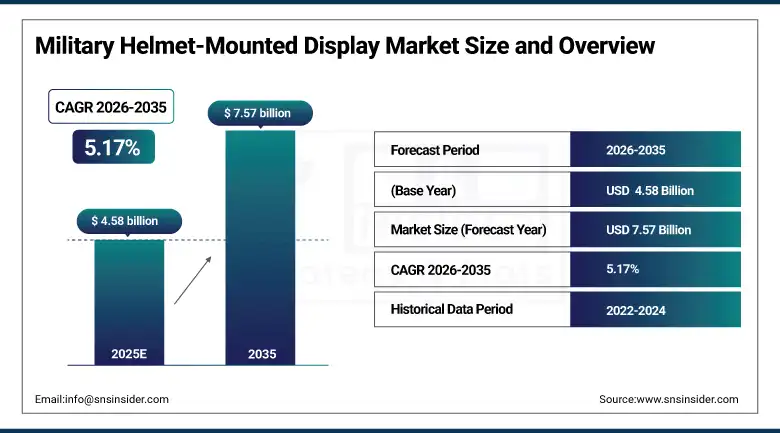
To Get more information On Military Helmet-Mounted Display Market - Request Free Sample Report
Military Helmet-Mounted Display Market Trends:
-
Rising Adoption of AR/MR Technologies – Increasing integration of augmented reality (AR) and mixed reality (MR) systems for real-time situational awareness, targeting, and mission planning across air, ground, and naval platforms.
-
Defense Modernization Programs Driving Demand – Growing defense budgets and modernization initiatives in North America, Europe, and Asia Pacific are accelerating the procurement of advanced HMD systems.
-
Miniaturization and Lightweight Designs – Shift toward ultra-lightweight, ergonomic, and modular helmets to reduce soldier fatigue while maintaining performance and sensor integration.
-
Integration with Advanced Sensors and Optics – Enhanced HMD systems increasingly incorporate night vision, infrared sensors, and helmet-mounted cameras for improved operational effectiveness.
-
Software-Defined and Modular HMD Systems – Growing adoption of software-defined architectures enables flexible upgrades, mission-specific configurations, and integration with other battlefield systems.
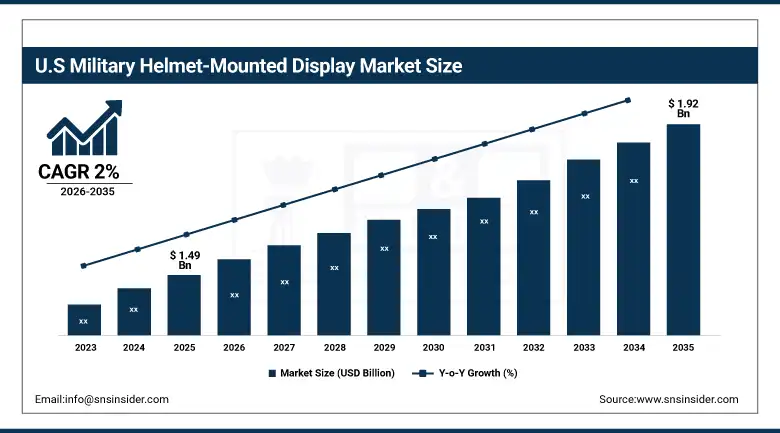
The U.S. Military Helmet-Mounted Display Market size is USD 1.49 Billion in 2025 and is expected to reach USD 1.92 Billion by 2035, growing at a CAGR of 2% over the forecast period of 2026-2035.
Increasing demand from defense modernization programs, end users including aviation and ground combat units, and technology integrators is projected to drive the U.S. Military Helmet-Mounted Display market growth. Developments in AR, MR, sensor technology and modular helmet designs will make HMD systems more lightweight, rugged and dependable. These factors are driving the growth of the Military Helmet-Mounted Display market in combat operations, surveillance & reconnaissance, and training & simulation applications. That patterns defense R&D spend, and good links to the U.S. prospect market with government funding for more advanced soldier Systems being made available.
Military Helmet-Mounted Display Market Growth Drivers:
-
Rising Defense Modernization and Operational Efficiency Needs
The Military Helmet-Mounted Display market is witnessing significant growth throughout the region because of increasing defense modernization programs, increasing AR/MR adoption in helmet systems, and rising demand for improved situational awareness, targeting, and navigation. Advanced sensors, light weight materials and integrated modular helmet designs have enabled a level of durability, ergonomics and real-time data that has dramatically progressed in recent years. Industry surveys suggest army, air force and naval deployment programs are driving more than half of market adoption rates today; HMDs are poised to become an increasingly critical tool in forward defense efforts. Moreover, growing emphasis on advanced training simulation, unmanned systems integration and SD HMD platforms is also augmenting market growth.
Military Helmet-Mounted Display Market Restraints:
-
High System Complexity and Deployment Costs
Market development is hampered by the expense as well as technological complexity to develop and field leading-edge HMD systems. These systems demand high end sensor integration, ergonomic designs, hardened parts and software/hardware timing that aren’t always available from smaller defense contractors or emerging markets. Production issues, environmental tolerances and real-time operational dependability are strong barriers to adoption. Additionally, the incompatibility with legacy command and control systems and absence of standard protocols continue to inhibit market growth.
Military Helmet-Mounted Display Market Opportunities:
-
Expansion in Advanced Soldier Systems and Training Applications
Rapid growth of the market can be attributed to the rise in popularity of HMDs among armed forces for combat operations, surveillance & reconnaissance and virtual/augmented training. AR/MR, sensor fusion and modular software defined architectures allow more effective situational awareness, mission planning, and operations. Helmet systems is the fastest growing segment in defense market research with over 5% CAGR making it a rapidly growing next generation helmet technology for future adoption. Key partnerships between players, government initiatives, and joint developments of research with tech companies are expected to drive market growth in developed markets as well as developing regions.
Military Helmet-Mounted Display Market Segment Analysis:
-
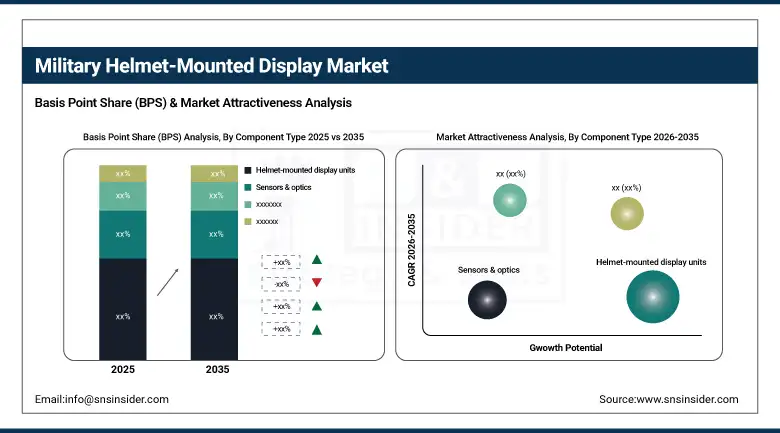
By Component Type: In 2025, helmet-mounted display units dominated with 50% share; sensors & optics are the fastest-growing segment during 2026–2035
-
By Technology: In 2025, augmented reality (AR) dominated with 45% share; mixed reality (MR) is the fastest-growing segment during 2026–2035.
-
By Application: In 2025, surveillance & reconnaissance dominated with 55% share; training & simulation is the fastest-growing segment during 2026–2035.
-
By End User: In 2025, army dominated with 60% share; naval forces are the fastest-growing segment during 2026–2035.
By Component Type: Helmet-Mounted Display Units Lead as Sensors & Optics Expand Rapidly.
Helmet-mounted display devices to account for the largest share of Military Helmet-Mounted Display market: The helmet-mounted display units segment dominates the military HMMD market, as these are critical in providing situational awareness, allowing increased targeting capabilities, and displaying real-time operation information for soldiers as well as pilots. The systems are extensively used in army, air force, naval forces and other defense R&D and training programs.
The sensors & optics market is also expected to gain significant growth with growing requirements for integrated night vision, infrared, as well as high-resolution camera systems. Advancements in lightweight optics, modular helmet mounting and high-grade sensor fusion technology are promoting increased usage particularly among combat troops, surveillance and reconnaissance operations.
By Technology: Augmented Reality (AR) Leads as Mixed Reality (MR) Accelerates.
While the soldier’s attention is redirected to a CANA display and away from the game space, as AR still remains the pre-dominant technology in this space as it allows real time tactical information to predominately overlay what the solider sees. Military applications of AR HMDs are used both in military aviation and ground operating forces as well as defense simulation to improve mission effectiveness.
Mixed reality (MR) is emerging as a critical approach to merge interactive virtual objects together with actual-world environments, which is useful in advanced training, simulation and operation planning. Increasing demand for sensor fusion, software-defined HMD systems, and mission-specific modular platforms fuels the deployment of MR technologies.
By Application: Surveillance & Reconnaissance Lead as Training & Simulation Expands
Surveillance and reconnaissance are the most desired applications because of the increasing demand for timely intelligence, tactical within military campaign perimeters. HMDs offer augmented real-world visual overlays, sensor fusion and improved targeting to increase mission effectiveness.
Simulation and training activities are booming as military forces deploy AR/MR helmet systems for live and virtual exercises. Due to the fact that HMDs enable realistic mission rehearsal, enhanced safety and cost savings in training, they are driving demand for army, air force and naval training programs according to the official.
By End User: Army Leads as Naval Forces Expand
Based on end user, Military Helmet-Mounted Display market is dominated by army segment on account of the use of HMDs in infantry, armored units and special operations for enhanced operational efficiency and situational awareness.
Navies are growing rapidly as requirements increase for integrated HMD systems for shipboard, amphibious and aviation missions. Incorporating advanced sensors, augmented reality overlays and modular design for helmets means operators can work more effectively, safely And Plan Their Missions during naval missions.
Regional Analysis:
North America Military Helmet-Mounted Display Market Insights:
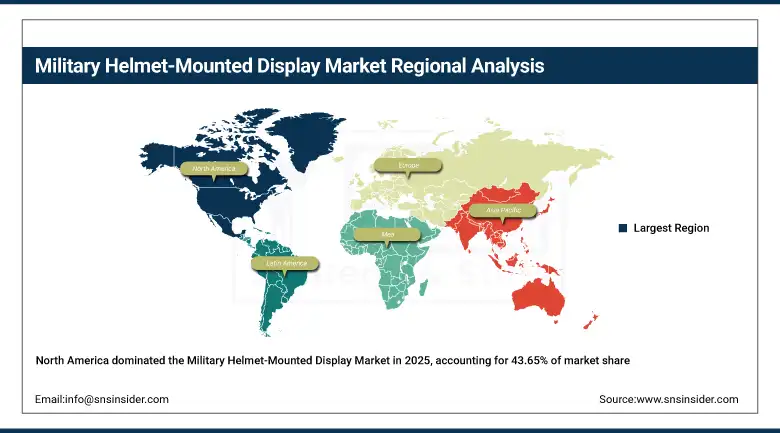
In 2025, North America’s Military Helmet-Mounted Display Market accounting for the highest regional revenue share of approximately 43.65% in 2025. Military Helmet-Mounted Display Market, by Region: North America is estimated to lead the military helmet-mounted display market owing to its defense modernization programs, which focus on delivery of enhanced capabilities and next-generation systems The region has a number of advanced R&D organizations in the field of the military that are supporting multiple programs for development of AR/MR-enabled helmet systems along with adequate infrastructure for the same Furthermore, high investment made towards procurement and development of advanced soldier system shall further fuel demand for military HMMD in North America.
Get Customized Report as per Your Business Requirement - Enquiry Now
U.S. and Canada Military Helmet-Mounted Display Market insights:
U.S. and Canada are the contractive countries that is driving the North American Military Helmet-Mounted Display market due to increasing defense modernization programs and AR/MR-based helmet systems in them. Sensor fusion and ergonomics All recent EO/IR sensors feature a combination of advanced sensor fusing, packaging the end product to minimum weight and ergonomic design (man- machine interface) supported by modular SOAs targeted at delivering situational awareness, targeting capability, and operational efficiency. Strong R&D, government initiatives, and partnerships support the regional adoption on air, ground, and naval systems.
Asia Pacific Military Helmet-Mounted Display Market Insights:
Asia Pacific represents a high-growth region for the Military Helmet-Mounted Display market, registering a CAGR of 8.58% during 2026–2035. The Asia Pacific Military Helmet-Mounted Display has gained significant traction due to increasing defense modernization programs and rising instances of AR/MR-based helmet systems being used in military in combat, surveillance, and training applications. Robust military R&D, industry–academia partnerships and investments toward the development of advanced lightweight sensor integrated helmet systems will propel demand. Top countries such as China, India, Japan and South Korea is driving the market of the APAC region which offer immense growth opportunities in the regional military helmet-mounted display market.
Europe Military Helmet-Mounted Display Market Insights:
Growth in Europe is driven by countries with established defense R&D infrastructure, favorable national policy initiatives and development projects, new semiconductor technologies and nanoelectronics research are deployed in the region that offers promising growth opportunities to indigenous producers of helmet-mounted displays. Adoption is being propelled by government ownership programs, industry–academia partnerships and research on advanced electronics, augmented reality and flexible soldier systems. Advances in modular helmet platform architectures, sensor fusion and compact ergonomic configurations are improving precision, reliability and scalability of these systems driving the market growth.
Latin America Military Helmet-Mounted Display Market Insights:
The value of the Latin America Military Helmet-Mounted Display market is anticipated to register a moderate CAGR during the forecast period, due to an increase in defense R&D spending, rise in advanced electronics infrastructure development, and surge in utilization of HMDs for combat, training and surveillance applications. The development of government-sponsored programs, academic and industrial cooperation projects, as well as technology innovation in sensor fusion integration, lightweight helmet-based systems and modular architectures represents additional market drivers enhancing regional proliferation with countries such as Brazil and Mexico leading regional adoption.
Middle East and Africa Military Helmet-Mounted Display Market Insights:
Rise in Defense R & D and Technology Innovation Programs to Propel Growth of the Military Helmet-Mounted Display Market in the MEA Investment in defense R&D, disruptive technologies as well as technological advancements are influencing growth on the MEA military helmet-mounted display market. Countries such as Saudi Arabia, the UAE and South Africa are building lab spaces and manufacturing capacity to develop helmet systems. Promising market trends are emerging in the academic–industry space, sensor fusion advances as well as modular AR/MR helmet designs and lightweight ergonomic architectures that will continue to propel market expansion through 2035.
Military Helmet-Mounted Display Market Competitive Landscape:
BAE Systems is a major defense contractor involved in the development and integration of advanced military helmet-mounted display systems for air and ground platforms. The company focuses on sensor fusion, night vision, augmented reality overlays, and mission-critical avionics integration to enhance pilot and soldier situational awareness.
-
In 2025: BAE Systems advanced its next-generation helmet-mounted display solutions for combat aircraft through upgrades to digital night vision and sensor-fusion capabilities under ongoing defense modernization programs.
Elbit Systems is a leading provider of military helmet-mounted displays, specializing in AR-enabled pilot and soldier systems with integrated sensors, avionics, and real-time battlefield data visualization. Its HMD solutions are widely deployed across fighter jets, helicopters, and ground forces worldwide.
-
In 2025: Elbit Systems expanded production and integration of its advanced helmet-mounted display systems for multiple international defense contracts, enhancing augmented reality symbology and multi-sensor data fusion.
Thales Group plays a key role in the Military Helmet-Mounted Display market through advanced avionics, optronics, and digital soldier solutions. The company develops HMD technologies that integrate targeting, navigation, and sensor data to improve operational effectiveness across air, land, and naval forces.
-
In 2025: Thales strengthened its helmet-mounted display portfolio by advancing AR-based pilot and soldier visualization systems as part of ongoing European defense and aviation modernization initiatives.
Military Helmet-Mounted Display Market Key Players:
-
BAE Systems plc
-
Elbit Systems Ltd.
-
Thales Group
-
Collins Aerospace (RTX / Raytheon Technologies)
-
L3Harris Technologies, Inc.
-
Honeywell International Inc.
-
Leonardo S.p.A.
-
Saab AB
-
Rheinmetall AG
-
Northrop Grumman
-
Lockheed Martin
-
Gentex Corporation
-
3M
-
Safariland LLC
-
MKU Limited
-
Oshkosh Corporation
-
Textron Inc.
-
Vision Systems International
-
Kopin Corporation
-
Microsoft Corporation
| Report Attributes | Details |
|---|---|
| Market Size in 2025 | USD 4.58 Billion |
| Market Size by 2035 | USD 7.57 Billion |
| CAGR | CAGR of 5.17% From 2026 to 2035 |
| Base Year | 2025 |
| Forecast Period | 2026-2035 |
| Historical Data | 2022-2024 |
| Report Scope & Coverage | Market Size, Segments Analysis, Competitive Landscape, Regional Analysis, DROC & SWOT Analysis, Forecast Outlook |
| Key Segments | • By Component Type: (Helmet-mounted display units, Sensors & optics, Software & communication interfaces) • By Technology: (Augmented Reality (AR), Mixed Reality (MR), Heads-Up Display (HUD)) • By Application: (Combat operations, Surveillance & reconnaissance, Training & simulation) • By End User: (Army , Air Force , Naval forces) |
| Regional Analysis/Coverage | North America (US, Canada), Europe (Germany, UK, France, Italy, Spain, Russia, Poland, Rest of Europe), Asia Pacific (China, India, Japan, South Korea, Australia, ASEAN Countries, Rest of Asia Pacific), Middle East & Africa (UAE, Saudi Arabia, Qatar, South Africa, Rest of Middle East & Africa), Latin America (Brazil, Argentina, Mexico, Colombia, Rest of Latin America). |
| Company Profiles | BAE Systems plc, Elbit Systems Ltd., Thales Group, Collins Aerospace (RTX / Raytheon Technologies), L3Harris Technologies, Inc., Honeywell International Inc., Leonardo S.p.A., Saab AB, Rheinmetall AG, Northrop Grumman, Lockheed Martin, Gentex Corporation, 3M, Safariland LLC, MKU Limited, Oshkosh Corporation, Textron Inc., Vision Systems International, Kopin Corporation, Microsoft Corporation |
Frequently Asked Questions
The Military Helmet-Mounted Display market is expected to grow at a CAGR of 5.17% during 2026-2035.
The market was valued at USD 4.58 Billion in 2025 and is projected to reach USD 7.57 Billion by 2035.
The key drivers of the Military Helmet-Mounted Display market are rising defense modernization, increasing adoption of AR/MR technologies, and demand for enhanced situational awareness and soldier safety.
The helmet-mounted display units segment dominated the Military Helmet-Mounted Display market, driven by high adoption in combat, aviation, and training applications.
North-America dominated the Military Helmet-Mounted Display market in 2025.
