
Mobile Gamma Cameras Market Report Scope and Overview
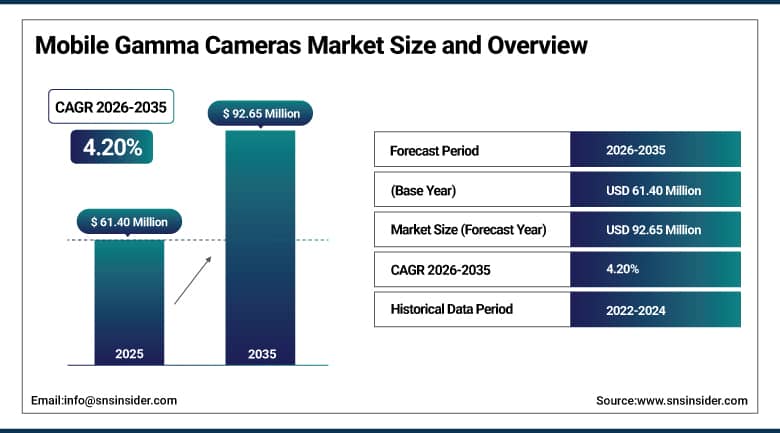
The Mobile Gamma Cameras Market was valued at USD 61.40 Million in 2025 and is estimated at USD 63.98 Million in 2026. The market is forecast to reach USD 92.65 Million by 2035, registering a CAGR of 4.20% from 2026 to 2035. Mobile gamma cameras are compact, wheeled, or handheld imaging devices that detect radiotracers at the bedside, in the operating room, or in small clinics, without moving the patient to a nuclear medicine suite. North America accounted for the largest regional share at 37.40% in 2025, while Asia Pacific is expected to grow fastest. Demand is lifted by cardiac, cancer, and thyroid imaging needs.
To Get More Information On Mobile Gamma Cameras Market - Request Free Sample Report
Key Market Trends & Insights
- By product type: Single-head cameras held the largest market share of 54.80% in 2025.
- By detector technology: Scintillator-based cameras held the largest market share of 72.40% in 2025.
- By application: Cardiology held the largest market share of 40.60% in 2025.
- By end user: Hospitals held the largest market share of 52.00% in 2025.
- North America accounted for the largest regional share of 37.40% in 2025.
- Asia Pacific is projected to register the fastest regional CAGR of 6.00% from 2026 to 2035.
- The U.S. is the leading country market in North America, supported by hospital nuclear medicine programs and cardiac imaging volumes.
Growth Outlook
Nuclear medicine relies on gamma cameras to show how a radiotracer moves through the body, which helps doctors assess the heart, thyroid, bones, and tumors. Mobile units bring this capability to places where a full scanner room is impractical, such as intensive care units, emergency departments, operating theaters, and small clinics. Their lower cost and smaller footprint also let hospitals offer imaging closer to the patient, which reduces transport and waiting time. These practical advantages matter most to hospitals with limited space.
Technology is improving what small cameras can do. Semiconductor detectors raise image quality and energy resolution, compact electronics cut weight, and software now helps with image correction and quantification. Handheld devices combine gamma imaging with optical views to guide surgeons during sentinel node procedures, which widens the range of uses beyond routine diagnostic scans and supports steady demand from cancer centers. Manufacturers are also working on lower dose protocols, longer battery life, and wireless data transfer, so that a single technologist can operate a camera at the bedside and share images with specialists elsewhere in the hospital. Such improvements lower training needs and help portable units fit into routine care pathways.
Market Dynamics
Driver: Rising Cardiac and Cancer Imaging Needs and the Shift to Point-of-Care Imaging Raise Demand for Mobile Gamma Cameras
Heart disease, thyroid disorders, and cancer all call for functional imaging, and populations are aging in most major economies. Mobile gamma cameras let clinicians perform scans in settings that lack a fixed nuclear medicine department, including smaller hospitals, mobile cardiology services, and surgical suites. This reach is valuable to providers that wish to expand imaging without large capital spending on gantry based SPECT systems. Many countries are also building cardiac and cancer screening programs, which raise the number of patients who need functional scans. Smaller hospitals and private clinics often start with a mobile unit before deciding whether to invest in a full department, which creates a steady entry point for suppliers.
Regulatory attention to patient dose is also shaping purchases. On 23 February 2026, the European Commission issued Recommendation Euratom/2026/403 on diagnostic reference levels for medical exposures, which encourages hospitals to monitor and optimize the radiation delivered in imaging. Newer cameras with better sensitivity can deliver diagnostic quality at lower activities, which supports replacement of older equipment in many hospitals. Hospitals also value the lower shielding and room requirements of portable equipment, since a camera that can be wheeled into a treatment room avoids expensive building work and keeps patients close to the care team. Insurers and hospital boards also favor equipment that reduces patient transfers and related risks.
Restraint: Isotope Supply Fragility, Reimbursement Pressure, and Competition from Fixed SPECT Systems Restrain Market Growth
Gamma imaging depends on technetium-99m, which is made from molybdenum-99 produced in a small number of aging research reactors worldwide. Unplanned shutdowns have caused supply shortages in the past, and hospitals may postpone scans or equipment purchases when supply is uncertain. Procurement teams also weigh the small size of the mobile segment, which limits the number of specialist suppliers and the pace of product innovation. Small volumes also mean that suppliers spread development costs over few units, which keeps prices high compared with the value of each device and discourages price sensitive buyers in emerging markets from adopting them. Such limits slow the arrival of new designs and keep competition modest.
Mobile cameras also compete with fixed SPECT and SPECT/CT systems, which offer tomographic images, quantification, and hybrid anatomical detail that portable units cannot match. Hospitals that can afford a gantry system often prefer it for complex cases, and portable devices are then limited to bedside, surgical, and screening tasks, which keeps the addressable market modest. Reimbursement for nuclear imaging procedures is under pressure in several health systems, and lower payment for scans can slow equipment purchases, especially among independent clinics with limited budgets. A shortage of trained nuclear medicine technologists in some regions further limits adoption. These constraints weigh on smaller providers in particular, which are the natural buyers of portable devices.
Opportunity: Intraoperative Imaging, Theranostics, and U.S.-Based Isotope Production Open New Revenue Streams
Surgeons use handheld gamma devices to locate sentinel lymph nodes and radioguided lesions, and early clinical results with portable gamma optical cameras show that they can shorten procedures and improve confidence. As theranostics expands, clinics also need simple tools to check uptake of radiolabeled therapies, which creates a new use for compact cameras outside the traditional imaging suite. Breast imaging, prostate cancer detection, and thyroid care also show promise for dedicated compact detectors, and research groups continue to publish results on small field of view cameras that fit specialized tasks, which gives makers a pipeline of new products. Such targeted designs can command higher prices than general purpose cameras.
Supply security is improving. On 8 September 2025, the National Nuclear Security Administration selected a U.S. isotope producer for USD 32.00 Million to finish a molybdenum-99 production facility, which is intended to reduce reliance on foreign reactors. More stable supply would make hospitals more willing to invest in nuclear imaging equipment, including mobile cameras. Cancer centers that deliver radioligand therapies need reliable tracer supply, so improved production capacity benefits the entire nuclear medicine chain, from isotope producers to camera makers and radiopharmacies. Greater reliability of supply also helps manufacturers plan production, since orders for equipment tend to follow the confidence of departments in their tracer deliveries and scan schedules.
Market Characteristics & Concentration
The Mobile Gamma Cameras Market is Fragmented. A small group of specialist makers supplies portable and handheld devices, while large imaging groups such as GE HealthCare, Siemens Healthineers, Philips, and Canon Medical compete mainly in fixed SPECT systems and enter the mobile space selectively. Most portable specialists are small or mid sized firms, and several have changed ownership in recent years, which reflects the limited scale of the segment. Relationships with hospital physicists and nuclear medicine physicians remain important in sales.
Competition centers on detector sensitivity, image resolution, weight and portability, software support, radiation shielding, and price. Specialists emphasize compact designs and service for smaller hospitals, while large groups bundle cameras with broader nuclear medicine portfolios and long service contracts. Buyers also test image quality in real clinical settings before ordering, and reference sites carry considerable weight in procurement decisions. Customers also compare the weight of devices, the ease of cleaning, and the time needed to train staff, since these factors affect daily use in busy wards.
Barriers to entry include detector expertise, regulatory clearance in each region, and the need for a trained service network that can support equipment in clinics. The small installed base means that new products reach the market slowly, although surgical and handheld designs have drawn research funding and new entrants. Long equipment lifetimes mean replacement cycles run for many years, so suppliers must keep strong service relationships to protect their installed base.
Analyst Perspective
Mobile gamma cameras occupy a small but steady corner of nuclear medicine, and growth will follow the spread of point-of-care and intraoperative imaging. Suppliers that offer light, sensitive, and easy to service devices, backed by software and training, will be best placed to win orders from smaller hospitals and surgical centers. Isotope supply and payment policy will remain important influences on purchasing. Ownership changes among small makers also show that scale and service reach matter in this field. An SNS Insider Analyst, commented, "Hospitals want imaging at the bedside and in the operating room without a large capital outlay, and the makers that deliver compact, dependable cameras with strong clinical support will capture the largest share of new demand."
Segment Analysis
Product Type Insights
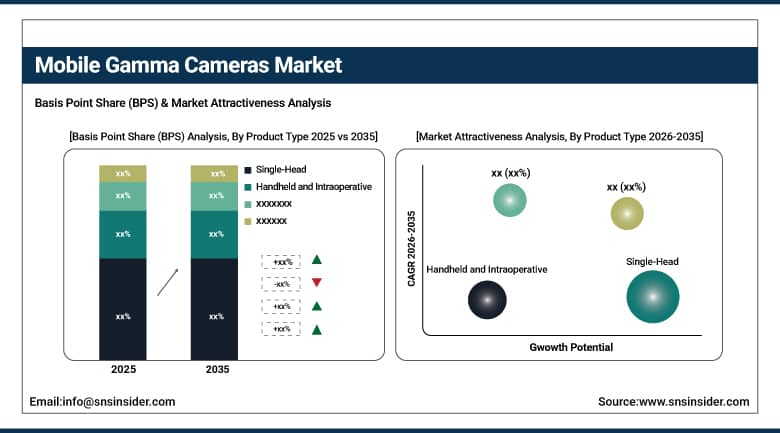
Single-head cameras accounted for 54.80% of the market in 2025. They are light, simple to position, and priced below multi-head models, which suits bedside, cardiac, and thyroid scans in smaller facilities. Technologists value that these cameras can be moved between rooms by one person, and manufacturers continue to reduce weight while keeping field of view large enough for heart and thyroid studies. Their lower price also makes them the first choice for hospitals buying a first camera. Handheld probes are also lighter than full camera heads. Single-head units also need less shielding, which simplifies installation in older buildings. Training time is short, so staff can use them after brief instruction.
Handheld and intraoperative devices are the fastest growing product type, with a projected CAGR of 6.80% from 2026 to 2035. Surgeons use them for sentinel node and radioguided procedures. Dual-head units serve busier departments that need shorter scans. Dual-head cameras shorten scan times and improve throughput, which helps larger departments, while handheld designs bring gamma imaging into surgery. Growth in cancer surgery programs supports demand for compact probes and cameras that guide resection decisions in real time. Costs of handheld units are falling steadily as electronics become smaller and cheaper. Surgical teams value the immediate feedback these devices provide.
Detector Technology Insights
Scintillator-based cameras accounted for 72.40% of the market in 2025. Sodium iodide crystals are well understood, inexpensive, and supported by established service networks, which keeps them the standard choice. Replacement crystals and photomultiplier tubes are widely available, and technicians are familiar with the technology, which keeps service costs low. Upgrades in electronics and software allow older designs to meet current image quality expectations. Established suppliers use this technology in most portable designs, and buyers appreciate its proven record in thousands of installations worldwide, which reduces perceived clinical and technical risk for first time buyers.
Semiconductor detectors are the fastest growing technology, with a projected CAGR of 7.40% from 2026 to 2035. Cadmium zinc telluride offers better energy resolution and a smaller, lighter build, which suits portable designs. Semiconductor cameras cost more but allow smaller form factors and the use of lower tracer doses. As production yields improve and prices fall, makers expect them to move from premium cardiac and surgical devices into wider portable use. Research partnerships between detector makers and hospitals continue to refine the technology. Early adopters include cardiac programs and surgical teams.
Application Insights
Cardiology accounted for 40.60% of the market in 2025. Portable cameras are used for stress and rest perfusion studies and for bedside checks of heart function, and mobile cardiology services take them to remote sites. Many hospitals use them for quick checks in patients too ill to transfer, such as detecting pulmonary perfusion defects or checking thyroid uptake, and the low cost of each scan supports frequent use. Cardiac programs in remote areas also rely on mobile units for outreach screening. Both uses are well established in clinical guidelines and have trained staff supporting them.
Oncology is the fastest growing application, with a projected CAGR of 5.90% from 2026 to 2035, helped by sentinel node mapping and breast imaging. Thyroid and endocrine imaging and other uses add stable demand. Surgeons rely on gamma guidance for breast cancer and melanoma, and handheld cameras provide a real time map of tracer location. Orthopedic and neurological uses are smaller but growing as researchers test new tracers that portable cameras can detect. Clinical evidence continues to build in these areas. Neurology studies are also emerging as new tracers for brain disorders reach clinical use.
End User Insights
Hospitals accounted for 52.00% of the market in 2025. Intensive care units, emergency departments, and operating theaters use portable cameras to avoid moving fragile patients, and hospitals hold the budgets for equipment. Their purchasing decisions are tied to departmental budgets, nuclear medicine staffing, and radiation safety approvals, and large systems often buy several units for different wards. Service contracts with suppliers add recurring revenue that smaller buyers value. Such stable procurement helps suppliers plan production and service staffing more effectively across multiple years and regions. Hospitals often keep spare units for emergencies.
Ambulatory surgical centers are the fastest growing end user, with a projected CAGR of 5.80% from 2026 to 2035, as more procedures move to outpatient settings. Diagnostic imaging centers and specialty clinics add further orders. Specialty clinics, including cardiology and endocrinology practices, are small but loyal users that prefer simple and affordable cameras. Imaging centers add steady demand where volumes support a dedicated technologist but not a full gantry system. Many such buyers also rent or lease equipment to manage cash flow and reduce upfront spending, which broadens access for smaller organizations and supports a recurring revenue model for suppliers.
Regional Insights
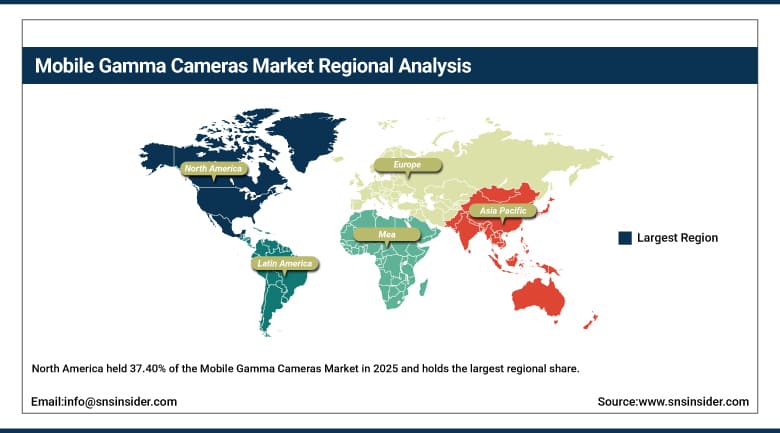
North America held 37.40% of the Mobile Gamma Cameras Market in 2025 and holds the largest regional share. The region has a large base of hospital nuclear medicine programs and cardiac imaging volumes. Mexico is reported within Latin America in this analysis, so regional figures here cover the United States and Canada only. Canada adds demand through its provincial hospital programs and cancer centers. Early adoption of new imaging tools by academic centers also helps new devices reach clinical practice.
Get Customized Report as Per Your Business Requirement - Enquiry Now
U.S. Mobile Gamma Cameras Market
The U.S. Mobile Gamma Cameras Market was valued at USD 19.29 Million in 2025 and is projected to expand at a CAGR of 3.90% from 2026 to 2035. Hospitals, cardiology practices, and cancer centers drive demand, and the country hosts several imaging makers and research centers working on portable gamma technology. Academic medical centers also lead clinical studies of portable and intraoperative gamma cameras, which supports early adoption. Many hospitals also keep older cameras in service.
Payment policy matters for purchasing. In the final rule for hospital outpatient payments released on 21 November 2025, the Centers for Medicare & Medicaid Services moved a common SPECT procedure code to a lower payment tier from 1 January 2026, while adding an extra payment for technetium-99m made from U.S.-produced molybdenum-99. Providers are weighing these changes when they plan imaging investments. Isotope supply is a further policy priority, and federal programs aim to build home production of molybdenum-99, which could stabilize scan volumes over time.
Europe Mobile Gamma Cameras Market
Europe accounted for 27.80% of the market in 2025, led by Germany, the United Kingdom, France, Italy, and Spain. Strong public health systems, active nuclear medicine societies, and home-grown makers of compact and handheld cameras support demand, and radiation protection rules push hospitals toward efficient, low dose equipment. German and Danish firms are well known for compact camera design, and university hospitals across the region take part in trials of intraoperative imaging, which helps spread new devices.
Asia Pacific Mobile Gamma Cameras Market
Asia Pacific is projected to register the fastest regional CAGR of 6.00% from 2026 to 2035, and the region held 23.60% of the market in 2025. China, Japan, India, South Korea, and Australia lead demand, supported by expanding hospital networks, rising cancer and heart disease burdens, and growing investment in nuclear medicine departments. Japan has a mature nuclear medicine community, while China and India are adding scanners and departments quickly, and local makers are developing lower cost cameras that suit regional hospitals.
Latin America Mobile Gamma Cameras Market
Latin America held 5.80% of the market in 2025, led by Brazil and Mexico, followed by Argentina and Colombia. Public hospitals and private diagnostic chains are the main buyers, and compact cameras appeal where space and budgets are limited. Mexico benefits from its large hospital sector and from cross border medical supply links with North America. Growth is gradual, as currency swings and import costs slow purchasing, although public programs for cancer and cardiac care continue to expand access to nuclear imaging.
Middle East & Africa Mobile Gamma Cameras Market
The Middle East & Africa accounted for 5.40% of the market in 2025, led by Saudi Arabia, the United Arab Emirates, Turkey, Israel, and South Africa. Investment in specialist hospitals and cancer centers drives demand, while most equipment is imported and supported through distributors and service partners. Growth in Gulf health investment and a rising burden of cancer and heart disease are expected to widen use, while limited nuclear medicine staffing in parts of Africa slows adoption.
Key Mobile Gamma Cameras Market Company Insights
Competition in the Mobile Gamma Cameras Market spans specialist portable camera makers, detector developers, and large imaging groups. Leading participants compete on sensitivity, portability, service coverage, and software support. Several smaller makers also act as supply partners for larger groups.
Key Mobile Gamma Cameras Companies:
- Catalyst MedTech, Inc.
- X3D ApS
- Spectrum Dynamics Medical
- Mediso Medical Imaging Systems
- GE HealthCare Technologies Inc.
- Siemens Healthineers AG
- Koninklijke Philips N.V.
- Canon Medical Systems Corporation
- Serac Imaging Systems Ltd.
- Crystal Photonics GmbH
- SurgicEye GmbH
- Lemer Pax
- GAEDE Medizinsysteme GmbH
- MiE GmbH
Recent Developments
- In July 2026, Spectrum Dynamics announced an all-energy enhancement for its Veriton CT-400 SPECT/CT system, with the first site in Florida.
- In May 2026, Siemens Healthineers received FDA 510(k) clearance for the VA40 software release of its Symbia Pro.specta SPECT/CT family.
- In May 2026, Eden Radioisotopes filed a construction permit application with the U.S. Nuclear Regulatory Commission for a molybdenum-99 and lutetium-177 production facility.
- In April 2026, SHINE Technologies received a conditional loan commitment of up to USD 263.00 Million for a molybdenum-99 production facility in Wisconsin.
- In April 2026, Catalyst MedTech acquired X3D, formerly DDD-Diagnostic, adding the CorCam cardiac and QuantumCam general purpose gamma cameras to its Digirad portfolio.
- In October 2025, Mediso installed its AnyScan TRIO-TheraMAX SPECT/CT system at Heidelberg University Hospital for theranostic imaging.
- In May 2025, GE HealthCare received FDA 510(k) clearance for Aurora, a dual-head SPECT/CT system, together with Clarify DL image reconstruction.
- In April 2025, Serac Imaging Systems reported clinical use of its investigational Seracam portable gamma-optical camera in more than 150 patients.
Scope and Research Methodology
This report estimates the Mobile Gamma Cameras Market through a bottom-up build from installed base and annual unit shipments of portable, single-head, dual-head, and handheld devices, multiplied by typical selling prices, and checked against a top-down view of the wider gamma camera and nuclear imaging market. The scope covers mobile and portable gamma cameras. Fixed SPECT and SPECT/CT systems, PET scanners, radiotracers, and service contracts are excluded. Prices are tracked by product type and detector technology, and unit estimates are cross checked against hospital procurement records and nuclear medicine department counts in major countries. Estimates for handheld devices are tested against surgical case volumes in breast cancer and melanoma programs.
Secondary research draws on regulatory databases, standards bodies, payment rules, company reports, clinical literature, and technical publications. Primary research includes conversations with camera makers, detector suppliers, nuclear medicine physicians, and hospital buyers, used to confirm pricing, adoption, and replacement cycles. Region coverage follows the five regions used throughout this report, with Mexico reported within Latin America. Interview findings were compared across supplier tiers to test the consistency of the estimates, and unusual inputs were followed up with further questions. Qualitative inputs from conferences and clinical trials are used to track new designs. Interviews also cover service providers, since their view of installed equipment age and replacement timing informs the forecast.
Segment shares are built from unit volumes and prices by product type, detector technology, application, and end user, then aligned with regional totals. Forecasts apply growth assumptions for each segment and region that reflect procedure volumes, isotope supply, and technology change, and they are tested against alternative scenarios. Figures are reviewed at each update as new data become available, and values are stated in U.S. dollars. Market shares of companies are assessed from product portfolios, installed base evidence, and announced orders, and company profiles describe strategy, products, and recent actions in the market. Sensitivity analysis explores how isotope supply and payment changes could move the outlook, and senior analysts review figures before release.
Mobile Gamma Cameras Market Report Scope :
| Report Attributes | Details |
|---|---|
| Market Size in 2025 | USD 61.40 Million |
| Market Size by 2035 | USD 92.65 Million |
| CAGR | CAGR of 4.20% From 2026 to 2035 |
| Base Year | 2025 |
| Forecast Period | 2026-2035 |
| Historical Data | 2022-2024 |
| Report Scope & Coverage | Market Size, Segments Analysis, Competitive Landscape, Regional Analysis, DROC & SWOT Analysis, Forecast Outlook |
| Key Segments | • By Product Type (Single-Head, Dual-Head, and Handheld and Intraoperative) • By Detector Technology (Scintillator and Semiconductor) • By Application (Cardiology, Oncology, Thyroid and Endocrine, and Others) • By End User (Hospitals, Diagnostic Imaging Centers, Ambulatory Surgical Centers, and Specialty Clinics) |
| Regional Analysis/Coverage | North America (US, Canada), Europe (Germany, UK, France, Italy, Spain, Russia, Poland, Rest of Europe), Asia Pacific (China, India, Japan, South Korea, Australia, ASEAN Countries, Rest of Asia Pacific), Middle East & Africa (UAE, Saudi Arabia, Qatar, South Africa, Rest of Middle East & Africa), Latin America (Brazil, Argentina, Mexico, Colombia, Rest of Latin America). |
| Company Profiles | Catalyst MedTech, X3D, Spectrum Dynamics, Mediso, GE HealthCare |

Frequently Asked Questions
The market was valued at USD 61.40 Million in 2025 and is projected to reach USD 92.65 Million by 2035.
The market is expected to register a CAGR of 4.20% from 2026 to 2035.
North America led the market with a 37.40% share in 2025.
Asia Pacific is expected to grow the fastest, at a CAGR of 6.00% from 2026 to 2035.
Key players include Catalyst MedTech, X3D, Spectrum Dynamics, Mediso, and GE HealthCare.
