
Molecular Biology Enzymes, Reagents and Kits Market Report Scope & Overview:
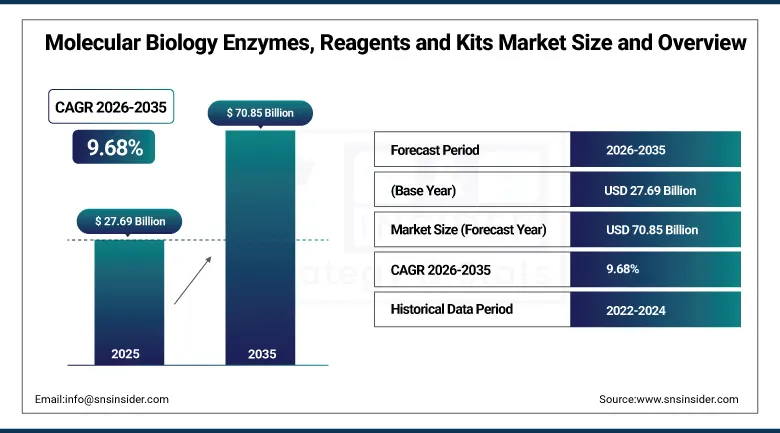
The Molecular Biology Enzymes, Reagents and Kits Market was valued at USD 27.69 Billion in 2025 and is expected to reach USD 70.85 Billion by 2035, growing at a CAGR of 9.68% from 2026 to 2035.
The Molecular Biology Enzymes, Reagents, and Kits Market is experiencing robust growth owing to increasing use of molecular diagnostic techniques, increasing genomics and proteomics research, and increasing funding in biotechnology and pharmaceutical R&D. Increasing usage of PCR, NGS, gene editing, and personalized medicine is contributing towards driving up the product usage. Growing incidences of infectious diseases, cancer, and genetic disorders are also adding to the growing demand for advanced molecular diagnosis. Moreover, increasing advancements in high-quality enzymes, automation in laboratories, and increasing research and development activities are further driving market growth during the forecast period.
According to the National Human Genome Research Institute (NHGRI), the cost of sequencing a human genome has declined dramatically from approximately USD 100 million in 2001 to less than USD 600, making next-generation sequencing (NGS) more accessible across research and clinical settings and substantially increasing the demand for molecular biology enzymes, reagents, and kits. Furthermore, the World Health Organization (WHO) reported nearly 20 million new cancer cases globally in 2022, while the continued burden of infectious diseases and genetic disorders is driving greater adoption of PCR, sequencing, and molecular diagnostic assays, further strengthening market growth.
To Get more information On Molecular Biology Enzymes, Reagents and Kits Market - Request Free Sample Report
Molecular Biology Enzymes, Reagents and Kits Market Trends
-
Rising adoption of molecular diagnostics and genetic testing driving demand for high-quality molecular biology enzymes, reagents, and kits across clinical and research laboratories
-
Growing investments in genomics, proteomics, and precision medicine accelerating the use of advanced PCR, sequencing, and nucleic acid extraction reagents
-
Increasing application of molecular biology tools in drug discovery, vaccine development, and biopharmaceutical research supporting market expansion
-
Expanding use of automated and high-throughput laboratory workflows boosting demand for standardized, ready-to-use molecular biology kits and reagents
-
Continuous advancements in enzyme engineering, next-generation sequencing (NGS), and CRISPR-based technologies enhancing the accuracy, sensitivity, and efficiency of molecular biology workflows
The U.S. Molecular Biology Enzymes, Reagents and Kits Market Outlook
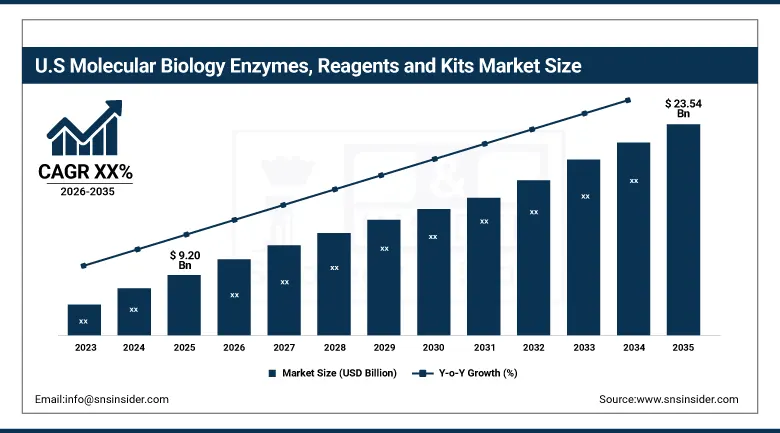
The U.S. Molecular Biology Enzymes, Reagents and Kits Market was valued at approximately USD 9.20 Billion in 2025 and is expected to reach approximately USD 23.54 Billion by 2035.
The United States leads the molecular biology enzymes, reagents, and kits industry, owing to its extensive usage of molecular techniques in clinical diagnosis, research as well as drug development. Its success owes to the considerable institutional support, state-of-the-art laboratories and the extensive usage of molecular biology tests in hospitals, academic institutions and biotechnology companies. Usage of PCR, sequencing and cloning techniques makes way for an increasing demand for enzymes, reagents and kits for molecular biology, which is also fueled by government grants provided by institutes such as National Institutes of Health and the increased usage of innovative molecular biology techniques in clinics and academics institutions.
According to the National Institutes of Health (NIH), total NIH funding exceeded USD 47 billion in FY2024, making it the world’s largest public biomedical research funding organization and significantly supporting genomics, molecular diagnostics, and life science research activities.
Molecular Biology Enzymes, Reagents and Kits Market Segment Analysis
-
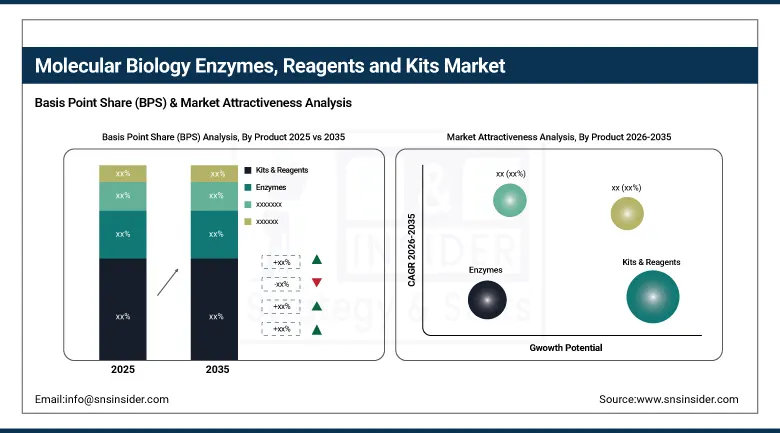
By Product, Kits & Reagents segment dominated the Molecular Biology Enzymes, Reagents, and Kits Market in 2025 with 66% share; Enzymes segment is the fastest growing segment.
-
By Application, PCR segment dominated the market in 2025 with 34% share; Epigenetics segment is the fastest growing segment.
-
By End-use, Pharma & Biotech segment dominated the market in 2025 with 48% share; Hospital & Diagnostics segment is the fastest growing segment.
By Product, Kits & Reagents segment dominates the Molecular Biology Enzymes, Reagents, and Kits Market, Enzymes segment expected to grow fastest
The Kits & Reagents segment dominated the Molecular Biology Enzymes, Reagents, and Kits Market owing to its wide usage in processes such as PCR, sequencing, cloning, nucleic acid extraction, and other molecular biology processes. This is largely driven by the fact that the laboratory uses kits and reagents owing to the standard protocol they follow, enhance reproducibility, minimize errors and make complicated procedures easy. The suitability for use in automated systems, consistency in performance, and usage in pharmaceutical firms, research institutions, and laboratories are some factors that drive the dominance of the segment.
The Enzymes segment is the fastest growing in the Molecular Biology Enzymes, Reagents, and Kits Market due to growing demand for advanced molecular biology techniques with better performing enzymes. Increasing applications in the field of genome editing, synthetic biology, next-generation sequencing, and precision medicine are driving the adoption of the products. Innovation in high-performance enzymes such as polymerases, ligases, reverse transcriptases, and restriction enzymes is expected to drive the segment growth.
By Application, PCR segment dominates the Molecular Biology Enzymes, Reagents, and Kits Market, Epigenetics segment expected to grow fastest
The PCR segment dominated the Molecular Biology Enzymes, Reagents, and Kits Market owing to its broad application in clinical diagnostics, infectious disease detection, genetic testing, forensic science, and biomedical research. Its high sensitivity, specificity, rapid processing, and reliable amplification capabilities make it an essential molecular biology technique. Continuous advancements in PCR technologies, increasing molecular diagnostic testing, and expanding research activities have further strengthened its position as the most widely adopted application.
The Epigenetics segment is the fastest growing in the Molecular Biology Enzymes, Reagents, and Kits Market due to growing demand for advanced molecular biology techniques with better performing enzymes. Increasing applications in the field of genome editing, synthetic biology, next-generation sequencing, and precision medicine are driving the adoption of the products. Innovation in high-performance enzymes such as polymerases, ligases, reverse transcriptases, and restriction enzymes is expected to drive the segment growth.
By End-use, Pharma & Biotech segment dominates the Molecular Biology Enzymes, Reagents, and Kits Market, Hospital & Diagnostics segment expected to grow fastest
The Pharma & Biotech segment dominated the Molecular Biology Enzymes, Reagents, and Kits Market owing to the significant application of molecular biology enzymes, reagents, and kits in drug discovery, biologic development, vaccine discovery, and genomics applications. Increasing R&D investments, growing use of precision medicine, and rising clinical research are the major factors driving the demand for such products. Collaborations, innovations, and advancements in therapeutic development processes have further contributed to its dominance.
The Hospital & Diagnostics segment is the fastest growing in the Molecular Biology Enzymes, Reagents, and Kits Market due to the rising adoption of molecular diagnostic tests in diagnosing infectious diseases, cancers, and genetic disorders. The rising need for early diagnosis and personalized medicine treatments is contributing significantly to this growth rate. Improved lab infrastructure and rising integration of molecular tests in the healthcare facilities have further contributed to the growth.
Regional Analysis
|
Region |
Major Country |
Share within Region, 2025 (%) |
|---|---|---|
|
North America |
United States |
82.47% |
|
Europe |
Germany |
28.47% |
|
Asia Pacific |
China |
38.47% |
|
Middle East & Africa |
UAE |
22.84% |
|
Latin America |
Brazil |
43.84% |
North America Molecular Biology Enzymes, Reagents and Kits Market Insights
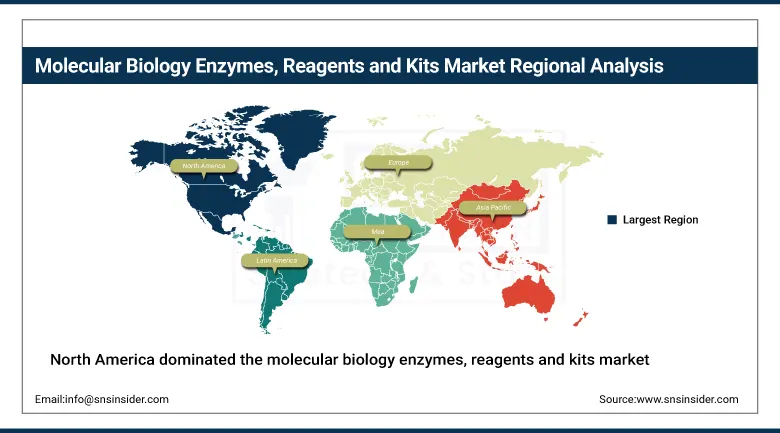
North America dominated the molecular biology enzymes, reagents and kits market, holding the largest revenue share, due to its advanced research infrastructure, strong presence of biotechnology and pharmaceutical companies, and consistent funding for molecular science. The region benefits from high adoption of technologies including PCR and next-generation sequencing across academic, clinical, and commercial laboratories, with the growth of the market fuelled by the region's widespread presence in the biotechnology and pharmaceutical research industry, as well as high levels of investment in molecular diagnostics and genomics.
The United States accounts for approximately 82.47% of regional revenue through its dominant contribution backed by widespread government funding from organisations including the National Institutes of Health and growing uptake of cutting-edge molecular biology methods in clinics and academic institutions.
In addition, the National Cancer Institute estimates approximately 2 million new cancer cases annually in the United States, which is substantially increasing the demand for molecular diagnostic reagents, genomic testing, PCR assays, sequencing workflows, and other advanced molecular biology products used for early detection, disease monitoring, and precision medicine applications.
Get Customized Report as per Your Business Requirement - Enquiry Now
Europe Molecular Biology Enzymes, Reagents and Kits Market Insights
Europe held a significant share of global Molecular Biology Enzymes, Reagents and Kits revenues, ranking as a major market because of increased research activities, established healthcare infrastructure, and expanding uses of molecular biology in individualised medicine. Germany accounts for approximately 28.47% of European revenues through its advanced research infrastructure and increasing adoption of molecular tools in healthcare and academia, with the country's focus on precision diagnostics, biotechnology, and personalised treatment driving demand for PCR kits, sequencing reagents, and specialised enzymes.
The United Kingdom and France are similarly leading nations in genomics research, with government-led initiatives supporting life sciences and expanding diagnostic capabilities encouraging adoption of molecular biology products across academic, clinical, and pharmaceutical settings.
Furthermore, the European Commission's 1+ Million Genomes Initiative aims to enable secure access to genomic data from more than one million genomes across Europe, accelerating genomic research, precision medicine, and cross-border collaboration in healthcare. In addition, Europe's Beating Cancer Plan allocates €4 billion to strengthen cancer prevention, early diagnosis, genomic testing, and personalized medicine, driving greater adoption of molecular diagnostics and advanced laboratory technologies.
Asia Pacific Molecular Biology Enzymes, Reagents and Kits Market Insights
Asia Pacific is expected to register the fastest growth rate over the forecast period, with growth supported by rising government investment, expanding biotechnology ecosystems, and strong demand for molecular diagnostics across the region.
China spearheads the region's growth, with substantial investments in genomics and biopharmaceutical development, accounting for approximately 38.47% of Asia Pacific revenues through the country's growing R&D efforts and robust government interest in molecular diagnostics. The pharmaceutical and biotechnology industry is shifting toward local reagent manufacturers to cut costs and increase adoption, with India's government having embarked on several biotechnology sector initiatives for startups that will drive growth of the molecular biology enzymes, kits and reagents market in the country.
According to the National Health Commission of China, the country reports more than 4 million new cancer cases annually, significantly increasing the demand for molecular diagnostics, genomic sequencing, PCR-based testing, and precision medicine technologies.
Similarly, the Indian Council of Medical Research (ICMR) estimates approximately 1.5 million new cancer cases annually in India, while the continued expansion of genomic medicine, molecular diagnostics, and biomedical research is driving greater adoption of molecular biology enzymes, reagents, and kits.
MEA & Latin America Molecular Biology Enzymes, Reagents and Kits Market Insights
Middle East and Latin America are growing Molecular Biology Enzymes, Reagents and Kits markets where expanding healthcare infrastructure, growing biotechnology investment, and rising molecular diagnostics adoption are creating increasing commercial demand. The UAE leads MEA revenues at approximately 22.84% of the regional total through its growing investment in life sciences research infrastructure and expanding molecular diagnostics capability across its healthcare system. Brazil leads Latin American revenues at approximately 43.84% of the regional total through its growing pharmaceutical and biotechnology sector, expanding academic research institutions, and increasing molecular diagnostics adoption across its healthcare system.
Market Dynamics
Drivers: Rising precision medicine adoption and increasing cancer burden accelerate demand for advanced molecular diagnostics.
The growth in the market for molecular biology enzymes, reagents and kits will be supported by the fusion of the evolution of the practice of clinical medicine through the advent of precision medicine and its increasing reliance on the molecular diagnostic tools that facilitate treatment based on biomarkers and the increased cancer burden around the world, whereby over 19.3 million cases of cancer were diagnosed globally in 2023.
Public funding in addition to venture capital and industry-led research and development ensure continuous and steady financing of life sciences research and therefore constant procurement of molecular biology reagents throughout different economic periods, while high penetration rates of molecular diagnostics in the fields of infectious disease diagnostics, oncology and genetic testing lead to a higher usage of PCR and amplification reagents.
Restraints: High product costs and batch-to-batch variability limit adoption among budget-constrained laboratories.
There are several factors that have the potential to limit the growth of the market for enzymes, kits, and reagents used in the field of molecular biology. These include the expensive nature of the products, variability of batches, and the demand for extremely reliable performance in certain tests, which cannot accommodate any sort of inconsistency in the reagents used. This particular category of consumers, that is, academic labs and biotechnology startups, is seen as having a limited budget and therefore being price-sensitive, and not interested in premium products.
Opportunities: CRISPR gene editing and next-generation sequencing innovations create significant commercial growth opportunities.
Increased use of artificial intelligence in genomics research is enhancing the process of data analysis and leading to breakthroughs that fuel even greater need for advanced molecular biology reagents whose data will be analyzed by these AI algorithms, thus forming a reinforcing growth cycle between the capabilities of computational genomics and enzyme/reagent usage.
Availability of inexpensive high throughput sequencing technologies is opening up possibilities for molecular research for developing nations, while increased collaborations between biotech companies and research institutions are fostering innovation in the development of new enzyme/reagent formulas whose technological development keeps expanding the application potential of molecular biology consumables.
Recent Developments:
-
2024: Illumina launched the MiSeq i100 and i100 Plus sequencing systems featuring room-temperature reagent storage, eliminating cold-chain logistics requirements and substantially expanding sequencing accessibility in resource-constrained laboratory settings globally.
-
2024: QIAGEN received FDA clearance for its NeuMoDx CT/NG Assay 2.0 for direct detection of Chlamydia trachomatis and Neisseria gonorrhoeae, expanding clinical molecular diagnostic capability across U.S. laboratory settings.
-
2023: QIAGEN expanded its standalone enzyme offerings for customisable workflows, providing researchers with greater flexibility to design tailored molecular biology protocols using individually sourced high-quality enzyme components.
Molecular Biology Enzymes, Reagents and Kits Market Key Players are:
-
Thermo Fisher Scientific
-
Merck KGaA (MilliporeSigma)
-
QIAGEN N.V.
-
F. Hoffmann-La Roche Ltd.
-
Agilent Technologies, Inc.
-
Bio-Rad Laboratories, Inc.
-
Danaher Corporation
-
Promega Corporation
-
New England Biolabs, Inc.
-
Takara Bio Inc.
-
Illumina, Inc.
-
PerkinElmer, Inc.
-
Bio-Techne Corporation
-
LGC Limited
-
Eurofins Scientific SE
-
Abcam plc
-
Sartorius AG
-
Revvity, Inc.
-
Oxford Nanopore Technologies plc
-
Zymo Research Corporation
Molecular Biology Enzymes, Reagents and Kits Market Report Scope:
| Report Attributes | Details |
|---|---|
| Market Size in 2025 | USD 27.69 Billion |
| Market Size by 2035 | USD 70.85 Billion |
| CAGR | CAGR of 9.68% from 2026 to 2035 |
| Base Year | 2025 |
| Forecast Period | 2026-2035 |
| Historical Data | 2022-2024 |
| Report Scope & Coverage | Market Size, Segments Analysis, Competitive Landscape, Regional Analysis, DROC & SWOT Analysis, Forecast Outlook |
| Key Segments | • By Product (Kits & Reagents, Enzymes) • By Application (Cloning, Sequencing, PCR, Epigenetics, Restriction Digestion, Other Applications) • By End-use (Pharma & Biotech, Academic & Research, Hospital & Diagnostics, Others) |
| Regional Analysis/Coverage | North America (US, Canada), Europe (Germany, UK, France, Italy, Spain, Russia, Poland, Rest of Europe), Asia Pacific (China, India, Japan, South Korea, Australia, ASEAN Countries, Rest of Asia Pacific), Middle East & Africa (UAE, Saudi Arabia, Qatar, South Africa, Rest of Middle East & Africa), Latin America (Brazil, Argentina, Mexico, Colombia, Rest of Latin America). |
| Company Profiles | Thermo Fisher Scientific, Merck KGaA (MilliporeSigma), QIAGEN N.V., F. Hoffmann-La Roche Ltd., Agilent Technologies, Inc., Bio-Rad Laboratories, Inc., Danaher Corporation, Promega Corporation, New England Biolabs, Inc., Takara Bio Inc., Illumina, Inc., PerkinElmer, Inc., Bio-Techne Corporation, LGC Limited, Eurofins Scientific SE, Abcam plc, Sartorius AG, Revvity, Inc., Oxford Nanopore Technologies plc, Zymo Research Corporation. |

Frequently Asked Questions
The Molecular Biology Enzymes, Reagents and Kits Market is expected to grow at a CAGR of 9.68% from 2026 to 2035.
The Molecular Biology Enzymes, Reagents and Kits Market was valued at USD 27.69 Billion in 2025.
Growing precision medicine adoption, rising cancer diagnostics demand, CRISPR and NGS advancements, expanding research investments, and AI-driven genomic analysis accelerate market growth.
The kits & reagents segment dominated the Molecular Biology Enzymes, Reagents and Kits Market
North America dominated the Molecular Biology Enzymes, Reagents and Kits Market in 2025.
