
Non-Alcoholic Beer Market Report Scope & Overview:
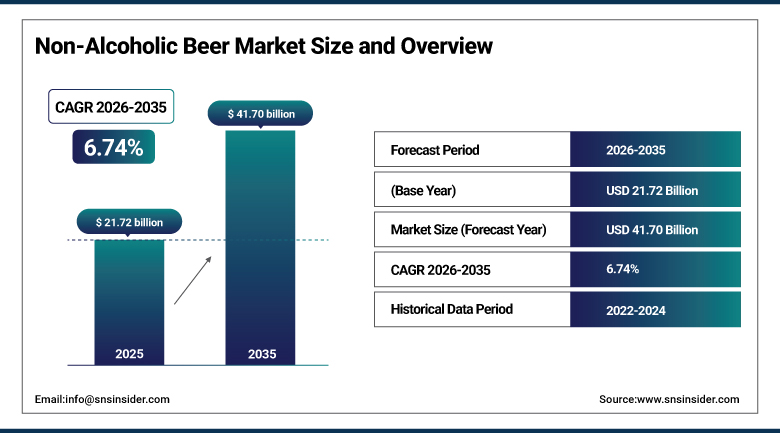
The Non-Alcoholic Beer Market was valued at USD 21.72 Billion in 2025 and is expected to reach USD 41.70 Billion by 2035, growing at a CAGR of 6.74% from 2026 to 2035.
Rapid Growth in the Market for Non-Alcoholic Beers is driven by increasing health awareness, changes in lifestyle preferences and increasing sobriety trends, and advancements in brewing technology that are bridging the gap in tastes between conventional beers. Non-alcoholic beer is manufactured by either eliminating the alcohol content from a fully brewed beer or by interfering with the process of fermentation such that alcohol does not form in significant quantities. Over the years, the non-alcoholic beer segment has transitioned from being an unconventional segment into a popular one due to the increasing quality and taste of the brews. In addition, the growth of this market is driven by increased awareness about the risks associated with consumption of alcohol, increased product innovation, increased distribution channels and availability of products.
Athletic Brewing Company and Heineken both expanded their non-alcoholic beer production and flavor innovation programs in 2026 to meet surging consumer demand for authentic-tasting, alcohol-free beer alternatives as the sober-curious and mindful drinking movement continues gaining mainstream momentum across major beer-drinking markets.
Market Size and Forecast
- Market Size in 2026E: USD 23.18 Billion
- Market Size by 2035: USD 41.70 Billion
- CAGR: 6.74% from 2026 to 2035
- Fastest Growing Region: Asia Pacific
- Largest Region: Europe
To Get more information Non-Alcoholic Beer Market - Request Free Sample Report
Non-Alcoholic Beer Market Trends
- Rising sober-curious and mindful drinking movements, particularly among younger consumer demographics, are driving mainstream adoption of non-alcoholic beer beyond its traditional niche positioning.
- Growing technological advancement in brewing and alcohol removal processes is narrowing the taste perception gap between non-alcoholic and conventional beer, expanding the category's broader consumer appeal.
- Increasing expansion of craft non-alcoholic beer offerings is providing consumers with more diverse flavor profiles and styles, moving the category beyond basic lager toward ales, stouts, and wheat beers.
- Expanding retail and foodservice distribution, including growing supermarket shelf space and dedicated bar and restaurant menu placement, is significantly improving non-alcoholic beer accessibility.
- Strategic partnerships among major brewers, craft producers, and health-focused retailers are supporting development of increasingly diverse, premium-positioned non-alcoholic beer product portfolios.
The U.S. Non-Alcoholic Beer Market Outlook
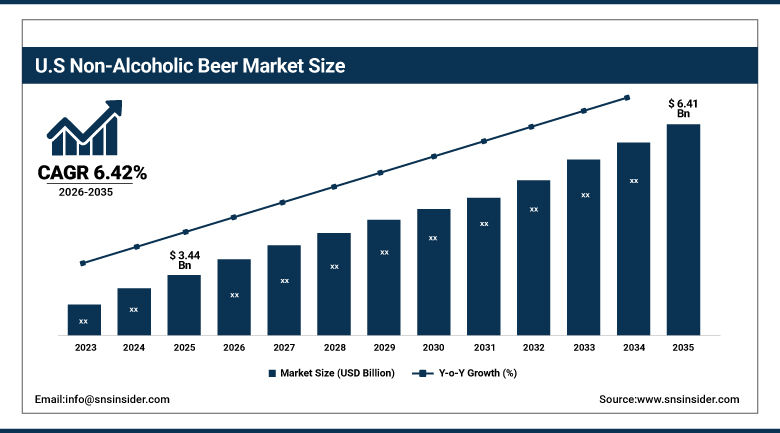
The U.S. Non-Alcoholic Beer Market was valued at USD 3.44 Billion in 2025 and is projected to reach USD 6.41 Billion by 2035, growing at a CAGR of 6.42% during 2026–2035.
Top breweries of the nation continue making progress with regards to their non-alcoholic beer production, as they adopt the sobriety curious movement that is being led by companies like the Athletic Brewing Company, which has been making a lot of headway in terms of its market share by way of flavor differentiation and retail distribution of its products. Consumer appeal in relation to low calorie functional beverages as well as increased shelf space in retail grocers and specialty shops and food services is what continues to drive demand in the nation's growing beverage market.
The U.S. manufacturing capacity and range of flavors was increased in 2026 by Athletic Brewing Company due to high consumer demand for its alcohol-free craft beer, thus affirming itself as the top brand in the market.
Non-Alcoholic Beer Market Segment Analysis
- By Category, regular non-alcoholic beer dominated the non-alcoholic beer market with a 54.60% share in 2025, while flavored non-alcoholic beer is the fastest-growing product type segment with a CAGR of 8.60% from 2026–2035.
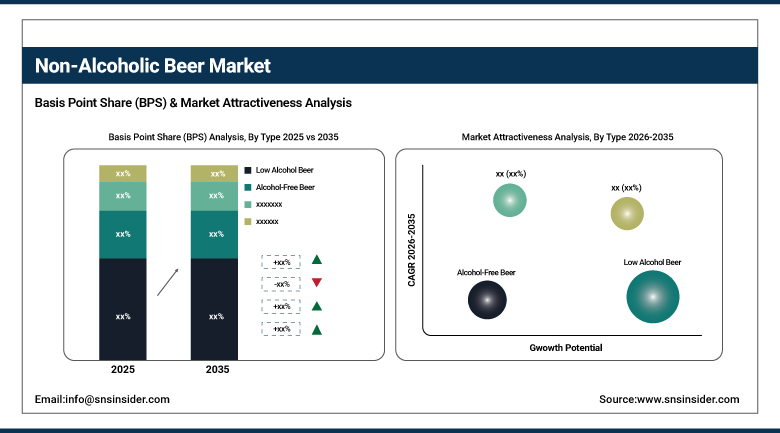
- By Type, low-alcohol dominated the non-alcoholic beer market with a 60.00% share in 2025, while alcohol-free is the fastest-growing alcohol content segment with a CAGR of 8.90% from 2026–2035.
- By Packaging, bottles dominated the non-alcoholic beer market with a 52.30% share in 2025, while cans is the fastest-growing packaging segment with a CAGR of 8.40% from 2026–2035.
- By Distribution Channel, supermarkets/hypermarkets dominated the non-alcoholic beer market with a 48.60% share in 2025, while online retail is the fastest-growing distribution channel segment with a CAGR of 10.20% from 2026–2035.
By Type, low-alcoholic dominated the non-alcoholic beer market, while alcohol-free is the fastest-growing segment.
The low alcohol category ruled the non-alcoholic beer industry by holding a revenue market share of 60.00% in 2025. The low alcohol category will continue to dominate the non-alcoholic beer market due to its balanced combination of true beer flavoring along with low alcohol percentage, which makes it compliant with the non-alcoholic beer label criteria in almost all regions.
The alcohol-free segment is expected to witness the fastest CAGR of 8.90% during the forecast period 2026-2035. Growing consumer preference for completely alcohol-free options, particularly among pregnant individuals, recovering alcoholics, and religiously observant consumers, is driving rising demand for this strictly zero-alcohol category, as brewing technology continues improving the taste quality achievable at true 0.0% alcohol content.
By Packaging, bottles dominated the non-alcoholic beer market, while cans is the fastest-growing segment.
In 2025, the Bottles accounted for 52.30% market share of the Non-Alcoholic Beer Market value. Bottles continue to lead among all the other types of packages due to consumers' beliefs that glass bottles are premium in nature and have higher similarity to the package of a traditional beer drink, which helps establish non-alcoholic beer as a real alternative.
The cans segment is expected to witness the fastest CAGR of 8.40% during the forecast period 2026-2035. As consumers tend to show increasing favor toward the lightweight and eco-friendly packaging offered by the can form, especially among younger generations, along with the convenience factors that come with cans in such activities, more companies are moving towards canned non-alcoholic beer options.
By Distribution Channel, supermarkets/hypermarkets dominated the non-alcoholic beer market, while online retail is the fastest-growing segment.
The supermarkets/hypermarkets segment dominated the non-alcoholic beer market with a revenue share of 48.60% in 2025. Supermarkets and hypermarkets remain the dominant distribution channel owing to their expanding dedicated shelf space for non-alcoholic beer as the category has grown from a niche offering to a standard product category stocked across the majority of grocery retail formats worldwide.
The online retail segment is expected to witness the fastest CAGR of 10.20% during the forecast period 2026-2035. Growing direct-to-consumer brand models, particularly among craft non-alcoholic beer producers seeking to build brand loyalty without relying on limited physical retail shelf space, combined with expanding subscription-based delivery services, is driving rapid growth in online retail distribution across the category.
Regional Insights
|
Region |
Major Country |
Share within Region, 2025 (%) |
|---|---|---|
|
North America |
United States |
82.60% |
|
Europe |
Germany |
27.40% |
|
Asia Pacific |
China |
43.90% |
|
Middle East & Africa |
UAE |
25.70% |
|
Latin America |
Brazil |
37.80% |
North America Non-Alcoholic Beer Market Insights
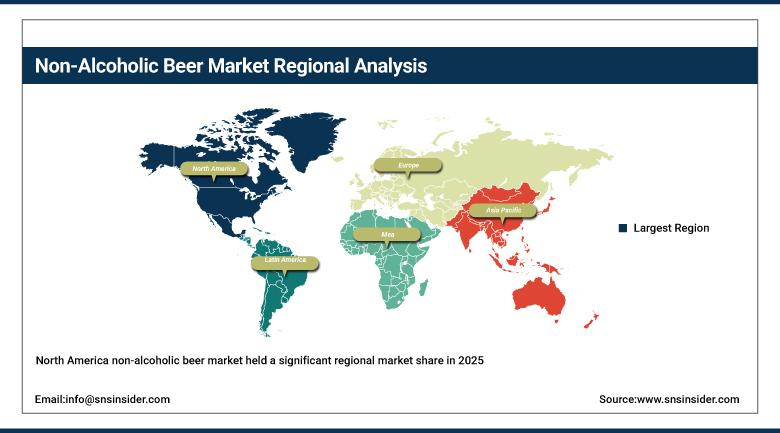
The North America non-alcoholic beer market held a significant regional market share in 2025 owing to strong sober-curious movement adoption, well-established craft brewing culture that has extended into the non-alcoholic category, and rising health-conscious consumer demand across the region's diverse beer-drinking population.
In 2025, the US emerged as the top country within the North America non-alcoholic beer market with 82.60% market share in the region due to factors such as domestic dominance from brands like Athletic Brewing Company, increased availability of products through retail and food service channels, and consumer acceptance of alcohol-free beer as a credible product type. The growth of the Canadian craft beer industry and consumer interest in mindfulness are fueling regional growth.
Get Customized Report as per Your Business Requirement - Enquiry Now
Europe Non-Alcoholic Beer Market Insights
Non-alcoholic beer held the largest market share among all regions in Europe due to the well-developed beer culture within the region as well as increasing wellness trends in Europe. This is an excellent situation for non-alcoholic beer to take advantage of since people prefer beer culture, but at the same time, they consider their health.
Germany is one of the major markets in Europe owing to its extensive brewing heritage and strong presence of leading breweries such as Erdinger and Bitburger that have successfully extended their traditional expertise into non-alcoholic product lines. Other countries such as Spain, the United Kingdom, and the Netherlands are also contributing to market growth through expanding non-alcoholic beer retail presence and rising consumer wellness trend adoption.
Asia Pacific Non-Alcoholic Beer Market Insights
The Asia Pacific non-alcoholic beer market is expected to witness the fastest growth rate during the forecast period 2026-2035. The market growth is driven by rapid urbanization, expanding middle-class populations, and growing cultural acceptance of alcohol-free beverages across the region's rapidly evolving beer-drinking markets.
China is one of the main growth drivers in the Asia Pacific non-alcoholic beer market, owing to its massive beer-drinking population and rapidly growing health and wellness consumer trends. Also contributing to the growth in the region are Japan and South Korea with their established drinking culture of non-alcoholic beers as well as new product innovations by the leading breweries in both domestic and foreign companies.
Middle East & Africa and Latin America Non-Alcoholic Beer Market Insights
Middle East & Africa and Latin American regions are showing steady growth in non-alcoholic beer adoption due to changing consumer attitudes and increasing product availability, with the Middle East region representing a particularly significant growth opportunity given religious and cultural preferences favoring alcohol-free beverage alternatives.
Emerging market opportunity in Brazil lies in the form of increasing consumer awareness about health, coupled with the rising distribution of non-alcoholic beers. The Middle East & Africa markets include UAE and Saudi Arabia where there is already a considerable market presence due to strong consumer preferences for non-alcoholic beverages owing to religious reasons.
Growth Drivers: Rising health consciousness and mindful drinking trends driving market growth
The rising health consciousness and shifting lifestyle preferences, growing sober-curious and mindful drinking movements among younger demographics, and continued advancement in brewing and alcohol removal technologies are among the primary drivers of the Non-Alcoholic Beer Market. Non-alcoholic beer has evolved from a niche category into a mainstream beverage segment as brewers increasingly deliver authentic flavor profiles that closely replicate traditional beer drinking experiences without the associated alcohol content and calorie load.
The technology used in vacuum distillation, reverse osmosis, and fermentation techniques has improved greatly to reduce the gap in taste perception between non-alcoholic beer and regular beer, which had been the major barrier for adoption in the past. Increased knowledge of the negative effects of alcohol on health, growth in distribution channels, increased awareness of health benefits, and increasing innovations in flavors and craft non-alcoholic beers will continue to boost demand over the forecast period.
Restraints: Taste perception gaps and higher production costs limiting market expansion
One of the main barriers to market growth is the persistent taste perception gap that some consumers continue to associate with non-alcoholic beer relative to conventional alternatives, despite significant brewing technology improvements, as certain traditional beer drinkers remain skeptical of alcohol-free options without having sampled recent-generation products.
Furthermore, the manufacturing process of non-alcoholic beer typically includes extra stages not required in standard brewing, such as alcohol extraction or fermentation control, leading to increased manufacturing costs and hence greater prices, which may restrict acceptance of non-alcoholic beers in certain consumer groups due to higher costs. Non-alcoholic beers' less developed distribution networks, as compared to those used for conventional beer distribution, may be a further barrier to their growth in some markets.
Opportunities: Expansion of craft offerings and emerging market distribution creating new growth avenues
Growth of the number of craft non-alcoholic beers brands, emergence of more opportunities in the developing regions of Asia-Pacific and Latin America, and product customization according to different cultural or religious consumer needs are the trends that will create great potential for the Non-Alcoholic Beer Market. High demand for authentic flavors in the non-alcoholic category is forecasted to drive future demand as the market keeps maturing past the stage of traditional lagers.
There is a considerable growth opportunity in the continued development of partnerships with health-focused retailers and food service operators offering exclusive or featured non-alcoholic beer placement, further normalizing the category within mainstream beverage retail environments. Growth in distribution networks along with the availability of products in emerging markets such as Asia Pacific, Latin America, and the Middle East will generate significant growth in demand over the forecast period, especially in regions that have a favorable culture towards non-alcoholic beverages.
Recent Developments:
- 2025: Athletic Brewing Company launched a new flavor expansion for national retail distribution, reinforcing its market-leading position in the U.S. non-alcoholic craft beer category with over 12.8% global market share.
- 2025: Heineken updated its Heineken 0.0 marketing campaign and product formulation, aiming to further narrow the taste gap with conventional beer while expanding its global non-alcoholic distribution footprint.
- 2026: Carlsberg Group launched a new non-alcoholic pilsner, expanding its portfolio of alcohol-free beer offerings targeting health-conscious consumers across its core European markets.
- 2026: Anheuser-Busch InBev expanded its Budweiser Zero product line with additional flavor variants, strengthening its position within the rapidly growing mainstream non-alcoholic beer segment.
Non-Alcoholic Beer Companies are:
- Athletic Brewing Company
- Heineken N.V.
- Anheuser-Busch InBev
- Carlsberg Group
- Molson Coors Beverage Company
- Beer52 Limited
- Diageo plc
- Pabst Brewing Company
- Koninklijke Grolsch N.V.
- Lagunitas Brewing Company
- Mikkeller ApS
- Krombacher Brauerei
- Brooklyn Brewery
- BrewDog plc
- Asahi Group Holdings, Ltd.
- Erdinger Weißbräu
- Bitburger Braugruppe GmbH
- Damm S.A. (Estrella Damm)
- Suntory Holdings Limited
- Kirin Holdings Company, Limited
Non-Alcoholic Beer Market Report Scope :
| Report Attributes | Details |
|---|---|
| Market Size in 2025 | USD 21.72 Billion |
| Market Size by 2035 | USD 41.70 Billion |
| CAGR | CAGR of 6.74% From 2026 to 2035 |
| Base Year | 2025 |
| Forecast Period | 2026-2035 |
| Historical Data | 2022-2024 |
| Report Scope & Coverage | Market Size, Segments Analysis, Competitive Landscape, Regional Analysis, DROC & SWOT Analysis, Forecast Outlook |
| Key Segments | • By Category (Regular Non-Alcoholic Beer, Flavored Non-Alcoholic Beer, Malt-Based Non-Alcoholic Beer, Craft Non-Alcoholic Beer) • By Type (Alcohol-Free Beer, Low Alcohol Beer) • By Packaging (Bottles, Cans, PET Bottles, Kegs) • By Distribution Channel (Supermarkets/Hypermarkets, Convenience Stores, Online Retail, Specialty Stores) |
| Regional Analysis/Coverage | North America (US, Canada), Europe (Germany, UK, France, Italy, Spain, Russia, Poland, Rest of Europe), Asia Pacific (China, India, Japan, South Korea, Australia, ASEAN Countries, Rest of Asia Pacific), Middle East & Africa (UAE, Saudi Arabia, Qatar, South Africa, Rest of Middle East & Africa), Latin America (Brazil, Argentina, Mexico, Colombia, Rest of Latin America). |
| Company Profiles | Athletic Brewing Company, Heineken N.V., Anheuser-Busch InBev, Carlsberg Group, Molson Coors Beverage Company, Beer52 Limited, Diageo plc, Pabst Brewing Company, Koninklijke Grolsch N.V., Lagunitas Brewing Company, Mikkeller ApS, Krombacher Brauerei, Brooklyn Brewery, BrewDog plc, Asahi Group Holdings, Ltd., Erdinger Weißbräu, Bitburger Braugruppe GmbH, Damm S.A. (Estrella Damm), Suntory Holdings Limited, Kirin Holdings Company, Limited. |
Frequently Asked Questions
The Non-Alcoholic Beer Market is expected to grow at a CAGR of 6.74% from 2026 to 2035.
The Non-Alcoholic Beer Market was valued at USD 21.72 Billion in 2025.
The market is driven by rising health consciousness, growing sober-curious and mindful drinking movements, and continued advancement in brewing and alcohol removal technologies.
The Alcoholic Free segment dominated the Non-Alcoholic Beer Market in 2025, accounting for approximately 60.00% market share.
The Europe region dominated the Non-Alcoholic Beer Market in 2025, driven by the region's deeply established beer culture combined with strong wellness trends.
