
Offshore Wind Cable Market Report Scope & Overview:
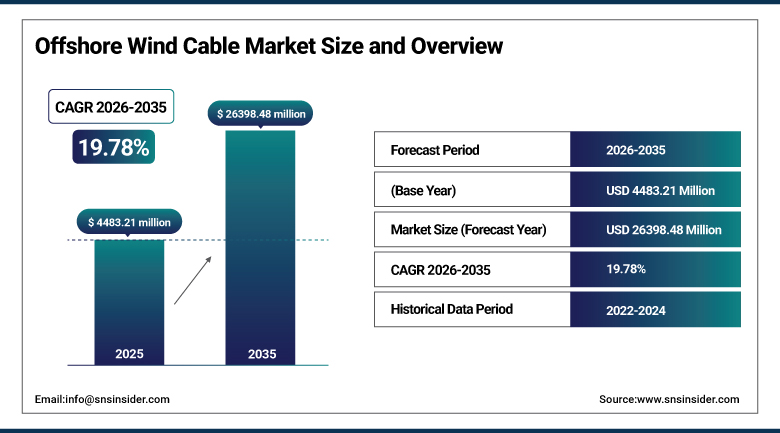
The Offshore Wind Cable Market was valued at USD 4483.21 million in 2025 and is expected to reach USD 26,398.48 million by 2035, growing at a CAGR of 19.78% from 2026-2035.
The Offshore Wind Cable Market is experiencing significant growth owing to the fast pace at which offshore wind energy projects are expanding on a global scale and due to the massive investments being made in the development of renewable energy infrastructures. The increasing initiatives of governments towards carbon neutral and renewable energy policies have also boosted the development of offshore wind farms, thereby leading to an increased need for inter-array, export, and transmission cables. Innovations in technologies related to high-voltage submarine cables are enhancing transmission capacity over large distances.
Global offshore wind capacity reached about 83 GW in 2024, showing significant expansion as more wind farms are deployed worldwide.
In France, 12 GW of renewable energy tenders were launched, including 10 GW of offshore wind projects, as part of a strategy to expand clean energy infrastructure.
To Get more information Offshore Wind Cable Market - Request Free Sample Report
Offshore Wind Cable Market Trends
-
Rising investments in offshore wind energy projects are driving the offshore wind cable market.
-
Growing demand for efficient power transmission from offshore turbines to onshore grids is boosting market growth.
-
Expansion of large-scale offshore wind farms is fueling deployment of inter-array and export cables.
-
Increasing focus on high-voltage subsea cables and grid connectivity is shaping adoption trends.
-
Advancements in cable insulation, durability, and installation technologies are enhancing performance and reliability.
-
Rising government support and renewable energy targets are supporting market expansion.
-
Collaborations between cable manufacturers, offshore developers, and EPC contractors are accelerating innovation and global adoption.
The U.S. Offshore Wind Cable Market Outlook:
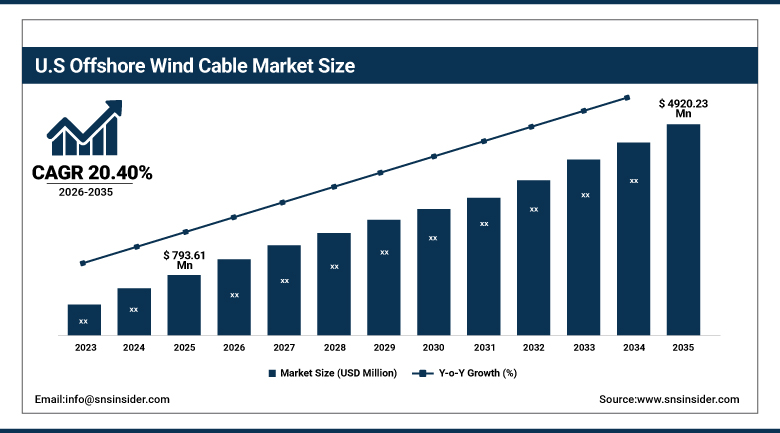
U.S. Offshore Wind Cable Market was valued at USD 793.61 million in 2025 and is expected to reach USD 4920.23 million by 2035, growing at a CAGR of 20.40% from 2026-2035.
U.S. Offshore Wind Cable Market is projected to experience significant growth owing to the rising installation of offshore wind farms, government initiatives related to clean energy, and high goals set by the renewable energy industry. With the increased investment in subsea transmission system, expansion of offshore lease projects, and growing requirement for grid connectivity, the use of offshore wind cables is on the rise.
Offshore Wind Cable Market Segment Analysis
-
By Cable Type, Inter-Array Cables segment dominated the Offshore Wind Cable Market in 2025 with 46.07% share; Dynamic Cables segment is the fastest growing segment with a CAGR of 21.67%.
-
By Current Type, AC Cables segment dominated the market in 2025 with 70.84% share; DC Cables segment is the fastest growing segment with a CAGR of 22.48%.
-
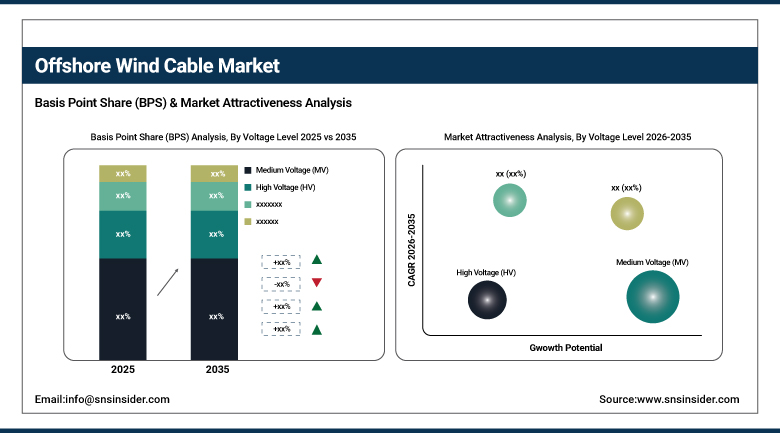
By Voltage Level, Medium Voltage (MV) segment dominated the market in 2025 with 43.44% share; Extra High Voltage (EHV) segment is the fastest growing segment with a CAGR of 24.58%.
-
By Armoring Type, Wire Armor segment dominated the market in 2025 with 81.29% share; Wire Armor segment is also the fastest growing segment with a CAGR of 20.98%.
-
By Installation Type, Buried Cables segment dominated the market in 2025 with 45.32% share; Dynamic Installation (Floating Systems) segment is the fastest growing segment with a CAGR of 25.31%.
-
By Conductor Material, Copper segment dominated the Offshore Wind Cable Market in 2025 with 80.96% share; Aluminum segment is the fastest growing segment with a CAGR of 22.43%.
By Voltage Level, Medium Voltage (MV) segment dominates the Offshore Wind Cable Market, Extra High-voltage (EHV) Cables segment expected to grow fastest
Medium Voltage (MV)
Why the Segment is Important: The Medium Voltage cables are the key segment of the electrical infrastructure that is necessary in every offshore wind farm irrespective of its size because the inter-array collection system cables are always a vital part of electrical infrastructure for any offshore projects. The importance of this segment is driven by the high demand of this segment, as inter-array cables are always in high demand due to the high volume of inter-array circuits.
Growth Outlook: The growth rate in the medium voltage segment is forecasted to be relatively low compared to others and at 17.74% for the period between 2026-2035 as it is the most developed segment with limited changes except for building new projects. Although there will be additional value for the segment with the increasing shift towards high voltage inter-array circuits up to 66 kV from 33 kV.
Extra High Voltage (EHV)
Why the Segment is Important: Extra high voltage cables, although comprising only a small share of the current market by value, are at the cutting edge of offshore wind technology and demand, as EHV systems are incorporated in designs for larger generation clusters while also being specified for future offshore grid interconnection projects that will mark the next stage in developing the industry.
Growth Outlook: The EHV segment is expected to grow at the highest growth rate among all voltage level categories and one of the highest growth rates across the entire segment analysis between 2026-35 with a CAGR of 24.58%, directly reflective of an accelerating pipeline of both gigawatt-scale offshore wind projects as well as initiatives to develop offshore grid interconnectors that will rely on export and interconnection cable systems rated for high voltages (EHV).
By Current Type, AC Cables segment dominates the Offshore Wind Cable Market, DC Cables segment expected to grow fastest
AC Cables
Why the Segment is Important: AC cables are the basis of all inter-array cables in offshore wind farms as well as the dominant technology used in export transmissions in most existing offshore wind energy projects. The significance of this segment lies in the fact that it is both the de facto solution and most cost-effective one for a vast majority of configurations, thanks to an already established supply chain, industry standards, and decades of experience in offshore wind and oil and gas subsea cable sectors.
Growth Outlook: It is expected that the segment of AC cables will see a growth rate of 18.46% from 2026 to 2035, which is somewhat lower than the average for the whole market but still positive, owing mainly to steady volumes of sales due to demand for inter-array cables in all offshore wind projects, even though an increasing number of offshore wind energy projects favor DC export transmissions in larger projects located farther off the shore.
DC Cables
Why the Segment is Important: The DC cables play an important role as the enabling technology required to realize offshore wind development projects on a large scale far from the coast. This involves the connection of several gigawatt offshore wind parks through shared high voltage direct current transmission systems within the North Sea's offshore wind power hubs. The importance of this segment can be seen in the offshore grid integration concept, which includes DC cables for use in multi-terminal networks and interconnectors spanning across multiple projects.
Growth Outlook: The growth forecast in the DC cable segment shows a CAGR of 22.48% from 2026 to 2035, which is the higher of the two type segments, thanks to a growing pipeline of large-scale offshore wind farms located further out than economically feasible AC transmission distances and increasing policy interest and developer enthusiasm in offshore grid projects using DC transmission technology.
By Cable Type, Inter-Array Cables segment dominates the Offshore Wind Cable Market, Dynamic Cables segment expected to grow fastest
Inter-Array Cables
Why the Segment is Important: Inter-array cables form the biggest volume category of cables by the length installed on a project basis because every turbine within an offshore wind farm needs to be interconnected with neighboring turbines, and with the offshore substation as well. Such importance is accentuated by the high volume of turbines installed within modern offshore wind farms, where projects comprising up to 80 to 100+ turbines contribute to high total lengths of inter-array cables, correlating with the total electrical installation cost.
Growth Outlook: The segment is forecasted to experience the slowest growth pace at CAGR of 17.98% in the period of 2026-2035 compared to other two categories of cables, owing to its rather high penetration rate and fairly developed standards of inter-array medium voltage cables within the industry. Growth will be driven by the continuous expansion of global offshore wind power capacities, with new growth drivers provided by increased turbine unit capacities allowing for decreasing cable consumption on megawatt basis.
Dynamic Cables
Why the Segment is Important: dynamic cables constitute the least proportion of the cable type segmentation in terms of volume, they have a very vital significance to the future development of offshore wind power, considering their critical importance in floating offshore wind turbines that are essential for tapping into deep water offshore wind resources. The importance of dynamic cables comes from the fact that without dynamic cables, it would not be possible to develop floating offshore wind projects economically.
Growth Outlook: Dynamic cables have the greatest growth potential among all segments analyzed under the cable type segmentation category, growing at a CAGR of 21.67% during the years 2026-2035, thanks to the expanding pipeline of demonstration and commercial offshore floating wind projects in deep water areas such as the Mediterranean, Celtic Sea, West coast of America, and some parts of Asia Pacific.
Regional Analysis
|
Region |
Major Country |
Share within Region, 2025 (%) |
|---|---|---|
|
North America |
United States |
86.13% |
|
Europe |
United Kingdom |
26.84% |
|
Asia Pacific |
China |
54.51% |
|
Middle East & Africa |
UAE |
23.84% |
|
Latin America |
Brazil |
52.03% |
North America Offshore Wind Cable Market Insights
North America Offshore Wind Cable Market is anticipated to exhibit the highest growth rate during the forecast period, growing at a CAGR of 23.62%. The primary factors driving the growth include increasing investments in offshore wind energy projects, favorable government policies related to renewable energy usage, and the setting of aggressive targets of clean energy generation. Increasing developments in the number of offshore wind farms on the eastern seaboard, improvements in the grid infrastructure, and increased demand for subsea transmission cables have all played significant roles in boosting market growth.
According to the U.S. Department of Energy, the United States aims to achieve 30 GW of offshore wind capacity by 2030 and 110 GW by 2050, highlighting the substantial growth expected in offshore renewable energy infrastructure. Additionally, the Bureau of Ocean Energy Management reports that millions of offshore acres have been leased for wind energy development, creating significant opportunities for subsea cable deployment.
Furthermore, the National Renewable Energy Laboratory estimates that offshore wind resources in U.S. waters have the potential to generate more than 2,000 GW of electricity, underscoring the long-term demand for advanced offshore cable systems to support future offshore wind expansion and grid connectivity.
Europe Offshore Wind Cable Market Insights
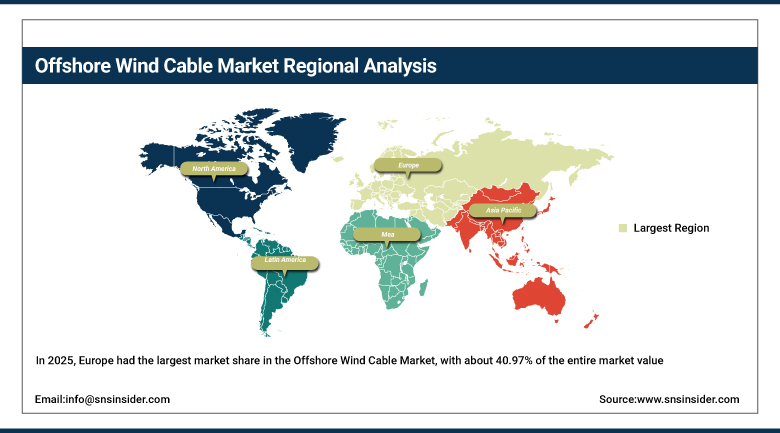
In 2025, Europe had the largest market share in the Offshore Wind Cable Market, with about 40.97% of the entire market value. The main advantages include the wide adoption of offshore wind power, high quality subsea cable production facilities, and favorable regulatory policies for promoting renewable energy generation. Nations such as Germany, the UK, Denmark, and the Netherlands keep investing in offshore wind farms projects, thus boosting the need for inter-array and export cables. Technological progressions in transmission systems, offshore grids, and network extensions reinforce Europe’s dominance and growth potential within the market.
According to the WindEurope, Europe has installed more than 35 GW of offshore wind capacity, demonstrating the region’s strong leadership in offshore renewable energy development. Furthermore, the European Commission aims to increase offshore wind capacity from approximately 30 GW to 300 GW by 2050, creating substantial long-term demand for offshore transmission and export cable infrastructure.
Get Customized Report as per Your Business Requirement - Enquiry Now
Asia Pacific Offshore Wind Cable Market Insights
The Asia Pacific Offshore Wind Cable Market is experiencing substantial growth owing to increasing investment in renewable energy infrastructure and increasing development of offshore wind projects within the region. The implementation of various policies, financial incentives, and strategies for sustainable energy production is enabling increased development of offshore wind power. The growing demand for electricity, transmission network development, and utilization of high-capacity subsea cables is fueling market growth. Furthermore, developments in cable technology, rising number of floating offshore wind projects, and robust manufacturing base are providing ample opportunities for offshore wind cable manufacturers in the coming years.
Middle East & Africa and Latin America Offshore Wind Cable Market Insights
The Middle East & Africa and Latin America Offshore Wind Cable Markets are emerging markets that have generated huge interest in renewable energy technology. Investments in offshore wind power systems have increased due to the government initiatives, high demand for energy, and efforts to diversify energy sources. The emergence of sub-sea cables, international partnerships, and good policies are expected to continue making an impact in the market and paving way for future expansion.
Market Dynamics:
Growth Drivers: Rising global demand for renewable energy sources and government incentives accelerating offshore wind energy projects worldwide significantly boosting cable market growth
The increasing usage of renewable energy sources is leading nations to increase investment in offshore wind power developments. The involvement of government initiatives in terms of subsidies, tax rebates, and renewable energy goals is making it mandatory for utilities and private organizations to develop offshore wind farms. The increase in such projects leads to an increased need for offshore wind cables with high capacities and reliability. Technical innovations related to AC and DC cables, alongside the increased use of HVDC transmission lines, also support the growth of this market.
Restraints: Complex regulatory frameworks and environmental compliance requirements slowing offshore wind cable deployment and raising project uncertainties
Environmental regulations, marine permits, and safety standards have to be adhered to by offshore wind power generation projects, and their requirements differ from country to country. The process of obtaining permissions for laying cables, disturbing the seabed, and environmental impact evaluations could take a lot of time and money. Regulatory delays could delay project implementation, which will affect the timeline of cable demand. Furthermore, compliance with international maritime laws and environmental policy in the region is complicated due to the involvement of international regulations. Such regulatory issues could become a barrier to market development, particularly where new renewable energy policies exist.
Opportunities: Expansion of floating offshore wind farms and deep-water projects creating new growth avenues for specialized subsea cable solutions globally
With nearshore locations becoming increasingly congested, attention is being paid to developing deep water and floating offshore wind energy systems. This will need advanced cables, which are durable and flexible enough to endure the challenging conditions and movements of deep-water and floating offshore systems. Investments made in floating wind technologies in Europe, the Asia Pacific region, and North America present an ideal opportunity for the development of cables that have been uniquely engineered for this purpose. There are substantial possibilities available for companies in the field of offshore wind cable systems.
Recent Developments:
-
2026: Prysmian developed the world’s first negative-carbon-footprint cable, strengthening sustainable offshore wind transmission solutions and supporting decarbonization of submarine power infrastructure globally.
-
2024: Prysmian signed a €1.1 million agreement with 50Hertz for submarine and underground cable systems, supporting offshore wind transmission expansion and strengthening Europe’s renewable grid connectivity infrastructure.
-
2022: Prysmian showcased sustainable cable solutions at WindEnergy Hamburg, highlighting offshore wind technologies designed to improve efficiency, reduce costs, and support large-scale renewable energy deployment.
Key Players
Some of the Offshore Wind Cable Market Companies
-
APAR Industries Ltd.
-
Brugg Cables
-
Hellenic Cables
-
Hengtong Group Co., Ltd.
-
KEI Industries Limited
-
LS Cable & System
-
Nexans
-
NKT A/S
-
Prysmian
-
Qingdao Hanhe Cable Co., Ltd.
-
Sumitomo Electric Industries, Ltd.
-
Taihan Cable & Solution Co., Ltd.
-
Far East Cable
-
Furukawa Electric Co., Ltd.
-
Ningbo Orient Wires & Cables Co., Ltd.
-
TFKable
-
Tratos
-
ZTT
-
TBEA Co., Ltd.
-
Hydro Group
Offshore Wind Cable Market Report Scope :
| Report Attributes | Details |
|---|---|
| Market Size in 2025 | USD 4483.21 Million |
| Market Size by 2035 | USD 26,398.48 Million |
| CAGR | CAGR of 19.78% From 2026 to 2035 |
| Base Year | 2025 |
| Forecast Period | 2026-2035 |
| Historical Data | 2022-2024 |
| Report Scope & Coverage | Market Size, Segments Analysis, Competitive Landscape, Regional Analysis, DROC & SWOT Analysis, Forecast Outlook |
| Key Segments | • By Cable Type (Inter-Array Cables, Export Cables, Dynamic Cables) • By Current Type (AC Cables, DC Cables) • By Voltage Level (Medium Voltage (MV), High Voltage (HV), Extra High Voltage (EHV)) • By Armoring Type (Wire Armor, Tape Armor) • By Installation Type (Buried Cables, Direct-Lay Cables, Surface-Laid Cables, Dynamic Installation (Floating Systems)) • By Conductor Material (Copper, Aluminum) |
| Regional Analysis/Coverage | North America (US, Canada), Europe (Germany, UK, France, Italy, Spain, Russia, Poland, Rest of Europe), Asia Pacific (China, India, Japan, South Korea, Australia, ASEAN Countries, Rest of Asia Pacific), Middle East & Africa (UAE, Saudi Arabia, Qatar, South Africa, Rest of Middle East & Africa), Latin America (Brazil, Argentina, Mexico, Colombia, Rest of Latin America). |
| Company Profiles | APAR Industries Ltd., Brugg Cables, Hellenic Cables, Hengtong Group Co., Ltd., KEI Industries Limited, LS Cable & System, Nexans, NKT A/S, Prysmian, Qingdao Hanhe Cable Co., Ltd., Sumitomo Electric Industries, Ltd., Taihan Cable & Solution Co., Ltd., Far East Cable, Furukawa Electric Co., Ltd., Ningbo Orient Wires & Cables Co., Ltd., TFKable, Tratos, ZTT, TBEA Co., Ltd., Hydro Group |

Frequently Asked Questions
Europe dominated the Offshore Wind Cable Market in 2025.
The Medium Voltage (MV) segment dominated the Offshore Wind Cable Market in 2025.
Rising global demand for renewable energy sources and government incentives accelerating offshore wind energy projects worldwide significantly boosting cable market growth.
The Offshore Wind Cable Market was valued at USD 4483.21 million in 2025.
The Offshore Wind Cable Market is expected to grow at a CAGR of 19.78% from 2026 to 2035.
