
Fault Location System Market Report Scope and Overview:
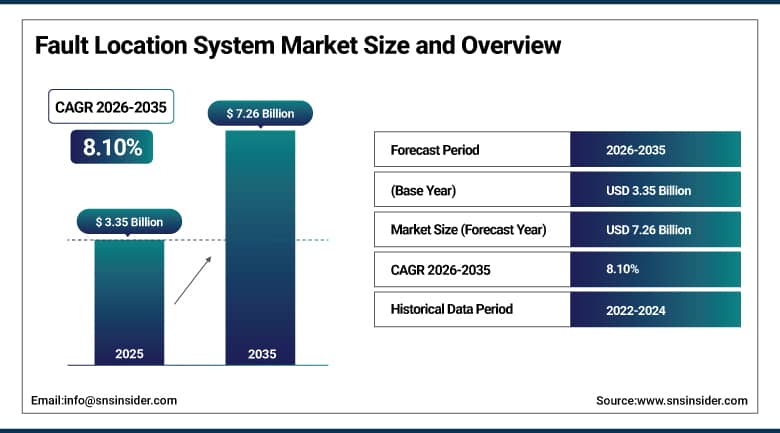
The Fault Location System Market was valued at USD 3.35 Billion in 2025 and is projected to reach USD 7.26 Billion by 2035, registering a CAGR of 8.10% from 2026 to 2035.
The Fault Location System Market is driven by rapid modernization initiatives within the grid, high levels of integration of renewable energy resources resulting in stability issues within the grid, increasing usage of underground power lines in urban regions, and varied use-cases ranging from transmission lines, distribution systems, and industrial installations on a global scale. Advanced sensor networks, collaboration between technology providers and utilities, and increased capabilities in artificial intelligence analytics have been enabled by significant investments made by power utilities, industrial establishments, and businesses for improving the efficiency of their grids.
The Fault Location System Market helps utilities and industrial organizations quickly detect and locate any faults within transmission, distribution, and substation networks, which helps in minimizing the outage time and reducing its effects on the end consumers. These systems make use of advanced sensor technology, traveling wave analysis, and analytics to detect the fault locations within overhead, underground, and substation infrastructures.
To Get More Information On Fault Location System Market - Request Free Sample Report
Fault Location System Market Trends
-
Rising adoption of traveling wave technology continues improving fault detection accuracy on overhead lines.
-
Growing deployment of underground cables in urban areas continues expanding demand for impedance-based fault detection.
-
Expanding renewable energy integration is broadening demand for fault management on increasingly complex networks.
-
Increasing use of IoT-enabled sensors and AI analytics continues improving predictive maintenance capabilities.
-
Growing emphasis on digital substations continues shaping investment in integrated fault location platforms.
U.S. Fault Location System Market Outlook
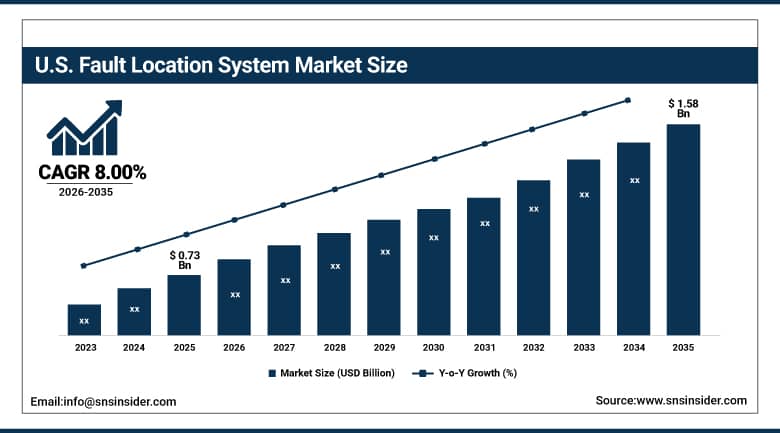
The U.S. Fault Location System Market was valued at approximately USD 0.73 Billion in 2025 and is projected to reach approximately USD 1.58 Billion by 2035, registering a CAGR of approximately 8.00% from 2026 to 2035.
In the United States, demand was primarily influenced by a well-developed electrical power network, high automation rate of power grids, and strict regulations that stimulate the adoption of advanced fault detection solutions. Utilities within the country lead the trend of using digital substations, IoT sensors, and real-time analytics, backed up by constant growth in renewable energy usage and vehicle electrification.
The application of the traveling wave and AI-based fault detection software played a crucial role in reinforcing the leadership position of the fault location system market in the United States. Moreover, a growing number of deployments of impedance-based technology in underground cable networks increased demand for the product.
Fault Location System Market Segment Analysis
-
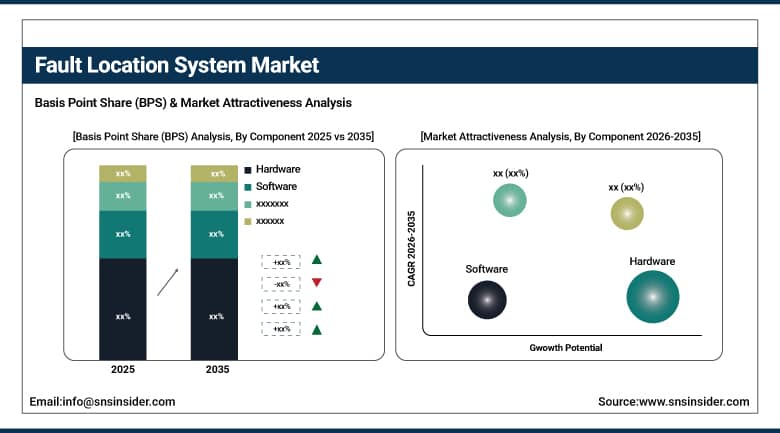
By Component, Hardware segment dominated the Market in 2025 with 44.50% share; Software segment is the fastest growing segment, registering a CAGR of approximately 10.40%.
-
By Type, Overhead Lines segment dominated the market in 2025 with 46.80% share; Underground Lines segment is the fastest growing segment, registering a CAGR of approximately 10.80%.
-
By Application, Utilities segment dominated the market in 2025 with 31.40% share; Industrial segment is the fastest growing segment, registering a CAGR of approximately 10.20%.
-
By End User, Power Utilities segment dominated the market in 2025 with 54.60% share; Commercial segment is the fastest growing segment, registering a CAGR of approximately 10.60%.
By Component, Hardware Dominates the Fault Location System Market While Software Grows Fastest
Hardware commanded the leading share of the Fault Location System Market in 2025 at approximately 44.50%, forming the backbone of fault detection infrastructure through sensors, relays, and communication devices responsible for capturing real-time grid condition data. The proliferation of smart sensors and IoT-enabled devices from vendors such as OMICRON electronics, offering advanced test systems for protection and fault detection, illustrates why utilities continue prioritizing hardware procurement ahead of software licensing across new network deployments.
Software is projected to expand at a CAGR of approximately 10.40%, the fastest pace within the Component segment, as advanced analytics platforms, machine learning algorithms, and visualization tools empower utilities to process vast amounts of field data and derive actionable insights. Growing emphasis on grid automation and cloud-based solutions for scalability and remote monitoring further reinforces this accelerating growth trajectory.
By Type, Overhead Lines Dominate the Fault Location System Market While Underground Lines Grow Fastest
Overhead Lines accounted for the biggest share in terms of type in 2025, accounting for approximately 46.80%, because of the extensive usage of overhead power transmission and distribution lines in the countryside and semi-urban regions that are susceptible to weather-based and equipment-based faults. The introduction of cutting-edge technologies like traveling wave and fault detectors has helped enhance precision and accuracy in fault detection for this segment.
Underground Lines are forecasted to witness a CAGR of about 10.80%, the fastest-growing among all types, due to urbanization and the consequent expansion of subterranean power grids. The growing usage of underground cables in densely-populated urban cities is expected to boost the market growth.
By Application, Utilities Dominate the Fault Location System Market While Industrial Grows Fastest
The utilities sector accounted for the highest market share at 31.40% in 2025 and will continue to be under immense pressure to increase reliability, cut down losses, and adhere to strict regulatory measures through effective fault management and proper maintenance. The vital importance of utilities in ensuring stable electricity supply to millions of customers has led to their becoming the core segment of fault location systems deployment.
The industrial segment is anticipated to record a CAGR of around 10.20%, the fastest growth rate across all application segments, owing to the need to reduce downtime and protect valuable machinery in manufacturing plants, data centers, and critical infrastructure. Growing investments in Industry 4.0 solutions further reinforce the demand for industrial fault location solutions.
By End User, Power Utilities Lead the Fault Location System Market While Commercial Grows Fastest
The Power Utilities became the major end users’ segment in 2025, generating about 54.60% of the total revenue because of the necessity to maintain the grid stability and provide continuous power to millions of consumers. The utilities will be actively using advanced fault location technology for grid improvement purposes, and this is associated with attempts to decrease the outages duration and meet the requirements of regulations.
The fastest growth rate is expected from the Commercial end users, which will reach about 10.60% CAGR due to the increasing use of smart building technologies and energy management systems in office buildings, shopping malls, hospitals and educational institutions. Increasing complexity and energy consumption of commercial buildings has become the major factor for the segment to become a fast growing one.
Regional Analysis:
|
Region |
Major Country |
Share within Region, 2025 (%) |
|---|---|---|
|
Asia Pacific |
China |
33.00% |
|
North America |
United States |
82.00% |
|
Europe |
Germany |
24.00% |
|
Middle East and Africa |
Saudi Arabia |
29.00% |
|
Latin America |
Brazil |
48.00% |
Europe Fault Location System Market Insights
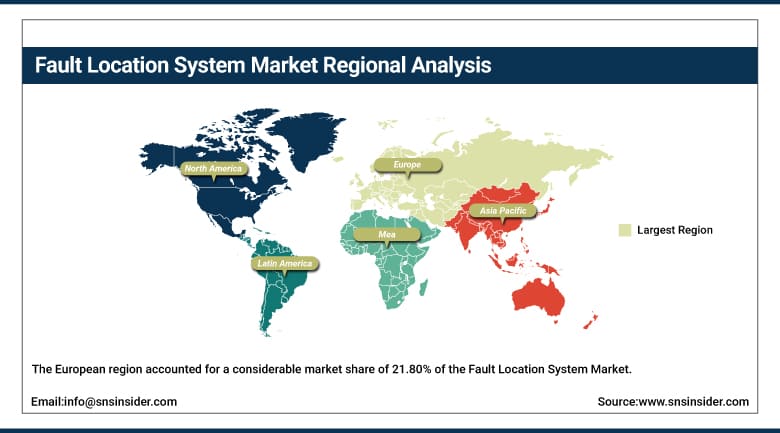
The European region accounted for a considerable market share of 21.80% of the Fault Location System Market. Sustainable practices, energy efficiency, and modernization were among the major factors that influenced the adoption of fault location solutions in Europe. Countries such as Germany, United Kingdom, and France have been investing in smart grids as well as interconnectivity, leading to increased need for effective fault location solutions.
Germany is one of the major countries that generated revenues from the Fault Location System Market in Europe, accounting for approximately 24.00% of the region’s total share. This was mainly due to heavy investments made towards modernization of grids in the country. The United Kingdom and France continued being key drivers of regional demand due to significant investments towards interconnectivity projects.
Get Customized Report as Per Your Business Requirement - Enquiry Now
North America Fault Location System Market Insights
North America had an important market share in the Fault Location System Market in 2025, thanks to its well-developed power network, high level of grid automation, and stringent regulations which lead to the implementation of advanced technology-based fault location systems. The utilities in the U.S. and Canada are among the leaders when it comes to the deployment of digital substations and IoT-based sensors.
The U.S. was responsible for nearly 82.00% of the total North America revenue share mainly due to continuous integration of renewable energy sources and electrification of transport sector, which have been driving a steady demand for fault location systems.
Asia Pacific Fault Location System Market Insights
The Asia Pacific region dominated the Fault Location System market share in 2025, accounting for a share of around 28.60%, and also is expected to dominate as the fastest growing region with a compound annual growth rate of around 9.60% from 2026 to 2035. This double dominance has been fueled by the increasing urbanization rate, expanding power infrastructure, and the presence of some government initiatives focusing on improving grid stability and accessibility through various cities of China, India, Japan, and South Korea.
China held the largest share in the revenue of the Asia Pacific region with a share of around 33.00% due to the massive investments in power infrastructure and increasing domestic manufacturing capacity for fault location technology. The fast expansion of smart grids in India, Japan, and South Korea also drove the Asia Pacific region's growth.
MEA and Latin America Fault Location System Market Insights
The Middle East & Africa and Latin America regions showed constant growth due to the fact that utilities from these regions focus on upgrading their grids and cutting down losses; these regions make up around 9.90% and 12.20% of the global market, respectively. Rising government investment in infrastructure development along with increasing use of renewable energy sources needing fault location solutions makes Middle East & Africa and Latin America more and more attractive markets for platforms offering fault location systems.
In Middle East & Africa, the largest contributor was Saudi Arabia, which accounted for around 29.00% of total regional share due to investments in grid modernization and energy diversification in the country. In Latin America, the largest market is Brazil, which accounts for about 48.00% of regional share due to developed power infrastructure in the country and need for optimized fault location.
Market Dynamics:
Growth Drivers: Rising Investment in Grid Modernization
Market growth is facilitated by the increase in initiatives related to grid modernization globally since the current grid infrastructure finds it difficult to cope with the rising electricity demands and inclusion of distributed energy resources. Such grids help identify and isolate the faults quickly and limit their duration and effects, while the increasing use of digital substations and automation technologies drives the development of advanced equipment for locating faults.
Moreover, the quick growth of renewable energy projects, such as wind and solar power plants, that create problems for the stable functioning of the network and require solutions provided by fault location systems is also among the examples that prove the market’s growth and development. Technological developments in sensors, artificial intelligence, and communication protocols can be viewed as the other driving force behind the market’s performance.
Restraints: High Initial Investment and Legacy Infrastructure Integration
The high capital expenditures involved, along with the difficulties in combining the emerging technology with existing infrastructure, can represent major obstacles for energy providers and consumers who have little budget available. These financial and technological obstacles are intensified by the need to build extensive sensor networks and communication systems in expansive grid environments.
The absence of a single protocol and the non-interoperability of the solutions provided by different vendors represent another obstacle for the adoption of smart grid technology, especially in areas where there are scattered power grids. Data privacy and cybersecurity issues may delay the process of digitalization even more.
Opportunities: Smart Grid Transition and Emerging Market Expansion
The rising popularity of IoT-based sensors, sophisticated analytics, and artificial intelligence is enabling the creation of innovative opportunities for detecting faults, performing maintenance, and responding to situations automatically. The platform-based offerings of companies, such as ABB Ltd. and Siemens AG, which incorporate AI-based analytics along with traditional fault detection technology, demonstrate how vendors are leveraging the widening range of use cases to distinguish themselves among utilities and industries.
Furthermore, there exist several markets with huge potential of growth, including Asia Pacific, Latin America, and Middle East & Africa due to rapid urbanization and increasing infrastructure for electricity in these geographies. Vendors who provide affordable and easily deployable solutions catering to regional requirements will be able to capture a sizable market share.
Recent Developments:
-
2025: OMICRON electronics introduced a new test system for protection relays and fault detection equipment, targeting digital substation commissioning projects.
-
2025: S&C Electric Company expanded its IntelliRupter fault interrupter line with enhanced automated fault isolation and self-healing grid capabilities.
-
2025: Nexans introduced an advanced underground cable monitoring solution integrating real-time fault detection sensors for urban distribution networks.
-
2025: Landis+Gyr expanded its grid sensor portfolio with new fault indication capabilities for distribution network monitoring.
-
2026: Arteche Group launched an enhanced fault passage indicator series featuring wireless communication for remote distribution grid monitoring.
-
2026: Schneider Electric integrated new fault detection modules into its EcoStruxure Grid platform, adding predictive analytics for substation asset management.
Fault Location System Market key players are:
-
Schneider Electric SE
-
ABB Ltd.
-
Siemens AG
-
GE Vernova Inc.
-
Eaton Corporation plc
-
Schweitzer Engineering Laboratories, Inc.
-
Megger Group Limited
-
Landis+Gyr Group AG
-
Nexans S.A.
-
OMICRON electronics GmbH
-
Horiba Ltd.
-
Arteche Group
-
Toshiba Corporation
-
Honeywell International Inc.
-
Power Grid Corporation of India Limited
-
Littelfuse, Inc.
-
Itron Inc.
-
Legrand S.A.
-
S&C Electric Company
-
CG Power and Industrial Solutions Limited
Fault Location System Market Report Scope:
| Report Attributes | Details |
|---|---|
| Market Size in 2025 | USD 3.35 Billion |
| Market Size by 2035 | USD 7.26 Billion |
| CAGR | 8.10% from 2026 to 2035 |
| Base Year | 2025 |
| Forecast Period | 2026-2035 |
| Historical Data | 2022-2024 |
| Report Scope & Coverage | Market Size, Segments Analysis, Competitive Landscape, Regional Analysis, DROC & SWOT Analysis, Forecast Outlook |
| Key Segments | •Component (Hardware, Software, and Services) •Type (Overhead Lines, Underground Lines, and Substation) •Application (Transmission Lines, Distribution Lines, Industrial, Utilities, and Others) •End User (Power Utilities, Industrial, Commercial, and Others) |
| Regional Analysis/Coverage | North America (US, Canada), Europe (Germany, UK, France, Italy, Spain, Russia, Poland, Rest of Europe), Asia Pacific (China, India, Japan, South Korea, Australia, ASEAN Countries, Rest of Asia Pacific), Middle East & Africa (UAE, Saudi Arabia, Qatar, South Africa, Rest of Middle East & Africa), Latin America (Brazil, Argentina, Mexico, Colombia, Rest of Latin America). |
| Company Profiles | Schneider Electric SE, ABB Ltd., Siemens AG, GE Vernova Inc., Eaton Corporation plc, Schweitzer Engineering Laboratories, Inc., Megger Group Limited, Landis+Gyr Group AG, Nexans S.A., OMICRON electronics GmbH, Horiba Ltd., Arteche Group, Toshiba Corporation, Honeywell International Inc., Power Grid Corporation of India Limited, Littelfuse, Inc., Itron Inc., Legrand S.A., S&C Electric Company, CG Power and Industrial Solutions Limited. |

Frequently Asked Questions
Key players in the Fault Location System Market include Schneider Electric SE, ABB Ltd., Siemens AG, GE Vernova Inc., and Eaton Corporation plc, among others.
Key opportunities in the Fault Location System Market include expansion into emerging markets across Asia Pacific, Latin America, and the Middle East & Africa, alongside growing integration of IoT-enabled sensors and AI-driven predictive maintenance capabilities.
The market is driven by the global surge in grid modernization projects, rapid expansion of renewable energy installations, and the urgent need to minimize power outages and operational downtime across utility and industrial sectors.
The Hardware segment dominated the Fault Location System Market, accounting for approximately 44.50% market share.
The Asia Pacific region dominated the Fault Location System Market in 2025 with a 28.60% share, driven by rapid urbanization and expanding power infrastructure investment across China and India.
