
Lightweight Aggregates Market Report Scope & Overview:
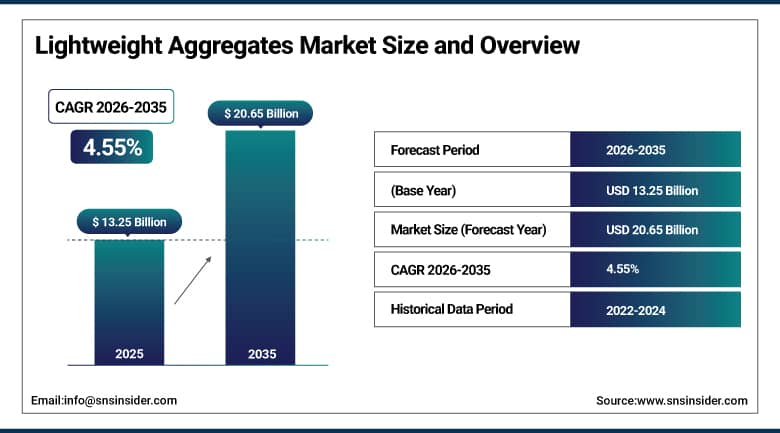
The Lightweight Aggregates Market was valued at USD 13.25 Billion in 2025 and is expected to reach USD 20.65 Billion by 2035, growing at a CAGR of 4.55% from 2026 to 2035.
The Lightweight Aggregates Market is experiencing steady growth due to the rise in construction activities worldwide, increased need for lightweight structures in tall buildings and earthquake-prone areas, and the growing trend of sustainable and energy-efficient construction materials. Lightweight aggregates that include expanded clay, shale, slate, pumice, perlite, and vermiculite are well recognized because they can lower the dead load of the structure while keeping enough compressive strength and improve the performance of thermal insulation and workability in concrete masonry units, structural concrete, and geotechnical fills. As the construction in urban areas prefers to build higher buildings and bridges with longer span structures that use lightweight materials but do not sacrifice the strength, the demand for lightweight aggregates keeps growing.
⮞In 2026, Saint-Gobain's Leca brand introduced an upgraded lightweight expanded clay aggregate formulation designed to improve thermal insulation performance in masonry block applications, strengthening its position in the sustainable construction materials segment.
To Get More Information On Lightweight Aggregates Market - Request Free Sample Report
Lightweight Aggregates Market Trends:
-
Rising adoption of lightweight aggregates in high-rise and seismic-resistant construction is reducing structural dead load across major building projects.
-
Growing use of recycled and industrial byproduct-based lightweight aggregates is supporting circular economy initiatives in construction.
-
Expanding precast and modular construction methods are accelerating lightweight aggregate concrete adoption across residential and commercial projects.
-
Increasing infrastructure investment in bridges and elevated structures is driving demand for high-strength expanded shale and clay aggregates.
-
Strategic capacity expansions by aggregate manufacturers are strengthening regional supply chain reliability for green building projects.
U.S. Lightweight Aggregates Market Outlook:
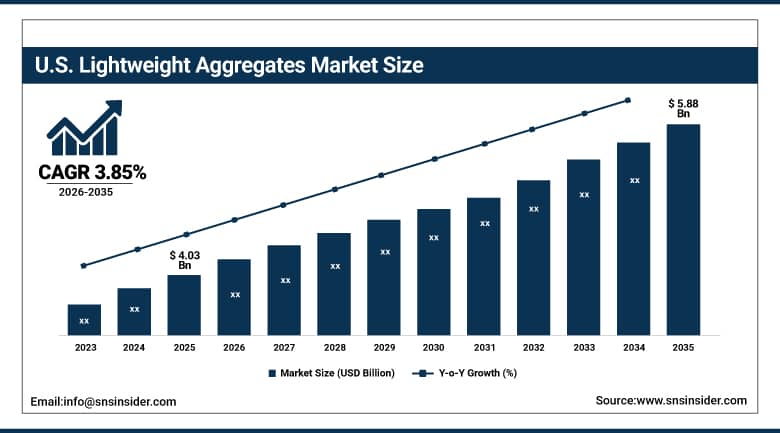
The U.S. Lightweight Aggregates Market was valued at USD 4.03 Billion in 2025 and is projected to reach USD 5.88 Billion by 2035, growing at a CAGR of 3.85% during 2026–2035.
The United States remains the biggest producer of lightweight aggregates from any one single nation in the world due to heavy construction projects taking place in the country, availability of rotary kilns producing expanded shales and clays, and increased need for sustainable building materials that are lighter in terms of weight in response to green buildings certification programs. The country's local aggregate companies are increasing their production capacity as demand increases for their lightweight aggregates from precast concrete and structural concrete applications. The rehabilitation of bridges and elevated structures is ensuring that there will be sustained demand for lightweight aggregates that are stronger in nature.
⮞In 2025, Arcosa expanded its expanded shale lightweight aggregate production capacity at its Texas facility to meet rising structural concrete demand across the U.S. Gulf Coast.
Lightweight Aggregates Market Segment Analysis:
-
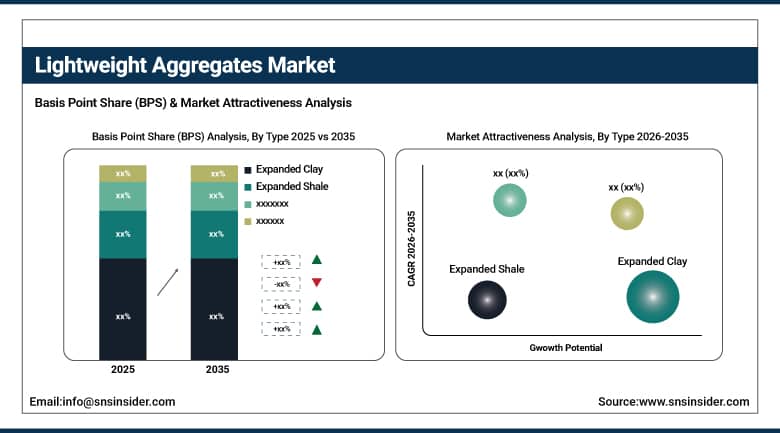
By Type, Expanded Clay dominated the Lightweight Aggregates Market with a 34.80% share in 2025, while Expanded Shale is the fastest-growing type segment with a CAGR of 5.90% from 2026–2035.
-
By Manufacturing Process, Manufactured dominated the Lightweight Aggregates Market with a 62.40% share in 2025, while Natural is the fastest-growing manufacturing process segment with a CAGR of 5.40% from 2026–2035.
-
By Application, Structural Concrete dominated the Lightweight Aggregates Market with a 41.60% share in 2025, while Concrete Masonry Units is the fastest-growing application segment with a CAGR of 5.80% from 2026–2035.
-
By End-Use, Commercial dominated the Lightweight Aggregates Market with a 38.90% share in 2025, while Infrastructure is the fastest-growing end-use segment with a CAGR of 6.10% from 2026–2035.
By Type, Expanded Clay led while Expanded Shale is the fastest-growing segment.
The Expanded Clay segment was the leading contributor in the Lightweight Aggregates Market in 2025. Such dominance is attributed to the superior combination of properties of expanded clay, including thermal insulation capacity, compressive strength, and availability of the basic raw materials, resulting in its preference for use in masonry blocks, structural concrete, and even in horticulture in residential and commercial construction projects, which has enabled the continued dominance of expanded clay as a leader among the existing rotary kiln plants in North America, Europe, and Asia-Pacific regions.
The Expanded Shale segment is expected to witness the highest CAGR during the forecast period 2026-2035. The increasing need for high strength concrete usage for structures such as bridges, elevated roads, and tall buildings, where the compressive strength features of expanded shale compared to other lightweight aggregates play an important role, is fueling faster growth in this market sector. Growing infrastructure rehabilitation and new bridge construction activity across North America continues to support above-average growth for expanded shale relative to the broader lightweight aggregates market.
⮞In November 2025, researchers published a study on phase-change-material-infused lightweight expanded shale aggregates for high-performance concrete, investigating their potential to improve thermal regulation and insulation in concrete applications.
By Manufacturing Process, Manufactured led while Natural is the fastest-growing segment.
The Manufactured category held majority market share of the Lightweight Aggregates Market in 2025. Artificial lightweight aggregates made from the thermal expansion of clay, shale, and slate using controlled rotary kilns still make up the majority of such processes because they offer more predictable performance in terms of strength than natural lightweight aggregates, which makes them the better option for use in concrete structures.
The Natural segment is anticipated to grow at the fastest rate during the forecast period 2026-2035. The increasing importance of sustainability and preference for natural products like pumice, perlite, and vermiculite that do not need much energy input during the manufacturing process unlike kiln-expanded products is pushing the adoption rate of expanded aggregates at a fast pace.
⮞In July 2025, India's Bureau of Indian Standards circulated a draft standard addressing lightweight aggregates, covering materials produced through expansion, pelletization, or sintering and outlining relevant properties for construction applications.
By Application, Structural Concrete led while Concrete Masonry Units is the fastest-growing segment.
The Structural Concrete segment dominated the Lightweight Aggregates Market in 2025. Structural concrete remains the leading application category as lightweight aggregate concrete is extensively used in high-rise building construction, precast concrete elements, and bridge deck applications where reducing structural dead load while maintaining adequate compressive strength delivers significant design and cost advantages, reinforcing structural concrete as the foundational application driving the majority of global lightweight aggregate consumption.
The Concrete Masonry Units segment is expected to register the fastest CAGR during the forecast period 2026-2035. The increasing trends in house and commercial buildings construction, using lightweight blocks which offer better insulation qualities, along with lower transportation and handling costs have led to rapid acceptance of lightweight aggregates for manufacturing masonry units due to preference of energy-efficient wall systems under building codes.
⮞In August 2025, Leca International documented the reconstruction of Spain's El Castro Viaduct, where lightweight expanded clay aggregate was used to stabilize difficult terrain and support the construction of replacement viaduct structures.
By End-Use, Commercial led while Infrastructure is the fastest-growing segment.
The Commercial segment dominated the Lightweight Aggregates Market in 2025. Commercial construction continues to be the most prevalent use type in light aggregate concrete as office buildings, shopping malls, and mixed-use buildings that require light aggregate concrete are constructed in order to keep down structural loadings and save on foundation expenses in keeping with growing standards for green building certification.
The Infrastructure segment is expected to witness the fastest CAGR during the forecast period 2026-2035. The increasing demand for construction in the form of bridges, overpasses, and transport systems that need to be light in structure but do not affect load carrying capacity has increased the use of lightweight high strength aggregates due to the priority of governments to build infrastructure.
⮞In April 2026, the Indiana Department of Transportation introduced a pilot program for concurrent placement of recycled concrete aggregate base and bridge decks, reflecting continued efforts to improve material use and construction efficiency in infrastructure projects.
Regional Insights
|
Region |
Major Country |
Share within Region, 2025 (%) |
|---|---|---|
|
North America |
United States |
82.60% |
|
Europe |
Germany |
24.30% |
|
Asia Pacific |
China |
38.40% |
|
Middle East & Africa |
UAE |
27.60% |
|
Latin America |
Brazil |
33.80% |
North America Lightweight Aggregates Market Insights
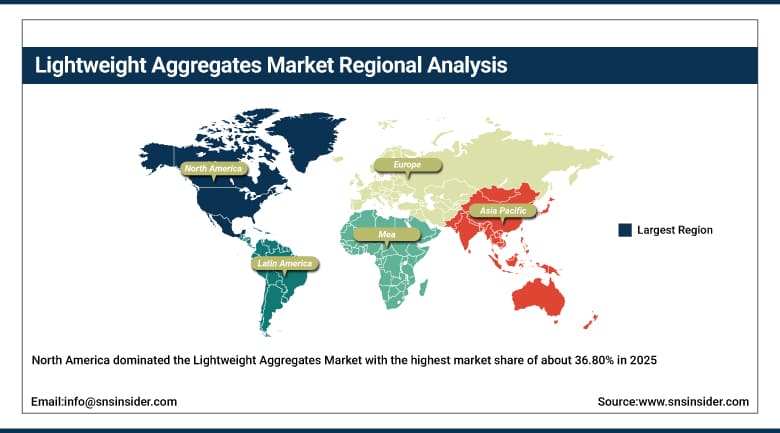
North America dominated the Lightweight Aggregates Market with the highest market share of about 36.80% in 2025, owing to the region's extensive commercial and infrastructure construction activity, well-established rotary kiln expanded shale and clay production infrastructure, and growing green building certification requirements favoring sustainable, weight-reducing construction materials. The region's mature aggregate production and distribution network, combined with continued infrastructure rehabilitation investment, continues to reinforce North America's position as the largest lightweight aggregates market globally.
The US was the leading country within the North America Lightweight Aggregates Market in 2025 of the regional market, driven by extensive commercial construction activity and substantial infrastructure rehabilitation investment. Canada is contributing to regional growth through its expanding residential construction sector and growing adoption of lightweight aggregate concrete in cold-climate building applications.
⮞In June 2025, Heidelberg Materials North America acquired assets of Calgary-based Concrete Crushers Inc., including a recycled-aggregates yard and four mobile crushing plants, expanding its regional recycling capabilities and circular construction-materials operations.
Get Customized Report as Per Your Business Requirement - Enquiry Now
Europe Lightweight Aggregates Market Insights
The Europe region was a major contributor to the Lightweight Aggregates Market in 2025, supported by the region's stringent EU sustainability and energy efficiency building regulations, substantial commercial and residential construction activity, and well-established network of specialty lightweight aggregate manufacturers. The region's continued emphasis on green building certification and low-carbon construction materials is expected to support steady market growth across the forecast period.
Germany is one of the major markets in Europe owing to its substantial construction sector and strong presence of leading expanded clay and perlite aggregate manufacturers. Other countries such as Italy and France, home to established lightweight aggregate concrete producers, are also contributing to regional market growth through continued sustainable construction material demand.
⮞In May 2026, Spain's CEDEX published the final report of the PEDLER project, documenting full-scale testing of Leca lightweight expanded clay aggregate in railway embankments under simulated passenger and freight train loading conditions.
Asia Pacific Lightweight Aggregates Market Insights
The Asia Pacific Lightweight Aggregates Market is expected to witness the fastest growth rate during the forecast period 2026-2035, registering a CAGR of 6.20%. The market growth is driven by rapid urbanization and high-rise construction activity, expanding infrastructure development programs, and increasing government emphasis on sustainable, energy-efficient building material adoption across the region's major and emerging construction markets.
China is one of the main growth drivers in the Asia Pacific Lightweight Aggregates Market, owing to its massive high-rise construction and infrastructure development sector requiring extensive lightweight aggregate concrete consumption. India and Southeast Asian countries, both experiencing rapid urban infrastructure development, are also contributing to regional growth through expanding commercial construction activity and rising green building certification adoption.
⮞In February 2025, China's national standards authorities initiated a standard-development project for phosphogypsum lightweight aggregate, establishing a framework for evaluating materials intended for nonstructural concrete products, permeable paving blocks, and road-base applications.
Middle East & Africa and Latin America Lightweight Aggregates Market Insights
Middle East & Africa and Latin American regions are gradually expanding lightweight aggregates adoption as construction and infrastructure investment grows, supported by rising high-rise commercial construction activity, expanding government infrastructure programs, and growing awareness of sustainable, energy-efficient building material benefits across the regions' major economies.
Brazil will emerge as one of the major markets in Latin America due to the existence of a significant construction industry that requires lightweight materials for structures. The Middle East & Africa region features the United Arab Emirates that is making significant investments in skyscrapers for residential and commercial buildings, thus gradually increasing market activities in the region.
⮞In August 2026, Dubai Customs convened construction-materials traders and logistics representatives to address freight costs, shipment handling, and customs procedures, highlighting efforts to improve the efficiency of regional construction-materials supply chains.
⮞In September 2026, researchers published a study evaluating lightweight artificial aggregates made from smectite clay and porcelain-polishing residue sourced in Brazil, investigating their potential for structural applications and lower-carbon construction-material production.
Market Dynamics
Growth Drivers: Rising high-rise construction and sustainability focus driving market growth
The continuous expansion of high-rise and infrastructure construction activity worldwide, combined with growing emphasis on structural weight reduction and seismic resistance, is among the primary drivers of the Lightweight Aggregates Market. Lightweight aggregates' ability to reduce structural dead load while maintaining sufficient compressive strength continues to reinforce their position as preferred materials across structural concrete, masonry unit, and geotechnical fill applications, particularly as urban construction increasingly favors taller buildings and longer-span structures requiring reduced material weight.
The increasing popularity of precast and modular construction techniques due to lightweight aggregate concrete being highly efficient in terms of its strength to weight ratio that helps in saving time and cutting down on transportation costs is still expected to drive growth over the forecast period. The increasing investments from the manufacturers towards aggregate types with recycled and industrial wastes for sustainability purposes along with the demand for green building certifications are also expected to boost demand.
⮞In January 2026, the U.S. Geological Survey published its Mineral Commodity Summaries for pumice, estimating global production at approximately 20 million metric tons in 2025 and identifying lightweight building blocks and construction products among its principal applications.
Restraints: Limited compressive strength and high production costs limiting market expansion
One of the most critical obstacles to market growth is the comparatively limited compressive strength of lightweight aggregates relative to conventional dense aggregates, which restricts their adoption in certain high-load structural applications and requires careful engineering consideration when specifying lightweight aggregate concrete for load-bearing structural elements.
Moreover, the energy-intensive rotary kiln expansion process required to produce manufactured lightweight aggregates such as expanded clay and shale creates exposure to volatile energy costs that can pressure manufacturer margins, particularly across regions with rising industrial energy pricing. Moreover, the transport costs of lightweight aggregates, although less in comparison to that of conventional aggregates on account of their lighter weight, may account for a substantial amount of total delivered cost if the projects are at great distance from manufacturing plants.
Opportunities: Recycled material innovation and emerging market infrastructure expansion creating new growth avenues
The increasing adoption of lightweight aggregates made using recycling products and industrial by-products along with increasing investments in infrastructural development in developing countries creates significant potential for the Lightweight Aggregates Market. Construction companies and material suppliers that have to ensure that their products are environmentally certified along with having robust structural strength are preferring new-age materials that have both environmental benefits as well as good performance.
High-strength lightweight aggregates have significant scope for development in terms of their use as a part of infrastructure construction, particularly for bridges and elevated highways that will keep on growing around the world in the coming years. High-rise building activities in the Asia-Pacific and Middle Eastern regions, along with precast and modular construction techniques, will also keep on adding to the demand for lightweight aggregates.
⮞In December 2025, researchers published a study evaluating artificial lightweight aggregates incorporating ceramic manufacturing residues and eucalyptus firewood ash, reporting the potential to reduce environmental impacts and production costs through locally sourced recycled materials.
Recent Developments:
-
2026: Enva became Scotland’s first producer of a recycled lightweight aggregate derived from air pollution control residue ash to receive BSI certification for use in concrete, mortar, and grout.
-
2026: SusMaX successfully completed pilot-scale manufacturing of its SPORA lightweight aggregate, producing 400 pounds and supplying samples to ready-mix concrete customers for performance testing ahead of commercialization.
-
2025: Holcim launched a new low-carbon expanded clay aggregate product line aimed at supporting green building certification requirements in commercial construction.
Lightweight Aggregates Key Players are:
-
Arcosa, Inc.
-
Saint-Gobain S.A. (Leca)
-
Holcim Ltd
-
Boral Limited
-
Liapor GmbH & Co. KG
-
Norlite Corporation
-
Charah Solutions, Inc.
-
STALITE Lightweight Aggregate
-
Argex S.A.
-
Salt River Materials Group
-
Utelite Corporation
-
Mitsui Mining & Smelting Co., Ltd.
-
Sumitomo Osaka Cement Co., Ltd.
-
Taiheiyo Materials Corporation
-
Fuyo Perlite Co., Ltd.
-
Laterlite S.p.A.
-
Dicalite Management Group
-
Dennert Poraver GmbH
Lightweight Aggregates Market Report Scope:
| Report Attributes | Details |
|---|---|
| Market Size in 2025 | USD 13.25 Billion |
| Market Size by 2035 | USD 20.65 Billion |
| CAGR | CAGR of 4.55% From 2026 to 2035 |
| Base Year | 2025 |
| Forecast Period | 2026-2035 |
| Historical Data | 2022-2024 |
| Report Scope & Coverage | Market Size, Segments Analysis, Competitive Landscape, Regional Analysis, DROC & SWOT Analysis, Forecast Outlook |
| Key Segments | • By Type (Expanded Clay, Expanded Shale, Expanded Slate, Pumice, Perlite & Vermiculite & Others) • By Manufacturing Process (Natural, Manufactured) • By Application (Structural Concrete, Concrete Masonry Units, Geotechnical Fill, Horticulture & Others) • By End-Use (Residential, Commercial, Infrastructure & Industrial) |
| Regional Analysis/Coverage | North America (US, Canada), Europe (Germany, UK, France, Italy, Spain, Russia, Poland, Rest of Europe), Asia Pacific (China, India, Japan, South Korea, Australia, ASEAN Countries, Rest of Asia Pacific), Middle East & Africa (UAE, Saudi Arabia, Qatar, South Africa, Rest of Middle East & Africa), Latin America (Brazil, Argentina, Mexico, Colombia, Rest of Latin America). |
| Company Profiles | Arcosa, Inc., Saint-Gobain S.A. (Leca), Holcim Ltd, Boral Limited, Cemex, S.A.B. de C.V., Liapor GmbH & Co. KG, Norlite Corporation, Charah Solutions, Inc., STALITE Lightweight Aggregate, Argex S.A., Salt River Materials Group, Utelite Corporation, Mitsui Mining & Smelting Co., Ltd., Sumitomo Osaka Cement Co., Ltd., Taiheiyo Materials Corporation, Ube Industries, Ltd., Fuyo Perlite Co., Ltd., Laterlite S.p.A., Dicalite Management Group, Dennert Poraver GmbH. |

Frequently Asked Questions
The market is driven by rising global construction activity, increasing demand for structural weight reduction in high-rise and seismic-prone buildings, and growing emphasis on sustainable, energy-efficient construction materials.
The Structural Concrete segment dominated the Lightweight Aggregates Market in 2025, accounting for approximately 41.60% market share.
