
Organic Semiconductor Market Report Scope & Overview:
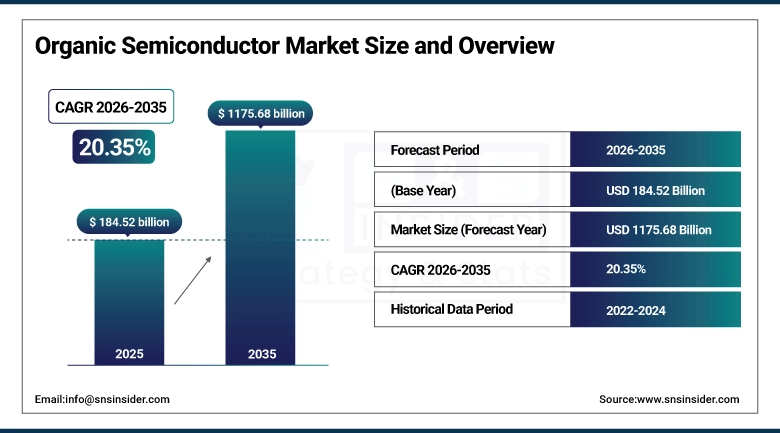
The Organic Semiconductor Market size was valued at USD 184.52 Billion in 2025 and is projected to reach USD 1175.68 Billion by 2035, growing at a CAGR of 20.35% during 2026–2035.
The Organic Semiconductor Market is witnessing impressive growth due to adoption of light weight, flexible and energy efficient electronic materials in a range of industries. The solution-processability and mechanical flexibility of these semiconductors allow for new applications in OLED displays, organic photovoltaics, wearables, and smart sensors. Growing uptake in the consumer electronics and renewable energy segments is adding additional momentum to market growth. In conjunction, developments in material engineering and printing technologies are enhancing organic semiconductor performance and scalability towards potential market applications. With the transition of industries towards sustainability and futuristic electronics, the market will continue to innovate and will witness a wider range of application adoption across the globe.
In Sept 2025 – Heliatek GmbH ramps up production of lightweight flexible organic solar films for integration into commercial buildings The company was at the forefront of large-area commercial leasing of organic photovoltaic panels to outfitting façades and curved surfaces, bolstering substantial integration of cost-effective, lightweight energy-saving organic semiconductor materials used in urban design.
Market Size and Forecast:
-
Market Size in 2025: USD 184.52 Billion
-
Market Size by 2035: USD 1175.68 Billion
-
CAGR: 20.35% (from 2026 to 2035)
-
Base Year: 2025
-
Forecast Period: 2026–2035
-
Historical Data: 2022–2024
To Get more information on Organic Semiconductor Market - Request Free Sample Report
Organic Semiconductor Market Trends Highlights:
-
Strong market growth driven by increasing demand for flexible and lightweight electronic components across industries
-
Rising adoption of OLED displays, organic photovoltaics, and wearable electronics boosting market expansion
-
Advancements in material science and printing technologies improving performance, efficiency, and scalability
-
Growing focus on energy-efficient and sustainable semiconductor solutions supporting long-term demand
-
Expanding applications in consumer electronics, automotive, healthcare, and smart devices enhancing market potential
U.S. Organic Semiconductor Market Size Outlook:
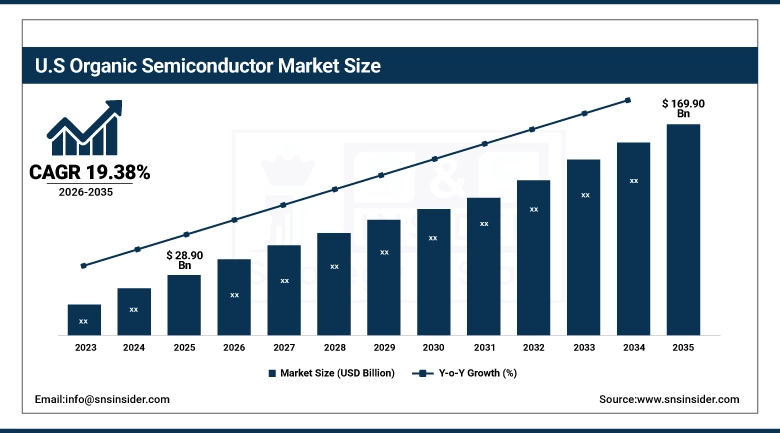
The U.S. Organic Semiconductor Market size was valued at USD 28.90 Billion in 2025 and is projected to reach USD 169.90 Billion by 2035, growing at a CAGR of 19.38%during 2026–2035, Increasing demand for flexible electronics, OLED displays, and organic photovoltaics, as well as rising adoption in wearable devices and smart sensors, is expected to fuel the market growth. Threaded connection, so it is easy to be assembled, and some material innovation and printing technology promote the performance and scaling up. Moreover, robust R&D investments and presence of mature electronics and semiconductor industry are speed up commercialization and diversification of application fields covering consumer electronics and energy sectors.
Market Drivers: Enhanced Luminosity and Energy Efficiency Driving Organic Semiconductor Adoption
The progress regarding molecular stacking processes act as one of the major factor driving the organic semiconductor market which enhances the efficiency of light emission and energy performance. Improved structural organization of the organic materials provides increased exciton management with higher fluorescence yield, leading to higher brightness at lower power consumption (more than 3x brighter than comparable OLEDs). Such advances are especially advantageous for OLED displays, lighting and nano-lasers, where efficiency and brightness are paramount. These kinds of advancements are driving the growth of new organic semiconductor materials into the realm of consumer electronic and optoelectronic applications, with industries finding evermore importance in energy-efficient and high performance electronic components.
March 23, 2026 – A study by University of Würzburg, published in Nature Chemistry, demonstrates that stacked organic dye molecules significantly boost luminosity for next-generation organic semiconductors. By stacking 4–6 units, luminescence increases sharply, with efficiency rising from 47% (2 units) to 75% (14 units), enabling brighter, energy-efficient semiconductor and nano-laser applications.
Market Restraints: Stability and Performance Limitations Restrict Market Scalability
A few of the significant restraining used in the market of organic semiconductor are the instability of organic semiconductor materials, non-existence of operational lifetime and environmental sensitivity for moisture, oxygen, and temperature variations. However, these challenges become an impediment to fast, reliable and long-term performance of devices, especially in high-end applications. Moreover, a comparatively lower charge carrier mobility as compared to inorganic semiconductors limits applications in high-pass electronics. The need for consistent large-area fabrication and encapsulation also increase production costs due to the manufacturing complexities introduced. Despite the rapid evolution of the technology and growing investments in research, it limits widespread commercialization and adoption–particularly in high-demand industrial and automotive applications–thereby impeding market growth.
Market Opportunities: Strain-Engineered Mobility Breakthrough Unlocks Next-Gen Organic Semiconductor Potential
The evolution of strain-engineering techniques are providing high growth opportunities in the organic semiconductor market as they facilitate orders of amplification in charge carrier mobility and device performance enhancement. These advances address the limitations posed by molecular vibrations, which can enable the manufacturing of faster and smaller electronic devices. The increased application of high-mobility organic materials is anticipated as demand for flexible, lightweight, and energy-efficient devices continues to grow in markets for a variety of applications, including wearable electronics, displays, and sensors. Such changing trends bring volition to innovate, commercialize, and distinguish themselves from the competition of materials manufacturers and technology developers.
October 1, 2025 – A study published in Science Advances reports record Hall mobility exceeding 100 cm²/V·s in strained organic semiconductors, demonstrating enhanced charge transport through strain engineering and reduced lattice vibrations.
Organic Semiconductor Market Segment Highlights:
-
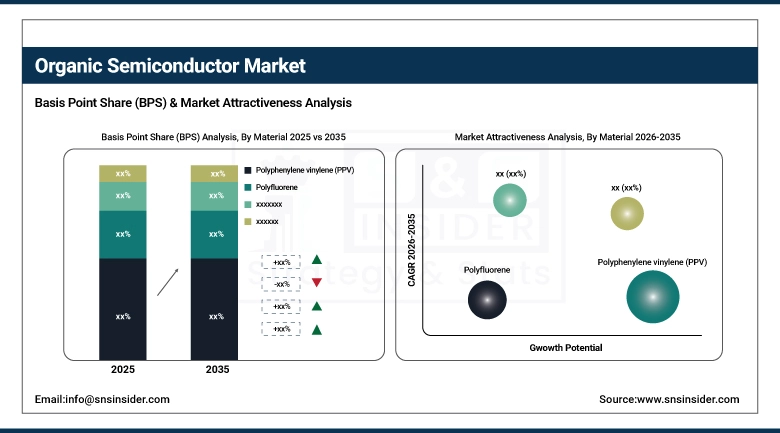
By Type: Dominant – Polymeric Organic Semiconductors (61.40% in 2025 → 56.60% in 2035); Fastest Growing – Small Molecule Organic Semiconductors (38.60% in 2025 → 43.40% in 2035)
-
By Material: Dominant – Polyphenylene Vinylene (PPV) (21.60% in 2025 → 18.40% in 2035); Fastest Growing – Others (10.50% in 2025 → 14.50% in 2035)
-
By Process Technology: Dominant – Vacuum Evaporation (33.40% in 2025 → 28.60% in 2035); Fastest Growing – Inkjet Printing (18.60% in 2025 → 23.40% in 2035)
-
By End Use Industry: Dominant – Consumer Electronics (47.30% in 2025 → 41.70% in 2035); Fastest Growing – Automotive (14.40% in 2025 → 17.60% in 2035)
By Material: Polyphenylene Vinylene (PPV) (Dominant) and Rubrene (Fastest-Growing)
Polyphenylene Vinylene (PPV) segment dominates the organic semiconductor material in order of rising application in light-emitting devices, conductive polymers, and established applications in display. Due to its stability and ease of handling, it is highly suitable for larger electronic applications. However, Rubrene segment constitutes the fastest growing segment owing to outstanding charge transport characteristics, high mobility and growing popularity is attributed to their importance in organic field-effect transistors and modern optoelectronic devices supporting next-generation high-performance electronics.
By Type: Polymeric Organic Semiconductors (Dominant) and Small Molecule Organic Semiconductors (Fastest-Growing)
The Polymeric Organic Semiconductors segment dominates the market owing to its wide applications in flexible electronics, large-area displays, and low-cost manufacturing techniques which facilitate the scalable production of organic electronic devices. The durability-driven market position is bolstered by high mechanical flexibility and compatibility with printing techniques. On the flip side, Small Molecule Organic Semiconductors segment is obtaining highest growth owing to excellent charge mobility, better structural uniformity, and rising leading-edge OLED display and electronic applications adopting small molecule materials leading to improvements in next-generation device efficiency and performance.
By Process Technology: Vacuum Evaporation (Dominant) and Inkjet Printing (Fastest-Growing)
The Vacuum Evaporation segment holds the dominant position due to its high precision, uniform thin-film deposition, and widespread use in OLED display manufacturing and high-end electronic device production. Its ability to deliver high-quality layers ensures strong industrial adoption. Conversely, the Inkjet Printing segment is experiencing the fastest growth due to its material efficiency, cost-effectiveness, and suitability for flexible and large-area electronics, making it a key enabling technology for next-generation printed electronic applications.
By End Use Industry: Consumer Electronics (Dominant) and Automotive (Fastest-Growing)
The Consumer Electronics segment dominates the organic semiconductor market due to the increased demand of mobile devices like Smartphones, Tablets, and Wearable devices containing OLED-based flexible displays needing advanced organic materials and for improved performance. The leadership of LG Display has also been bolstered by continuous innovation in the field of display technology. On the other hand, the Automotive segment represents the fastest-growing segment as the growing adoption of advanced displays, smart lighting systems, and other electronic components in electric and autonomous vehicles is creating a vast room for the adoption of organic semiconductor technologies in modern transportation systems.
Organic Semiconductor Market Regional Highlights:
-
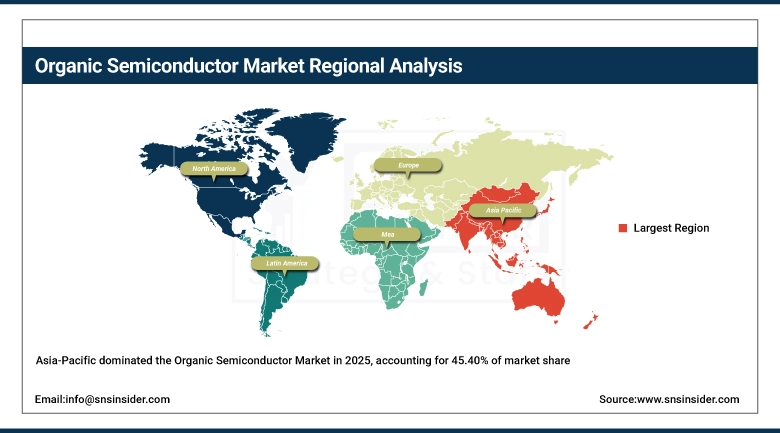
Asia-Pacific (Dominating & Fastest Growing – 45.40% in 2025 → 48.60% in 2035, CAGR 21.17%)
-
North America (23.80% in 2025 → 22.20% in 2035, CAGR 19.51%)
-
Europe (20.80% in 2025 → 19.20% in 2035, CAGR 19.38%)
-
Latin America (5.10% in 2025 → 5.90% in 2035, CAGR 22.10%)
-
Middle East & Africa (4.90% in 2025 → 4.10% in 2035, CAGR 18.20%)
Asia-Pacific Organic Semiconductor Market Insights:
The Asia Pacific region is the largest market for organic semiconductors with the strong presence of electronics and displays manufacturing in the region. It is driven by mass production of advanced display technologies, increasing usage of lightweight and flexible electronic devices, and ongoing investments in material development and research in the region. Frequent supportive government initiatives along with low manufacturing infrastructure along with high consumer electronics demand further contributes to strengthen the position of the region globally in organic semiconductor industry.
Get Customized Report as per Your Business Requirement - Enquiry Now
China Organic Semiconductor Market Insights:
China is a dominant and rapidly growing market for organic semiconductors, driven by strong electronics manufacturing, increasing OLED and flexible display adoption, and rising investment in advanced materials and next-generation electronic technologies.
North America Organic Semiconductor Market Insights:
The North American market is experiencing the fastest growth in the global organic semiconductor industry, owing to the strong research and development growth, high adoption of advanced display technologies at various end-use industries, and rising demand for flexible and energy-efficient electronic devices. It enjoys the strong presence of major technology companies, mature semiconductor ecosystem, and deep investments into organic electronics and OLED applications. Moreover, continuous evolution of material science combined with increasing applications in healthcare, automotive display, and wearable devices further propel market growth across North America.
U.S. Organic Semiconductor Market Insights:
The rise in organic semiconductor materials is driven by growing R&D spending, advanced electronics manufacturing in the U.S. market, and increasing demand for OLED displays and flexible devices, all contributing to gradual growth in this area. Innovation in organic materials, coupled with increasing adoption of organic electronics in various sectors such as healthcare, automotive, and consumer electronics, further supports growth.
Europe Organic Semiconductor Market Insights:
The Europe organic semiconductor market is anticipated to witness steady growth in the coming years, supported by strong research and innovation activities in advanced materials and sustainable electronics. Increasing demand for energy-efficient displays, flexible devices, and organic photovoltaic applications is driving market expansion across the region. Europe also benefits from well-established chemical and materials industries, along with supportive regulatory frameworks promoting green and low-power technologies. Additionally, growing investments in organic electronics for automotive, healthcare, and industrial applications are further contributing to the region’s stable and sustained market development.
Germany Organic Semiconductor Market Insights:
Germany organic semiconductor industry is benefiting from steady chemical and materials industry presence, stronger R&D, and the start of commercialization products (such as OLED displays and flexible electronics). The growing investments in sustainable technologies and partnerships between research institutes and manufacturers are contributing to the growth of the market..
Latin America Organic Semiconductor Market Insights:
Latin America organic semiconductors market is a slowly developing market, owing to the increasing adoption of high-performance electronic devices and devices utilizing energy-efficient display technologies. The market in this region is being supported by the growing consumer electronics demand and increasing investments in the development of telecommunications and modernization of the industrial sector. Along with this, enhancement of technological support and gradual incorporation of flexible electronics in specific applications are driving its growth moderately. While still nascent relative to developed markets, rising awareness and feasible use cases in healthcare, automotive, and smart devices are likely to power long-term expansion even further.
Brazil Organic Semiconductor Market Insights:
Brazil holds the largest share in Latin America organic semiconductor industry, attributed to expanding electronics industry, increasing adoption of advanced display technologies, and rising investments in innovation and modernization of the industrial sector. The market growth in the country is also being supported with the rising integration of consumer electronic products and the slow penetration of flexible electronic constituents.
Middle East & Africa Organic Semiconductor Market Insights:
The Middle East & Africa organic semiconductor industry is witnessing significant momentum, This trend is attributed to increasing investments in advanced electronics, growing adoption of smart devices, and rising focus towards digital transformation initiatives in this region. The other factors assisting market growth across the region include growing telecommunications infrastructure and increased demand for energy-efficient display technologies. However, the ongoing government-driven diversification strategies, especially in some of the Gulf countries, are pushing innovations in advanced technology industries — organic electronics included. While the region is still development-oriented, there is increasing adoption of flexible electronics and OLED-based applications, and the long-term potential for market growth remains strong.
United Arab Emirates Organic Semiconductor Market Insights:
The United Arab Emirates is a key market in MEA organic semiconductors, owing to smart city projects, digital transformation and adoption of various advanced display technologies. Organic Electronics Applications Growth is Further Accelerated by Strong Government Support and Investment in High-Tech Infrastructure.
Organic Semiconductor Market Competitive Landscape:
Universal Display Corporation (UDC) is the leader in OLED technologies and materials, founded in 1994 and located in the Ewing, New Jersey, U.S. provides phosphorescent emitter systems and licenses its intellectual property, as well as supplying advanced materials utilized in high-performance display and lighting applications around the globe.
-
In March, 2026 – Universal Display Corporation’s blue phosphorescent OLED “dream material” still faces delays in commercialization, with timelines uncertain due to ongoing technical challenges in stability and lifetime for mass production.
Samsung Electronics Founded in 1969 has a world-leading position in advanced electronics, semiconductors, and display technologies, with ubiquitous applications in consumer electronics, automotive components, and next generation digital system solutions, headquartered in Suwon, Korea..
-
July 2025 – Samsung Electronics and LG Electronics will showcase automotive technologies at IAA Mobility 2025 in Munich, highlighting OLED displays, vehicle chips, EV batteries, and software-defined vehicle solutions.
Organic Semiconductor Companies are:
-
BASF SE
-
DuPont de Nemours, Inc.
-
Sumitomo Chemical Co., Ltd.
-
Idemitsu Kosan Co., Ltd.
-
LG Chem Ltd.
-
LG Display Co., Ltd.
-
Samsung Electronics Co., Ltd.
-
Universal Display Corporation (UDC)
-
Heliatek GmbH
-
Novaled GmbH
-
Covestro AG
-
Evonik Industries AG
-
JNC Corporation
-
DIC Corporation
-
Eastman Chemical Company
-
Konica Minolta, Inc.
-
Tokyo Ohka Kogyo Co., Ltd. (TOK)
-
AGC Inc.
| Report Attributes | Details |
|---|---|
| Market Size in 2025 | USD 184.52 Billion |
| Market Size by 2035 | USD 1175.58 Billion |
| CAGR | CAGR of 20.35% From 2026 to 2035 |
| Base Year | 2025 |
| Forecast Period | 2026-2035 |
| Historical Data | 2022-2024 |
| Report Scope & Coverage | Market Size, Segments Analysis, Competitive Landscape, Regional Analysis, DROC & SWOT Analysis, Forecast Outlook |
| Key Segments | • By Type (Polymeric organic semiconductors and Small molecule organic semiconductors) • By Material (Polyphenylene vinylene (PPV), Polyfluorene, Polythiophene, Pentacene, Anthracene, Rubrene and Others) • By Process Technology (Vacuum evaporation, Organic vapor phase deposition (OVPD), Inkjet printing, Spin coating, Spray coating and Others) • By End Use Industry (Consumer electronics, Automotive, Healthcare, Energy, Industrial, Aerospace & defense and Others) |
| Regional Analysis/Coverage | North America (US, Canada), Europe (Germany, UK, France, Italy, Spain, Russia, Poland, Rest of Europe), Asia Pacific (China, India, Japan, South Korea, Australia, ASEAN Countries, Rest of Asia Pacific), Middle East & Africa (UAE, Saudi Arabia, Qatar, South Africa, Rest of Middle East & Africa), Latin America (Brazil, Argentina, Mexico, Colombia, Rest of Latin America). |
| Company Profiles | Merck KGaA (EMD Performance Materials), BASF SE, DuPont de Nemours, Inc., Sumitomo Chemical Co., Ltd., Idemitsu Kosan Co., Ltd., LG Chem Ltd., Samsung SDI Co., Ltd., LG Display Co., Ltd., Samsung Electronics Co., Ltd., Universal Display Corporation (UDC), Heliatek GmbH, Novaled GmbH, Covestro AG, Evonik Industries AG, JNC Corporation, DIC Corporation, Eastman Chemical Company, Konica Minolta, Inc., Tokyo Ohka Kogyo Co., Ltd. (TOK), AGC Inc. |

Frequently Asked Questions
Asia-Pacific dominated the Organic Semiconductor Market in 2025.
The “Polymeric organic semiconductors” segment dominated during the projected period.
Increasing demand for flexible electronics, OLED displays, and energy-efficient semiconductor solutions is driving the growth of the Organic Semiconductor Market.
The Market was valued at USD 184.52 Billion in 2025 and is projected to reach USD 1175.68 Billion by 2035.
The Market is expected to grow at a CAGR of 20.35% during 2026–2035.
