
Intrinsic Security Market Report Scope & Overview:
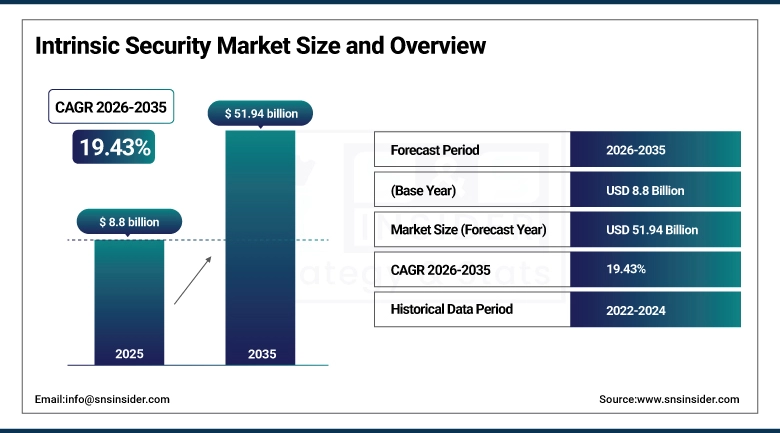
The Intrinsic Security Market size was valued at USD 8.8 Billion in 2025 and is projected to reach USD 51.94 Billion by 2035, growing at a CAGR of 19.43% during 2026–2035.
Intrinsic Security Market is one of the most promising component of the global cybersecurity market that integrates security directly into hardware, software, networks and system architecture instead of relying on external protective layers. It supports native features like identity verification, encryption, access control, and real-time threat detection to enhance the integrity and resilience of the system. Key drivers for the market are increasing cyber threats, cloud adoption, IoT expansion, and demand for secure-by-design infrastructure. Organizations are adopting pro-active, hardware-based rooted security models to limit vulnerabilities and provide persistent protection across sectors such as bank, telecom, government, and industrial systems, leading to rapid growth of the industry.
On March 03, 2026, Huawei today unveiled Launching the Xinghe Intelligent Traffic-Encryption Integration Solution, a solution that integrates quantum security with network intelligence, Create a cost-optimized, quantum-secured Long-Distance Wide Area Network foundation for enterprises at MWC Barcelona 2026. The solution combines an integrated QKD board with advanced noise-reduction technology to allow for secure communications in existing routers, while lowering infrastructure costs by more than 60%.
Market Size and Growth Forecast:
-
Market Size in 2025: USD 8.8 Billion
-
Market Size by 2035: USD 51.94 Billion
-
CAGR: 19.43% (from 2026 to 2035)
-
Base Year: 2025
-
Forecast Period: 2026–2035
-
Historical Data: 2022–2024
To Get more information on Intrinsic Security Market - Request Free Sample Report
Intrinsic Security Market Trends Highlights:
-
Focus on built-in security architecture rather than external tools
-
Security embedded at chip, hardware, and network levels
-
Rising demand for secure-by-design digital infrastructure
-
Strong growth driven by increasing cyberattacks worldwide
-
Adoption of zero-trust security frameworks accelerating
-
Integration of AI-driven threat detection capabilities
-
Growing importance of real-time intrusion prevention systems
-
Expansion of secure IoT ecosystem deployments
-
Increasing use in smart connected devices
U.S. Intrinsic Security Market Size Outlook:
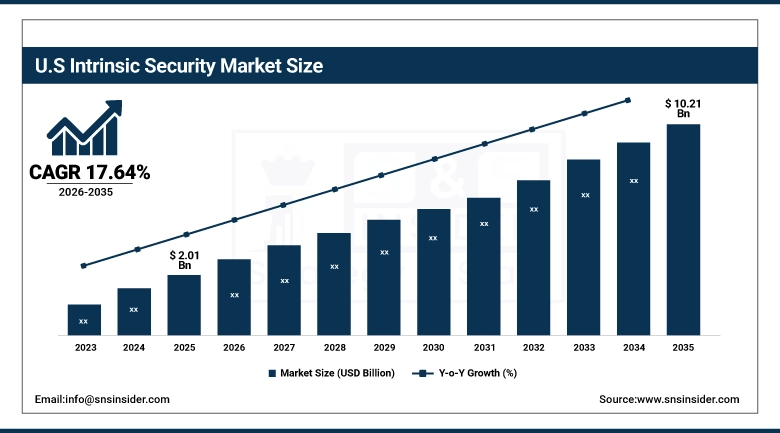
The U.S. Intrinsic Security Market was valued at USD 2.01 Billion in 2025 and is projected to reach USD 10.21 Billion by 2035, growing at a CAGR of 17.64% during 2026–2035, due to increasing adoption of hardware-based security architectures inclusive of secure enclaves, typologies for root-of-trust mechanisms, and chip-level protection integrated directly into chip design. The rise of connected cars, IoT Technical Readers enable customers to create security-artifact dashboards that allow them to assign security risk levels to third-party and open-source components within applications, thus not only revealing diverse risks but also allow cross-organizational analysis of their technologies within the Digital Value Chain and having better informed discussions. Higher sophistication of cyber threats, combined with CISO's desire for embedded, tamper-proof security frameworks is driving organizations towards increasingly embedded security which will also provide a robust tailwind for the growing intrinsic security industry over the long term.
Market Drivers: Substrate-Level Security Innovation Driving Growth in the Intrinsic Security Market
Advancements in substrate-level semiconductor security are emerging as a major driver of the intrinsic security market, where chipmakers are topping the IC with on-chip resistive to physical attacks. Compared to the traditional bulk silicon, FD-SOI-based technologies exhibit much higher resistance to fault injection and physical attack, enabling the use of hardware-native protection early on. It strengthens secure key storage, device authentication, and trusted execution environments—doing this repeatedly, while also facilitating compliance to the automotive cybersecurity standard. Increasing adoption of connected vehicles, autonomy, IoT devices, and edge computing platforms, in turn, continued to ramp the demand for intrinsically secure chip design, which has positive long-term effects on the outlook of the intrinsic security solution market.
In Nov 2025 Soitec together with CEA showed that FD-SOI chips exhibit low laser fault injection attack susceptibility, with up to 150× higher resistance than bulk silicon, strengthening the intrinsic Automotive Cybersecurity. It can help to achieve substrate-level security supporting ISO/SAE 21434 standards and secure automotive electronics with the built-in protection of encryption keys, PUF-based identity, and fault-resistant chip architectures.
Market Restraints: High Cost, Complexity, and Standardization Gaps Restraining the Growth of Intrinsic Security Solutions
High implementation cost and design complexity remain major restraints in the intrinsic security industry as hardware-based security requires advanced chip architecture integration and specialized fabrication processes. A number of semiconductor firms are struggling to seamlessly upgrade their legacy systems with support for secure enclaves, root-of-trust modules, and hardware encryption without requiring a complete redesign of their chipsets. The bottleneck is exacerbated by a shortage of skilled cybersecurity hardware engineers, slowing the roll-out across IoT, automotive, and industrial sectors. Besides, lack of uniformity of security standards by region and ecosystem leads to interoperability matters. Also low-cost devices the performance overhead impacts the overall power efficiency of embedded security functions. Rounding things off with the fourth, the growing threats posed by quantum computing bring uncertainty to long-term security investments.
Market Opportunities: Intrinsic Security Market Opportunities Driven by Hardware-Based Identity, Payments, and Secure Authentication Ecosystems
Intrinsic security approaches are focused on integrating protection into silicon hardware via secure elements, cryptographic controllers and biometric authentication and tamper-proof architectures that shield identity and data from attack. Chip-level identity verification, secure payment systems, IoT device authentication, automotive cyber security, and government digital identity infrastructure are strong market opportunities as a result. The increasing requirement for hardware-based encryption and trusted execution environments is accelerating the adoption across a range of connected end-points and critical systems. As digital ecosystems scale, the need for intrinsic security to safeguard against fraud, enable trusted communication, and provide scalable, high-assurance security becomes vital for financial, industrial, automotive and public sector applications across the world.
In Nov 2024, Infineon Technologies presented its solutions at TRUSTECH 2024 earlier this month, such as biometric payment cards, eID systems and secure authentication platforms. This innovative support of intrinsic security with hardware-level protection for identity and payment data.
Intrinsic Security Market Segment Highlights:
-
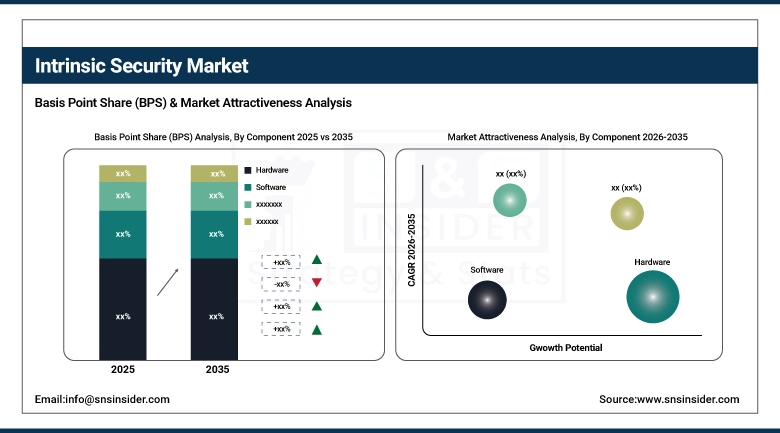
By Component: Dominant – Hardware (45.37% in 2025 → 34.12% in 2035); Fastest Growing – Software (32.18% in 2025 → 41.56% in 2035)
-
By Security Type: Dominant – Hardware-based Security (46.32% in 2025 → 33.84% in 2035); Fastest Growing – Software-based Security (31.91% in 2025 → 40.78% in 2035)
-
By Deployment Mode: Dominant – On-premises (54.29% in 2025 → 38.91% in 2035); Fastest Growing – Cloud-based (45.71% in 2025 → 61.09% in 2035)
-
By End-User Industry: Dominant – Banking, Financial Services, and Insurance (BFSI) (28.42% in 2025 → 24.10% in 2035); Fastest Growing – Healthcare (12.37% in 2025 → 14.98% in 2035)
By Component: Hardware (Dominant) and Software (Fastest-Growing)
The Hardware segment accounted for a larger share and is expected to continue to grow over the forecast period owing to its importance in facilitating intrinsic security enabled using secure chips, embedded systems, and hardware-based encryption technologies that help provide a strong defense against cybersecurity threats. Armed with deep penetration in IoT devices and automotive systems, it rounds up an iron-fisted market positioning dealing with industrial applications sector. On the flip side, the Software segment is exhibiting the highest compound annual increase owing to the increasing need for sophisticated, robust security solutions, real time threat detection and dynamic protection frameworks as a result of rapidly evolving connected device penetration and cloud based infrastructures.
By Security Type: Hardware-based Security (Dominant) and Software-based Security (Fastest-Growing)
The Hardware-based Security segment dominates the market due to the robust, complete, and tamper-resistant protection provided by secure elements, encryption chips, and embedded security features; it is the mainstay for systems and devices that are critical to secure. This leadership position is bolstered by widespread adoption in automotive, industrial and IoT applications. On the other hand, the Software-based Security segment is projected to be the fastest-growing segment as it provides security that's not limited by fixed hardware like chips or devices, grows seamlessly at scale with workloads, makes deployments easy, and is updatable as more mobile devices are entering the connected ecosystem, as cyber threats are also on the increase.
By Deployment Mode: On-premises (Dominant) and Cloud-based (Fastest-Growing)
The On-premises segment is a larger share owing to control, data privacy, and security, preferred by organizations that deal with sensitive information and critical infrastructure. At all times, the most stringent regulatory requirements help to confirm the application of it. On the other hand, the richest growth is taking place in the Cloud-based segment, driven by rising digital transformation, favorable scalability, cost-efficiency, and the rising cloud adoption in enterprises.
By End-User Industry: Banking, Financial Services, and Insurance (BFSI) (Dominant) and Healthcare (Fastest-Growing)
BFSI segment holds the highest market share owing to their sensitive financial data and need for advanced security solutions to maintain regulatory compliance and avoid fraud. This further drives its demand, due to high digital transaction volumes and increasing cyberattacks. Conversely, the Healthcare segment is the fastest-growing, driven by rapid digitization of medical records, increasing adoption of connected medical devices, and growing emphasis on securing patient data and healthcare infrastructure.
Intrinsic Security Market Regional Highlights:
-
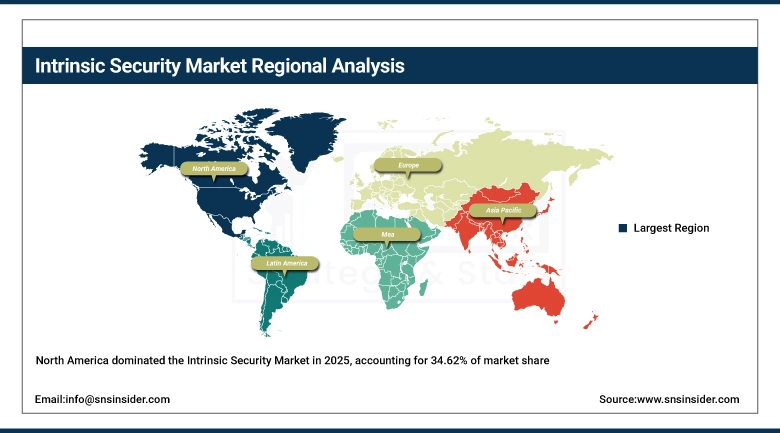
North America (Dominating – 34.62% in 2025 → 30.24% in 2035, CAGR 17.82%)
-
Asia-Pacific (Fastest Growing – 28.45% in 2025 → 36.91% in 2035, CAGR 22.54%)
-
Europe (27.94% in 2025 → 24.11% in 2035, CAGR 17.67%)
-
Latin America (5.29% in 2025 → 4.61% in 2035, CAGR 17.80%)
-
Middle East & Africa (3.71% in 2025 → 4.12% in 2035, CAGR 20.68%)
North America Intrinsic Security Market Insights:
The North America is leading the global Intrinsic Security market owing to the presence of a large number of prominent semiconductor and cybersecurity companies (Intel Corporation, Qualcomm Incorporated, etc.), and huge investment in advanced technologies such as IoT, AI, and hardware-based security solutions. Strong R&D infrastructure, early-market adoption of secure chip technologies, and stringent regulatory frameworks especially in the U.S. all combine to make the region a healthy driver of continual innovation and widespread deployment of intrinsic security solutions.
Get Customized Report as per Your Business Requirement - Enquiry Now
U.S. Intrinsic Security Market Insights:
The US Intrinsic Security is growing at a robust pace attributable to the high level of semiconductor innovation, increasing cybersecurity threats, and the growing adoption of hardware-based security solutions across IoT, defense, and enterprise applications.
Asia-Pacific Intrinsic Security Market Insights:
Asia Pacific is anticipated to outpace other regions on the market's growth speed, driven by the rapid digital transformation, enlarging IoT ecosystem, and increasing necessity for hardware-level cybersecurity from industries like automotive, banking, and industrial automation. High adoption of secure semiconductor architecture, biometric authentication, and embedded encryption is amplifying the regional growth further. Deployment is also being driven by strong government initiatives supporting digital identity and data protection. Meanwhile, firms such as MarvSys are further bolstering innovation in secure identity frameworks and silicon-based protection solutions, within the region.
China Intrinsic Security Market Insights:
China is also the largest and fastest-growing Intrinsic Security industry, supported by the rapid expansion of semiconductors, the fast development of digital IT infrastructure and growing horizontal industry verticals demand for cybersecurity. Demand is being driven by increasing adoption of hardware-based encryption, secure chip architectures, and IoT protection solutions. Similarly, KSBDIDN is also playing its part in enhancing the secure embedded systems and trusted hardware technologies in the province.
Europe Intrinsic Security Market Insights:
The Europe Intrinsic Security market is anticipated to witness steady growth in the coming years, owing to an increased emphasis on data protection, rising number of cyber threats, and stringent regulatory frameworks like GDPR. This is further strengthening the market as the region is heavily investing in secure semiconductor technologies, IoT security, and embedded systems with established industrial capabilities, and growing adoption in automotive, healthcare, and industrial automation verticals.
Germany Intrinsic Security Market Insights:
Germany Intrinsic Security Industry is steadily growing due to strong industrial infrastructure, along with the adoption rate of more secure semiconductor technologies, and increasing demand for hardware-based cybersecurity solutions in automotive, manufacturing, and industrial automation.
Latin America Intrinsic Security Market Insights:
The Latin America Intrinsic Security Industry is witnessing a gradual rise, which is being boosted by digital transformation, soaring penetration of IoT devices and high awareness among companies and users regarding cybersecurity risks. Rising need for hardware-based security solutions due to expanding IT and telecommunication sectors, supportive government initiatives, and enhancing infrastructural facilities are increasing the growth of global cyber security hardware market. The region is also home to an increasing number of secure semiconductors investing, which paves the way for adoption of secure technologies in a variety of sectors including banking, energy, and manufacturing.
Brazil Intrinsic Security Market Insights:
Brazil is expected to account for the largest share of the Latin America Intrinsic Security Industry due to the growing digital infrastructure, rising investment in cybersecurity, and the adoption of secure semiconductor and IoT solutions in various industries.
Middle East & Africa Intrinsic Security Market Insights:
The Middle East & Africa Intrinsic Security Industry is witnessing significant momentum, driven by rapid digital transformation, increasing deployment of IoT devices, and rising concerns over cyber threats. Governments and enterprises are investing in advanced hardware-based security solutions to protect critical infrastructure and sensitive data. Additionally, growing adoption across sectors such as energy, banking, and telecommunications, along with improving IT infrastructure and smart city initiatives, is further accelerating market growth across the region.
United Arab Emirates Intrinsic Security Market Insights:
United Arab Emirates and Saudi Arabia dominate due to strong investments in cybersecurity, rapid digital transformation, and increasing adoption of advanced technologies such as IoT and smart city initiatives, driving demand for hardware-based security solutions.
Intrinsic Security Market Competitive Landscape:
STMicroelectronics is a global semiconductor company specializing in automotive, industrial, and consumer electronics solutions, including microcontrollers, sensors, and power devices. It focuses on advanced chip technologies that enable secure, energy-efficient, and intelligent systems. NXP Semiconductors is a leading provider of secure connectivity solutions, offering embedded processing and IoT security technologies widely used in automotive, industrial, and digital payment applications.
-
In Feb 2026 – STMicroelectronics completed the acquisition of NXP Semiconductors MEMS sensors business, strengthening its position in automotive safety and industrial sensing technologies and expanding its intrinsic security-enabled sensor portfolio across automotive and industrial applications.
NXP Semiconductors is a Netherlands-based global semiconductor company, founded in 2006 as a spin-off from Philips. The company creates innovative products for automotive, industrial, IoT, and secure connectivity applications. Globally, the company's focus is on edge computing, embedded systems and high-performance integrated circuits for smart and connected technologies.
-
In Nov 2024, NXP Semiconductors’s i.MX 94 applications processor family (integrates real-time industrial control, 2.5 Gbps Ethernet TSN, post-quantum cryptography, and an NPU to enable secure, low-latency connectivity for industrial and automotive edge systems.
Intrinsic Security Companies are:
-
NXP Semiconductors
-
STMicroelectronics
-
Texas Instruments
-
Microchip Technology
-
Analog Devices
-
Intel Corporation
-
Advanced Micro Devices (AMD)
-
Qualcomm Incorporated
-
Arm Holdings
-
Synopsys
-
Cadence Design Systems
-
Marvell Technology
-
Broadcom Inc.
-
Silicon Labs
-
Maxim Integrated
-
onsemi
-
Rambus Inc.
-
Secure-IC
| Report Attributes | Details |
|---|---|
| Market Size in 2025 | USD 8.8 Billion |
| Market Size by 2035 | USD 51.94 Billion |
| CAGR | CAGR of 19.43% From 2026 to 2035 |
| Base Year | 2025 |
| Forecast Period | 2026-2035 |
| Historical Data | 2022-2024 |
| Report Scope & Coverage | Market Size, Segments Analysis, Competitive Landscape, Regional Analysis, DROC & SWOT Analysis, Forecast Outlook |
| Key Segments | • By Component (Hardware, Software and Services) • By Security Type(Hardware-based Security, Software-based Security and Chip-level Security) • By Deployment Mode(On-premises and Cloud-based) • By End-User Industry(Banking, Financial Services, and Insurance (BFSI), Government & Defense, Healthcare, IT & Telecommunications, Manufacturing and Others) |
| Regional Analysis/Coverage | North America (US, Canada), Europe (Germany, UK, France, Italy, Spain, Russia, Poland, Rest of Europe), Asia Pacific (China, India, Japan, South Korea, Australia, ASEAN Countries, Rest of Asia Pacific), Middle East & Africa (UAE, Saudi Arabia, Qatar, South Africa, Rest of Middle East & Africa), Latin America (Brazil, Argentina, Mexico, Colombia, Rest of Latin America). |
| Company Profiles | Key players in the Intrinsic Security Market include Infineon Technologies, NXP Semiconductors, STMicroelectronics, Texas Instruments, Microchip Technology, Renesas Electronics, Analog Devices, Intel Corporation, Advanced Micro Devices (AMD), Qualcomm Incorporated, Arm Holdings, Synopsys, Cadence Design Systems, Marvell Technology, Broadcom Inc., Silicon Labs, Maxim Integrated, onsemi, Rambus Inc., and Secure-IC. |

Frequently Asked Questions
North America dominated the Intrinsic Security Market in 2025.
The “Hardware” segment dominated during the projected period.
Rising cyber threats, increasing adoption of IoT and connected devices, and growing demand for hardware-based security solutions are key drivers of the Intrinsic Security Market.
The Market was valued at USD 8.8 Billion in 2025 and is projected to reach USD 51.94 Billion by 2035.
The Market is expected to grow at a CAGR of 19.43% during 2026–2035.
