
Pedicle Screw Systems Market Report Scope & Overview:
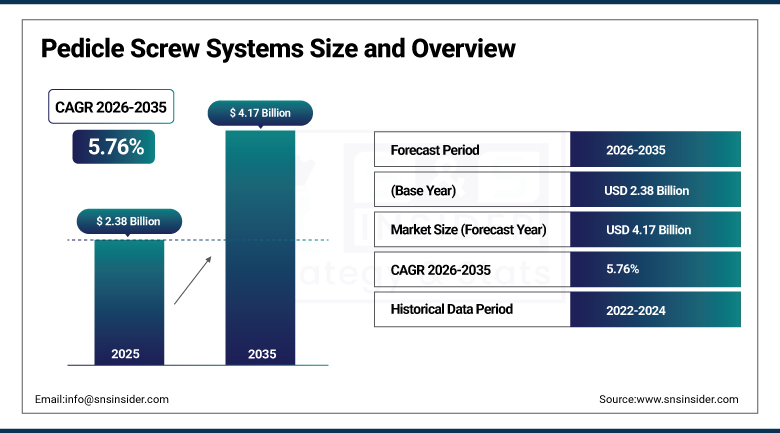
The Pedicle Screw Systems Market was valued at USD 2.38 Billion in 2025 and is expected to reach USD 4.17 Billion by 2035, growing at a CAGR of 5.76% from 2026–2035.
A spine surgeon's toolkit has gotten a lot more sophisticated over the last decade, and pedicle screws sit right at the center of that shift. These implants anchor rods and plates to the vertebrae during fusion, trauma repair, and deformity correction procedures, and as more people live longer with degenerative disc disease and osteoporosis, the number of surgeries relying on them keeps climbing. What's changed the market lately isn't just volume, it's precision. Navigation and robotics-assisted implantation, along with patient-specific 3D-printed guides, are letting surgeons place screws with a level of accuracy that manual techniques struggled to match consistently, and that improvement is reshaping which systems hospitals actually want to buy.
National health expenditures in the U.S. grew by 8.2% in 2024, reflecting increased spending on healthcare services, spinal treatments included. That kind of spending growth tends to show up fairly directly in capital equipment purchases at hospitals investing in newer surgical technology.
To Get more information On Pedicle Screw Systems - Request Free Sample Report
Pedicle Screw Systems Market Trends
-
Spinal disorder prevalence keeps climbing alongside aging populations and increasingly sedentary lifestyles worldwide.
-
Minimally invasive spine surgery techniques continue gaining ground for the better patient outcomes and shorter recovery they tend to deliver.
-
Healthcare infrastructure and awareness are expanding across emerging markets, opening up meaningful new demand.
-
Navigation and robotics-assisted systems, along with 3D-printed patient-specific guides, keep advancing further into mainstream surgical practice.
-
Deformity correction and revision surgery applications are growing, supported by strategic partnerships across the industry.
The U.S. Pedicle Screw Systems Market Outlook
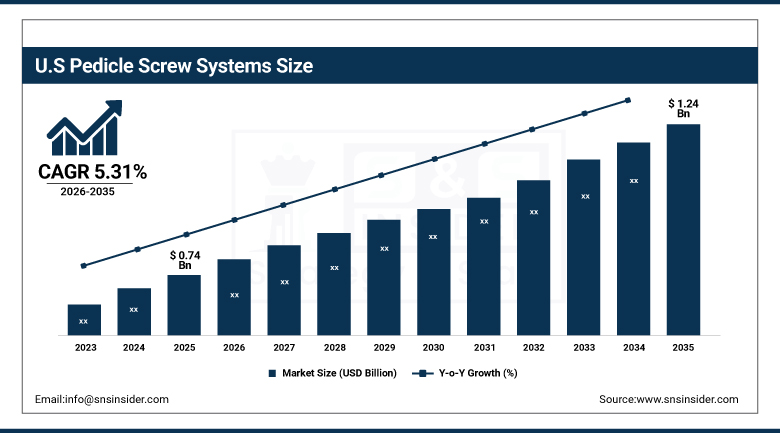
The U.S. Pedicle Screw Systems Market was valued at approximately USD 0.74 Billion in 2025 and is expected to reach approximately USD 1.24 Billion by 2035, growing at a CAGR of approximately 5.31%.
The U.S. market keeps growing on the back of rising spinal disorder rates, an advanced hospital system, and surgeons who've become genuinely comfortable adopting minimally invasive techniques ahead of most other countries. Technological innovation, a growing elderly population, and steady investment in spine care infrastructure all continue reinforcing this position.
In March 2025, Stryker showcased its next-generation Mako 4 suite at the AAOS Annual Meeting in San Diego, expanding Mako Spine and Mako Shoulder into its SmartRobotics platform. Stryker completed its first Mako Spine cases in October 2024 and continued a limited U.S. market release, with a full commercial launch expected in the second half of 2025, a signal that robotics-assisted spine surgery is moving from early adopter territory into broader clinical practice.
Pedicle Screw Systems Market Segment Analysis
-
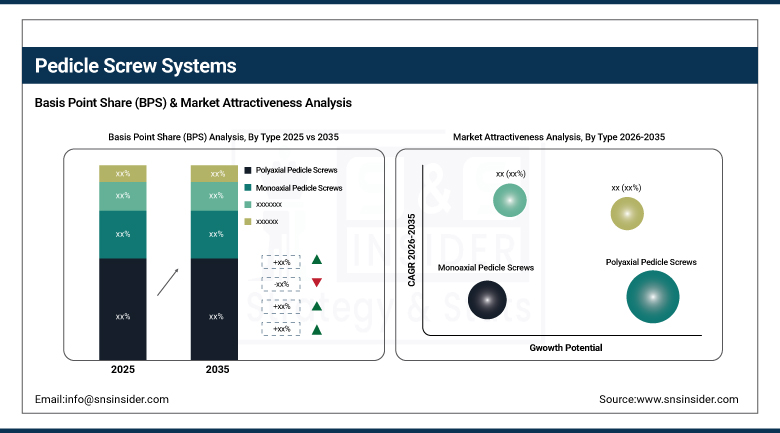
By Type, Polyaxial Pedicle Screws dominated with 37.38% share in 2025, while Expandable/Augmented Pedicle Screws is the fastest growing at a CAGR of 6.59%.
-
By Application, Spinal Fusion led with 43.86% share in 2025, while Deformity Correction is the fastest growing at a CAGR of 6.73%.
-
By Sales Channel, Hospital Purchasing/Direct Sales led with 58.64% share in 2025, and is also the fastest growing at a CAGR of 6.05%.
-
By Technology, Conventional Open-Surgery Systems led with 39.46% share in 2025, while Patient-Specific/3D-Printed Guides & Implants is the fastest growing at a CAGR of 6.73%.
By Type, polyaxial screws lead, expandable screws grow fastest
Polyaxial pedicle screws lead the market, and it's mostly down to their flexibility, they're easier to implant and adapt well to complex spinal anatomy across a wide range of procedures. That adaptability has made them the default choice for a lot of surgeons who need a screw that can handle whatever angle the patient's spine presents.
Expandable and augmented screws are growing the fastest, driven by demand for better fixation in osteoporotic bone specifically. Their ability to hold securely in weaker bone, combined with steady technological refinement, is what's positioning them as a genuinely high-growth segment as the patient population continues aging.
By Application, spinal fusion dominates, deformity correction accelerates
Spinal fusion for degenerative disorders dominates, which makes sense given how common degenerative disc disease and chronic back pain are, particularly among older patients. That sheer volume of cases keeps this application well ahead of every other category.
Deformity correction, scoliosis and kyphosis treatment among them, is growing fastest, pushed along by rising awareness, better surgical technique, and growing adoption of advanced correction technology worldwide.
By Sales Channel, hospital purchasing leads and keeps expanding
Hospital purchasing and direct sales dominate, supported by strong hospital networks, bulk procurement advantages, and supplier relationships that have been built over years. Direct sales also tend to come with better customization, pricing, and post-sale support, which matters a lot to hospitals managing complex surgical inventories.
This channel is also the fastest-growing, driven by hospitals investing more heavily in advanced spinal surgery equipment and expanding infrastructure that keeps favoring direct supplier relationships over third-party distribution.
By Technology, conventional systems lead, 3D-printed guides grow fastest
Conventional open-surgery systems still dominate, largely because surgeons are simply more familiar with them and they remain more cost-effective than newer alternatives. That established comfort level keeps them the default option in a lot of surgical settings, even as newer technology gains ground.
Patient-specific and 3D-printed guides and implants are the fastest-growing technology, driven by advances in 3D printing, rising demand for personalized spinal solutions, and better surgical accuracy. These innovations tend to reduce complications and improve outcomes, which is exactly why adoption keeps accelerating.
Regional Analysis
|
Region |
Major Country |
Share within Region, 2025 (%) |
|---|---|---|
|
North America |
United States |
78.0% |
|
Europe |
Germany |
25.0% |
|
Asia Pacific |
Japan |
33.0% |
|
Latin America |
Brazil |
35.0% |
|
Middle East & Africa |
Saudi Arabia |
25.0% |
North America Pedicle Screw Systems Market Insights
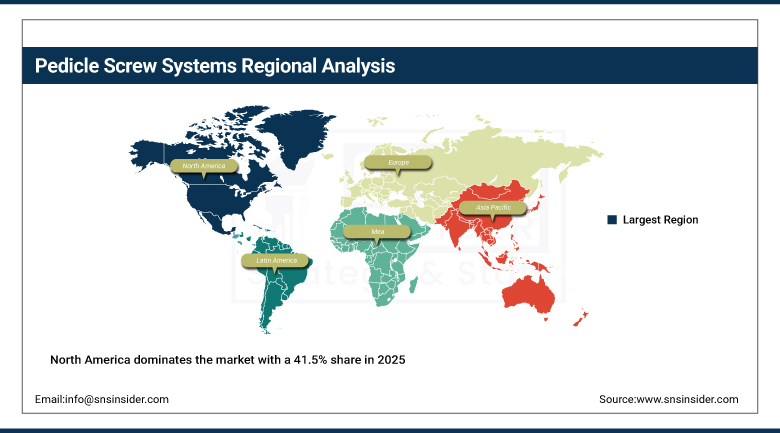
North America dominates the market with a 41.5% share in 2025, driven by advanced healthcare infrastructure, high adoption of minimally invasive spinal surgery, and strong investment in medical technology. A large patient pool with spinal disorders, a growing elderly population, and supportive reimbursement policy all continue reinforcing this leadership.
The U.S. leads in the North America market due to its sophisticated healthcare network, significant investment in healthcare, early development of the novel spinal surgery technology and advanced research and development capabilities. The constant innovation in technology coupled with effective logistics makes it an important center for pedicle screw innovation.
Get Customized Report as per Your Business Requirement - Enquiry Now
Europe Pedicle Screw Systems Market Insights
Europe will have an important market share in 2025 due to its advanced healthcare system, increasing geriatric population, and prevalence of spinal disorders. The strong usage of minimally invasive spinal surgery, technological advancement, and good reimbursement policy all help in promoting growth.
Germany leads in the European market because of its advanced healthcare system, well-established medical technology industry, and strong adoption of innovative spinal surgery techniques. The ability for R&D and the presence of an aging population that suffers from a high prevalence of spinal disorders helps in its leading position.
Asia Pacific Pedicle Screw Systems Market Insights
Asia Pacific is expected to grow at the fastest CAGR, at 6.61% from 2026 to 2035, driven by improving healthcare infrastructure, rising awareness of advanced spinal treatments, and increasing healthcare expenditure across the region. Growing spinal disorder incidence, an expanding geriatric population, and rising demand for minimally invasive surgery are all driving adoption.
Japan is leading in the Asia-Pacific region because of the availability of well-equipped healthcare facilities, higher adoption rate of minimally invasive spine surgery procedures, substantial backing from the government for medical technology, and an aged population.
MEA & Latin America Pedicle Screw Systems Market Insights
Latin America and the Middle East and Africa together are emerging markets for pedicle screw systems, driven by improving healthcare infrastructure and rising awareness of advanced spinal treatment options. Growing investment in medical technology, increasing spinal disorder incidence, and expanding access to minimally invasive surgery are fueling demand across both regions.
Supportive government initiatives, collaborations between healthcare providers and device manufacturers, and expanding surgical capability continue creating meaningful growth opportunities, positioning these regions for steady, incremental expansion through the forecast period.
Market Dynamics
Growth Drivers: Rising spinal disorder prevalence and surgical innovation drive global growth
The market is primarily driven by rising spinal disorder prevalence, degenerative disc disease, scoliosis, and spinal fractures among them, fueled by an aging population and increasingly sedentary lifestyles. Growing trauma and accident incidence is contributing further to demand for spinal stabilization solutions.
Advances in surgical technique, particularly minimally invasive spine surgery, along with innovative pedicle screw design, keep improving procedural efficiency and patient outcomes. Growing awareness of spinal health and rising healthcare expenditure in emerging economies continue boosting adoption rates worldwide.
Restraints: Costs, risks, and regulatory hurdles limit accessibility
Real limitations exist within the market; this is because the implant as well as the surgery procedure is costly and, therefore, inaccessible in the developing regions. Advanced surgical techniques need specialized skills, which restrict the wide adoption of the system.
Safety issues include risk of pedicle screw insertion, nerve damage, screw loss and implant failure among others. There are regulatory barriers and strict approvals that delay the launch of products. Reimbursement issues and lack of health care facilities in the emerging nations have continued to slow down the market penetration rate.
Opportunities: Emerging markets and technological innovation drive growth
There is great opportunity for growth in the emerging markets, with advancements in healthcare infrastructure and increasing awareness about modern spinal treatment leading to actual demand. Technological advancement in implantation with the help of systems guided by navigation and robotics along with 3D printed devices for specific patients provides an actual opportunity for precision and minimizing complications.
Increasing use in deformity correction and revision surgery, along with collaboration between device companies and healthcare providers, presents promising growth opportunities in this industry. The elevation of Vietnam to a secondary emerging market by FTSE Russell in 2025 indicates improvements in healthcare infrastructure and investor confidence similar to those needed to bring investments into such industries.
Recent Developments:
-
2024: In March 2024, Medtronic launched the CD Horizon ModuLeX spinal system for deformity procedures, featuring a modular screw platform allowing intra-operative customization to match patient anatomy, part of Medtronic's AiBLE ecosystem integrating navigation, robotic guidance, and AI.
-
2024: In November 2024, Globus Medical launched the ExcelsiusHub Navigation System, enhancing real-time visualization of instrument placement during spine surgery.
-
2025: In March 2025, Stryker showcased its next-generation Mako 4 suite at the AAOS Annual Meeting, expanding Mako Spine and Mako Shoulder into its SmartRobotics platform, with full U.S. commercial launch of Mako Spine expected in the second half of 2025.
Pedicle Screw Systems Market key players are:
-
Globus Medical Inc.
-
Medtronic PLC
-
DePuy Synthes (Johnson & Johnson)
-
Zimmer Biomet Holdings Inc.
-
Stryker Corporation
-
B. Braun Melsungen AG
-
Alphatec Holdings Inc.
-
NuVasive Inc.
-
Orthofix Medical Inc.
-
RTI Surgical Holdings Inc.
-
Aesculap Implant Systems LLC
-
LDR Holding Corporation
-
SeaSpine Holdings Corporation
-
Medacta International SA
-
Precision Spine Inc.
-
Z-Medical GmbH & Co. KG
-
CoreLink Holding LLC
-
Xtant Medical Inc.
-
Spinal Elements Inc.
-
Life Spine Inc.
Pedicle Screw Systems Market Report Scope:
| Report Attributes | Details |
|---|---|
| Market Size in 2025 | USD 2.38 Billion |
| Market Size by 2035 | USD 4.17 Billion |
| CAGR | CAGR of 5.76% From 2026 to 2035 |
| Base Year | 2025 |
| Forecast Period | 2026-2035 |
| Historical Data | 2022-2024 |
| Report Scope & Coverage | Market Size, Segments Analysis, Competitive Landscape, Regional Analysis, DROC & SWOT Analysis, Forecast Outlook |
| Key Segments | • By Type (Monoaxial Pedicle Screws, Polyaxial Pedicle Screws, Cannulated Pedicle Screws, Expandable/Augmented Pedicle Screws) • By Application (Spinal Fusion, Trauma & Fracture Stabilization, Deformity Correction, Revision/Reconstructive Spine Surgeries) • By Sales Channel (Hospital Purchasing/Direct Sales, Distributors & Medical Device Wholesalers, Ambulatory Surgical Centers & Specialty Clinics, Online/E-commerce) • By Technology (Conventional Open-Surgery Systems, Minimally Invasive Surgery Systems & Percutaneous Screws, Navigation & Robotics-Assisted Implantation Systems, Patient-Specific/3D-Printed Guides & Implants) |
| Regional Analysis/Coverage | North America (US, Canada), Europe (Germany, UK, France, Italy, Spain, Russia, Poland, Rest of Europe), Asia Pacific (China, India, Japan, South Korea, Australia, ASEAN Countries, Rest of Asia Pacific), Middle East & Africa (UAE, Saudi Arabia, Qatar, South Africa, Rest of Middle East & Africa), Latin America (Brazil, Argentina, Mexico, Colombia, Rest of Latin America). |
| Company Profiles | Globus Medical Inc., Medtronic PLC, DePuy Synthes (Johnson & Johnson), Zimmer Biomet Holdings Inc., Stryker Corporation, B. Braun Melsungen AG, Alphatec Holdings Inc., NuVasive Inc., Orthofix Medical Inc., RTI Surgical Holdings Inc., Aesculap Implant Systems LLC, LDR Holding Corporation, SeaSpine Holdings Corporation, Medacta International SA, Precision Spine Inc., Z-Medical GmbH & Co. KG, CoreLink Holding LLC, Xtant Medical Inc., Spinal Elements Inc., Life Spine Inc. |
Frequently Asked Questions
The Pedicle Screw Systems Market is expected to grow at a CAGR of 5.76% from 2026 to 2035.
The Pedicle Screw Systems Market was valued at USD 2.38 Billion in 2025.
The key driver is the rising prevalence of spinal disorders, coupled with advancements in minimally invasive surgical technologies and increasing demand for improved spinal stabilization solutions.
North America dominated the Pedicle Screw Systems Market in 2025 with a 41.5% share.
