
Peptide API CMO Market Report Scope & Overview:
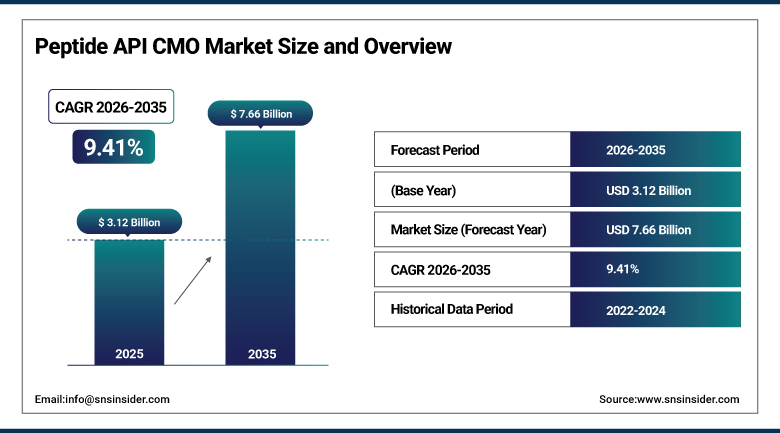
The Peptide API CMO Market was valued at USD 3.12 Billion in 2025 and is expected to reach USD 7.66 Billion by 2035, growing at a CAGR of 9.41% from 2026-2035.
The Peptide API CMO Market will see traction as GLP-1 receptor agonists, amylin analogs and a deep oncology pipeline lift demand for contract-made peptide active ingredients. Pharmaceutical sponsors are outsourcing synthesis, purification and lyophilization, as building multi-ton solid-phase capacity in-house takes years and heavy capital. Contract manufacturers are responding with large reactors, hybrid synthesis routes and greener solvent systems, while large expansions in Switzerland, the United States, India and South Korea extend the supply base. Patent expiries on first-generation peptide drugs are adding generic volumes, and long-term supply agreements are giving suppliers visibility to commit capital, which makes peptide manufacturing a capacity-led, relationship-driven services market.
To Get more information Peptide API CMO Market - Request Free Sample Report
⮞In April 2026, Bachem inaugurated Building K at its Bubendorf site in Switzerland and began ramping commercial GMP peptide production, with a USD 618 million Sisslerfeld greenfield campus targeted for 2030. The expansions reflect a supplier racing to add large-scale capacity as obesity and diabetes programs move from clinical supply into global commercial launch.
Peptide API CMO Market Trends
-
Rising contract capacity additions in large-scale solid-phase peptide synthesis to serve GLP-1 obesity and diabetes programs.
-
Growing adoption of hybrid and liquid-phase routes that lower solvent use and cost for long-chain peptides.
-
Expanding long-term supply agreements and customer-funded capacity reservations between sponsors and contract manufacturers.
-
Increasing investment in green chemistry, solvent recovery and acetonitrile-reduction initiatives across peptide plants.
-
Continued consolidation, with global CDMO groups acquiring peptide specialists to secure scale and regional redundancy.
-
Rising demand for peptide-drug conjugates, radioligands and macrocycles that need specialized synthesis and purification.
U.S. Peptide API CMO Market Outlook
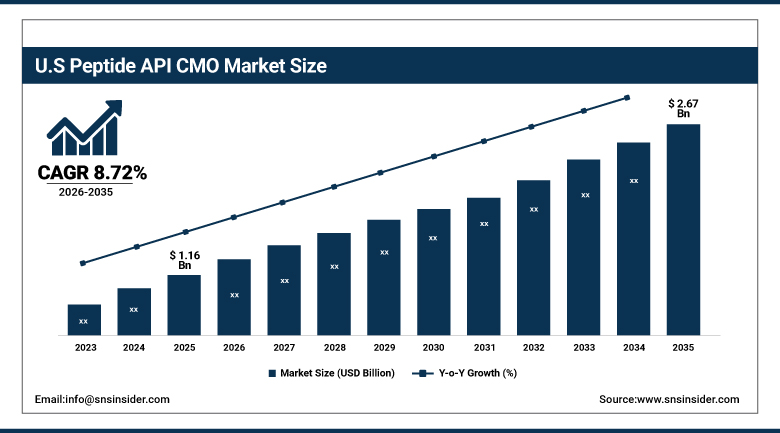
The U.S. Peptide API CMO Market was valued at USD 1.16 Billion in 2025 and is expected to reach USD 2.67 Billion by 2035, growing at a CAGR of 8.72% from 2026-2035.
The U.S. Peptide API CMO Market is expanding owing to the concentration of GLP-1 and oncology peptide developers in the country, which routes a large share of global commercial and clinical supply demand to U.S.-based sponsors. Federal and state incentives for pharmaceutical onshoring, together with tariff discussions on imported active ingredients, are encouraging companies to qualify North American suppliers for strategic products. The FDA’s well-defined guidance on synthetic peptide impurities and generic peptide drug applications gives manufacturers a clear path to approval. Large biotech clusters in Massachusetts, California, North Carolina and Colorado also provide a steady flow of early-stage programs that later transition into commercial contracts.
⮞In June 2026, CordenPharma agreed to acquire AmbioPharm, adding a peptide API plant in North Augusta, South Carolina and a site in Shanghai with about 400 employees. The deal gives the company a second U.S. peptide facility alongside its Colorado operations and extends its solid-phase, liquid-phase and Tag-Assisted Peptide Synthesis (TAPS) offering.
Peptide API CMO Market Segment Analysis
-
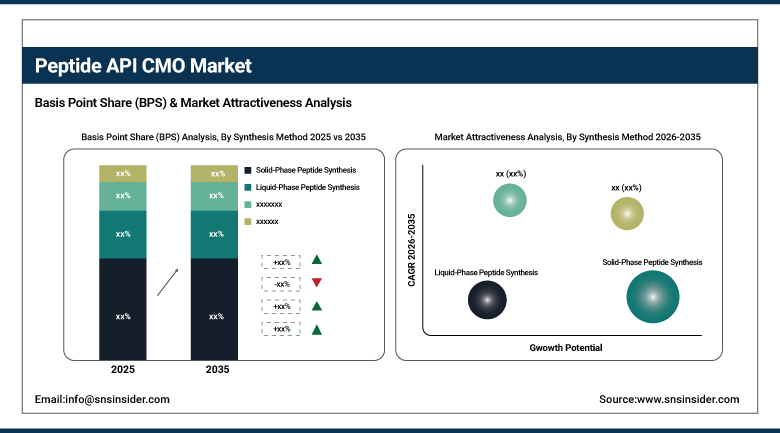
By Synthesis Method, the Solid-Phase Peptide Synthesis (SPPS) segment dominated the Peptide API CMO Market with approximately 57.26% share in 2025, while the Hybrid & Recombinant Synthesis segment is the fastest growing with a CAGR of approximately 12.38%.
-
By Scale of Operation, the Commercial segment dominated the Peptide API CMO Market with approximately 47.83% share in 2025, while the Clinical segment is the fastest growing with a CAGR of approximately 10.94%.
-
By Therapeutic Area, the Metabolic Disorders segment dominated the Peptide API CMO Market with approximately 43.62% share in 2025, while the Oncology segment is the fastest growing with a CAGR of approximately 12.07%.
-
By Product Type, the Innovator Peptides segment dominated the Peptide API CMO Market with approximately 62.41% share in 2025, while the Generic Peptides segment is the fastest growing with a CAGR of approximately 12.64%.
By Synthesis Method, SPPS dominates, and Hybrid & Recombinant Synthesis grows fastest
Solid-phase peptide synthesis remained the leading production route in 2025, as most approved synthetic peptides and clinical candidates up to roughly 40 amino acids are built on resin using well-characterized Fmoc chemistry. Contract manufacturers can reuse validated platforms across customers, which shortens technology transfer and supports predictable batch records. Automated synthesizers, large stainless steel reactors and continuous purification trains have raised output per batch, helping lower cost per kilogram for high-volume molecules. Sponsors also value the broad regulatory familiarity with the route, since impurity profiles and control strategies have been reviewed many times, which reduces the risk of questions during filing and inspection.
Hybrid and recombinant synthesis is the fastest-growing method, as longer peptides and complex analogs such as incretin-class molecules strain the economics of pure solid-phase production. Combining fragment condensation, liquid-phase coupling and biologically expressed precursors reduces solvent consumption and raises purity at scale, which matters when annual volumes reach multiple metric tons. Enzymatic ligation and tag-assisted platforms are also gaining attention, offering shorter cycle times and fewer difficult couplings. Contract manufacturers that master these routes can win long-term supply contracts on cost and sustainability grounds, and several are filing patents around proprietary processes, which strengthens customer retention and pricing power through the forecast period.
⮞In September 2025, PolyPeptide Group reported the installation of prefabricated modules at its Malmö, Sweden, facility as part of a project designed to double solid-phase peptide synthesis capacity, strengthening its ability to serve pharmaceutical customers requiring larger peptide API volumes.
By Scale of Operation, Commercial dominates, and Clinical grows fastest
Commercial-scale manufacturing held the largest share of the Peptide API CMO Market in 2025, reflecting the sharp rise in marketed peptide therapies for obesity, diabetes and rare diseases. Commercial campaigns involve multi-hundred-kilogram batches, extensive validation and long-term supply agreements, which generate larger and steadier contract values than development work. Sponsors prefer experienced partners with inspected facilities, secure raw material sourcing and proven regulatory records, and they are often willing to prepay for reserved capacity. As blockbuster programs progress, outsourcing partners also take on filling, lyophilization and stability testing, increasing revenue per program and deepening their integration with customer supply chains and making partner switching costly.
Clinical-scale production is the fastest-growing segment, as the number of peptide candidates entering Phase 1 to Phase 3 trials continues to climb across metabolic, oncology, cardiovascular and rare disease programs. Small and mid-sized biotechs often lack internal GMP capacity and rely on contract manufacturers for process development, analytical method transfer and clinical batches. Multi-agonist obesity candidates and peptide-drug conjugates require more development cycles, which lengthens the pipeline of paid work. Early engagement also lets contract partners secure future commercial supply, so clinical contracts frequently convert into long-term agreements, and this conversion potential motivates suppliers to invest in flexible, mid-sized suites through 2035.
⮞In September 2026, Avacta Therapeutics reported clinical proof of mechanism for AVA6103, its peptide-drug conjugate, in the Phase 1 FOCUS-01 trial, demonstrating progress in translating specialized peptide-based therapeutics into clinical development.
By Therapeutic Area, Metabolic Disorders dominate, and Oncology grows fastest
Metabolic disorders accounted for the largest share of the Peptide API CMO Market in 2025, with GLP-1 and related incretin therapies for type 2 diabetes and obesity driving unprecedented ingredient volumes. Semaglutide, tirzepatide and liraglutide require large quantities of long-chain peptide, and brand owners continue to outsource a significant portion of synthesis and purification to specialist suppliers. Oral formulations and higher-dose regimens increase kilogram requirements per patient, which stretches existing capacity. Competitive dynamics among sponsors have turned supply assurance into a strategic priority, so contract partners that can guarantee volumes and quality are securing multi-year commitments from large pharmaceutical customers.
Oncology is the fastest-growing therapeutic area, supported by peptide receptor radionuclide therapies, peptide-drug conjugates, cyclic peptides and cancer vaccines moving through clinical development. These molecules often require specialized chemistry, such as chelator attachment, macrocyclization and conjugation, which only a limited set of manufacturers can handle under GMP conditions. Radioligand programs also depend on peptide precursors with demanding purity requirements, and regulatory approvals of lutetium-based therapies have increased sponsor confidence. As more oncology assets progress into registrational trials, contract manufacturers are adding high-potency containment and conjugation suites, and this mix of premium services supports faster revenue growth than the market average.
⮞In May 2026, Bicycle Therapeutics announced initial Phase 2 Duravelo-2 results for zelenectide pevedotin in previously untreated metastatic urothelial cancer, highlighting clinical progress for its proprietary bicyclic peptide-based drug conjugate technology in oncology.
By Product Type, Innovator Peptides dominate, and Generic Peptides grow fastest
Innovator peptides led the Peptide API CMO Market in 2025, GLP-1 branded drugs and novel compounds currently form the largest part of the contract manufacturing market. Premium prices are paid by branded drug makers in terms of process development, regulatory services, and security of supply, typically locking into multi-year contracts from technology transfer through commercialization. Patents on their IP also serve as an incentive for drug sponsors to work only with selected vendors, thus limiting potential leakages. In case of highly complicated compounds such as lipidated or with unnatural amino acids and peptides, sophisticated analytical controls are indispensable.
Generic peptides are the fastest-growing product type, as patent expirations on liraglutide, teriparatide and other established molecules open the way for lower-cost versions, and semaglutide exclusivity is ending in several large markets during 2026. Generic developers in India, China and Europe rely on contract manufacturers for validated, cost-efficient synthesis and for the analytical packages regulators expect, including impurity characterization and immunogenicity assessment. Clearer FDA and EMA guidance on synthetic peptide generics has reduced regulatory uncertainty, encouraging more filings. High-volume campaigns reward suppliers with scale and strong yields, and competition on price will push efficiency gains across the industry through 2035.
⮞In March 2025, Neuland Laboratories submitted its first peptide API Drug Master File to the U.S. FDA for difelikefalin acetate, marking a regulatory milestone in its generic peptide portfolio and strengthening its ability to support pharmaceutical customers developing peptide-based medicines.
Regional Analysis
|
Region |
Major Country |
Share within Region, 2025 (%) |
|
North America |
United States |
90.17% |
|
Europe |
Switzerland |
27.38% |
|
Asia-Pacific |
China |
39.14% |
|
Middle East & Africa |
GCC |
52.41% |
|
Latin America |
Brazil |
51.76% |
North America Peptide API CMO Market Insights
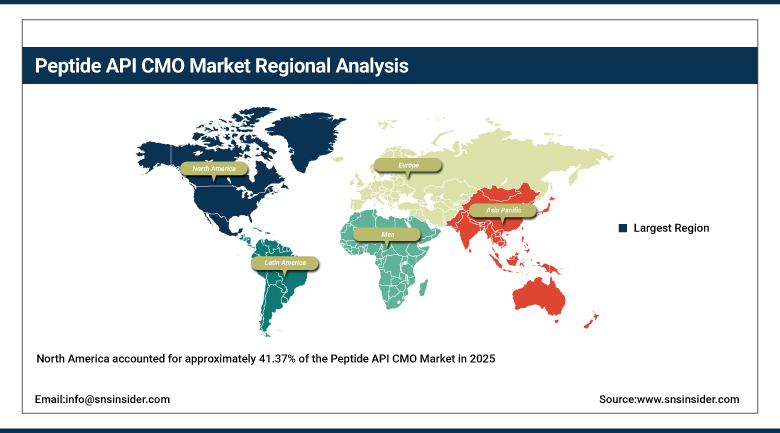
North America accounted for approximately 41.37% of the Peptide API CMO Market in 2025, the largest share among all regions, supported by a concentration of GLP-1 innovators, venture-backed biotechs and a mature clinical trial ecosystem. The United States drives the substantial majority of regional revenue, with sponsors in Indiana, Massachusetts, California and North Carolina placing long-term supply orders and funding capacity reservations. Large U.S. facilities operated by CordenPharma, Bachem and PolyPeptide, together with newly announced Colorado and South Carolina capacity, are anchoring regional supply. Federal interest in pharmaceutical supply chain resilience and tariff considerations further encourage sponsors to qualify North American manufacturing sites for strategic active ingredients.
Canada contributes a smaller but stable share, built on a growing life sciences cluster in Ontario and Quebec and contract manufacturers that serve regional generic and specialty developers. Mexico represents a comparatively smaller but emerging opportunity, as pharmaceutical companies evaluate nearshore options for downstream formulation and packaging of peptide products. Regulatory clarity from the FDA on synthetic peptide impurities and generic peptide applications supports steady investment, and the agency’s Drug Master File system lets contract suppliers share confidential data with multiple customers. Strong venture capital funding for peptide-focused start-ups also sustains a deep pipeline of early-stage projects that are expected to turn into commercial volumes.
Get Customized Report as per Your Business Requirement - Enquiry Now
⮞In October 2025, Cambrex announced a USD 120 million investment in its U.S. manufacturing network to expand API production capacity, including capabilities supporting commercial-scale liquid-phase peptide manufacturing, strengthening domestic supply options for pharmaceutical sponsors.
Europe Peptide API CMO Market Insights
Europe continues to be the second-largest regional market, anchored by Switzerland, which hosts Bachem, CordenPharma’s Muttenz site and a dense cluster of specialized chemistry suppliers. Sweden, Belgium and France contribute large-scale PolyPeptide operations, while Germany, Italy and Denmark add strengths in fine chemicals, process engineering and sponsor demand, including from the Danish obesity leaders. The region benefits from highly skilled chemists, established Good Manufacturing Practice oversight and proximity to major pharmaceutical customers. Several multi-hundred-million-euro expansions are underway, which will raise European solid-phase capacity substantially through the late 2020s and strengthen the region’s role in commercial supply and keep it close to major sponsors.
The United Kingdom and Ireland add contract development talent and biotech sponsors, with Almac and other companies operating peptide services for clinical and commercial programs. Environmental regulations on solvents, including restrictions on certain polar aprotic solvents, are driving investment in greener processes and solvent recovery, giving European suppliers a first-mover advantage in sustainable manufacturing that global customers increasingly request. Although energy costs and labor expenses remain higher than in Asia, customers value traceability, supply security and regulatory track records. Cross-border consolidation, including investor-backed acquisitions and recent offers for listed peptide specialists, is also reshaping the competitive landscape and encouraging further investment.
⮞In August 2025, PolyPeptide Group reported that commercial revenue increased alongside the ramp-up of new solid-phase peptide synthesis capacity at its Braine-l’Alleud facility, demonstrating the contribution of expanded European manufacturing operations to growing demand for peptide APIs.
Asia-Pacific Peptide API CMO Market Insights
Asia-Pacific is currently witnessing the highest growth rate in the Peptide API CMO Market, projected to expand at a CAGR of 11.26% from 2026 to 2035, as Chinese and Indian suppliers scale up peptide capacity for global sponsors. China hosts a deep base of raw material and amino acid producers, along with CDMOs such as WuXi AppTec, Hybio and Asymchem that offer fast development timelines at competitive cost. Government support for biologics and high-end chemical manufacturing strengthens the ecosystem, and large generic GLP-1 programs are generating domestic volume. Geopolitical considerations are leading some Western sponsors to dual-source, but cost and speed advantages keep the region central to global supply.
India is building credibility as an alternative hub, with Neuland Laboratories, Piramal Pharma Solutions, Sai Life Sciences and Syngene adding SPPS and LPPS reactors, spray drying and regulated-market inspection records. South Korea is entering the field as SK pharmteco invests in a dedicated peptide campus in Sejong, and global CDMOs are seeking regional entry points through acquisitions and partnerships. Japan contributes advanced chemistry and sponsors such as Ajinomoto Bio-Pharma Services, which has formed a partnership with Olon for large-scale peptide manufacturing. Rising local drug development, expanding clinical trial activity and favorable investment policies further support regional growth through 2035, particularly for generic GLP-1 supply.
⮞In August 2026, JYMed Peptides announced plans for additional peptide API production lines in response to growing customer demand for GLP-1-class peptides and peptide-drug conjugates, reflecting continued investment in China's contract peptide manufacturing capabilities.
MEA & South America Peptide API CMO Market Insights
The Middle East & Africa region represents a smaller but gradually developing market, with demand concentrated in the Gulf Cooperation Council countries that are building domestic pharmaceutical capacity under national industrial strategies. Saudi Arabia and the United Arab Emirates are encouraging local production of high-value injectables, and diabetes prevalence in the Gulf supports demand for GLP-1 therapies that are still largely imported. Contract peptide synthesis remains limited, so regional drug makers mostly source active ingredients from Europe and Asia. Israel and South Africa have small specialty chemistry and biotech sectors that occasionally contract peptide work, but volumes remain modest compared with other regions.
Latin America is experiencing early but steady growth, with Brazil leading on the back of strong public health programs for diabetes and a local pharmaceutical industry that is pursuing technology transfer agreements for peptide generics. Mexico and Argentina contribute smaller volumes through formulation and finishing partnerships with global manufacturers, while Colombia and Chile are exploring biologics-related investments. Expiring semaglutide protection in Brazil is encouraging local companies to qualify peptide active ingredient suppliers, creating opportunities for contract manufacturers with regional presence. Regulatory modernization by ANVISA and growing access to peptide therapies are expected to support gradual market development over the forecast period.
⮞In April 2025, Saudi pharmaceutical investment company Lifera and Novo Nordisk signed a memorandum of understanding to localize manufacturing of GLP-1 treatments for diabetes and obesity, supporting Saudi Arabia's ambitions to develop domestic pharmaceutical manufacturing and regional supply capabilities.
Market Dynamics
Growth Drivers: GLP-1 Demand and Outsourcing of Complex Synthesis
Growth in the Peptide API CMO Market is primarily attributed to the explosive demand for GLP-1 and related incretin therapies for diabetes and obesity, which require peptide quantities that exceed the in-house capacity of most pharmaceutical companies. Each additional indication, higher dose or oral version of these drugs multiplies the kilograms required, and sponsors are signing multi-year agreements that fund reactor construction at partner sites. Contract manufacturers with validated large-scale solid-phase and hybrid processes are therefore operating at high utilization and investing heavily in additional trains. This demand visibility has also attracted private equity and strategic acquirers, giving the industry fresh capital for expansion.
Outsourcing of complex chemistry is a second major driver, as peptides become longer, more modified and more difficult to purify. Contract manufacturers invest in specialized equipment, high-pressure chromatography, lyophilization lines and analytical teams that individual sponsors would find costly to replicate. Rising numbers of small and mid-sized biotechs, which lack manufacturing infrastructure, depend on external partners from development through commercial launch. Regulatory expectations for impurity control and batch consistency also favor experienced suppliers with strong inspection histories, while the growing pipeline of peptide-drug conjugates, radioligands and macrocycles adds new categories of work for specialists and supports premium pricing for technically demanding projects.
⮞In August 2025, the U.S. FDA approved Teva Pharmaceuticals' generic liraglutide injection referencing Saxenda for chronic weight management, adding a regulatory milestone in the expansion of generic GLP-1 medicines and reinforcing demand for cost-efficient peptide API supply.
Restraints: Capacity Bottlenecks and Solvent Intensity
Capacity remains a recurring limitation as new capacity in terms of designing, constructing, and validating new large-scale reactors, purification skids, and lyophilizers will require about three to five years. Equipment lead times, shortage of trained peptide chemists and limitations on available raw materials such as protected amino acids hinder the growth of companies. Sponsors may experience limits on allocation and delays in their campaigns because of the surge in demand, posing program risks to the sponsors. The need for significant investment in contract manufacturers is seen in hundreds of millions of dollars being required prior to finalizing contracts due to the risk of underutilization and return on investments due to forecasting problems.
The environmental and economic factors compound the complexity of the situation. There have been stringent regulations regarding the use of traditional solvent methods such as dimethylformamide and acetonitrile for synthesis. These factors force investment into recovery and alternative chemistry techniques that increase validation time. Competition based on pricing from Asia hinders the profit margin in mature products. There has been an increased dependency on raw material supply chains from a few countries making the company susceptible to disruptions. Impurity, immunogenicity, and genotoxicity issues result in a lot of analytical testing. Any adverse findings from a regulatory agency for a specific site will lead to program delays and loss of business opportunities.
Opportunities: Green Chemistry, Hybrid Routes and Onshoring
The development of greener and more efficient synthesis routes offers substantial opportunity for contract manufacturers. Hybrid strategies that combine solid-phase, liquid-phase and recombinant methods cut solvent use and cost per kilogram, and tag-assisted platforms promise faster cycle times for long peptides. Suppliers that commercialize these technologies can position themselves as sustainability partners, an increasingly important selection criterion for global pharmaceutical customers with environmental targets. Investments in continuous purification, solvent recycling and alternative solvents can also lower operating costs, creating a competitive edge as volumes scale and price pressure from generic and biosimilar entrants intensifies, while customers reward demonstrated reductions in environmental impact.
Regional capacity diversification presents another opportunity, as sponsors look to dual-source across the United States, Europe and Asia to protect supply. Contract manufacturers expanding in North America and India are well placed to secure strategic contracts, particularly where governments offer incentives for onshoring or nearshoring. The emergence of oral peptides, peptide-drug conjugates, radioligands and longer-acting obesity candidates expands the addressable volume, while patent expiries on established molecules open a sizable generic segment. Companies that combine ample capacity, regulatory credentials and flexible commercial terms can expect strong, steady, multi-year growth through 2035, supported by customers that prefer fewer, deeper supplier relationships.
⮞In December 2025, Lupin Manufacturing Solutions and PolyPeptide Group announced a long-term strategic alliance to strengthen peptide API sourcing, coordinate supply planning, and improve supply-chain resilience, creating opportunities to support pharmaceutical customers seeking reliable manufacturing capacity across markets.
Recent Developments:
-
2026, Samsung Biologics agreed to acquire PolyPeptide Group in a CHF 1.46 billion deal, giving the Korean contract manufacturer entry into peptide API production across sites in Sweden, Belgium, France, the United States and India.
-
2026, Neuland Laboratories commissioned Module One of its peptide campus in India, with 7,000 liters of reactor capacity comprising 750-liter SPPS and 6,250-liter LPPS lines, backed by a USD 30 million investment.
-
2026, Piramal Pharma Solutions added a Band 5 containment spray drying suite at its Turbhe, India peptide facility, enabling powder production for peptides and high-potency APIs from concentrated solutions.
-
2025, SK pharmteco advanced construction of a USD 260 million dedicated peptide API campus in Sejong, South Korea, designed with eight production trains and an integrated R&D and pilot plant.
-
2025, Ajinomoto Bio-Pharma Services and Olon S.p.A. formed a strategic partnership to advance large-scale peptide and protein manufacturing, combining Ajinomoto’s development expertise with Olon’s fermentation and chemical synthesis capacity.
Peptide API CMO Market Key Players
-
Bachem Holding AG
-
PolyPeptide Group AG
-
CordenPharma International
-
Lonza Group AG
-
WuXi AppTec Co., Ltd.
-
Thermo Fisher Scientific Inc. (Patheon)
-
Hybio Pharmaceutical Co., Ltd.
-
Neuland Laboratories Limited
-
Piramal Pharma Solutions
-
Cambrex Corporation
-
Olon S.p.A.
-
Almac Group
-
CPC Scientific Inc.
-
Asymchem Laboratories (Tianjin) Co., Ltd.
-
Biosynth AG
-
Sai Life Sciences Limited
-
Ajinomoto Bio-Pharma Services
-
Syngene International Limited
-
Divi's Laboratories Limited
-
Senn Chemicals AG
Peptide API CMO Market Report Scope:
| Report Attributes | Details |
|---|---|
| Market Size in 2025 | USD 3.12 Billion |
| Market Size by 2035 | USD 7.66 Billion |
| CAGR | CAGR of 9.41% From 2026 to 2035 |
| Base Year | 2025 |
| Forecast Period | 2026-2035 |
| Historical Data | 2022-2024 |
| Report Scope & Coverage | Market Size, Segments Analysis, Competitive Landscape, Regional Analysis, DROC & SWOT Analysis, Forecast Outlook |
| Key Segments | • By Synthesis Method (Solid-Phase Peptide Synthesis (SPPS), Liquid-Phase Peptide Synthesis (LPPS), Hybrid & Recombinant Synthesis) • By Scale of Operation (Pre-Clinical, Clinical, Commercial) • By Therapeutic Area (Metabolic Disorders, Oncology, Cardiovascular Diseases, Infectious Diseases, Other Therapeutic Areas) • By Product Type (Innovator Peptides, Generic Peptides) |
| Regional Analysis/Coverage | North America (US, Canada), Europe (Germany, UK, France, Italy, Spain, Russia, Poland, Rest of Europe), Asia Pacific (China, India, Japan, South Korea, Australia, ASEAN Countries, Rest of Asia Pacific), Middle East & Africa (UAE, Saudi Arabia, Qatar, South Africa, Rest of Middle East & Africa), Latin America (Brazil, Argentina, Mexico, Colombia, Rest of Latin America). |
| Company Profiles | Bachem Holding AG, PolyPeptide Group AG, CordenPharma International, Lonza Group AG, WuXi AppTec Co., Ltd., Thermo Fisher Scientific Inc. (Patheon), Hybio Pharmaceutical Co., Ltd., Neuland Laboratories Limited, Piramal Pharma Solutions, Cambrex Corporation, Olon S.p.A., Almac Group, CPC Scientific Inc., Asymchem Laboratories (Tianjin) Co., Ltd., Biosynth AG, Sai Life Sciences Limited, Ajinomoto Bio-Pharma Services, Syngene International Limited, Divi's Laboratories Limited, Senn Chemicals AG |

Frequently Asked Questions
Key players include Bachem Holding AG, PolyPeptide Group AG, CordenPharma International, Lonza Group AG, and WuXi AppTec Co., Ltd., among others.
Key opportunities include greener hybrid and liquid-phase synthesis routes, regional capacity diversification and onshoring, and rising demand from oral peptides, peptide-drug conjugates, radioligands and generic GLP-1 programs.
The primary growth factor is the surge in GLP-1 and related incretin therapies for diabetes and obesity, combined with sponsors' growing reliance on specialist contract manufacturers for large-scale, complex peptide synthesis.
By synthesis method, the Solid-Phase Peptide Synthesis (SPPS) segment dominates the Peptide API CMO Market with approximately 57.26% share in 2025.
North America dominates the Peptide API CMO Market with approximately 41.37% share in 2025, while Asia-Pacific is the fastest-growing region at a CAGR of 11.26% from 2026-2035.
