
Ophthalmic Eye Dropper Market Report Scope & Overview:
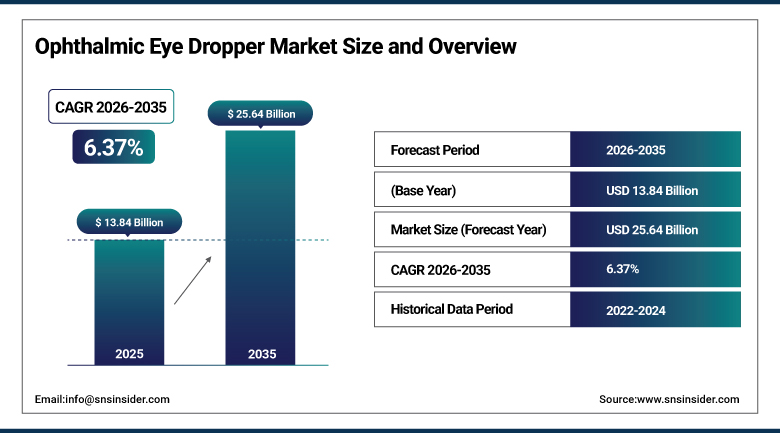
The Ophthalmic Eye Dropper Market was valued at USD 13.84 Billion in 2025 and is expected to reach USD 25.64 Billion by 2035, growing at a CAGR of 6.37% from 2026-2035.
The Ophthalmic Eye Dropper Market will see traction as dry eye disease, glaucoma and allergic conjunctivitis become more common among aging and screen-intensive populations. Prescription launches in dry eye and presbyopia are widening the treated patient pool, while preservative-free multi-dose dispensers are changing how formulators choose packaging. Pharmacy chains and online retailers continue to broaden access to over-the-counter lubricants, and generic filings are lowering the cost of long-term glaucoma therapy. Contract fill-finish capacity for sterile ophthalmic solutions is expanding in India and Europe, supporting steadier supply. Taken together, these shifts are moving eye drops from a commodity purchase toward a differentiated, device-enabled therapy category.
To Get more information Ophthalmic Eye Dropper Market - Request Free Sample Report
⮞In May 2025, Alcon secured U.S. FDA approval for Tryptyr (acoltremon ophthalmic solution) 0.003%, a TRPM8 agonist that stimulates natural tear production in dry eye disease. The launch places a first-in-class prescription drop alongside the company’s Systane lubricant range, deepening its presence across both clinic-led and retail-led dry eye care.
Ophthalmic Eye Dropper Market Trends
-
Rising shift toward preservative-free multi-dose bottles that protect formulations without benzalkonium chloride.
-
Growing launch activity in dry eye, with new mechanisms such as TRPM8 agonists and lipid-based emulsions.
-
Expanding use of low-dose atropine and pilocarpine-class drops for pediatric myopia control and presbyopia correction.
-
Increasing adoption of dropper aids and dose-guidance devices that reduce waste and improve patient adherence.
-
Continued growth of online pharmacies and direct-to-consumer subscriptions for refill-driven ophthalmic therapies.
-
Rising generic and 505(b)(2) filings that extend access to branded glaucoma and allergy therapies at lower prices.
U.S. Ophthalmic Eye Dropper Market Outlook
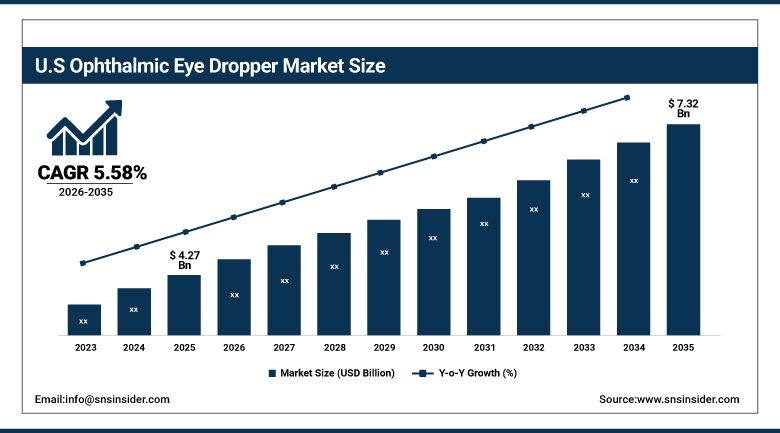
The U.S. Ophthalmic Eye Dropper Market was valued at USD 4.27 Billion in 2025 and is expected to reach USD 7.32 Billion by 2035, growing at a CAGR of 5.58% from 2026-2035.
The U.S. Ophthalmic Eye Dropper Market is expanding owing to a large and aging patient base living with dry eye disease, glaucoma and allergic conjunctivitis, supported by broad Medicare Part D and commercial coverage for prescription drops. The country also hosts the most active ophthalmic development pipeline, with several first-in-class dry eye and presbyopia therapies reaching pharmacies in recent years. Over-the-counter lubricants benefit from deep retail penetration through pharmacy chains, mass merchants and e-commerce platforms. In addition, the FDA’s 505(b)(2) and abbreviated pathways allow reformulated and generic products to enter the market efficiently, widening treatment choice and increasing the number of refills dispensed each year.
⮞In June 2026, Théa Pharma began U.S. commercial availability of Zolymbus (bimatoprost ophthalmic gel) 0.01%, a preservative-free single-dose gel for open-angle glaucoma and ocular hypertension that uses mucoadhesive technology to extend ocular surface contact time and reduce irritation for long-term users, strengthening the company’s position in the competitive U.S. glaucoma segment.
Ophthalmic Eye Dropper Market Segment Analysis
-
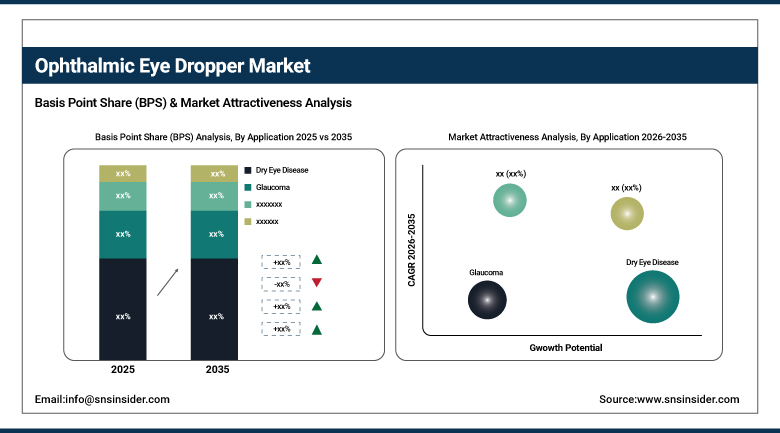
By Application, the Dry Eye Disease segment dominated the Ophthalmic Eye Dropper Market with approximately 34.28% share in 2025, while the Myopia & Presbyopia segment is the fastest growing with a CAGR of approximately 9.46%.
-
By Formulation, the Solutions segment dominated the Ophthalmic Eye Dropper Market with approximately 58.74% share in 2025, while the Emulsions & Gels segment is the fastest growing with a CAGR of approximately 8.12%.
-
By Dispensing Format, the Multi-Dose Bottles segment dominated the Ophthalmic Eye Dropper Market with approximately 52.36% share in 2025, while the Preservative-Free Multi-Dose Dispensers segment is the fastest growing with a CAGR of approximately 9.03%.
-
By Distribution Channel, the Retail Pharmacies segment dominated the Ophthalmic Eye Dropper Market with approximately 49.82% share in 2025, while the Online Pharmacies segment is the fastest growing with a CAGR of approximately 8.74%.
By Application, Dry Eye Disease dominates, and Myopia & Presbyopia grows fastest
Dry eye disease held the largest share of the Ophthalmic Eye Dropper Market in 2025, reflecting the sheer size of the affected population and the recurring nature of lubricant and anti-inflammatory use. Prolonged screen time, contact lens wear, aging and post-surgical ocular surface changes continue to enlarge the diagnosed pool, and many patients now move from basic artificial tears to prescription therapies. Manufacturers are responding with lipid-based emulsions, cyclosporine formulations and neurostimulating mechanisms that address the underlying cause rather than only the symptoms. Optometrists also play a larger role in initiating therapy, which shortens the path from diagnosis to a prescription fill and supports steady volume growth.
Myopia and presbyopia is the fastest-growing application segment, with new low-dose atropine protocols and pilocarpine or aceclidine-based eye drops creating novel treatment categories, myopia management in children is becoming more and more popular in East Asia, which has the highest prevalence rate and parents ready to spend money on treatments that would slow down axial elongation. At the same time, pharmacological presbyopia correction provides adults with a good substitute for reading glasses, as it requires only once-a-day administration and acts fast. Clinical trials have strengthened the doctors’ belief in the drugs, and growing eye care chains are adopting the drops, indicating the beginning of their widespread use until 2035.
⮞In April 2025, Rohto Pharmaceutical and Tsubota Lab commenced a Phase II clinical trial in Japan for ROH-001, an investigational eye drop designed to suppress myopia progression, advancing pharmaceutical approaches to pediatric myopia management.
By Formulation, Solutions dominate, and Emulsions & Gels grow fastest
Solutions accounted for the largest share of the Ophthalmic Eye Dropper Market in 2025, as most lubricants, antibiotics, anti-glaucoma agents and antihistamines are formulated as clear aqueous liquids. Their simple manufacturing, predictable sterility profile and compatibility with a wide range of dropper tips keep unit costs low and make them the default choice for generics. Formulators continue to refine buffers, viscosity agents and tonicity to improve comfort and residence time without resorting to preservatives. Regulatory familiarity also helps, as reviewers and compounding pharmacies already understand the quality attributes involved, which shortens development timelines for new combinations and fixed-dose products across markets.
Emulsions and gels are expanding fastest, as developers look for ways to keep active ingredients on the ocular surface for longer than a thin aqueous drop allows. Lipid-based emulsions restore the tear film while delivering hydrophobic drugs such as cyclosporine, and mucoadhesive gels allow once-daily glaucoma dosing with less irritation. Single-dose and preservative-free presentations are well suited to these thicker vehicles, which in turn encourages new packaging designs with controlled flow. Although manufacturing is more demanding and requires tighter particle size control, clinicians report better comfort and longer relief, and these advantages are enabling premium pricing and stronger prescription uptake over the forecast period.
⮞In April 2025, Zhaoke Ophthalmology enrolled the first patient in an additional Phase III trial of its cyclosporine ophthalmic gel for moderate-to-severe dry eye disease in China, advancing clinical development of a hydrogel formulation designed to extend ocular-surface drug exposure.
By Dispensing Format, Multi-Dose Bottles dominate, and Preservative-Free Dispensers grow fastest
Multi-dose bottles remained the leading dispensing format in 2025, owing to their low cost per dose, familiar handling and suitability for chronic therapies that are used for months at a time. Pharmaceutical companies and private-label brands rely on standard LDPE dropper bottles, which are available in 5 ml to 30 ml sizes and can be filled on established sterile lines. Patients also prefer a single bottle that can be carried and reused over a box of disposable vials. Packaging suppliers are improving tip geometry and flow control so that a single squeeze delivers a consistent drop, reducing waste and helping elderly users who struggle with accuracy.
Preservative-free multi-dose dispensers are the fastest-growing format, as clinicians seek alternatives to benzalkonium chloride for patients on long-term glaucoma and dry eye therapy. Tip-seal and filter-based systems keep contamination out for weeks after opening, giving the convenience of a bottle without the preservative burden of older designs. Aptar Pharma, Nemera and other packaging specialists are supplying these systems to brand owners that want to reformulate flagship products, and regulators in the United States, Europe and Asia have cleared a growing list of approved drug-device pairings. Lower waste than unit-dose vials and better sustainability credentials further strengthen the commercial case through 2035.
⮞In January 2026, Aptar Pharma highlighted Beat the Blink™, an ophthalmic delivery system developed under an exclusive partnership with Bausch + Lomb. Its horizontal drop delivery and tip-seal design target dosing precision and preservative-free formulation protection.
By Distribution Channel, Retail Pharmacies dominate, and Online Pharmacies grow fastest
Retail pharmacies accounted for the largest share of the Ophthalmic Eye Dropper Market in 2025, supported by the combined sale of prescription refills and over-the-counter lubricants through the same counter. The chain drugstores, pharmacies, and even outlets within supermarkets allow people access to tears, redness relief, and allergy drops without the need for consulting a specialist. They will be there for advice in the choice of products that can suit the lenses and for information that symptoms may require an eye examination. The producers put effort into effective shelf placement, training, and loyalty schemes to build preferences for their brands, while the prescriptions have the benefit of being able to be refilled.
Online pharmacies are growing fastest, as patients embrace home delivery, subscription refills and price comparison for recurring eye drop purchases. Telehealth consultations now lead directly to e-prescriptions, and digital platforms connect eye care practices with mail-order dispensing for chronic therapies such as glaucoma. Major e-commerce marketplaces carry broad lubricant assortments, giving smaller brands access to national audiences without retail slotting fees. Manufacturers are also launching direct-to-consumer storefronts that bundle drops with reminder apps, which helps address adherence challenges. Younger and tech-comfortable consumers are driving most of the shift, and improved cold-chain and authenticity controls are expected to widen the channel’s share through 2035.
⮞In July 2026, LENZ Therapeutics launched a telehealth prescribing option for VIZZ, its aceclidine ophthalmic solution for presbyopia, connecting eligible patients with independent eye-care professionals, electronic prescription fulfillment and home delivery through an e-pharmacy partner.
Regional Analysis
|
Region |
Major Country |
Share within Region, 2025 (%) |
|
North America |
United States |
83.74% |
|
Europe |
Germany |
24.38% |
|
Asia-Pacific |
Japan |
33.41% |
|
Middle East & Africa |
GCC |
47.86% |
|
Latin America |
Brazil |
45.32% |
North America Ophthalmic Eye Dropper Market Insights
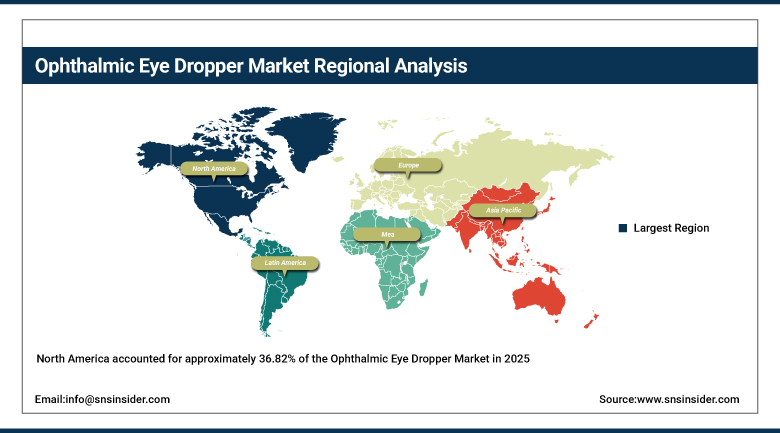
North America accounted for approximately 36.82% of the Ophthalmic Eye Dropper Market in 2025, the largest share among all regions, supported by high diagnosis rates for dry eye and glaucoma, broad insurance coverage and an active pipeline of first-in-class therapies. The United States generates the substantial majority of regional revenue, where launches such as TRPM8-targeted dry eye drops and preservative-free glaucoma gels are reaching patients through both specialist clinics and retail pharmacies. Strong over-the-counter demand for lubricants, combined with large optometry networks that initiate therapy early, keeps per-capita consumption among the highest in the world and supports premium pricing across therapy classes.
The share in Canada is modest but consistent due to the provincial formulary system which leans towards cost-efficient generics for glaucoma. Mexico shows a relatively smaller but rising market, owing to an expansion of private health systems and pharmacy chains selling lubricants and allergy medications under brands. Regional manufacturing of the drugs is also a factor here with the USA and Puerto Rico offering sterile fill-finish capabilities to big players owning their brands. With continual FDA approvals of reformulated or generic ophthalmic solutions, competition should remain tough while lowering prices for chronic customers and ensuring volume growth.
Get Customized Report as per Your Business Requirement - Enquiry Now
⮞In April 2025, Canadian pharmaceutical company LSL Pharma signed two commercial agreements to market six to ten sterile prescription ophthalmic products in Canada, with initial commercialization expected from the fourth quarter of 2025, expanding its domestic ophthalmic portfolio.
Asia-Pacific Ophthalmic Eye Dropper Market Insights
Asia-Pacific is currently witnessing the highest growth rate in the Ophthalmic Eye Dropper Market, projected to expand at a CAGR of 7.94% from 2026 to 2035, driven by rapidly aging populations, rising myopia prevalence and growing use of digital devices. Japan is the largest regional market, anchored by domestic leaders such as Santen, Senju and Rohto, which sell prescription and consumer eye drops through well-established pharmacy and drugstore channels. China is advancing quickly as volume-based procurement widens access to generic therapies, while local developers file new dry eye and myopia-control drops that compete directly with imported brands in hospitals and online retail.
A well-established generic manufacturing platform exists in India, with companies such as Sun Pharma, Cipla, and Lupin providing ophthalmic solutions in both domestic and regulated export markets. In South Korea and Australia, the demand for premium products is based on preservative-free and specialty products, fueled by the high usage rate of eye care. Myopia control in children is one of the unique growth opportunities in the region, with parents' awareness and school screening initiatives encouraging early treatment. The rise in e-commerce platforms and cross-border retail is making it easier for consumers to buy international lubricant brands, thus driving the volume till 2035. Early diagnosis of glaucoma and diabetic eye disease through government-sponsored screening programs is driving the prescription volume in cities.
⮞In September 2026, Santen Pharmaceutical announced that China's Center for Drug Evaluation had accepted its new drug application for STN1012700, a preservative-free atropine ophthalmic solution intended to slow myopia progression in children.
Europe Ophthalmic Eye Dropper Market Insights
Europe is the third-largest regional market, with demand supported by aging populations, universal healthcare coverage and a strong tradition of preservative-free ophthalmic innovation. Germany, France and the United Kingdom account for most regional demand, with Germany leading in value on the strength of high prescription volumes and a dense network of ophthalmologists. Several of the most widely used preservative-free multi-dose systems were developed by European packaging and pharmaceutical groups, giving the region an advantage in drug-device pairing. Regulatory expectations on excipients and sustainability are also pushing brand owners to reformulate older preserved products, which keeps replacement demand healthy even as price controls limit revenue per unit.
Southern and Eastern Europe are growing steadily, as Italy, Spain and Poland expand access to dry eye and glaucoma therapies through national reimbursement lists and retail pharmacy networks. The European Medicines Agency’s centralized pathway allows launches to reach multiple markets together, although national pricing negotiations still determine uptake speed. Contract manufacturers in Germany, Italy and Ireland provide sterile blow-fill-seal capacity for private-label and generic products, supporting resilient supply. Rising awareness of digital eye strain among younger workers is also lifting over-the-counter lubricant sales, while hospital tenders continue to favor low-cost generic anti-infectives and glaucoma drops, keeping price competition firm in public procurement.
⮞In September 2025, the European Commission granted marketing authorization for Eyluxvi, a biosimilar of aflibercept, expanding treatment options for retinal conditions including wet age-related macular degeneration and diabetic macular edema across the European Union.
MEA & South America Ophthalmic Eye Dropper Market Insights
The Middle East & Africa region represents a smaller but strategically important market, with demand centered on the Gulf Cooperation Council countries where diabetes, dry climates and high dust exposure raise the burden of ocular surface disease. Both Saudi Arabia and the United Arab Emirates are investing in the development of specialized eye hospitals and the manufacture of drugs within their countries as part of their health care policy. Sub-Saharan Africa still relies mostly on affordable anti-infective and anti-inflammatory eye drops that come through government purchases and donors. The South African country is the most developed regarding private pharmacies and is the gateway for imported products.
Latin America is experiencing steady growth, with Brazil leading on the back of a large population, a strong generic industry and local approvals for preservative-free presentations. Mexico, Argentina and Colombia are expanding access through private pharmacy chains and a rising number of optometry clinics, although currency volatility can affect imported product pricing. Regional pharmaceutical companies are partnering with global packaging suppliers to bring preservative-free multi-dose eye drops to local patients, and regulators are shortening review times for reformulated products. Growing awareness of dry eye and allergic conjunctivitis, together with wider health insurance coverage, is expected to support healthy volume gains across the forecast period.
⮞In January 2026, Saudi Arabia inaugurated a pharmaceutical factory in Jeddah with annual capacity of 450 million units, including eye drops. The SAR 650 million investment supports domestic pharmaceutical manufacturing and the Kingdom's healthcare supply-security objectives.
⮞In October 2025, Brazil's health regulator ANVISA registered PAVBLU, Amgen Biotecnologia do Brasil's aflibercept biosimilar, for several retinal disorders, including wet age-related macular degeneration and diabetic macular edema, broadening the country's ophthalmic treatment portfolio.
Market Dynamics
Growth Drivers: Aging Populations and Chronic Ocular Disease Burden
Growth in the Ophthalmic Eye Dropper Market is primarily attributed to the expanding population living with chronic ocular conditions that require long-term topical therapy. Glaucoma, dry eye disease and allergic conjunctivitis are all more prevalent in older adults, and rising life expectancy in Japan, Europe and the United States is steadily enlarging the treated pool. Diabetes adds further demand through diabetic eye disease and associated ocular surface damage. As eye drops are non-invasive, inexpensive relative to surgery and easy to self-administer, ophthalmologists and primary care physicians continue to prefer them as first-line therapy, which sustains recurring refill volumes across the forecast period.
Continued product innovation is a second major driver, as pharmaceutical companies introduce new mechanisms and improved delivery systems to address long-standing patient complaints. First-in-class drops for dry eye and presbyopia, preservative-free glaucoma gels and lipid-based emulsions are all widening the addressable market and supporting premium pricing. Packaging advances, including tip-seal multi-dose bottles and flow-controlled droppers, improve dose accuracy and lower contamination risk, which strengthens clinician confidence. At the same time, greater awareness of digital eye strain and contact lens discomfort among younger consumers is lifting over-the-counter lubricant demand and drawing new buyers into the category, particularly among working-age urban consumers.
⮞In August 2026, Santen Pharmaceutical launched Rhopressa ophthalmic solution 0.02% in Japan for glaucoma and ocular hypertension, adding another prescription treatment option for chronic eye conditions requiring ongoing management and supporting continued pharmaceutical innovation in glaucoma care.
Restraints: Poor Adherence and Dosing Inaccuracy
Low patient adherence remains a persistent restraint, as many users find eye drops difficult to administer correctly and abandon therapy when symptoms ease or when dosing schedules become inconvenient. Studies of glaucoma patients regularly show that a large share miss doses or waste medication, which weakens outcomes and reduces the refill volumes that manufacturers depend on. Older patients with arthritis or tremors struggle to aim and squeeze the bottle, and a significant proportion of drops miss the eye entirely. These behavioral limitations push the industry toward costly device development and patient-support programs, which add expense without guaranteeing greater long-term use.
Regulatory and manufacturing complexity is another limiting factor, especially for preservative-free and emulsion-based products. Sterile ophthalmic production requires specialized fill-finish capacity, tight particle and endotoxin controls, and extended stability studies, all of which raise entry barriers and capital needs for smaller companies. Combination products that pair a drug with a novel dispenser face additional device-related review, lengthening timelines. Intense generic competition and tender-based pricing in several countries compress margins on older glaucoma and anti-infective drops, while periodic shortages of sterile packaging components can disrupt supply and delay launches across markets, forcing companies to hold higher safety inventories and qualify alternate suppliers.
Opportunities: Preservative-Free Systems and Myopia Control
The rapid development of preservative-free multi-dose dispensers is creating a substantial opportunity for packaging suppliers and drug developers. Brand owners are reformulating established glaucoma and dry eye products to remove benzalkonium chloride, and each conversion generates demand for new bottles, tip-seal mechanisms and filling lines. Partnerships between packaging specialists and pharmaceutical companies are producing horizontal-delivery and flow-controlled devices designed around the blink reflex, with potential to improve dose accuracy. Companies that secure early drug-device approvals can lock in long-term supply relationships and differentiate premium brands in crowded lubricant and glaucoma categories, while generic makers adopt the same systems to defend share.
At the same time, myopia control and pharmacological presbyopia correction are opening entirely new patient pools. Low-dose atropine for children and aceclidine or pilocarpine-based drops for adults address conditions that previously relied on glasses or contact lenses, giving eye care practices fresh recurring revenue streams. Asia-Pacific and Latin America offer additional growth as health insurance coverage widens and local manufacturers upgrade sterile production. Digital adherence tools, subscription-based refills and telehealth-linked prescribing can further expand reach, particularly among younger consumers who value convenience, and these channels are expected to support steady value growth through 2035 as acceptance among clinicians and payers continues to improve.
⮞In December 2025, Amneal Pharmaceuticals announced U.S. FDA approval of preservative-free cyclosporine ophthalmic emulsion 0.05% in single-use vials, with launch planned for the first quarter of 2026, creating an additional commercial option in prescription dry eye treatment.
Recent Developments:
-
2026, Aptar Pharma unveiled Beat the Blink, a horizontal drop-delivery technology developed with Bausch + Lomb to improve dose accuracy around the blink reflex, with commercial availability expected within 24 to 36 months.
-
2026, Bausch + Lomb launched Blink Triple Care Preservative Free eye drops in a multi-dose bottle, offering up to 10 hours of dry eye relief through a lipid and hyaluronate formula sold across major U.S. retailers.
-
2026, Gland Pharma received tentative USFDA approval for Brimonidine Tartrate Ophthalmic Solution 0.025%, an over-the-counter redness-relief generic referencing Lumify, strengthening its ophthalmic filing pipeline.
-
2025, LENZ Therapeutics secured U.S. FDA approval for VIZZ (aceclidine ophthalmic solution) 1.44%, the first aceclidine-based drop for presbyopia, expanding pharmacological correction of near vision.
-
2026, Harrow acquired global rights to Tyrvaya (varenicline nasal spray) from Viatris, extending its dry eye franchise alongside Vevye and IHEEZO across U.S. eye care practices.
Ophthalmic Eye Dropper Market Key Players
-
Alcon Inc.
-
Bausch + Lomb Corporation
-
Santen Pharmaceutical Co., Ltd.
-
AbbVie Inc. (Allergan)
-
Senju Pharmaceutical Co., Ltd.
-
Rohto Pharmaceutical Co., Ltd.
-
Laboratoires Théa
-
Sun Pharmaceutical Industries Ltd.
-
Viatris Inc.
-
Harrow, Inc.
-
Tarsus Pharmaceuticals, Inc.
-
Cipla Ltd.
-
Dr. Reddy's Laboratories Ltd.
-
Sandoz Group AG
-
Lupin Limited
-
Glenmark Pharmaceuticals Ltd.
-
Aptar Pharma (AptarGroup, Inc.)
-
Nemera
-
Gerresheimer AG
-
Silgan Dispensing Systems
Ophthalmic Eye Dropper Market Report Scope:
| Report Attributes | Details |
|---|---|
| Market Size in 2025 | USD 13.84 Billion |
| Market Size by 2035 | USD 25.64 Billion |
| CAGR | CAGR of 6.37% From 2026 to 2035 |
| Base Year | 2025 |
| Forecast Period | 2026-2035 |
| Historical Data | 2022-2024 |
| Report Scope & Coverage | Market Size, Segments Analysis, Competitive Landscape, Regional Analysis, DROC & SWOT Analysis, Forecast Outlook |
| Key Segments | • By Application (Dry Eye Disease, Glaucoma, Allergic Conjunctivitis, Infection & Inflammation, Myopia & Presbyopia, Other Applications) • By Formulation (Solutions, Suspensions, Emulsions & Gels) • By Dispensing Format (Multi-Dose Bottles, Unit-Dose Vials, Preservative-Free Multi-Dose Dispensers) • By Distribution Channel (Hospital Pharmacies, Retail Pharmacies, Online Pharmacies) |
| Regional Analysis/Coverage | North America (US, Canada), Europe (Germany, UK, France, Italy, Spain, Russia, Poland, Rest of Europe), Asia Pacific (China, India, Japan, South Korea, Australia, ASEAN Countries, Rest of Asia Pacific), Middle East & Africa (UAE, Saudi Arabia, Qatar, South Africa, Rest of Middle East & Africa), Latin America (Brazil, Argentina, Mexico, Colombia, Rest of Latin America). |
| Company Profiles | Alcon Inc., Bausch + Lomb Corporation, Santen Pharmaceutical Co., Ltd., AbbVie Inc. (Allergan), Senju Pharmaceutical Co., Ltd., Rohto Pharmaceutical Co., Ltd., Laboratoires Théa, Sun Pharmaceutical Industries Ltd., Viatris Inc., Harrow, Inc., Tarsus Pharmaceuticals, Inc., Cipla Ltd., Dr. Reddy's Laboratories Ltd., Sandoz Group AG, Lupin Limited, Glenmark Pharmaceuticals Ltd., Aptar Pharma (AptarGroup, Inc.), Nemera, Gerresheimer AG, Silgan Dispensing Systems |

Frequently Asked Questions
Key players include Alcon Inc., Bausch + Lomb Corporation, Santen Pharmaceutical Co., Ltd., AbbVie Inc. (Allergan), and Senju Pharmaceutical Co., Ltd., among others.
Key opportunities include preservative-free multi-dose dispenser conversions, new prescription therapies for dry eye, myopia control and presbyopia, and expanding eye care access across Asia-Pacific and Latin America.
The primary growth factor is the rising prevalence of dry eye disease, glaucoma and allergic conjunctivitis among aging and screen-dependent populations, combined with continued launches of differentiated prescription and preservative-free drops.
By application, the Dry Eye Disease segment dominates the Ophthalmic Eye Dropper Market with approximately 34.28% share in 2025.
North America dominates the Ophthalmic Eye Dropper Market with approximately 36.82% share in 2025, while Asia-Pacific is the fastest-growing region at a CAGR of 7.94% from 2026-2035.
