
Decentralized Clinical Trials Market Report Scope & Overview:
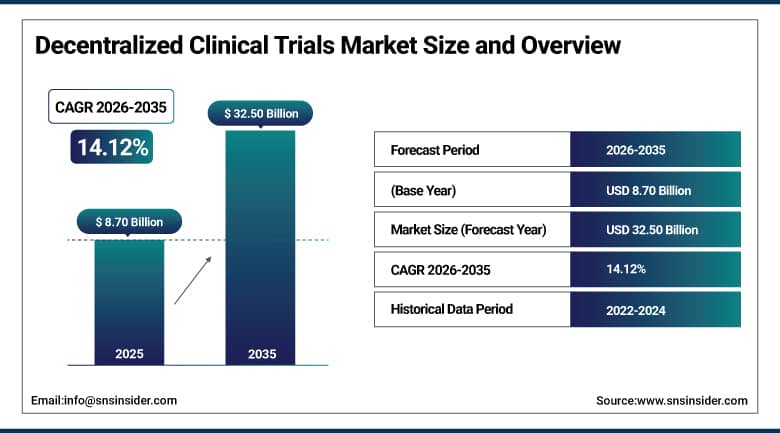
The Decentralized Clinical Trials Market was valued at USD 8.70 billion in 2025 and is expected to reach USD 32.50 billion by 2035, growing at a CAGR of 14.12% from 2026-2035.
The Decentralized Clinical Trials Market is witnessing strong growth this is because of the increase in demands for research that is centered on patients, flexibility in the participation process, and effective clinical study administration. Decentralized clinical trials make use of telemedicine, wearable gadgets, mobile apps, and remote technology for capturing data in order to cut down on hospital visits and make it easier for the patient to participate. Digital health platforms have been increasingly adopted by pharmaceutical and biotech companies in order to make it easier for them to recruit participants, gather information, and engage with their subjects. In addition, increasing costs of conducting clinical trials, geographic barriers, and the need to include more diversity in the participants of clinical studies has encouraged sponsors to move to decentralized and hybrid trial models.
⮞The International Council for Harmonisation’s E6(R3) Good Clinical Practice guideline modernizes trial quality and oversight expectations, including the use of fit-for-purpose systems and risk-based approaches.
To Get More Information On Decentralized Clinical Trials Market - Request Free Sample Report
Decentralized Clinical Trials Market Trends:
-
Growing demand for patient-centric research is increasing adoption of decentralized clinical trials across pharmaceutical and biotechnology companies.
-
Rising use of telemedicine and remote monitoring is improving patient participation and reducing traditional clinical trial site visits.
-
Increasing adoption of wearable devices and digital health technologies is enabling continuous data collection and remote patient monitoring.
-
Growing use of electronic consent platforms is simplifying enrollment and improving accessibility across geographically dispersed patient populations.
-
Advancements in digital trial management platforms are improving data collection, patient engagement, and clinical study efficiency.
U.S. Decentralized Clinical Trials Market Outlook:
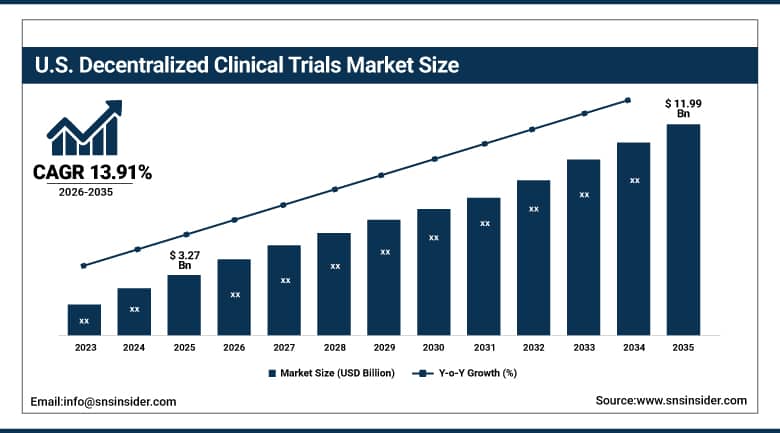
The U.S. Decentralized Clinical Trials Market was valued at USD 3.27 billion in 2025 and is expected to reach USD 11.99 billion by 2035, growing at a CAGR of 13.91% from 2026-2035.
The U.S. Decentralized Clinical Trials Market is witnessing strong growth as a result of the increased utilization of digital technology and patient-centered approach in clinical trials within the US. In decentralized trials, telemedicine, wearables, mobile apps, and remote monitoring tools are used to facilitate participation outside clinical sites. The rising demands for easy participation in trials, enhanced patient recruitment, and representation of diverse demographics are driving the adoption of decentralized and hybrid trials by pharmaceutical and biotechnology companies. Apart from that, rising costs of clinical trials and the need to enhance participant retention are also driving market adoption. There are advancements in areas such as electronic informed consent, remote data collection, and connected medical devices that have improved the efficiency of trials.
⮞FDA’s 2026 digital-health initiative invited projects using technologies such as sensors and digital measurements to support drug development and remote data acquisition.
Decentralized Clinical Trials Market Segment Analysis:
-
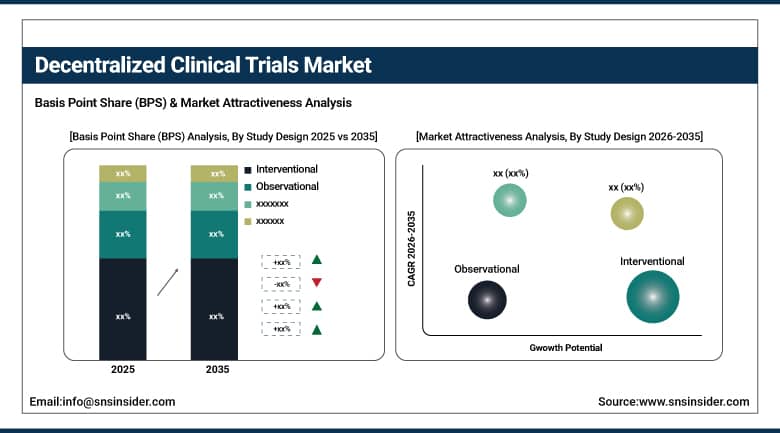
By Study Design, Interventional dominates the Decentralized Clinical Trials Market with 55% share in 2025; Observational is expected to grow at the fastest CAGR of 14.94% from 2026–2035.
-
By Component, Services dominate the Decentralized Clinical Trials Market with 35% share in 2025; Cloud-Based Platforms are expected to grow at the fastest CAGR of 15.02% from 2026–2035.
-
By Therapeutic Application, Oncology dominates the Decentralized Clinical Trials Market with 28% share in 2025; Neurology is expected to grow at the fastest CAGR of 17.41% from 2026–2035.
-
By End User, Pharmaceutical and Biotechnology Companies dominate the Decentralized Clinical Trials Market with 42% share in 2025; Contract Research Organizations (CROs) are expected to grow at the fastest CAGR of 15.08% from 2026–2035.
By Study Design, Interventional dominates the Decentralized Clinical Trials Market, Observational grows fastest.
Interventional dominated the Decentralized Clinical Trials Market with the highest revenue share of about 55% in 2025, enabled by the increasing reliance on remote technologies for conducting clinical research trials with investigational medicines. Such trials would involve monitoring patients, data entry through electronic means, and virtual follow-ups. The decentralized approach increases the ease of reaching out to participants and conducting clinical research trials.
Observational is expected to grow at the fastest CAGR of 14.94% from 2026–2035, motivated by the need for evidence from the real world and patient outcomes over time. Remote questionnaires, wearables, EHRs, and telemedicine consultations make it possible for investigators to conduct research beyond the clinic. There is an increasing trend towards gaining insights about patients' experiences, the disease trajectory, and treatment patterns.
By Component, Services dominate the Decentralized Clinical Trials Market, Cloud-Based Platforms grow fastest.
Services dominated the Decentralized Clinical Trials Market with the highest revenue share of about 35% in 2025, driven by the demand for specific assistance with respect to trial design, patient recruitment, remote monitoring, regulatory compliance, and data management. Sponsors often turn to third parties in order to organize their complex decentralized activities. The demand for technical skills and patient involvement, as well as successful trial conduct, will continue to drive investment in decentralized trials.
Cloud-Based Platforms are expected to grow at the fastest CAGR of 15.02% from 2026–2035, facilitated by growing need for scalable digital infrastructure and real-time clinical data accessibility. Cloud solutions combine electronic data capture systems, telemedicine, patient outcomes reporting, and remote monitoring devices. Collaboration capabilities provided by cloud-based solutions, data accessibility and efficient trial workflow management are anticipated to drive adoption..
By Therapeutic Application, Oncology dominates the Decentralized Clinical Trials Market, Neurology grows fastest.
Oncology dominated the Decentralized Clinical Trials Market with the highest revenue share of about 28% in 2025, driven by the wealth of research carried out in the clinic to develop new cancer drugs and a desire to enhance patient compliance. Decentralized testing involving remote consultations, telemonitoring of symptoms, and decentralized follow-up appointments will alleviate the need to travel when patients are undergoing tough treatment regimes. There is more research being done in oncology drugs.
Neurology is expected to grow at the fastest CAGR of 17.41% from 2026–2035, Motivated by the rise in the study of neurological disorders and the requirement for constant surveillance on the condition’s symptoms and functional changes. Wearable devices, digital assessment tools, telemedicine technology, and caregiver-provided information might aid researchers to gather data from the patient in their regular surroundings.
By End User, Pharmaceutical and Biotechnology Companies dominate the Decentralized Clinical Trials Market, CROs grow fastest.
Pharmaceutical and Biotechnology Companies dominated the Decentralized Clinical Trials Market with the highest revenue share of about 42% in 2025, backed by their heavy investment in clinical development and the increased use of remote trial techniques. These firms employ decentralized techniques to increase participant access, enhance recruitment flexibility, and alleviate the burden of conducting trials at sites. The large pipelines of drugs and requirement for clinical data collection help them maintain their market leadership position.
Contract Research Organizations (CROs) are expected to grow at the fastest CAGR of 15.08% from 2026–2035, Driven by growing outsourcing of clinical trial procedures and increasing need for expertise in decentralized clinical trials. CROs can assist sponsors in remote monitoring, patient enrollment, data collection, and regulation. The existing research networks and partnerships with technology companies and ability to conduct geographically dispersed studies should improve the position of CROs in providing decentralized clinical trials.
Regional Analysis:
|
Region |
Major Country |
Share within Region, 2025 (%) |
|---|---|---|
|
North America |
United States |
89.5% |
|
Europe |
Germany |
18.0% |
|
Asia Pacific |
China |
30.0% |
|
Middle East & Africa |
UAE |
15.0% |
|
Latin America |
Brazil |
40.0% |
North America Decentralized Clinical Trials Market Insights
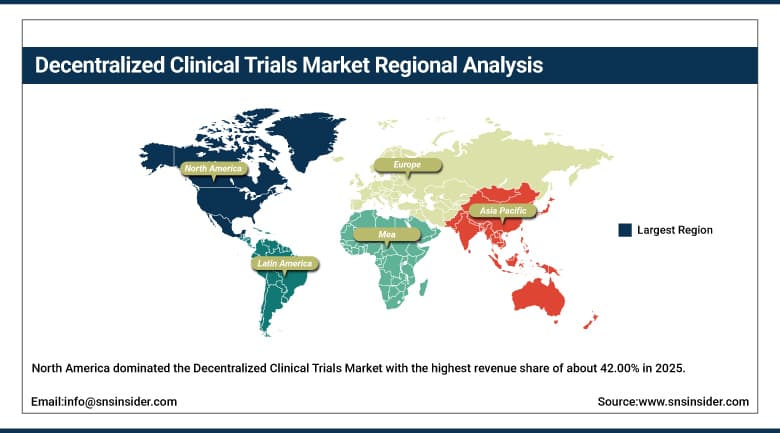
North America dominated the Decentralized Clinical Trials Market with the highest revenue share of about 42.00% in 2025, fueled by cutting-edge clinical research infrastructure, substantial R&D in pharmaceuticals, and the utilization of telehealth technologies. The presence of prominent contract research organizations, favorable regulatory environment, and extensive use of telemedicine and remote monitoring add to the strength of regional demands for decentralized trials.
The U.S. Decentralized Clinical Trials Market accounted for a market share of 89.5% in 2025, facilitated through advanced clinical research infrastructure, robust pharmaceutical research & development expenditure, and significant implementation of digital health tools. The presence of major contract research organizations, regulatory framework, and increasing implementation of telemedicine, wearables, and remote patient monitoring also boosts the growth of the market.
Get Customized Report as Per Your Business Requirement - Enquiry Now
Europe Decentralized Clinical Trials Market Insights
Europe’s Decentralized Clinical Trials Market is supported by established clinical research networks, increasing digital healthcare adoption, and growing demand for patient-centric trial models. Drug manufacturing companies have embraced remote monitoring, teleconsultations, and electronic data capture to enhance patient participation and retention. Cross-country research cooperation, technology, and reduction of participant burden in trials are some of the factors that favor regional market development.
The Germany Decentralized Clinical Trials Market accounted for a market share of 18.0% in 2025, motivated by clinical research institutions already well-established within the industry, the presence of a highly developed healthcare infrastructure, and the digitalization of clinical trials. Drug companies are using technology such as remote monitoring and data collection in their efforts to make their clinical trials more efficient and patient-friendly.
Asia Pacific Decentralized Clinical Trials Market Insights
Asia Pacific is expected to grow at the fastest CAGR of about 15.71% from 2026–2035, due to growing clinical research activities, wide and varied patient base, and increased utilization of digital healthcare technologies. Rising pharmaceutical funding, improving internet penetration, and increased need for cost-effective trials is driving adoption. Moreover, growing research infrastructure and availability of remote monitoring solutions is aiding regional growth.
The China Decentralized Clinical Trials Market accounted for a market share of 30.0% in 2025, Backed by a high patient base, increased clinical research activities, and increasing use of digital health technologies. The pharmaceutical industry and improved connectivity have encouraged remote contribution to and data collection from the trials. Also, the increasing need for efficient clinical research and research infrastructure has driven the use of decentralized trial solutions.
Middle East & Africa and Latin America Decentralized Clinical Trials Market Insights
The Middle East & Africa and Latin America Decentralized Clinical Trials Market is developing as healthcare digitization and clinical research investments expand. Remote assessments and monitoring can help in enhancing access for participants in geographically scattered communities. Furthermore, emerging trends in drug discovery collaborations, better internet connectivity, and increased attention on affordable and patient-centric clinical trials have spurred the use of these methods, despite regulatory differences and poor infrastructure.
The UAE Decentralized Clinical Trials Market accounted for a market share of 15.0% in 2025, Backed by healthcare digitalization, advancement in clinical research capacities, and advanced medical technologies. Telemedicine and remote monitoring can enhance convenience and availability of clinical trials for participants. Also, government health care programs and collaboration with foreign pharmaceutical firms and research organizations contribute to the growth of the market.
Market Dynamics:
Growth Drivers: Growing demand for patient-centric research is driving decentralized clinical trial adoption.
The growing trend of patient-oriented clinical studies has led to an uptake of decentralized clinical trials (DCTs) among pharmaceutical firms and clinical research organizations. DCTs use technology and novel ways of engagement to decrease the need for the patient's presence at a physical research site for each research procedure. Methods such as remote visits, electronic informed consent, use of wearable devices, and at-home testing might make the process more convenient for the participants and lessen the burden of traveling. This technique could be useful to enable recruitment of subjects living geographically apart from each other and retaining participants who encounter obstacles in transport, mobility, or scheduling. Clinical research is becoming more participant-oriented and accessible, so sponsors are considering hybrid and decentralized methods of conducting the research.
Restraints: Data privacy and cybersecurity concerns can restrict decentralized clinical trial adoption.
Decentralized clinical trials utilize technology platforms, connected devices, digital health records, and other forms of communication that handle sensitive data about the participants. This data needs to be adequately controlled, protected in transit, authenticated and handled according to the relevant privacy laws and regulations. The sponsor of such trials has an obligation to evaluate technology partners as well as handle data in a secure manner as it gets collected from various systems. Any form of cybersecurity risks and breaches may compromise the integrity of the process. Satisfying all these criteria might necessitate increased use of technology, additional assessments, and regulatory compliance efforts. Therefore, organizations must put in place adequate data governance and security processes before undertaking decentralized clinical trials.
Opportunities: Expansion of remote patient monitoring creates opportunities for decentralized trial services.
Increasing adoption of wearable sensors, networked medical devices, and remote monitoring solutions enables the provision of additional decentralized clinical trial services. These technologies could facilitate collecting certain physiological parameters and self-reported information outside traditional research sites. If the study design and validation of the device will allow it, remote monitoring could assist researchers in tracking changes in subjects' health status and decrease some of the in-person visits. Service providers could create comprehensive solutions using connected devices, data management, patient assistance, and clinical monitoring processes. Pharma companies could utilize such technologies in hybrid studies, where remote processes would be used along with some in-person procedures. Further technological advances would enable the adoption of decentralized approaches in various therapy areas.
Recent Developments:
-
2026 : Medidata Solutions, Inc. expanded its AI-powered clinical trial capabilities through enhancements to Medidata AI Study Build, using generative AI to accelerate study configuration across Rave EDC and eCOA workflows.
-
2026 : ICON plc selected Microsoft as its preferred technology partner to advance Orbis, its governed agentic AI platform, supporting AI-enabled study design, protocol optimization, and clinical trial operations.
-
2026 : Fortrea Holdings Inc. launched Fortrea Intelligent Technology™, an AI-enhanced suite designed to automate clinical trial workflows, improve oversight, and strengthen operational efficiency for sponsors and research sites.
-
2025 : IQVIA Holdings Inc. was recognized as a leader in IDC MarketScape’s decentralized clinical trial technology and consulting services assessment, highlighting its integrated DCT technologies, implementation expertise, and patient-centered trial capabilities.
Decentralized Clinical Trials Market key players are:
-
Medidata Solutions, Inc.
-
IQVIA Holdings Inc.
-
ICON plc
-
Parexel International Corporation
-
Fortrea Holdings Inc.
-
Labcorp Holdings Inc.
-
Thermo Fisher Scientific Inc. (PPD)
-
Oracle Corporation
-
Medable, Inc.
-
Science 37, Inc.
-
Signant Health
-
ObvioHealth, Inc.
-
THREAD Research, Inc.
-
Florence Healthcare, Inc.
-
Veeva Systems Inc.
-
Clinical Ink, Inc.
-
Curebase, Inc.
-
OpenClinica, LLC
-
Huma Therapeutics Limited
-
EmVenio Research Inc.
Decentralized Clinical Trials Market Report Scope:

Frequently Asked Questions
Key players in the Decentralized Clinical Trials Market include Medidata Solutions, Inc., IQVIA Holdings Inc., ICON plc, Medable, Inc., and Thermo Fisher Scientific Inc., among others.
Key opportunities in the Decentralized Clinical Trials Market include growing adoption of remote patient monitoring, expansion of digital clinical trial platforms, and increasing use of wearable devices and telehealth technologies.
The market is driven by increasing demand for patient-centric trials, rising adoption of digital health technologies, and the need to reduce clinical trial costs and recruitment timelines.
The Interventional segment dominated the Decentralized Clinical Trials Market, accounting for approximately 55.00% market share.
The North America region dominated the Decentralized Clinical Trials Market in 2025 with a 42.00% share, driven by advanced digital infrastructure and growing adoption of patient-centric clinical research.
