
Pharmaceutical Intermediates Market Report Scope & Overview:
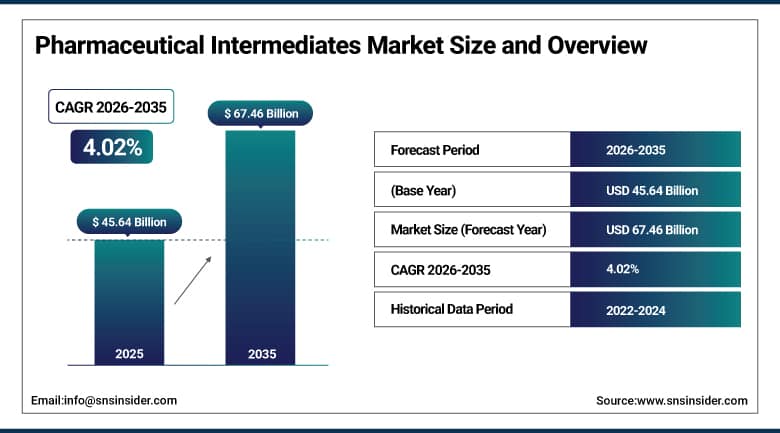
The Pharmaceutical Intermediates Market was valued at USD 45.64 billion in 2025 and is expected to reach USD 67.46 billion by 2035, growing at a CAGR of 4.02% from 2026-2035.
The Pharmaceutical Intermediates Market is witnessing steady growth Due to increase in manufacturing processes, increasing demands for active pharmaceutical ingredients and increased investments in research and development of drugs. Pharmaceutical intermediates are crucial ingredients which are used in the production of active pharmaceutical ingredients used in generic drugs as well as branded drugs. Increasing needs for therapies against chronic diseases, infections, and age-related diseases are promoting the demand for consistent production of high-quality intermediates. Moreover, the rise in generic drug manufacturing, outsourcing of drug manufacturing processes and focus on supply chain resilience are helping in promoting the market growth.
⮞The World Health Organization provides guidance on good manufacturing practices for APIs, reflecting the importance of controlled production and reliable pharmaceutical ingredient quality across manufacturing supply chains.
To Get More Information On Pharmaceutical Intermediates Market - Request Free Sample Report
Pharmaceutical Intermediates Market Trends:
-
Growing demand for generic and branded medicines is increasing consumption of pharmaceutical intermediates across drug manufacturing applications.
-
Rising adoption of custom synthesis is expanding demand for specialized intermediates supporting complex pharmaceutical compound development.
-
Increasing investments in active pharmaceutical ingredient manufacturing are strengthening demand for high-quality chemical intermediates.
-
Advancements in green chemistry are encouraging sustainable synthesis processes and reducing waste across pharmaceutical intermediate production.
-
Growing demand for biologics and specialty medicines is supporting development of advanced intermediates for complex therapeutic applications.
U.S. Pharmaceutical Intermediates Market Outlook:
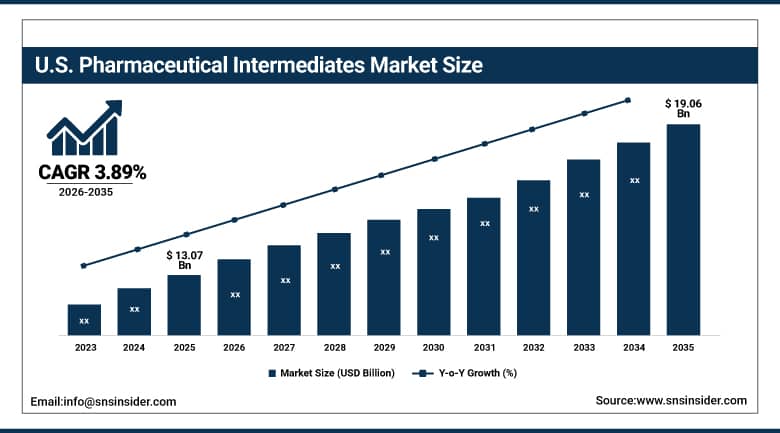
The U.S. Pharmaceutical Intermediates Market was valued at USD 13.07 billion in 2025 and is expected to reach USD 19.06 billion by 2035, growing at a CAGR of 3.89% from 2026-2035.
The U.S. Pharmaceutical Intermediates Market is witnessing steady growth attributed to the increase in pharmaceutical manufacturing activity, the rise in demand for active pharmaceutical ingredients, and investments in drug development and manufacture. Pharmaceutical intermediates have an important part in the manufacture of active pharmaceutical ingredients in generic as well as brand-name drugs. Increased demands for drugs that treat chronic illnesses, infectious diseases, and aging-related illnesses are driving up the demand for reliable intermediates. In addition to that, increased focus on local manufacturing of pharmaceutical products, supply chain reliability, and reduced dependence on foreign companies is driving investments in local manufacturing capacity. The developments in chemistry, process, and quality control are making the manufacturing process even more efficient and effective. The growing generic drug market and ongoing R&D efforts are also driving the market for pharmaceutical intermediates in the US.
⮞In March 2026, the Administration for Strategic Preparedness and Response announced an additional $8.3 million to expand U.S. production capacity for selected essential-medicine APIs.
Pharmaceutical Intermediates Market Segment Analysis:
-
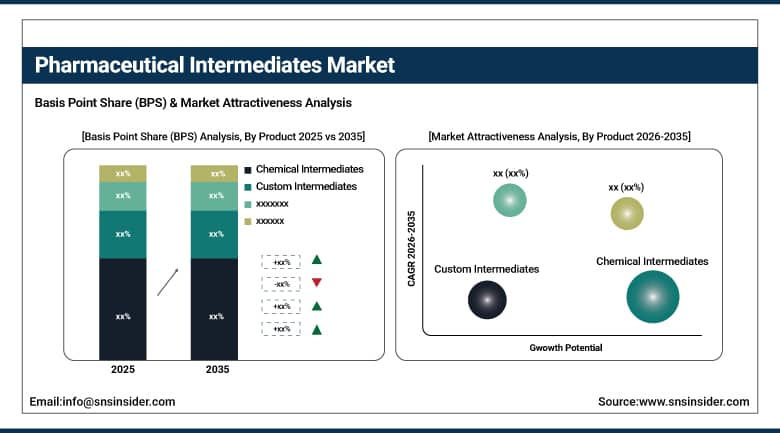
By Product, Chemical Intermediates dominate the Pharmaceutical Intermediates Market with 45% share in 2025; Custom Intermediates are expected to grow at the fastest CAGR of 4.82% from 2026–2035.
-
By Category, Generic Drug Intermediates dominate the Pharmaceutical Intermediates Market with 65% share in 2025; Branded Drug Intermediates are expected to grow at the fastest CAGR of 4.49% from 2026–2035.
-
By Application, Antimicrobial Drugs dominate the Pharmaceutical Intermediates Market with 18% share in 2025; Anti-cancer Drugs are expected to grow at the fastest CAGR of 6.93% from 2026–2035.
-
By End User, Biotechnology and Pharmaceutical Companies dominate the Pharmaceutical Intermediates Market with 58% share in 2025; CMOs / CROs are expected to grow at the fastest CAGR of 4.63% from 2026–2035.
By Product, Chemical Intermediates dominate the Pharmaceutical Intermediates Market, Custom Intermediates grow fastest.
Chemical Intermediates dominated the Pharmaceutical Intermediates Market with the highest revenue share of about 45% in 2025, This is because they play a fundamental part in the manufacture of active drug components, and many other drug production processes. Their versatility in various drug treatment classes, well-developed production facilities, and steady industrial demands make their adoption widespread. Greater drug production and reliable availability of precursor materials increase their market dominance.
Custom Intermediates are expected to grow at the fastest CAGR of 4.82% from 2026–2035, motivated by rising requirements for molecule specialization according to certain processes required for drug synthesis. Customized intermediates are needed by pharmaceutical manufacturers in order to increase efficiency, purity and consistency in the production process. The development of complicated active pharmaceutical ingredients, growth in specialty drugs pipeline and chemical synthesis outsourcing is expected to drive demand.
By Category, Generic Drug Intermediates dominate the Pharmaceutical Intermediates Market, Branded Drug Intermediates grow fastest.
Generic Drug Intermediates dominated the Pharmaceutical Intermediates Market with the highest revenue share of about 65% in 2025, backed by immense demand for cost-effective drugs and production on a massive scale of generic drugs. Producers need dependable intermediate supplies in order to keep their production cost-effective and respond to the demands that recur constantly within known therapeutic groups. Expiry of patents, access to essential drugs, and increase in generic production add more value to its dominance.
Branded Drug Intermediates are expected to grow at the fastest CAGR of 4.49% from 2026–2035, driven by ongoing investment in innovative drugs and advanced pharmaceutical formulations. For research-based companies, the need for high-purity intermediates is essential for producing branded drugs and facilitating complex synthetic reactions. The growth of biologics-related small molecule developments, specialty drugs, and investment in new active pharmaceutical ingredients is anticipated to maintain the demand for intermediates in branded drugs.
By Application, Antimicrobial Drugs dominate the Pharmaceutical Intermediates Market, Anti-cancer Drugs grow fastest.
Antimicrobial Drugs dominated the Pharmaceutical Intermediates Market with the highest revenue share of about 18% in 2025, motivated by steady demand for drugs that are employed for treating bacterial, fungal and other infections by microorganisms. Large-scale manufacture of proven antimicrobials calls for a regular supply of chemicals. Demand for the products from hospitals and healthcare facilities and from the manufacture of anti-infective drugs ensures the leadership of this segment.
Anti-cancer Drugs are expected to grow at the fastest CAGR of 6.93% from 2026–2035, Driven by increasing instances of cancer and increased research on targeted therapy and oncology drugs. The development of increasingly complicated drug structures will lead to the need for highly purified and quality intermediates. The increasing pipelines in oncology, research in cancer treatment, and production of novel therapies are anticipated to boost demand in this market segment.
By End User, Biotechnology and Pharmaceutical Companies dominate the Pharmaceutical Intermediates Market, CMOs / CROs grow fastest.
Biotechnology and Pharmaceutical Companies dominated the Pharmaceutical Intermediates Market with the highest revenue share of about 58% in 2025, supported by the need for a lot of raw materials for the discovery, development, and manufacture of drugs. They buy intermediates needed for API manufacturing, process development, and manufacturing. The presence of manufacturing network, wide range of products, and demand for pharmaceutical ingredients have made them market leaders.
CMOs / CROs are expected to grow at the fastest CAGR of 4.63% from 2026–2035, motivated by the growing outsourcing of research, process development, and chemical manufacture of pharmaceuticals. Such companies can assist drug developers in having access to unique synthesis technologies, increase production flexibility, and control manufacturing costs. The increasing number of research projects, need for complicated intermediates, and emphasis on cost-efficiency among pharmaceutical companies will stimulate the increased use of contract manufacturing and research services.
Regional Analysis:
|
Region |
Major Country |
Share within Region, 2025 (%) |
|---|---|---|
|
North America |
United States |
89.5% |
|
Europe |
Germany |
24.0% |
|
Asia Pacific |
China |
38.0% |
|
Middle East & Africa |
UAE |
18.0% |
|
Latin America |
Brazil |
35.0% |
North America Pharmaceutical Intermediates Market Insights
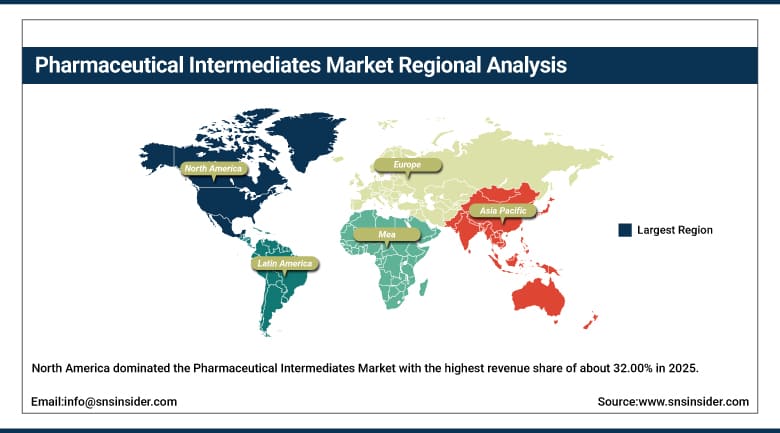
North America dominated the Pharmaceutical Intermediates Market with the highest revenue share of about 32.00% in 2025, driven by existing pharmaceutical production, research and development investment, and the requirement for high-quality pharmaceutical raw materials. Having major pharmaceutical manufacturers, high levels of technological advancement, high-quality standards, and an efficient drug development environment reinforces the regional demand for pharmaceutical intermediates.
The U.S. Pharmaceutical Intermediates Market accounted for a market share of 89.5% within North America in 2025, Backed up by an already developed pharmaceutical industry, research and development expenditure, and the need for good-quality raw materials used in making medicines. The country has excellent chemical production facilities, high-quality standards, and even leading pharmaceutical organizations that help in strengthening the demand.
Get Customized Report as Per Your Business Requirement - Enquiry Now
Europe Pharmaceutical Intermediates Market Insights
Europe’s Pharmaceutical Intermediates Market is supported by established pharmaceutical manufacturing, strong chemical industry capabilities, and continued investment in drug research and development. High standards of regulation and requirements for robust pharmaceutical supply chain drive the demand for quality intermediates. Moreover, innovation in specialty chemicals, increased generic drug production, and collaboration between chemical companies and pharmaceutical firms help develop the local market environment.
The Germany Pharmaceutical Intermediates Market accounted for a market share of 24.0% within Europe in 2025, driven by its existing pharmaceutical and chemical industries, manufacturing facilities, and research facilities. Demand is bolstered by generic drugs and specialty drugs manufacturing, strict quality standards, and constant innovations in the pharmaceutical industry. Moreover, cooperation between chemical companies, research organizations, and drug makers reinforces the market standing of the nation.
Asia Pacific Pharmaceutical Intermediates Market Insights
Asia Pacific is expected to grow at the fastest CAGR of about 4.80% from 2026–2035, Driven by the increase in the manufacture of pharmaceuticals, increase in the manufacture of generic drugs, and the increasing need for inexpensive intermediaries. China and India have advantages because of their well-established capacity for chemical production and export opportunities. In addition, there are investments being made in manufacturing facilities and diversification of the supply chain.
The China Pharmaceutical Intermediates Market accounted for a market share of 38.0% within Asia Pacific in 2025, backed by robust chemical manufacturing facilities, competitive cost of production, and a substantial pharmaceutical sector. The high demand for the intermediates from domestic producers and foreign clients fuels intermediate production. Furthermore, technology development for manufacturing, expansion of generics manufacture, and the pharmaceutical value chain support the growth of the market.
Middle East & Africa and Latin America Pharmaceutical Intermediates Market Insights
The Middle East & Africa and Latin America Pharmaceutical Intermediates Market is developing through growing pharmaceutical demand, expanding local drug manufacturing, and increasing investments in healthcare infrastructure. Initiatives aimed at improving medicines’ supply chains and decreasing dependence on imports are driving regional capabilities for manufacturing. Furthermore, increasing generic drugs demand, collaborations with foreign pharmaceutical firms, and improvements in the manufacturing infrastructure provide chances for pharmaceutical intermediates manufacturers.
The UAE Pharmaceutical Intermediates Market accounted for a market share of 18.0% within the Middle East in 2025, Backed by increasing efforts on the side of pharmaceutical production, investment in healthcare and strengthening the supply chains of medicine. Demand is driven by increasing the local production of medicines and requirement of intermediaries for reliable sourcing. Also, industrial development programs and collaborations with international pharmaceutical suppliers contribute to this market expansion.
Market Dynamics:
Growth Drivers: Rising pharmaceutical production is increasing demand for high-quality drug intermediates.
Increasing production of generic drugs, brand name drugs, and APIs is driving the growth of pharmaceutical intermediates needed for making the drugs. Chemical compounds act as the key components to make the API, which is further used to produce the medicine. The demand for medicines for the treatment of chronic disease, infections, and many other diseases is driving the pharmaceutical manufacturing process. The more a drug manufacturer increases its production capacity and expands its portfolio, the more intermediates are required by it according to certain purity and quality standards. This factor drives the manufacturers of intermediates, who are supplying to the pharmaceutical companies and contract development and manufacturing organizations.
Restraints: Volatile raw material prices can increase pharmaceutical intermediate manufacturing costs.
Production of pharmaceutical intermediates is highly reliant on chemical feedstock, solvent, catalyst, reagents, and others such specialized inputs that are subject to change in price as a result of changes in energy prices, supply situations, transport prices, or even geopolitical events. An abrupt increase in input prices will affect the cost of production and reduce profit margins especially for producers that are under fixed price supply arrangements. Reliance on few suppliers or imported key input will be another issue to handle. Producers may have to hold extra inventory of their inputs, find new suppliers, or alter the production process to overcome these problems. But changing the sources of raw materials may not be an easy process.
Opportunities: Supply-chain diversification creates opportunities for reliable regional intermediate manufacturers.
Drug manufacturers are looking more and more at concentrated sourcing and finding extra sources of supply in an effort to make their supplies more secure and decrease the chance of disruption. This offers possibilities to intermediate manufacturers in regions well suited for drug manufacturing to be suppliers of important starting materials and unique chemical compounds. Pharmaceutical manufacturing capability in India along with the Indian government support for manufacture of certain drug intermediaries and APIs shows this trend towards supply security. The advantages for suppliers are having reliable manufacturing capability, sound quality systems, and long term association with API manufacturers and contract manufacturing companies. Opportunities will be available for suppliers able to meet customer qualification needs and have reliable delivery capability. However, there are several conditions for success in this endeavor.
Recent Developments:
-
2026 : BASF SE inaugurated its modernized acid chlorides and chloroformates production plant in Ludwigshafen, Germany, increasing capacity by approximately 30% to strengthen pharmaceutical intermediate supply and reduce product carbon footprints.
-
2026 : Lonza Group AG began construction of a new commercial-scale pharmaceutical manufacturing facility in Bend, Oregon, expanding spray-drying capabilities to support drug development and commercial supply.
-
2026 : Evonik Industries AG announced a US$100 million investment to upgrade its Tippecanoe, Indiana, facility, expanding small-molecule API and advanced-intermediate manufacturing capabilities for pharmaceutical customers.
-
2025 : Cambrex Corporation continued expanding its pharmaceutical manufacturing capacity through its planned US$120 million Charles City, Iowa, facility, designed to increase large-scale API production capacity by approximately 20%.
Pharmaceutical Intermediates Market key players are:
-
BASF SE
-
Lonza Group AG
-
Evonik Industries AG
-
Cambrex Corporation
-
Arkema S.A.
-
Aarti Industries Limited
-
Divi’s Laboratories Limited
-
PI Industries Limited
-
Jubilant Pharmova Limited
-
WuXi AppTec Co., Ltd.
-
Siegfried Holding AG
-
Hikal Limited
-
Hovione S.A.
-
EUROAPI S.A.
-
Thermo Fisher Scientific Inc.
-
Actylis
-
Midas Pharma GmbH
-
Chiracon GmbH
-
Lianhe Chemical Technology Co., Ltd.
-
A.R. Life Sciences Private Limited
Pharmaceutical Intermediates Market Report Scope:
| Report Attributes | Details |
|---|---|
| Market Size in 2025 | USD 45.64 Billion |
| Market Size by 2035 | USD 67.46 Billion |
| CAGR | CAGR of 4.02% From 2026 to 2035 |
| Base Year | 2025 |
| Forecast Period | 2026-2035 |
| Historical Data | 2022-2024 |
| Report Scope & Coverage | Market Size, Segments Analysis, Competitive Landscape, Regional Analysis, DROC & SWOT Analysis, Forecast Outlook |
| Key Segments | • By Product (Chemical Intermediates, Bulk Drug Intermediates, Custom Intermediates) • By Category (Generic Drug Intermediates, Branded Drug Intermediates) • By Application (Analgesics, Anti-inflammatory Drugs, Cardiovascular Drugs, Anti-diabetic Drugs, Antimicrobial Drugs, Anti-cancer Drugs, Others) • By End User (Biotechnology and Pharmaceutical Companies, Research Laboratories, Contract Manufacturing Organizations (CMOs) / Contract Research Organizations (CROs)) |
| Regional Analysis/Coverage | North America (US, Canada), Europe (Germany, UK, France, Italy, Spain, Russia, Poland, Rest of Europe), Asia Pacific (China, India, Japan, South Korea, Australia, ASEAN Countries, Rest of Asia Pacific), Middle East & Africa (UAE, Saudi Arabia, Qatar, South Africa, Rest of Middle East & Africa), Latin America (Brazil, Argentina, Mexico, Colombia, Rest of Latin America). |
| Company Profiles | BASF SE, Lonza Group AG, Evonik Industries AG, Cambrex Corporation, Arkema S.A., Aarti Industries Limited, Divi’s Laboratories Limited, PI Industries Limited, Jubilant Pharmova Limited, WuXi AppTec Co., Ltd., Siegfried Holding AG, Hikal Limited, Hovione S.A., EUROAPI S.A., Thermo Fisher Scientific Inc., Actylis, Midas Pharma GmbH, Chiracon GmbH, Lianhe Chemical Technology Co., Ltd., and A.R. Life Sciences Private Limited. |

Frequently Asked Questions
Key players in the Pharmaceutical Intermediates Market include BASF SE, Lonza Group AG, Evonik Industries AG, Divi’s Laboratories Limited, and Aarti Industries Limited, among others.
Key opportunities in the Pharmaceutical Intermediates Market include growing demand for custom synthesis, expansion of contract manufacturing services, and increasing adoption of advanced pharmaceutical intermediate production technologies.
The market is driven by rising pharmaceutical production, increasing demand for generic drugs, and growing investments in drug development and pharmaceutical manufacturing.
The Chemical Intermediates segment dominated the Pharmaceutical Intermediates Market, accounting for approximately 45.00% market share.
The North America region dominated the Pharmaceutical Intermediates Market in 2025 with a 32.00% share, driven by strong pharmaceutical manufacturing and demand for drug intermediates.
