
Phosphate Fertilizer Market Report Scope & Overview:
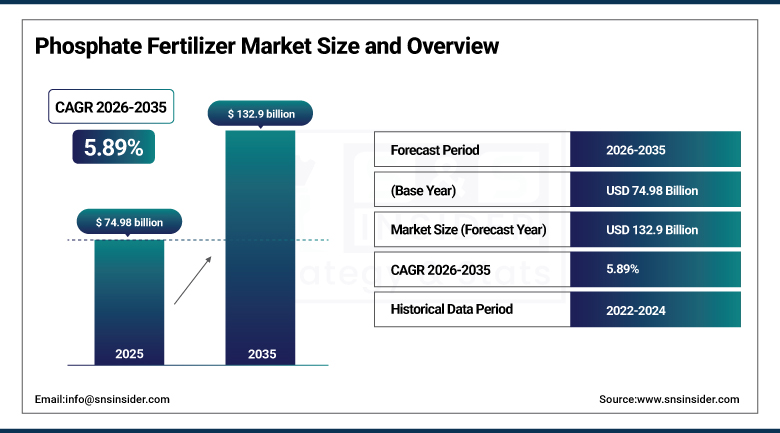
The Phosphate Fertilizer Market was valued at USD 74.98 billion in 2025 and is expected to reach USD 132.9 billion by 2035, growing at a CAGR of 5.89% from 2026–2035.
Market for Phosphate Fertilizers Growth is fuelled by rising demands for food globally, reduction in arable lands across the world, and the requirement to boost crop productivity levels. The growing trend towards practicing intensive farming, development of agriculture sector through modernization, and demands for higher yielding crops have boosted phosphate fertilizers consumption globally.
Morocco controls over 70% of the world's known phosphate rock reserves through the state-owned company OCP. This geographic concentration gives Morocco enormous influence over global phosphate supply and pricing, creating strategic considerations for importing nations and fertilizer companies that depend on Moroccan phosphate rock.
To Get more information on Phosphate Fertilizer Market - Request Free Sample Report
Phosphate Fertilizer Market Trends
-
Global population growth and rising food demand in developing countries are increasing the pressure on agricultural systems to produce more with better fertilizer management.
-
Precision agriculture and variable-rate fertilizer application technologies are improving phosphate use efficiency on farms.
-
Environmental regulations on fertilizer runoff are pushing farmers toward controlled-release and coated phosphate products.
-
Biostimulants and organic phosphate products are growing as farmers seek to complement or partially replace synthetic fertilizers.
-
Specialty phosphate fertilizers for high-value crops like fruits and vegetables are growing faster than bulk commodity products.
-
Supply chain diversification efforts by major agricultural economies are driving investment in new phosphate rock deposits and processing capacity.
-
Fertigation, the application of fertilizers through irrigation systems, is growing as a more efficient delivery method for phosphate.
Market Dyanmics
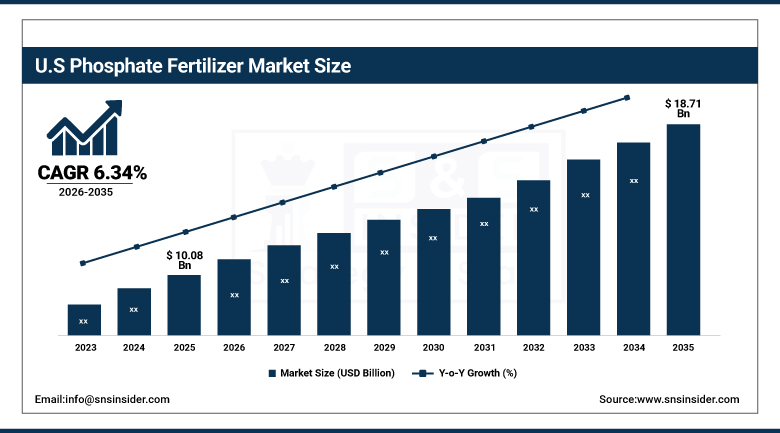
The U.S. Phosphate Fertilizer Market was valued at USD 10.08 billion in 2025 and is expected to reach USD 18.71 billion by 2035, growing at a CAGR of 6.34% from 2026 to 2035.
The USA is not only one of the major producers but also the biggest agriculture sector in the world in terms of size. There is an internal mining of phosphorite rocks in states like Florida and Idaho which has resulted in the development of a robust internal fertilization industry. The use of phosphate-based fertilizers by the farmers is mainly on corn, soybean, and wheat crops, which are some of the crops that require high amounts of phosphate in the world.
Florida's phosphate mining industry is facing growing environmental and regulatory pressure around land reclamation requirements and water quality impacts. This is creating long-term supply constraints for U.S.-produced phosphate rock, making American fertilizer companies increasingly dependent on imports, particularly from Morocco.
Phosphate Fertilizer Market Segment Insights
-
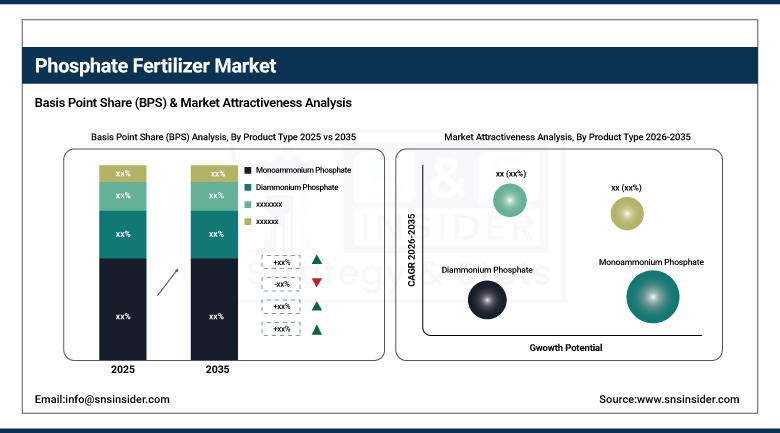
Based on Product Type, MAP (Monoammonium Phosphate) dominated the Phosphate Fertilizer Market with approximately 33.00% share in 2025, while DAP (Diammonium Phosphate) is expected to register the fastest growth with a CAGR of approximately 6.27% during 2026–2035.
-
Based on Crop Type, Cereals & Grains dominated the Phosphate Fertilizer Market with approximately 46.20% share in 2025, while Oilseeds & Pulses are expected to be the fastest-growing segment with a CAGR of approximately 6.18% during 2026–2035.
-
Based on Application, Soil Application dominated the Phosphate Fertilizer Market with approximately 46.00% share in 2025, while Fertigation is expected to be the fastest-growing segment with a CAGR of approximately 7.12% during 2026–2035.
-
Based on End Use, Agriculture dominated the Phosphate Fertilizer Market with approximately 95.34% share in 2025, while Industrial applications are expected to witness comparatively faster growth with a CAGR of approximately 4.86% during 2026–2035.
By Product Type, MAP Leads, DAP Closely Behind
The MAP (Monoammonium Phosphate) segment dominates the Phosphate Fertilizer Market due to its high phosphorus concentration, balanced nutrient composition, and broad applicability across different crops and soil conditions. MAP is widely used for cereals, grains, oilseeds, vegetables, fruits, and other crops where phosphorus is essential for root development and plant establishment. Its compatibility with fertilizer blends, established distribution networks, and familiarity among farmers further support its widespread adoption. The product also provides efficient nutrient availability, making it suitable for both conventional and modern agricultural practices.
The DAP (Diammonium Phosphate) segment is expected to witness strong growth during the forecast period. DAP supplies both nitrogen and phosphorus, making it an efficient option for improving crop establishment and supporting plant development. Increasing demand for balanced crop nutrition, rising agricultural productivity requirements, and expanding commercial farming are supporting its adoption. Its widespread availability and compatibility with major field crops further strengthen demand. Growing emphasis on improving fertilizer-use efficiency is also encouraging manufacturers to develop improved phosphate fertilizer formulations.
By Crop, Cereals Dominant, High-Value Crops Growing Faster
The Cereals & Grains segment dominates the Phosphate Fertilizer Market, supported by the extensive cultivation of corn, wheat, rice, and other cereal crops worldwide. These crops require adequate phosphorus for root development, energy transfer, flowering, and grain formation, resulting in substantial phosphate fertilizer consumption. Increasing global food requirements and efforts to improve yields from existing agricultural land are sustaining demand. Phosphate fertilizers remain an important component of nutrient management programs used across large-scale cereal production systems.
The Oilseeds & Pulses segment is expected to experience strong growth as demand for vegetable oils, plant-based proteins, and high-value agricultural products increases. Crops such as soybean, sunflower, rapeseed, chickpeas, and other pulses require sufficient phosphorus for root development, flowering, seed formation, and overall productivity. Expansion of commercial cultivation and increasing adoption of soil testing and precision nutrient management are encouraging more targeted fertilizer application. This is creating opportunities for phosphate fertilizer products designed to improve nutrient availability and crop performance.
By Applicarion, Soil Application is Dominant, Fertigation Growing Faster
The Soil Application segment dominates the Phosphate Fertilizer Market and remains one of the most established methods of delivering phosphorus to crops. Granular and solid phosphate fertilizers can be incorporated into the soil during planting or applied before cultivation, making them suitable for large agricultural fields. The method is widely used across cereals, grains, oilseeds, and commercial crops because of its compatibility with conventional agricultural machinery. Established farming practices and extensive fertilizer distribution networks continue to support soil application.
The Fertigation segment is expected to witness the fastest growth as farmers increasingly adopt precision irrigation and controlled nutrient delivery practices. Fertigation allows phosphate fertilizers to be supplied through irrigation systems according to crop requirements and growth stages. The approach can improve nutrient-use efficiency while supporting more precise agricultural resource management. Rising adoption of drip irrigation, water-efficient farming, precision agriculture, and protected cultivation is creating additional opportunities for fertigation-based phosphate fertilizer products.
By End Use, Agriculture is Dominant, Industrial Growing Faster
The Agriculture segment dominates the Phosphate Fertilizer Market because phosphorus is an essential macronutrient required for root development, energy metabolism, flowering, seed formation, and crop productivity. Phosphate fertilizers are extensively used across cereals, grains, oilseeds, pulses, fruits, vegetables, and other commercial crops. Increasing food production requirements, intensive cultivation, and declining soil nutrient availability are supporting continued agricultural demand. The need to improve crop yields and maintain soil fertility further strengthens the importance of phosphate fertilizers.
The Industrial segment represents a smaller but established area of phosphate-based product consumption. Phosphate materials are utilized in selected applications such as chemical processing, water treatment, animal feed production, and specialized manufacturing processes. Demand from these applications is influenced by industrial production, infrastructure development, and regulatory requirements. Expansion of water treatment facilities, food processing, and chemical manufacturing is expected to provide additional opportunities for phosphate-based products, although agriculture will continue to represent the primary demand center.
Regional Analysis
|
Region |
Major Country |
Share within Region, 2025 (%) |
|---|---|---|
|
North America |
United States |
78.00% |
|
Europe |
France |
25.00% |
|
Asia Pacific |
India |
38.00% |
|
Middle East & Africa |
Morocco |
65.00% |
|
Latin America |
Brazil |
62.00% |
North America Phosphate Fertilizer Market Insights
The US enjoys the greatest market share in North America, along with other nations in the region. Farming in the US is characterized by high productivity as well as intensive use of phosphate especially in the farming of corn and soybeans in the Midwest. The country has domestic sources of phosphate rocks that include Florida and Idaho, apart from importing from Morocco and Canada.
Get Customized Report as per Your Business Requirement - Enquiry Now
Europe Phosphate Fertilizer Market Insights
Europe already has an established and stable market for phosphate fertilizers under rigorous environmental regulations that dictate nutrient management practices. The EU’s Farm to Fork Strategy seeks to cut down fertilizer usage by 20% by 2030 without compromising food production, making it necessary to develop better phosphate fertilizers and application techniques. Eastern Europe is made up of important agricultural economies like Ukraine and Poland.
Asia Pacific Phosphate Fertilizer Market Insights
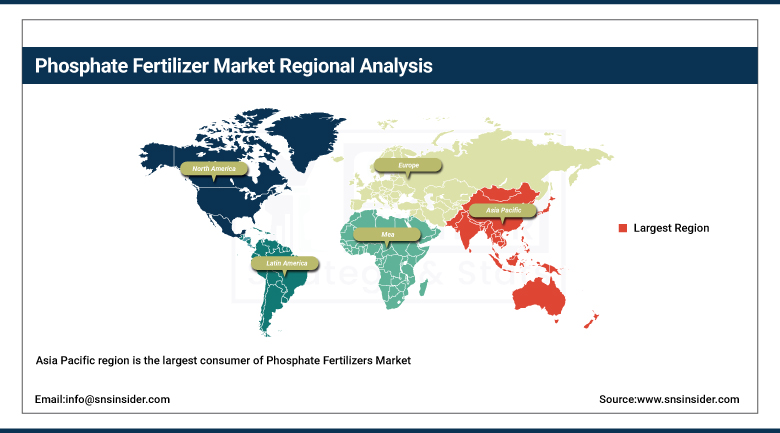
The Asia Pacific region is the largest consumer of phosphate fertilizers due to the large-scale agriculture industries found in countries such as India, China, and Southeast Asia. India happens to be among the biggest consumers of phosphate fertilizers across the globe, owing to its inadequate supply of domestic phosphate rocks and huge agricultural needs. China, on the other hand, used to be a leading producer as well as exporter of phosphate fertilizers.
MEA & Latin America Phosphate Fertilizer Market Insights
Indeed, the most prominent force in this region and even across the globe is Morocco because of the OCP Group being the custodian of the biggest phosphate rock deposits in the world. The company has put lots of effort into building their manufacturing capacities and establishing integrated fertilizer factories. Sub-Saharan Africa provides an important potential market since the soils on the continent lack phosphates and their fertilization levels are still below required levels.
Brazil is the largest consumer of phosphate fertilizers in Latin America, and one of the largest consumers globally. This is because Brazil has large-scale soybeans, maize, and sugarcane production that depend on phosphate fertilizers due to the phosphorus deficiency in the majority of the soil in Brazil. Brazil has been working on its ability to produce phosphate fertilizers domestically.
Market Dynamics
Growth Drivers: Global food demand growth requires higher crop yields from existing agricultural land
Market for Phosphate Fertilizer is showing a steady growth pattern due to the increasing demand for food in the world and the necessity to obtain greater yields from the available agricultural lands. The phosphate fertilizers help in promoting root development and increasing the quality of crops harvested. Due to the increase in the number of people, decrease in arable land and use of intensive farming systems, farmers have been encouraged to use fertilizers which are rich in nutrients.
Climate change is adding urgency to the need for efficient phosphate use. Drought conditions, changing rainfall patterns, and more frequent extreme weather events are making precision nutrient management more important. Farmers who apply the right amount of phosphate at the right time and place get better returns and also protect water quality by reducing runoff.
Restraints: Geographic concentration of phosphate rock reserves creates supply and price risks
The biggest structural challenge for the phosphate fertilizer market is that the key raw material, phosphate rock, is heavily concentrated in a very small number of countries. Morocco alone controls over 70% of global reserves. When any major supplier restricts exports or experiences production disruptions, it can cause significant global price volatility that disrupts agricultural planning and threatens food security in import-dependent countries. This concentration risk is a persistent concern for the market.
Opportunities: Phosphate recovery from wastewater and organic waste creates circular economy potential
One exciting opportunity is recovering phosphorus from wastewater treatment, sewage sludge, and food processing waste. These waste streams contain significant concentrations of phosphorus that is currently discharged into waterways, causing pollution. Technologies that can extract this phosphorus and convert it into usable fertilizer products could both reduce environmental damage and create alternative supply sources that reduce dependence on mined phosphate rock. Several European countries and companies are investing actively in this approach.
Recent Developments
-
2025: OCP Group announced a major expansion of its Jorf Lasfar fertilizer complex in Morocco, adding production capacity of over 1 million tonnes per year of DAP and MAP, the largest single phosphate fertilizer capacity addition globally in over a decade.
-
2024: Mosaic Company completed a major expansion of its MicroEssentials specialty phosphate fertilizer production capacity, responding to strong farmer demand for products that combine phosphate with sulfur and other micronutrients in a single granule for improved crop nutrition efficiency.
-
2023: The European Commission adopted new regulations on organic and recycled nutrient products under the EU Fertiliser Products Regulation, creating a legal framework for recovered phosphorus products to be sold as certified fertilizers, opening a new market for circular economy phosphate recovery.
Phosphate Fertilizer Market Key Players
-
OCP Group (Morocco)
-
The Mosaic Company (USA)
-
PhosAgro (Russia)
-
Nutrien Ltd. (Canada)
-
CF Industries Holdings
-
Jordan Phosphate Mines Company
-
Coromandel International (India)
-
Israel Chemicals Ltd.
-
Yara International ASA
-
Groupe Chimique Tunisien
-
Ma'aden Saudi Arabian Mining Company
-
Simplot Company
-
Agrium Inc. (merged into Nutrien)
-
Bunge Limited
-
Koch Fertilizer LLC
Phosphate Fertilizer Market Report Scope:
| Report Attributes | Details |
|---|---|
| Market Size in 2025 | USD 74.98 Billion |
| Market Size by 2035 | USD 132.9 Billion |
| CAGR | CAGR of 5.89% From 2026 to 2035 |
| Base Year | 2025 |
| Forecast Period | 2026-2035 |
| Historical Data | 2022-2024 |
| Report Scope & Coverage | Market Size, Segments Analysis, Competitive Landscape, Regional Analysis, DROC & SWOT Analysis, Forecast Outlook |
| Key Segments | • By Product Type (Monoammonium Phosphate (MAP), Diammonium Phosphate (DAP), Triple Superphosphate (TSP), Single Superphosphate (SSP), Others) • By Crop Type (Cereals & Grains, Oilseeds & Pulses, Fruits & Vegetables, Others) • By Application (Soil Application, Foliar Application, Fertigation) • By End-Use (Agriculture, Non-Agricultural) |
| Regional Analysis/Coverage | North America (US, Canada), Europe (Germany, UK, France, Italy, Spain, Russia, Poland, Rest of Europe), Asia Pacific (China, India, Japan, South Korea, Australia, ASEAN Countries, Rest of Asia Pacific), Middle East & Africa (UAE, Saudi Arabia, Qatar, South Africa, Rest of Middle East & Africa), Latin America (Brazil, Argentina, Mexico, Colombia, Rest of Latin America). |
| Company Profiles | OCP Group, The Mosaic Company, PhosAgro, Nutrien Ltd., CF Industries Holdings, Jordan Phosphate Mines Company, Coromandel International, Israel Chemicals Ltd., Yara International ASA, Groupe Chimique Tunisien, Ma'aden Saudi Arabian Mining Company, Simplot Company, Agrium Inc., Bunge Limited, Koch Fertilizer LLC |
Frequently Asked Questions
Key players in the Phosphate Fertilizer Market include OCP Group, The Mosaic Company, PhosAgro, Nutrien Ltd., CF Industries Holdings, Jordan Phosphate Mines Company, Coromandel International, Israel Chemicals Ltd., Yara International ASA, and Ma'aden Saudi Arabian Mining Company.
Key opportunities include the development of specialty phosphate fertilizers, precision nutrient application, fertigation, controlled-release products, and phosphorus recovery from wastewater and organic waste.
The major growth factor is rising global food demand and the need to increase crop productivity from limited arable land. Population growth, intensive farming, agricultural modernization.
By product type, MAP (Monoammonium Phosphate) dominates the market with approximately 33% share in 2025. By crop type, Cereals & Grains are the largest consumers, while Soil Application leads by application and Agriculture accounts for more than 95% of end-use consumption.
Asia Pacific dominates the Phosphate Fertilizer Market and is the largest consuming region, driven by large-scale agricultural activity in India, China, and Southeast Asia. India is among the world's largest phosphate fertilizer consumers due to its substantial agricultural requirements.
