
Phycoerythrin Fluorescence Sensors Market Size Analysis:
The Phycoerythrin Fluorescence Sensors Market size was valued at USD 116.52 Million in 2025E and is projected to reach USD 197.27 Million by 2033, growing at a CAGR of 6.86% during 2026-2033.
The phycoerythrin fluorescence sensors market is growing due to rising demand for advanced fluorescence-based detection in environmental monitoring, life-science research, and biotechnology. Increasing focus on water quality assessment, algal bloom detection, and ecosystem monitoring is driving adoption. Growth in biomedical research, flow cytometry, and immunoassays using phycoerythrin labels further supports demand. Additionally, technological advancements in portable, real-time, and multi-wavelength sensors are expanding application areas and improving measurement accuracy.
Market Size and Growth Projection:
-
Market Size in 2025E USD 116.52 Million
-
Market Size by 2033 USD 197.27 Million
-
CAGR of 6.86% From 2026 to 2033
-
Base Year 2025E
-
Forecast Period 2026-2033
-
Historical Data 2021-2024

To Get More Information On Phycoerythrin Fluorescence Sensors Market - Request Free Sample Report
Phycoerythrin Fluorescence Sensors Market Trends
-
Increasing adoption of portable and handheld fluorescence sensors for real-time, on-site environmental and laboratory monitoring.
-
Rising integration of sensors with IoT, cloud-based analytics, and automated data platforms for continuous monitoring and remote management.
-
Growing use of multi-wavelength and inline sensors in bioprocessing, pharmaceutical, and industrial biotechnology applications for process optimization.
-
Expansion of environmental monitoring initiatives in emerging economies, including aquaculture, water quality assessment, and ecosystem surveillance.
-
Technological advancements in miniaturization, higher sensitivity detectors, and durable field-deployable designs enhancing accuracy and usability across applications.
U.S. Phycoerythrin Fluorescence Sensors Market Size Outlook
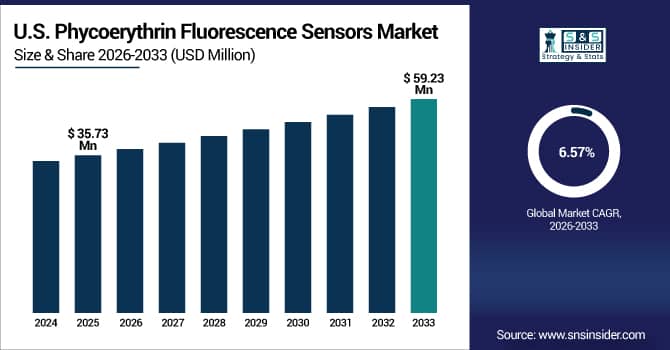
The U.S. Phycoerythrin Fluorescence Sensors Market size was valued at USD 35.73 Million in 2025E and is projected to reach USD 59.23 Million by 2033, growing at a CAGR of 6.57% during 2026-2033. The U.S. phycoerythrin fluorescence sensors market is growing due to strong investments in environmental monitoring, advanced life-science research, and biotechnology. Increasing emphasis on water quality regulation, algal bloom detection, and widespread use of fluorescence-based tools in biomedical research and diagnostics is further driving market expansion.
Phycoerythrin Fluorescence Sensors Market Growth Drivers:
-
Global Market Growth Driven by Real-Time Precise Detection in Environmental Research and Biotechnology Applications
The global phycoerythrin fluorescence sensors market is primarily driven by the growing need for precise and real-time detection technologies across environmental, life sciences, and biotechnology applications. Increasing concerns over water pollution, harmful algal blooms, and ecosystem health are significantly boosting the adoption of phycoerythrin-based fluorescence sensors in water quality monitoring and environmental surveillance. In the life sciences sector, expanding research in cell biology, immunology, and flow cytometry where phycoerythrin is widely used as a fluorescent label is supporting steady demand. Technological advancements, including miniaturization, higher sensitivity detectors, and integration with digital data platforms, are further enhancing sensor performance and adoption across both laboratory and field settings.
Emerging low-cost sensor systems developed in 2025 have achieved up to ~95 % accuracy in real-time algal detection, making continuous, affordable field monitoring more feasible for environmental agencies
Phycoerythrin Fluorescence Sensors Market Restraints:
-
Market Restraints Include Signal Interference Light Sensitivity and Performance Challenges in Complex Field Applications
The phycoerythrin fluorescence sensors market faces restraints related to signal interference from other fluorophores, sensitivity to ambient light conditions, and performance variability in highly turbid or complex samples. Calibration challenges, sensor fouling in long-term field deployments, and limited standardization across measurement protocols can affect data accuracy and slow adoption in critical environmental and clinical applications.
Phycoerythrin Fluorescence Sensors Market Opportunities:
-
Emerging Opportunities in Phycoerythrin Fluorescence Sensors Driven by Portable Multi-Wavelength Real-Time IoT Solutions
Key opportunities in the market are emerging from the rising demand for portable, multi-wavelength, and real-time sensing solutions, particularly in remote and resource-constrained environments. Rapid growth in bioprocessing, pharmaceutical manufacturing, and industrial biotechnology is creating opportunities for inline fluorescence sensors to enable continuous monitoring and process optimization. Additionally, increasing investments in environmental monitoring programs across emerging economies, coupled with expanding aquaculture and marine research activities, are expected to open new revenue streams. The integration of fluorescence sensors with IoT, cloud-based analytics, and automated monitoring systems also presents significant long-term growth potential for market participants globally.
University of Toledo scientists tested fluorescence-based sensors at a water treatment facility to detect cyanobacterial cell lysis in real time, giving operators early warnings of toxin release a practical application supporting public health protection
Phycoerythrin Fluorescence Sensors Market Segment Analysis
-
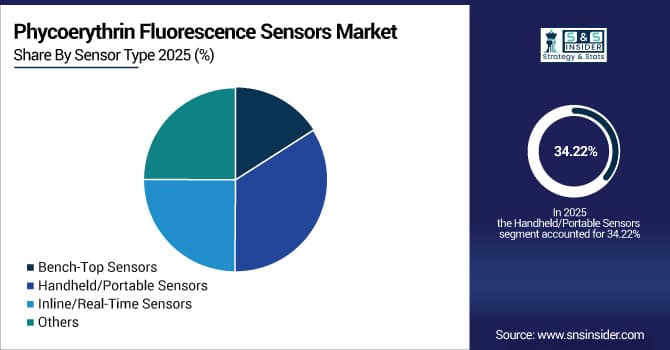
By Sensor Type, Handheld/Portable Sensors dominated with 34.22% in 2025E, and it is expected to grow at the fastest CAGR of 7.40% from 2026 to 2033.
-
By Detection Wavelength Range, Visible Spectrum (540–580 nm) dominated with 43.64% in 2025E, and Multi-Wavelength Systems is expected to grow at the fastest CAGR of 7.41% from 2026 to 2033.
-
By Application, Environmental Monitoring dominated with 32.37% in 2025E, and Bioprocess / Industrial Biotechnology is expected to grow at the fastest CAGR of 7.46% from 2026 to 2033.
-
By End User, Pharmaceutical & Biotechnology Companies dominated with 34.29% in 2025E, and it is expected to grow at the fastest CAGR of 7.33% from 2026 to 2033.
By Sensor Type, Handheld Portable Sensors Lead Market Growth Driven by Real-Time Multi-Wavelength IoT-Enabled Field Applications
Handheld/portable sensors dominate the phycoerythrin fluorescence sensors market in 2025E due to their flexibility for on-site environmental monitoring, research, and field-based applications. These sensors offer real-time detection, ease of deployment, and rapid results, making them preferred over bench-top or inline systems. Their adoption is expected to grow fastest from 2026–2033 as demand rises for portable, multi-wavelength, and IoT-enabled sensing solutions in remote and decentralized locations.
By Detection Wavelength Range, Visible Spectrum Dominates Market While Multi-Wavelength Systems Propel Rapid Growth Across Research and Diagnostics
The Visible Spectrum (540–580 nm) dominates the phycoerythrin fluorescence sensors market in 2025E, as phycoerythrin’s primary excitation and emission wavelengths fall within this range, making these sensors widely used in environmental monitoring, research, and laboratory applications. Multi-wavelength systems are expected to grow the fastest from 2026–2033, driven by demand for versatile sensors capable of detecting multiple fluorophores simultaneously, supporting advanced research, clinical diagnostics, and complex environmental applications.
By Application, Environmental Monitoring Leads Market While Bioprocess and Industrial Biotechnology Drive Rapid Future Growth Opportunities
Environmental monitoring dominates the phycoerythrin fluorescence sensors market in 2025E due to widespread use in water quality assessment, algal bloom detection, and ecosystem surveillance. Bioprocess and industrial biotechnology applications are expected to grow the fastest from 2026–2033, driven by increasing adoption of inline fluorescence sensors for continuous monitoring, process optimization, and quality control in biopharmaceutical manufacturing, industrial fermentation, and other biotech operations.
By End User, Pharmaceutical and Biotechnology Companies Lead Market Growth Through Advanced Real-Time High-Precision Fluorescence Applications
Pharmaceutical and biotechnology companies dominate the phycoerythrin fluorescence sensors market in 2025E due to extensive use in drug discovery, assay development, and diagnostic applications. This segment is also expected to grow the fastest from 2026–2033, driven by increasing R&D investments, adoption of real-time and multi-wavelength sensors, and the need for precise monitoring in bioprocessing, clinical trials, and high-throughput laboratory workflows globally.
North America Phycoerythrin Fluorescence Sensors Market Insights
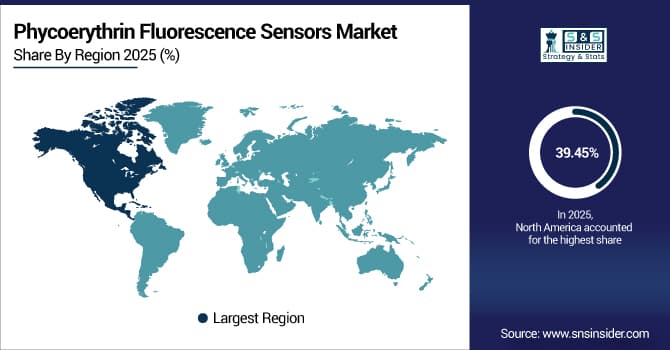
North America dominates the phycoerythrin fluorescence sensors market in 2025E with a 39.45% share, driven by strong environmental monitoring programs, advanced life-science research, and widespread adoption of biotechnology applications. The region benefits from robust R&D infrastructure, well-established regulatory frameworks for water quality and public health, and early adoption of portable and real-time fluorescence sensors. These factors collectively support high demand and technological advancement in both laboratory and field-based applications.
Get Customized Report as Per Your Business Requirement - Enquiry Now
U.S. Phycoerythrin Fluorescence Sensors Market Insights
In North America, the United States dominates the phycoerythrin fluorescence sensors market due to extensive environmental monitoring initiatives, advanced biotechnology research, well-funded academic institutions, and widespread adoption of real-time and portable fluorescence sensing technologies.
Europe Phycoerythrin Fluorescence Sensors Market Insights
Europe holds a 19.34% share of the phycoerythrin fluorescence sensors market in 2025E, supported by strong environmental regulations, advanced research infrastructure, and growing adoption in biotechnology and clinical applications. Countries such as Germany, the UK, and France lead in deploying fluorescence-based monitoring for water quality, ecosystem surveillance, and laboratory research. Technological advancements and government-led initiatives further drive market growth across both academic and industrial sectors.
Germany Phycoerythrin Fluorescence Sensors Market Insights
In Europe, Germany dominates the phycoerythrin fluorescence sensors market due to its advanced environmental monitoring programs, strong biotechnology and research infrastructure, and early adoption of fluorescence-based detection technologies in laboratories, industrial applications, and ecological surveillance.
Asia Pacific Phycoerythrin Fluorescence Sensors Market Insights
Asia Pacific is expected to grow at the fastest CAGR of 7.41% from 2026–2033 in the phycoerythrin fluorescence sensors market. This growth is driven by increasing investments in environmental monitoring, expanding biotechnology and research activities, rising adoption of portable and real-time fluorescence sensors, and growing demand for water quality assessment and industrial applications, supporting rapid market expansion across both laboratory and field-based applications.
China Phycoerythrin Fluorescence Sensors Market Insights
In Asia Pacific, China dominates the phycoerythrin fluorescence sensors market due to substantial investments in environmental monitoring, rapid expansion of biotechnology research, growing adoption of real-time and portable sensors, and increasing industrial and water quality monitoring initiatives.
Latin America (LATAM) and Middle East & Africa (MEA) Phycoerythrin Fluorescence Sensors Market Insights
Latin America (LATAM) and Middle East & Africa (MEA) represent emerging markets for phycoerythrin fluorescence sensors, driven by growing environmental monitoring initiatives, expanding research activities, and increasing awareness of water quality and ecosystem health. Adoption is supported by investments in portable and real-time sensing technologies for ecological surveillance, aquaculture, and industrial applications. These regions offer significant growth potential as governments and organizations implement advanced monitoring programs and modernize laboratory and field-based infrastructure.
Competitive Landscape for Phycoerythrin Fluorescence Sensors Market:
Hydrolab is a leading brand of water quality monitoring instruments under OTT HydroMet, providing rugged, multiparameter sondes and sensors for reliable field and laboratory measurements. Its products offer real‑time data collection, advanced diagnostics, and intuitive software for environmental monitoring, watershed studies, and aquatic ecosystem assessment. Hydrolab sondes support diverse parameters including phycoerythrin fluorescence, helping scientists and agencies track water quality changes accurately.
-
In November 2025, Hydromet introduced the Hydrolab HL7, a next‑generation multiparameter water quality sonde designed for long‑term continuous monitoring with enhanced anti‑fouling features, advanced power management, intuitive software for streamlined data collection and calibration, and multiple communication interfaces for integration with real‑time telemetry systems supporting environmental and field applications.
In‑Situ Inc. is a leading provider of water quality and environmental monitoring solutions, offering multiparameter sondes, real-time fluorescence sensors, and integrated telemetry platforms. The company serves research, industrial, and governmental applications, enabling accurate, field-ready water quality assessment, ecological monitoring, and data-driven decision-making across global markets.
-
In July 2025, In‑Situ expanded telemetry and data services by enhancing support for SDI‑12 instruments through its VuLink® telemetry and HydroVu® data management platform, improving real‑time data integration and ease of use for field monitoring.
Phycoerythrin Fluorescence Sensors Companies are:
-
Hydrolab
-
YSI
-
Xylem Analytics
-
Valeport Ltd
-
Felix Technology
-
ZATA
-
Eureka Water Probes
-
Renke
-
MADSUR
-
Desun Uniwill
-
Shanghai GL Environmental Technology
-
Yosemite Technologies
-
Thermo Fisher Scientific
-
Bio-Rad Laboratories
-
BD Biosciences
-
Merck KGaA
-
PerkinElmer
-
Miltenyi Biotec
| Report Attributes | Details |
|---|---|
| Market Size in 2025E | USD 116.52 Million |
| Market Size by 2033 | USD 197.27 Million |
| CAGR | CAGR of 6.86% From 2026 to 2033 |
| Base Year | 2025E |
| Forecast Period | 2026-2033 |
| Historical Data | 2021-2024 |
| Report Scope & Coverage | Market Size, Segments Analysis, Competitive Landscape, Regional Analysis, DROC & SWOT Analysis, Forecast Outlook |
| Key Segments | • By Sensor Type (Bench-Top Sensors, Handheld/Portable Sensors, Inline/Real-Time Sensors, and Others) • By Detection Wavelength Range (Visible Spectrum (540–580 nm), Multi-Wavelength Systems, Near-Infrared, and Others) • By Application (Research & Development, Clinical Diagnostics, Environmental Monitoring, and Bioprocess / Industrial Biotechnology) • By End User (Academic & Research Institutions, Pharmaceutical & Biotechnology Companies, Clinical Laboratories, and Environmental Agencies) |
| Regional Analysis/Coverage | North America (US, Canada), Europe (Germany, UK, France, Italy, Spain, Russia, Poland, Rest of Europe), Asia Pacific (China, India, Japan, South Korea, Australia, ASEAN Countries, Rest of Asia Pacific), Middle East & Africa (UAE, Saudi Arabia, Qatar, South Africa, Rest of Middle East & Africa), Latin America (Brazil, Argentina, Mexico, Colombia, Rest of Latin America). |
| Company Profiles | Hydrolab, YSI, In-Situ Inc., Xylem Analytics, Valeport Ltd, Felix Technology, Fondriest Environmental, ZATA, Eureka Water Probes, Renke, MADSUR, Desun Uniwill, Shanghai GL Environmental Technology, Yosemite Technologies, Thermo Fisher Scientific, Bio-Rad Laboratories, BD Biosciences, Merck KGaA, PerkinElmer, Miltenyi Biotec. |

Frequently Asked Questions
North America dominated the Phycoerythrin Fluorescence Sensors Market in 2025E.
Handheld/Portable Sensors dominated the Phycoerythrin Fluorescence Sensors Market.
The key drivers of the phycoerythrin fluorescence sensors market are the rising demand for real-time, precise detection in environmental monitoring, life sciences research, and biotechnology applications.
The Phycoerythrin Fluorescence Sensors Market size was USD 116.52 Million in 2025E and is expected to reach USD 197.27 Million by 2033.
The Phycoerythrin Fluorescence Sensors Market is expected to grow at a CAGR of 6.86% from 2026-2033.
