
Platform as a Service Market Report Scope & Overview:
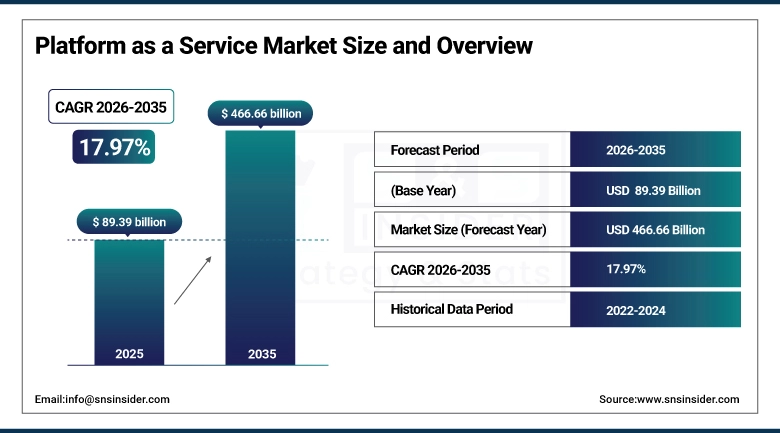
The Platform as a Service Market size was valued at USD 89.39 billion in 2025 and is expected to reach USD 466.66 billion by 2035, growing at a CAGR of 17.97% from 2026 to 2035.
The Platform as a Service (PaaS) Market is expanding rapidly due to increasing adoption of cloud computing and digital transformation across enterprises. Organizations are leveraging PaaS solutions to accelerate application development, reduce infrastructure costs, and enhance scalability. Growing demand for multi-cloud strategies, integration of AI and analytics, and the need for secure, collaborative development environments are further driving market growth. Additionally, rising focus on DevOps, mobile applications, and seamless deployment is fueling global PaaS adoption.
78% of enterprises adopted PaaS to accelerate cloud-native development cutting infrastructure costs by 35% and integrating AI, DevOps, and multi-cloud capabilities for faster, secure innovation.
Platform as a Service Market Size and Forecast
-
Market Size in 2025: USD 89.39 Billion
-
Market Size by 2035: USD 466.66 Billion
-
CAGR: 17.97% from 2026 to 2035
-
Base Year: 2025
-
Forecast Period: 2026–2035
-
Historical Data: 2022–2024
To Get more information on Platform as a Service Market - Request Free Sample Report
Platform as a Service Market Trends
-
Rising adoption of cloud-native application development platforms to accelerate digital transformation and agile software delivery
-
Growing integration of AI, analytics, and automation tools within PaaS environments to enhance developer productivity
-
Increasing demand for scalable multi-cloud and hybrid deployment capabilities across large enterprises and SMEs
-
Expansion of low-code and no-code platforms enabling faster application development by non-technical users
-
Rising focus on security, compliance, and governance features to support regulated industry application development
U.S. Platform as a Service Market Size Outlook:
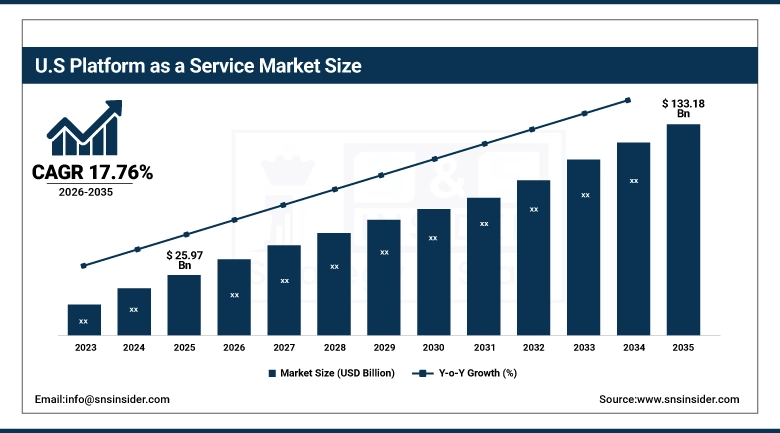
U.S. Platform as a Service Market was valued at USD 25.97 billion in 2025 and is expected to reach USD 133.18 billion by 2035, growing at a CAGR of 17.76% over the forecast period (2026-2035). The U.S. Platform as a Service (PaaS) Market is growing due to increasing cloud adoption, demand for faster application development, and cost-efficient infrastructure solutions. Enterprises are leveraging PaaS for scalable, secure, and collaborative environments, while integration of AI, analytics, and DevOps practices further drives market expansion.
Platform as a Service Market Growth Drivers:
-
Growing demand for rapid application development and deployment is driving adoption of PaaS solutions, enabling faster innovation and reduced development complexity across enterprises
Enterprises are increasingly seeking solutions that allow rapid development, testing, and deployment of applications without managing complex underlying infrastructure. PaaS platforms provide pre-configured environments, tools, and frameworks that simplify coding, integration, and deployment processes. This accelerates time-to-market for new applications, supports agile development practices, and reduces operational complexity for IT teams. Organizations adopting PaaS benefit from scalability, automated updates, and lower maintenance costs, enabling them to focus on core business innovation. The growing emphasis on digital transformation across industries is significantly driving global PaaS adoption.
76% of enterprises adopted PaaS to accelerate application delivery cutting development time by 40% and simplifying deployment through integrated, cloud-native tooling.
-
Rising adoption of cloud-native technologies, microservices, and DevOps practices is accelerating demand for scalable and flexible PaaS platforms globally
The increasing shift toward cloud-native applications and microservices architecture requires platforms that can efficiently manage distributed systems, continuous integration, and continuous delivery (CI/CD). DevOps practices further demand automation, monitoring, and collaboration tools that PaaS solutions readily provide. Enterprises benefit from elastic computing resources, container orchestration, and integrated development environments offered by PaaS, enabling seamless deployment of modern applications. The adoption of these practices across industries, from IT and banking to healthcare, is boosting demand for PaaS globally, as businesses look to improve agility, reduce deployment time, and enhance operational efficiency.
73% of enterprises embraced cloud-native development driving a 45% surge in PaaS adoption to support microservices, DevOps automation, and scalable application deployment worldwide.
Platform as a Service Market Restraints:
-
Concerns over data security, compliance requirements, and limited control over underlying infrastructure restrict PaaS adoption among highly regulated industries
Many organizations, particularly in finance, healthcare, and government sectors, are hesitant to adopt PaaS due to risks associated with storing sensitive data on third-party platforms. Compliance with regulations such as GDPR, HIPAA, and PCI DSS adds complexity and increases the need for robust security measures. Limited control over the underlying infrastructure makes enterprises dependent on service providers for data protection, monitoring, and maintenance. These security and compliance concern slow adoption, especially for mission-critical applications, and pose a significant challenge for PaaS vendors trying to penetrate highly regulated markets.
62% of highly regulated firms such as those in finance and healthcare hesitated to adopt PaaS due to data security risks, compliance burdens, and insufficient control over infrastructure.
-
Vendor lock-in risks and challenges in migrating applications between platforms limit flexibility and slow decision-making for enterprises considering PaaS solutions
PaaS platforms often use proprietary technologies, APIs, and frameworks, which can create dependency on a single vendor. Migrating applications or workloads to another platform may require significant effort, time, and cost, discouraging enterprises from switching providers. This lack of portability can limit flexibility, increase operational risks, and affect long-term strategic planning. Businesses are cautious about committing to a platform without assurances of interoperability or standardized solutions. Vendor lock-in concerns continue to restrain adoption, particularly among large enterprises with complex IT ecosystems requiring multi-cloud or hybrid-cloud strategies.
65% of enterprises delayed PaaS adoption due to vendor lock-in concerns and complex migration challenges, limiting agility and increasing long-term operational risks.
Platform as a Service Market Opportunities:
-
Integration of artificial intelligence, machine learning, and analytics into PaaS offerings creates opportunities for intelligent application development and enhanced business insights
PaaS providers are increasingly embedding AI and ML tools to help developers build smarter applications with predictive analytics, automation, and data-driven decision-making capabilities. These intelligent features enable enterprises to enhance operational efficiency, improve customer experiences, and gain deeper insights from application usage. AI-powered PaaS also supports advanced automation in testing, monitoring, and application scaling. The rising demand for intelligent applications across industries such as retail, healthcare, and finance presents significant growth opportunities for PaaS vendors. By offering AI/ML-enabled platforms, providers can differentiate their services and attract a broader enterprise clientele.
75% of PaaS providers embedded AI, ML, and analytics enabling developers to build intelligent apps 30% faster and unlocking real-time business insights across enterprise ecosystems.
- Expanding adoption of hybrid and multi-cloud strategies provides opportunities for PaaS vendors to offer interoperable, flexible platforms supporting diverse enterprise workloads
Organizations increasingly prefer hybrid and multi-cloud deployments to optimize costs, improve redundancy, and avoid reliance on a single provider. This trend creates opportunities for PaaS vendors to offer platforms that seamlessly integrate across private and public cloud environments. Flexible, interoperable PaaS solutions enable businesses to manage workloads efficiently, scale resources dynamically, and maintain application portability. Providers that support hybrid-cloud compatibility can attract large enterprises seeking agility, risk mitigation, and enhanced operational efficiency. The growth of multi-cloud adoption globally positions PaaS vendors to expand their market presence and cater to evolving enterprise requirements.
In 2025, 70% of enterprises adopted hybrid/multi-cloud architectures driving 40% growth in PaaS demand as vendors delivered interoperable platforms supporting diverse, scalable, and secure workloads across cloud environments.
Platform as a Service Market Segment Analysis
-
By Component: Application Development Platforms led with 39.6% share, while Business Analytics & Integration Tools are the fastest-growing segment with CAGR of 21.4%.
-
By Deployment Type: Public Cloud led with 48.9% share, while Multi-Cloud is the fastest-growing segment with CAGR of 22.1%.
-
By Application: Web Application Development led with 34.7% share, while AI & Machine Learning Workloads are the fastest-growing segment with CAGR of 24.3%.
-
By End-User Industry: IT & Telecom led with 31.8% share, while BFSI is the fastest-growing segment with CAGR of 20.6%.
By Deployment Type: Public Cloud led, while Multi-Cloud is the fastest-growing segment.
Public Cloud dominates PaaS deployment due to its cost efficiency, scalability, and ease of access for organizations of all sizes. Enterprises favor public cloud platforms for rapid provisioning, reduced infrastructure management, and pay-as-you-go pricing models. Strong vendor ecosystems, global data center availability, and built-in security features make public cloud PaaS highly attractive for application development and deployment. Its flexibility supports innovation, multi-user collaboration, and fast time-to-market, reinforcing its dominant role in the PaaS deployment landscape.
Multi-Cloud deployment is the fastest-growing segment as organizations seek greater flexibility, vendor independence, and risk mitigation. Enterprises adopt multi-cloud strategies to optimize performance, enhance resilience, and avoid vendor lock-in while complying with regulatory and data sovereignty requirements. Increasing complexity of enterprise workloads, combined with growing adoption of hybrid IT environments and cross-cloud orchestration tools, is driving strong growth. Multi-cloud PaaS enables businesses to strategically distribute workloads across providers, supporting scalability and innovation.
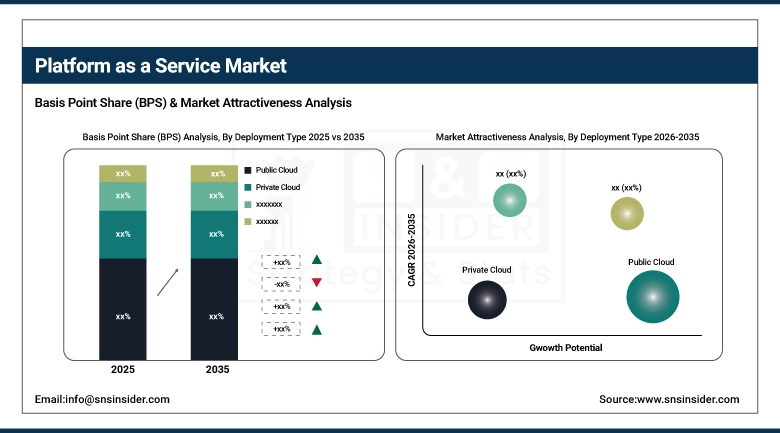
By Component: Application Development Platforms led, while Business Analytics & Integration Tools are the fastest-growing segment.
Application Development Platforms dominate the PaaS market as enterprises increasingly prioritize rapid application development, DevOps automation, and cloud-native architectures. These platforms offer integrated development environments, scalability, pre-built frameworks, and seamless CI/CD pipelines, enabling faster deployment of web and mobile applications. Their extensive adoption across IT, telecom, BFSI, and retail sectors strengthens their leadership. Strong ecosystem support, vendor innovation, and compatibility with microservices and containerization technologies further reinforce their dominant position within the PaaS component landscape.
Business Analytics & Integration Tools are the fastest-growing component due to the rising demand for real-time data insights, API-based connectivity, and seamless integration across cloud and on-premise systems. Enterprises are increasingly leveraging these tools to unify data streams, enable predictive analytics, and support digital transformation initiatives. The rapid expansion of AI-driven analytics, IoT data processing, and cross-platform integration requirements is significantly accelerating adoption, particularly among data-intensive industries such as BFSI, manufacturing, and retail.
By Application: Web Application Development led, while AI & Machine Learning Workloads are the fastest-growing segment.
Web Application Development leads the application segment as enterprises increasingly migrate legacy systems to cloud-native, browser-based platforms. PaaS solutions enable faster development cycles, scalable hosting, and seamless updates, making them ideal for customer-facing and internal web applications. Strong demand from e-commerce, digital banking, SaaS providers, and enterprise portals reinforces dominance. The continuous need for secure, responsive, and globally accessible web applications ensures sustained adoption and leadership of this segment within the PaaS market.
AI & Machine Learning Workloads are the fastest-growing application segment due to increasing enterprise focus on automation, predictive analytics, and intelligent decision-making. PaaS platforms provide ready-to-use ML frameworks, data processing tools, and scalable computing resources, lowering entry barriers for AI adoption. Rising demand for personalized services, fraud detection, demand forecasting, and intelligent automation across industries is fueling rapid growth. Continuous advancements in cloud-based AI capabilities further accelerate expansion in this segment.
By End-User Industry: IT & Telecom led, while BFSI is the fastest-growing segment.
IT & Telecom dominates the PaaS market due to heavy reliance on scalable platforms for application modernization, network management, and digital service delivery. These industries leverage PaaS to accelerate software development, manage large-scale data processing, and support continuous innovation. High cloud maturity, early adoption of DevOps practices, and strong demand for agile infrastructure drive leadership. Ongoing investments in 5G, cloud-native networks, and digital transformation initiatives further strengthen dominance of IT & Telecom in the PaaS ecosystem.
BFSI is the fastest-growing end-user segment as financial institutions increasingly adopt PaaS for digital banking, fintech integration, and real-time analytics. The need for secure, compliant, and scalable platforms to support mobile banking, payment systems, and AI-driven risk management is accelerating adoption. Regulatory compliance requirements, rising customer expectations for seamless digital services, and rapid fintech innovation are driving growth. PaaS enables BFSI organizations to modernize legacy systems while maintaining operational resilience and data security.
Platform as a Service Market Regional Analysis
North America Platform as a Service Market Insights:
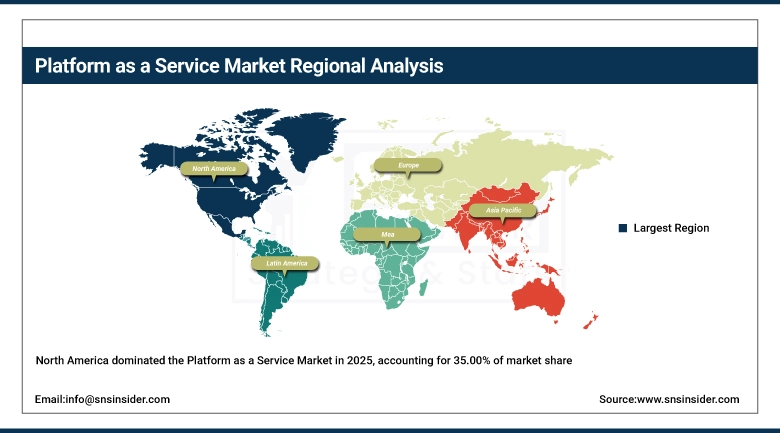
North America dominated the Platform as a Service Market with a 35.00% share in 2025 due to its advanced cloud infrastructure, high adoption of enterprise digital transformation initiatives, and strong presence of leading PaaS providers. Widespread use of AI, analytics, and scalable cloud applications further reinforced the region’s market leadership.
Get Customized Report as per Your Business Requirement - Enquiry Now
Asia Pacific Platform as a Service Market Insights
Asia Pacific is expected to grow at the fastest CAGR of about 18.50% from 2026–2035, driven by rapid digitalization, increasing adoption of cloud-based solutions among SMEs, and expanding IT infrastructure. Growing government support for cloud initiatives, rising demand for scalable and cost-efficient platforms, and the surge in IoT and AI applications accelerate market growth across the region.
Europe Platform as a Service Market Insights
Europe held a significant share in the Platform as a Service Market in 2025, supported by advanced cloud adoption, strong IT infrastructure, and the presence of major PaaS providers. High enterprise demand for digital transformation, robust data security regulations, and increasing adoption of AI and analytics-driven applications further strengthened Europe’s market position.
Middle East & Africa and Latin America Platform as a Service Market Insights
The Middle East & Africa and Latin America together showed steady growth in the Platform as a Service Market in 2025, driven by expanding IT infrastructure, increasing cloud adoption among SMEs, and rising demand for scalable, cost-efficient platforms. Government initiatives supporting digital transformation, growing investments in technology, and increasing awareness of cloud-based solutions further accelerated regional market growth.
Platform as a Service Market Competitive Landscape:
Amazon Web Services (AWS)
Amazon Web Services (AWS) is the leading global cloud platform, offering a comprehensive suite of infrastructure, platform, and software services, including Platform as a Service (PaaS). AWS PaaS solutions enable developers to build, deploy, and manage applications efficiently without worrying about underlying infrastructure. Known for scalability, reliability, and security, AWS supports multiple programming languages, databases, and development frameworks. Its global presence, extensive ecosystem, and continuous innovation make it a preferred choice for enterprises, startups, and developers worldwide.
-
July 2024, AWS launched AWS App Studio, a low-code PaaS that enables developers and business analysts to build full-stack applications using natural language.
Microsoft Corporation
Microsoft Corporation, through its Azure platform, provides robust PaaS offerings that allow organizations to develop, deploy, and manage applications with ease. Azure PaaS supports a variety of programming languages, frameworks, and tools while offering integrated DevOps, AI, and analytics services. Microsoft emphasizes security, scalability, and hybrid cloud capabilities, enabling businesses to innovate rapidly. Its strong enterprise relationships, global data centers, and comprehensive developer support have positioned Microsoft Azure as a leading platform in the global PaaS market.
-
January 2025, Microsoft enhanced its Azure PaaS offerings (including Azure App Service, Functions, and Container Apps) with Copilot for Developers, an AI pair programmer embedded directly into the Azure portal and Visual Studio.
Google LLC
Google LLC, via Google Cloud Platform (GCP), offers a wide range of PaaS services that simplify application development, deployment, and management. GCP PaaS solutions include App Engine, Cloud Functions, and Cloud Run, enabling developers to focus on coding rather than infrastructure. Google emphasizes scalability, high performance, and integration with AI and machine learning tools. Its global network, strong security measures, and commitment to open-source technologies have made Google Cloud a preferred choice for startups, enterprises, and developers seeking flexible and efficient PaaS solutions.
-
October 2023, Google rebranded and expanded AppSheet as the Google Cloud AppSheet Platform, integrating deeply with Vertex AI to enable AI-augmented no-code/low-code applications.
Platform as a Service Companies are:
-
Amazon Web Services
-
Google LLC
-
IBM Corporation
-
Oracle Corporation
-
Salesforce
-
SAP SE
-
Red Hat Inc.
-
VMware Inc.
-
Alibaba Cloud
-
Huawei Cloud
-
Tencent Cloud
-
VMware Tanzu
-
Pivotal Software
-
Mendix
-
DigitalOcean
-
Heroku
-
ServiceNow
-
Zoho Corporation
| Report Attributes | Details |
|---|---|
| Market Size in 2025 | USD 89.39 Billion |
| Market Size by 2035 | USD 466.66 Billion |
| CAGR | CAGR of 17.97% From 2026 to 2035 |
| Base Year | 2025 |
| Forecast Period | 2026-2035 |
| Historical Data | 2022-2024 |
| Report Scope & Coverage | Market Size, Segments Analysis, Competitive Landscape, Regional Analysis, DROC & SWOT Analysis, Forecast Outlook |
| Key Segments | • By Component (Application Development Platforms, Application Testing & Deployment Tools, Middleware, Database Management Systems, Business Analytics & Integration Tools) • By Deployment Type (Public Cloud, Private Cloud, Hybrid Cloud, Multi-Cloud) • By Application (Web Application Development, Mobile Application Development, Business Intelligence & Analytics, IoT Application Development, AI & Machine Learning Workloads) • By End-User Industry (BFSI, IT & Telecom, Healthcare, Retail & E-commerce, Manufacturing, Government & Public Sector) |
| Regional Analysis/Coverage | North America (US, Canada), Europe (Germany, UK, France, Italy, Spain, Russia, Poland, Rest of Europe), Asia Pacific (China, India, Japan, South Korea, Australia, ASEAN Countries, Rest of Asia Pacific), Middle East & Africa (UAE, Saudi Arabia, Qatar, South Africa, Rest of Middle East & Africa), Latin America (Brazil, Argentina, Mexico, Colombia, Rest of Latin America). |
| Company Profiles | Amazon Web Services, Microsoft Corporation, Google LLC, IBM Corporation, Oracle Corporation, Salesforce, SAP SE, Red Hat Inc., VMware Inc., Alibaba Cloud, Huawei Cloud, Tencent Cloud, VMware Tanzu, Pivotal Software, Mendix, OutSystems, DigitalOcean, Heroku, ServiceNow, Zoho Corporation. |
Frequently Asked Questions
The Platform as a Service Market is expected to grow at a CAGR of 17.97% from 2026 to 2033, driven by cloud adoption and digital transformation.
In 2025, the Platform as a Service Market is valued at USD 89.39 billion, supported by rising enterprise adoption of cloud-native development and scalable application platforms.
Key growth drivers include rapid application development needs, cloud-native adoption, DevOps integration, AI and analytics deployment, and demand for multi-cloud, scalable environments.
Application Development Platforms, Public Cloud deployment, Web Application Development application, and IT & Telecom end users dominated the Platform as a Service Market.
North America dominated in 2025 with a 35.00% share, due to advanced cloud infrastructure, strong enterprise digital initiatives, and high adoption of scalable PaaS solutions.
