
Polytetramethylene Ether Glycol Market Report Scope & Overview:
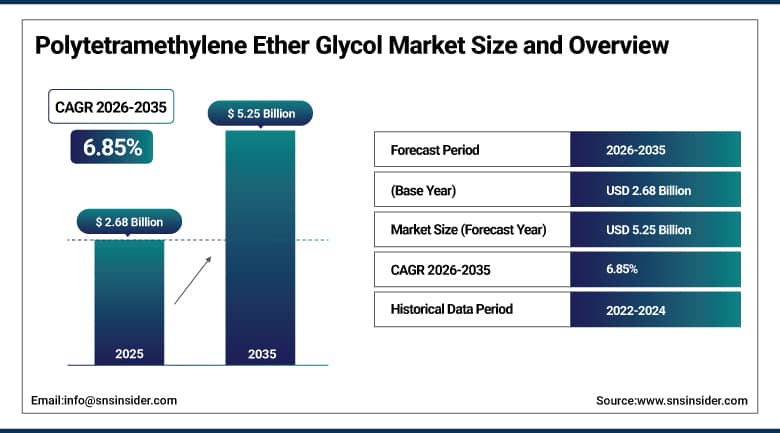
The Polytetramethylene Ether Glycol Market was valued at USD 2.68 Billion in 2025 and is expected to reach USD 5.25 Billion by 2035, growing at a CAGR of 6.85% from 2026 to 2035.
The Polytetramethylene Ether Glycol (PTMEG) Market is experiencing strong growth owing to rising worldwide spandex fibers requirement in athleisure and activewear garments, increased light weighting efforts in the automotive sector using thermoplastic polyurethane elastomers, and ongoing developments in technical textiles that require advanced polymers soft-segment materials. Polytetramethylene ether glycol, obtained from the catalytic polymerization of tetrahydrofuran, is an important ingredient in the production of spandex fibers, polyurethane elastomers, and copolyester ether elastomers due to its good elasticity, flexibility at low temperatures, and hydrolysis resistance. With continuing expansion of global apparel manufacturers’ stretch fabric and sports clothing range, and more use of thermoplastic polyurethane in vehicles for lightening and strength enhancement, the demand for PTMEG of different molecular weights is on the rise.
⮞In 2025, Hyosung Corporation launched a new bio-based PTMEG grade derived from renewable feedstocks, targeting sustainability-focused spandex fiber manufacturers seeking lower-carbon soft-segment polymer inputs.
To Get More Information On Polytetramethylene Ether Glycol Market - Request Free Sample Report
Polytetramethylene Ether Glycol Market Trends
-
Rising bio-based PTMEG development is supporting sustainable alternatives amid growing environmental regulation across the polyurethane value chain.
-
Growing spandex demand in athleisure and activewear is driving consistent PTMEG consumption across global textile manufacturing hubs.
-
Expanding automotive lightweighting initiatives are accelerating thermoplastic polyurethane elastomer adoption using PTMEG as a key soft-segment component.
-
Increasing backward integration by manufacturers into THF production is strengthening PTMEG supply chain resilience.
-
Strategic capacity expansions across Asia-Pacific are reinforcing the region's position as the leading PTMEG production and consumption hub.
U.S. Polytetramethylene Ether Glycol Market Outlook
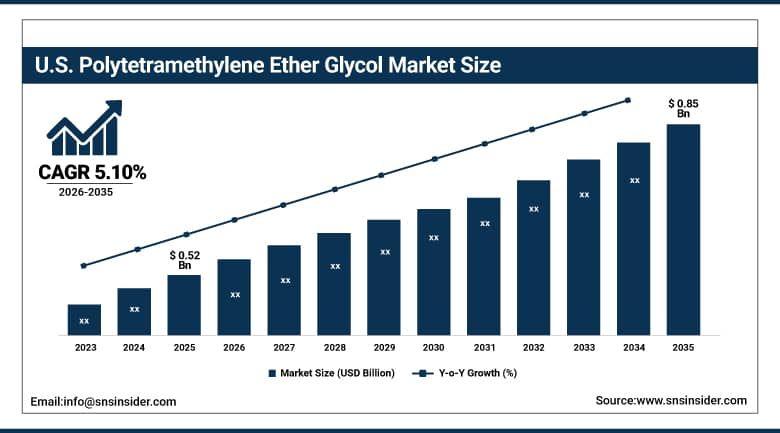
The U.S. Polytetramethylene Ether Glycol Market was valued at USD 0.52 Billion in 2025 and is projected to reach USD 0.85 Billion by 2035, growing at a CAGR of 5.10% during 2026–2035.
The U.S. still remains a major consumer of PTMEG globally owing to the existing domestic presence of TPU and specialty elastomers manufacturing facilities and strong demand from the domestic automotive sector for polymer parts that are light weight yet strong. The domestic players still remain interested in using PTMEG for producing high-end spandex fibers, industrial elastomers and specialty coatings and adhesives that require soft segment polymers for their manufacturing, while the rising efforts for automobile lightweighting ensure that there is sustained demand for TPU elastomers. Domestic interest in producing bio-based specialty chemicals together with the investments by manufacturers in ensuring a reliable supply chain in view of availability of tetrahydrofuran remains important for the PTMEG value chain in the country.
⮞In 2026, Mitsubishi Chemical Corporation introduced an upgraded high molecular weight PTMEG 2000 grade designed to improve elasticity performance in premium spandex fiber applications for North American textile manufacturers.
Polytetramethylene Ether Glycol Market Segment Analysis
-
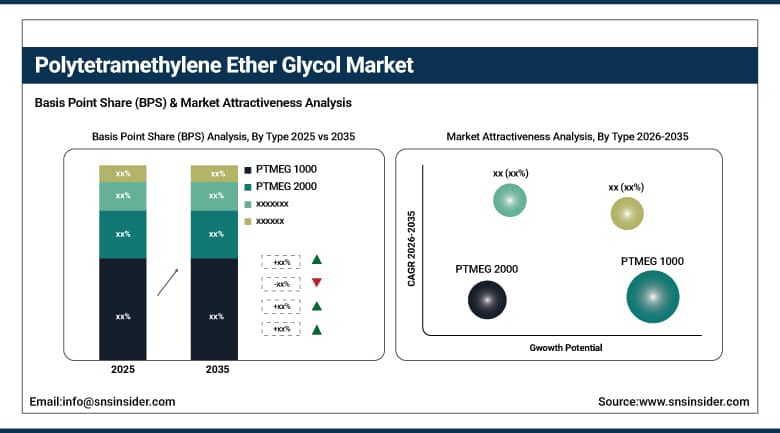
By Type, PTMEG 1000 dominated the Polytetramethylene Ether Glycol Market with a 27.40% share in 2025, while PTMEG 2000 is the fastest-growing type segment with a CAGR of 7.60% from 2026–2035.
-
By Source, THF-Based dominated the Polytetramethylene Ether Glycol Market with a 88.40% share in 2025, while Bio-Based is the fastest-growing source segment with a CAGR of 10.60% from 2026–2035.
-
By Application, Spandex/Polyurethane Fibers dominated the Polytetramethylene Ether Glycol Market with a 58.30% share in 2025, while Thermoplastic Polyurethane Elastomers is the fastest-growing application segment with a CAGR of 7.90% from 2026–2035.
-
By End-Use Industry, Textiles dominated the Polytetramethylene Ether Glycol Market with a 49.20% share in 2025, while Automotive is the fastest-growing end-use industry segment with a CAGR of 7.70% from 2026–2035.
By Type, PTMEG 1000 led while PTMEG 2000 is the fastest-growing segment.
The PTMEG 1000 segment was the leading contributor in the Polytetramethylene Ether Glycol Market in 2025. This superiority arises from the molecular weight properties that offer a perfect balance, hence giving good processability and mechanical performance, and is thus ideal for production of thermoplastic polyurethanes in the manufacture of footwear, industrial belts, and coated fabrics that need a middle range of flexibility and rigidity. This versatility and economical nature for intermediate performance needs have made PTMEG 1000 maintain its supremacy in the production of TPU worldwide.
The PTMEG 2000 segment is expected to witness the highest CAGR during the forecast period 2026-2035. The increasing demand for the use of higher molecular weight PTMEG in advanced spandex fibers that require excellent elasticity and recovery properties, especially in the athleisure and compression apparel industry segments, is aiding in the growth of the segment at an enhanced pace. The growing innovations being witnessed in the processing of PTMEG 2000 for elastomers have further boosted its growth rate.
⮞In February 2025, Sinopec Great Wall Energy Chemical (Ningxia) disclosed plans for a 60,000-ton-per-year PTMEG project in Ningdong, China, including a tetrahydrofuran production unit, supporting additional domestic capacity for PTMEG grades used in polyurethane elastomers and spandex production.
By Source, THF-Based led while Bio-Based is the fastest-growing segment.
The THF-Based category held a major market share of the Polytetramethylene Ether Glycol Market in 2025. conventional PTMEG which results from the catalytic polymerization of tetrahydrofuran obtained from petroleum sources is the leading category of PTMEG because of its economic viability, reliable manufacture process, and quality product which ensures that spandex, TPU, and elastomer companies can reliably manufacture their products using PTMEG.
The Bio-Based segment is anticipated to grow at the fastest rate during the forecast period 2026-2035. Growing brand owner and consumer emphasis on sustainable, renewably sourced textile and elastomer inputs is driving accelerated adoption of bio-based PTMEG derived from renewable feedstocks, particularly across premium spandex and specialty elastomer applications where fashion and apparel brands increasingly seek to reduce the carbon footprint of their supply chains, supporting above-average growth for this segment as production technology continues maturing toward broader commercial scalability.
⮞In April 2026, Covation Biomaterials announced mechanical completion of its first commercial C4-platform plant for bio-based tetrahydrofuran and PTMEG, while introducing its Xatryx® brand for non-food bio-based PTMEG products, marking a commercial-scale milestone for renewable polymer feedstocks.
By Application, Spandex/Polyurethane Fibers led while Thermoplastic Polyurethane Elastomers is the fastest-growing segment.
The Spandex/Polyurethane Fibers segment dominated the Polytetramethylene Ether Glycol Market in 2025. Spandex fiber production remains the dominant application category as PTMEG serves as the essential soft-segment polymer component providing the exceptional elasticity and recovery properties fundamental to stretch fabric performance, driving consistent, high-volume consumption across the global textile industry's expanding athleisure, activewear and intimate apparel product categories worldwide.
The Thermoplastic Polyurethane Elastomers segment is expected to register the fastest CAGR during the forecast period 2026-2035. Growing incorporation of thermoplastic polyurethane in the automobile industry due to benefits such as reduced weight, strength, and increased design capabilities compared to other materials, along with increasing uses of TPU in other industries including cable jacketing, hose manufacturing, and shoe manufacture, is pushing the demand for PTMEG as an elastomer soft segment raw material upward.
⮞In November 2025, The LYCRA Company opened its largest global spandex production facility in Yinchuan, China, with an initial capacity of 30,000 metric tons annually and investment exceeding RMB 800 million, expanding manufacturing capacity for stretch fibers used in apparel and performance textiles.
By End-Use Industry, Textiles led while Automotive is the fastest-growing segment.
The Textiles segment dominated the Polytetramethylene Ether Glycol Market in 2025. Fiber is still the dominant application of PTMEG because most of the world’s output is used to make spandex fiber used to produce stretch fabrics for the fashion industry. This makes fiber the primary application for PTMEG as most of the world’s consumption of PTMEG goes into this application.
The Automotive segment is expected to witness the fastest CAGR during the forecast period 2026-2035. Rising global vehicle production combined with growing automotive industry adoption of thermoplastic polyurethane elastomer components for lightweighting, durability, and design flexibility advantages is driving accelerated PTMEG demand from automotive applications, as manufacturers increasingly specify TPU-based components across interior trim, seals, and functional automotive parts.
⮞In November 2025, Hyundai Transys and BASF unveiled a modular concept seat for purpose-built vehicles using Elastollan® thermoplastic polyurethane processed with supercritical-fluid injection foaming technology, demonstrating lightweight, recyclable material solutions for automotive interior components.
Regional Insights
|
Region |
Major Country |
Share within Region, 2025 (%) |
|---|---|---|
|
North America |
United States |
81.90% |
|
Europe |
Germany |
26.40% |
|
Asia Pacific |
China |
52.80% |
|
Middle East & Africa |
UAE |
24.60% |
|
Latin America |
Brazil |
31.80% |
Asia Pacific Polytetramethylene Ether Glycol Market Insights
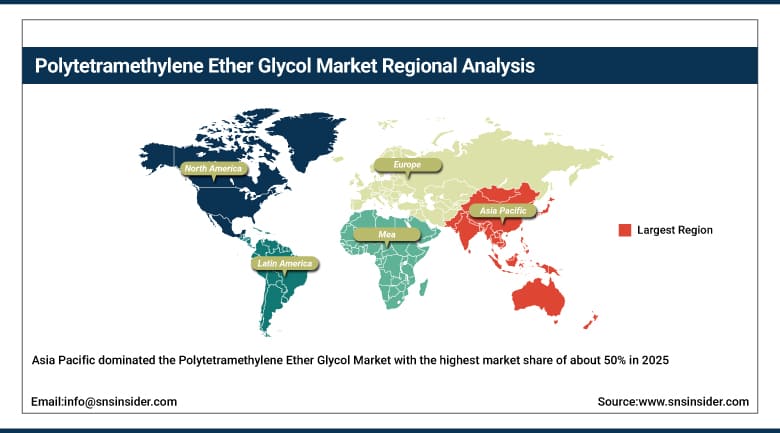
Asia Pacific dominated the Polytetramethylene Ether Glycol Market with the highest market share of about 50% in 2025, owing to the region's massive spandex fiber and textile manufacturing base, substantial PTMEG production capacity concentrated across China, Taiwan, and South Korea, and expanding automotive and industrial elastomer manufacturing activity. The region's cost-competitive chemical manufacturing infrastructure and dense concentration of downstream textile and TPU manufacturers continues to reinforce Asia Pacific's position as both the largest and fastest-growing PTMEG market globally, registering a CAGR of 8.20% during the forecast period 2026-2035.
China was the leading country within the Asia Pacific Polytetramethylene Ether Glycol Market in 2025 of the regional market, driven by its massive spandex fiber production capacity and extensive downstream textile manufacturing base. Taiwan and South Korea are contributing significantly to regional growth through their established PTMEG production infrastructure and strong presence of leading global manufacturers supplying both domestic and export markets.
⮞In November 2025, BASF began producing its first products at its Zhanjiang Verbund site in southern China, an integrated chemical manufacturing complex supplied with renewable electricity, strengthening the region's advanced chemical production infrastructure and supporting the broader transition toward lower-carbon materials.
Get Customized Report as Per Your Business Requirement - Enquiry Now
North America Polytetramethylene Ether Glycol Market Insights
The North America Polytetramethylene Ether Glycol Market was a significant contributor to the global market in 2025, Benefited from the presence of existing manufacturing facilities for thermoplastic polyurethane and specialty elastomers in the region, along with increasing demand from the automobile sector for lightweight and durable polymer products. The focus of the region towards high-performance specialty grade PTMEG and increasing preference for bio-based products will help in growing the market in future years.
The US was the leading country within the North America Polytetramethylene Ether Glycol Market in 2025, driven by its extensive thermoplastic polyurethane and automotive elastomer manufacturing infrastructure. Canada is assisting in regional development through its increasing specialty chemicals distribution industry and increasing industrial elastomers production industry.
⮞In March 2025, Qore announced a partnership with The LYCRA Company to use QIRA®, a bio-based alternative to fossil-derived butanediol, in LYCRA® fiber production, advancing renewable feedstock adoption in the U.S.-linked spandex value chain.
Europe Polytetramethylene Ether Glycol Market Insights
The Europe region was a meaningful contributor to the Polytetramethylene Ether Glycol Market in 2025, anchored by the region's substantial automotive manufacturing base and established specialty chemical production infrastructure. The region's stringent REACH regulatory framework governing chemical environmental compliance continues to shape product formulation priorities across European PTMEG manufacturers and downstream elastomer and textile industry customers.
Germany is considered one of the significant consumers of Europe due to the existence of extensive automobile and specialty chemicals production in the region with notable production from the top PTMEG manufacturers in the market which necessitates reliable supply of feedstocks. There are also other countries like France and Italy which have their own textile and elastomers industries consuming specialty polymers.
⮞In September 2025, BASF Performance Materials reported that all ten of its European production sites had achieved REDcert² certification, enabling engineering plastics, polyurethanes, thermoplastic polyurethanes, and specialty polymers to be offered as certified mass-balance solutions incorporating renewable or recycled feedstocks.
Middle East & Africa and Latin America Polytetramethylene Ether Glycol Market Insights
Middle East & Africa and Latin American regions are gradually expanding PTMEG consumption as domestic textile and automotive manufacturing capacity grows, supported by increasing specialty chemical distribution infrastructure investment and rising demand for performance textiles and automotive components across the regions' major economies.
Brazil is set to be a prominent Latin American market fueled by its substantial domestic textile manufacturing base and growing automotive industry requiring consistent elastomer and polymer intermediate supply. The Middle East & Africa region has the UAE investing in specialty chemical distribution and textile manufacturing infrastructure, gradually increasing regional market activity as the country strengthens its position as a regional manufacturing hub.
⮞In May 2025, ADNOC announced that suppliers had committed AED 3 billion (approximately USD 817 million) to manufacturing facilities across the UAE, covering industrial products and engineering services, reinforcing the country's industrial localization strategy and expansion of domestic manufacturing capabilities.
⮞In April 2025, Nissan began production of the new Kicks at its Resende facility in Brazil as part of a BRL 2.8 billion investment plan, advancing domestic vehicle manufacturing and supporting demand for automotive components and performance polymers.
Market Dynamics
Growth Drivers: Expanding spandex and automotive elastomer applications driving market growth
The constant growth in spandex fibers demand worldwide in athleisure, activewear, and performance apparel segments, together with the increasing utilization of thermoplastic polyurethane elastomers in the automotive industry, is one of the major factors that contribute to the development of the Polytetramethylene Ether Glycol Market. The remarkable elasticity, flexibility at low temperatures, and resistance to hydrolysis of PTMEG continue to support the significance of this material as an important constituent in spandex fibers, TPU, and copolyester ether elastomers production.
Increasing efforts towards automobile lightweighting through the use of thermoplastic polyurethane that can be used to reduce weight and increase durability in automobiles will keep on increasing the demand for PTMEG. The increased backward integration of manufacturers to secure their supply of tetrahydrofuran along with innovations in textile technology and the development of biodegradable PTMEG will continue to drive the demand for PTMEG.
⮞In June 2025, Huntsman introduced its POLYRESYST® EV5005 intumescent polyurethane coating system for electric-vehicle applications, designed to provide passive fire protection for metal and composite substrates, illustrating continued polyurethane technology development for automotive safety and component performance.
Restraints: Raw material price volatility and THF supply constraints limiting market expansion
One of the most critical obstacles to market growth is the volatility in tetrahydrofuran and butanediol feedstock pricing, which directly impacts PTMEG production economics and creates margin pressure for manufacturers operating under long-term supply contracts with spandex and elastomer manufacturers requiring stable, predictable pricing.
Moreover, limited global tetrahydrofuran production capacity concentrated among a relatively small number of petrochemical producers creates potential supply chain constraints that can affect PTMEG availability and pricing during periods of tight feedstock supply. Besides, stringent environmental compliance requirements governing chemical manufacturing processes, particularly under REACH in Europe, require ongoing investment in production infrastructure and regulatory affairs capability that raises operational costs, particularly for smaller specialty chemical manufacturers with limited compliance resources.
Opportunities: Bio-based production advancement and emerging application expansion creating new growth avenues
The growing shift toward bio-based PTMEG production derived from renewable feedstocks, combined with expanding automotive and technical textile applications, presents substantial growth opportunities across the Polytetramethylene Ether Glycol Market. Spandex manufacturers and apparel brands seeking to reduce the environmental footprint of their supply chains are increasingly favoring sustainably sourced alternatives, creating opportunity for producers investing early in bio-based production technology.
There is considerable potential for growth in emerging medical device and specialty elastomer applications as PTMEG's biocompatibility and performance characteristics find expanding use in medical tubing and specialty coating applications. The expansion of automotive and textile manufacturing infrastructure across Southeast Asia and Latin America, coupled with continued backward integration investment securing feedstock supply chains, will continue to drive incremental demand for PTMEG across the forecast period.
⮞In June 2025, BASF introduced its reduced-product-carbon-footprint portfolio for engineering plastics and thermoplastic polyurethanes, using renewable electricity and lower-emission steam to reduce manufacturing-related carbon footprints, creating additional opportunities for downstream manufacturers seeking lower-carbon polymer materials.
Recent Developments
-
2025: BASF expanded its PTMEG production capacity at its Ludwigshafen facility to meet rising spandex and TPU demand across European and export markets.
-
2026: Dairen Chemical Corporation expanded its PTMEG production capacity in Taiwan to strengthen supply to regional TPU and elastomer manufacturers.
Polytetramethylene Ether Glycol Key Players are:
-
BASF SE
-
Dairen Chemical Corporation
-
Mitsubishi Chemical Corporation
-
LyondellBasell Industries N.V. (Lyondell Chemical)
-
Gantrade Corporation
-
Hyosung Corporation
-
Sinopec Great Wall Energy Chemical (Ningxia) Co., Ltd.
-
Korea PTG Co., Ltd. (Yongsan Chemicals)
-
Chang Chun Group
-
The LYCRA Company
-
Sichuan Tianhua Fubang Chemical Co., Ltd.
-
Hangzhou Sanlong New Materials Co., Ltd.
-
Markor Meiou Chemical Co., Ltd.
-
Zhejiang Huafeng Spandex Co., Ltd.
-
Shandong Haili Chemical Industry Co., Ltd.
-
Tongkun Group Co., Ltd.
-
Formosa Plastics Corporation
-
Kolon Industries, Inc.
Polytetramethylene Ether Glycol Market Report Scope:
| Report Attributes | Details |
|---|---|
| Market Size in 2025 | USD 2.68 Billion |
| Market Size by 2035 | USD 5.25 Billion |
| CAGR | CAGR of 6.85% From 2026 to 2035 |
| Base Year | 2025 |
| Forecast Period | 2026-2035 |
| Historical Data | 2022-2024 |
| Report Scope & Coverage | Market Size, Segments Analysis, Competitive Landscape, Regional Analysis, DROC & SWOT Analysis, Forecast Outlook |
| Key Segments | • By Type (PTMEG 1000, PTMEG 2000, PTMEG 650, PTMEG 250 & Others) • By Source (THF-Based, Bio-Based) • By Application (Spandex/Polyurethane Fibers, Thermoplastic Polyurethane Elastomers, Copolyester Ether Elastomers & Others) • By End-Use Industry (Textiles, Automotive, Coatings & Adhesives, Construction & Others) |
| Regional Analysis/Coverage | North America (US, Canada), Europe (Germany, UK, France, Italy, Spain, Russia, Poland, Rest of Europe), Asia Pacific (China, India, Japan, South Korea, Australia, ASEAN Countries, Rest of Asia Pacific), Middle East & Africa (UAE, Saudi Arabia, Qatar, South Africa, Rest of Middle East & Africa), Latin America (Brazil, Argentina, Mexico, Colombia, Rest of Latin America). |
| Company Profiles | BASF SE, Dairen Chemical Corporation, Mitsubishi Chemical Corporation, LyondellBasell Industries N.V. (Lyondell Chemical), Gantrade Corporation, INVISTA, Hyosung Corporation, Sinopec Great Wall Energy Chemical (Ningxia) Co., Ltd., Korea PTG Co., Ltd. (Yongsan Chemicals), Chang Chun Group, The LYCRA Company, Sichuan Tianhua Fubang Chemical Co., Ltd., Hangzhou Sanlong New Materials Co., Ltd., Markor Meiou Chemical Co., Ltd., Nan Ya Plastics Corporation, Zhejiang Huafeng Spandex Co., Ltd., Shandong Haili Chemical Industry Co., Ltd., Tongkun Group Co., Ltd., Formosa Plastics Corporation, Kolon Industries, Inc. |

Frequently Asked Questions
The market is driven by expanding global spandex fiber demand across athleisure and activewear, growing automotive lightweighting initiatives, and continued technical textile innovation.
The Spandex/Polyurethane Fibers segment dominated the Polytetramethylene Ether Glycol Market in 2025, accounting for approximately 58.30% market share.
The Asia Pacific region dominated the Polytetramethylene Ether Glycol Market in 2025 with a 58.60% market share, driven by its massive spandex fiber and textile manufacturing base.
Key opportunities include spandex production, high-performance polyurethanes, thermoplastic elastomers, specialty coatings, and advanced fiber applications.
