
Potato & Yam Derivatives Market Report Scope & Overview:
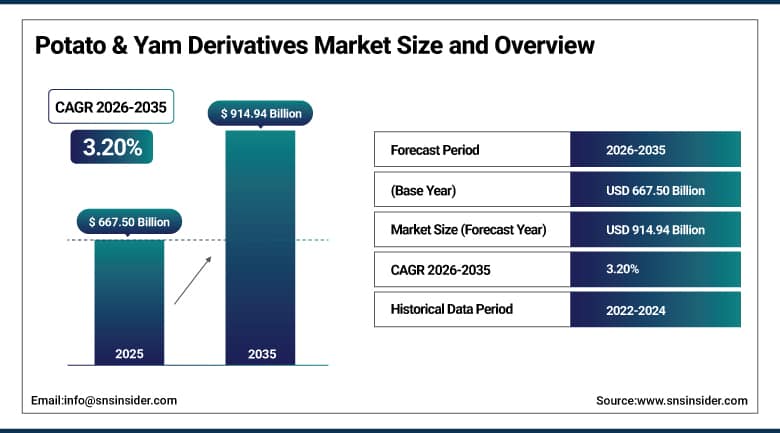
The Potato & Yam Derivatives Market was valued at USD 667.50 Billion in 2025 and is expected to reach USD 914.94 Billion by 2035, growing at a CAGR of 3.20% from 2026-2035.
The Potato & Yam Derivatives Market covers processing raw potatoes, sweet potatoes and yams into starch, protein isolates, flour, tapioca-style products, feed and fermentation feedstock supplied to food manufacturers, brewers and distillers, feed compounders, and industrial starch buyers. Processors convert seasonally harvested tuber crops into storable, shelf-stable ingredients that buyers can procure year round without carrying raw-crop risk themselves. Starch leads output because it feeds the broadest base of buyers, while protein isolation is scaling fastest as formulators seek functional, allergen-light ingredients. Europe processes the largest volume given its concentrated starch-industry base, while Asia Pacific expands output quickest as regional food manufacturing grows.
⮞In July 2026, industry data placed the global potato starch market at approximately USD 7.31 billion, forecast to reach USD 9.03 billion by 2030, as processors including Royal Avebe, Emsland Group, KMC and AGRANA extend supply into paper, textile, pharmaceutical and biodegradable-packaging applications beyond food use. Demand of that breadth across non-food industrial channels shows potato-derived ingredients increasingly competing well outside their traditional processing-region food base.
To Get More Information On Potato & Yam Derivatives Market - Request Free Sample Report
Potato & Yam Derivatives Market Trends:
-
Processors are signing multi-year tuber procurement contracts with growers to stabilize input costs against weather-driven yield swings.
-
Potato protein isolates are being positioned as allergen-light, non-soy alternatives in plant-based formulation, drawing new buyers beyond legacy starch customers.
-
Fermented beverage makers are sourcing potato-derived alcohol feedstock as a traceable, regionally grown alternative to grain spirits.
-
B2C retail packaging of starch and flour derivatives is expanding as home baking and gluten-free formulation sustain steady household demand.
-
Processors are investing in new extraction capacity closer to growing regions to cut transport cost and reduce raw-crop spoilage losses.
U.S. Potato & Yam Derivatives Market Outlook:
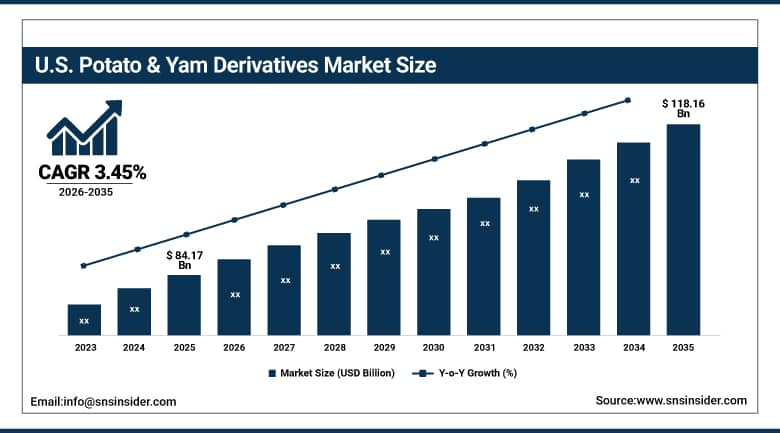
The U.S. Potato & Yam Derivatives Market was valued at USD 84.17 Billion in 2025 and is expected to reach USD 118.16 Billion by 2035, growing at a CAGR of 3.45% from 2026-2035.
The U.S. market is anchored by large-scale frozen and dehydrated potato processors that also run dedicated starch and flake extraction lines alongside their finished-product plants. Idaho, Washington and Maine supply most of the processing-grade crop, giving buyers predictable sourcing within a few growing regions rather than scattered import dependence. Consolidation among processors has concentrated purchasing power, letting larger buyers negotiate multi-year grower contracts that smaller ingredient houses cannot match. Tariff-driven cost pressure on imported fertilizer and equipment is pushing some processors to renegotiate supply terms earlier in the season. Export demand into Latin America and Asia adds a second revenue channel beyond local manufacturing, supporting added capacity through 2035.
⮞In November 2025, McCain Foods announced an agreement to acquire Penobscot McCrum, a frozen potato processor operating a plant in Washburn, Maine, adding processing capacity alongside its existing Easton, Maine facility and bringing roughly 130 employees into the business.
Potato & Yam Derivatives Market Segment Analysis:
-
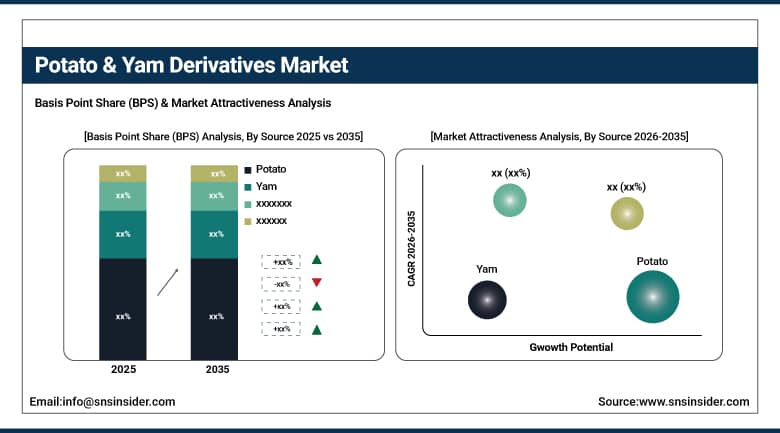
By Source, the Potato segment dominated the Potato & Yam Derivatives Market with approximately 53.50% share in 2025, while the Yam segment is the fastest growing with a CAGR of approximately 4.30%.
-
By Derivative Type, the Starch segment dominated the Potato & Yam Derivatives Market with approximately 34.00% share in 2025, while the Protein segment is the fastest growing with a CAGR of approximately 4.00%.
-
By Application, the Food segment dominated the Potato & Yam Derivatives Market with approximately 49.60% share in 2025, while the Fermented Beverages segment is the fastest growing with a CAGR of approximately 4.60%.
-
By Distribution Channel, the B2B segment dominated the Potato & Yam Derivatives Market with approximately 61.00% share in 2025, while the B2C segment is the fastest growing with a CAGR of approximately 3.60%.
By Source, Potato Dominates the Potato & Yam Derivatives Market and Yam Grows Fastest
Potato holds the leading position because it is grown at industrial scale across temperate regions with established cold-storage and processing infrastructure already built around it. Processors can source consistent volumes from a handful of major growing states and countries, which keeps extraction plants running near capacity through most of the year. Sweet potato trails behind as a smaller but steady contributor, used mainly in snack and specialty flour lines rather than bulk starch output. The crop's long storage life and well-mapped harvest calendar give buyers forward visibility that newer derivative sources still lack, reinforcing potato's position as the procurement backbone of the category.
Yam is expanding fastest off a much smaller processing base, driven largely by West African output entering organized supply chains for the first time rather than staying within informal local trade. Government-backed programs to formalize yam value chains, reduce post-harvest losses and connect smallholder output to processors are turning what was previously subsistence volume into exportable derivative feedstock. Flour and starch extraction from yam remains limited relative to potato, but rising investment in storage and primary processing is narrowing that gap. As more yam-growing regions build export-grade infrastructure, buyers are expected to source a growing share of specialty starch and flour from this previously underused crop.
⮞In February 2026, Nigeria's Minister of State for Agriculture and Food Security, Sen. Aliyu Abdullahi, stated that Nigeria accounts for 67% of global yam production, producing about 67.2 million metric tonnes annually. That scale of supply, if routed through organized processing, represents a substantial untapped feedstock base for derivative extraction.
By Derivative Type, Starch Dominates the Potato & Yam Derivatives Market and Protein Grows Fastest
Starch leads derivative output because it serves the widest base of downstream buyers, spanning paper, adhesives, textiles and a long list of food applications from thickening agents to binders. Extraction technology for potato starch is mature and well understood, letting processors run large continuous lines with predictable yields and low per-unit processing cost. Buyers across unrelated industries can substitute potato starch for other starches depending on price, which keeps volumes high even when any single end use softens. That breadth of demand, combined with decades of refined extraction know-how, keeps starch as the category's largest and most procurement-stable derivative line.
Protein is scaling fastest as plant-based food formulators look for functional, allergen-light proteins outside soy and pea, and potato protein isolate fits that gap with a clean flavor profile and strong foaming and gelling behavior. Specialty ingredient makers are expanding dedicated protein-isolation capacity rather than treating protein as a byproduct stream of starch extraction, signaling that buyers now see it as a primary product worth its own investment. Formulators in sports nutrition and meat-alternative categories are running trials specifically built around potato protein's functional properties. As more manufacturers qualify potato protein in finished recipes, processors are expected to keep adding isolation capacity ahead of broader starch-line expansion.
⮞In August 2025, Royal Avebe announced the acquisition of Solan, a Polish producer of potato flakes and granules, extending its specialty-ingredient portfolio beyond core starch and protein processing. Diversification of that kind by a leading European cooperative processor signals growing buyer demand for texture-focused potato derivatives alongside conventional starch and protein lines.
By Application, Food Dominates the Potato & Yam Derivatives Market and Fermented Beverages Grows Fastest
Food applications account for the largest share because potato and yam derivatives sit inside an enormous range of everyday products, from bakery and snack formulations to soups, sauces and processed meat binders. Food manufacturers favor these derivatives for their neutral flavor, reliable thickening behavior and lower cost relative to some competing starches, which keeps them embedded across packaged food categories worldwide. Reformulation toward gluten-free and clean-label claims has added further food-side demand, since potato starch and flour meet both requirements without major recipe changes. That combination of cost, functionality and labeling fit keeps food manufacturing as the dominant buyer category for derivative processors.
Fermented beverages are growing fastest as distillers position potato-derived alcohol feedstock as a traceable, regionally grown alternative to grain-based spirits, appealing to buyers who want a clear farm-to-bottle story. New entrants are launching potato vodka brands built around single-origin tuber sourcing rather than blended grain neutral spirit, a positioning that commands premium retail pricing. Established distillers are also testing potato-based feedstock to diversify supply away from grain markets that face their own weather and pricing volatility. As more beverage brands adopt tuber-based positioning, feedstock buyers in this smaller category are expected to keep growing faster than the broader food-application base overall.
⮞In May 2026, a group of Galician farmers and bartenders launched Vodka 636 in Spain’s A Limia region, distilling high-starch agria potatoes through an integrated single-site process spanning peeling, distillation and bottling. A regionally rooted, grower-led launch built around traceable local tuber sourcing illustrates the premium positioning independent distillers are attaching to potato-derived feedstock.
By Distribution Channel, B2B Dominates the Potato & Yam Derivatives Market and B2C Grows Fastest
B2B sales lead the category because the overwhelming majority of starch, protein, flour and feed volume moves directly from processors to food manufacturers, brewers, feed compounders and industrial buyers under negotiated supply contracts. These buyers purchase in bulk, often locking in multi-year pricing and volume terms that smooth out raw-crop price swings for both sides. Processors structure their plants and logistics around a relatively small number of large institutional accounts rather than fragmented retail orders, which keeps per-unit distribution cost consistently low. That contract-driven, high-volume buying pattern is what keeps B2B channels well ahead of consumer-facing sales across the category.
B2C is growing fastest as retail packaging of starch, flour and flake derivatives expands alongside home baking, gluten-free cooking and specialty diet trends that put consumers in direct contact with ingredients once sold only to manufacturers. Retailers are stocking more private-label potato starch and flour alongside branded lines, widening shelf access for smaller specialty processors that previously sold only through foodservice distribution. Online grocery and direct-to-consumer ingredient brands are adding further reach for products that once depended entirely on physical retail shelf space. As household interest in from-scratch and allergen-conscious cooking continues, consumer-facing sales are expected to keep expanding faster than contract-based bulk channels.
⮞In November 2026, AVEBE launched PuraMYL 440, an instant potato starch engineered for manufacturers formulating sauces, soups and bakery mixes without a pre-cooking step. A dedicated starch-specific product launch of that kind illustrates how processors are tailoring potato derivatives directly to formulators’ functional needs rather than relying on general-purpose grades.
Regional Analysis:
|
Region |
Major Country |
Share within Region, 2025 (%) |
|---|---|---|
|
Europe |
Germany |
23.65 |
|
Asia Pacific |
China |
36.90 |
|
North America |
United States |
85.20 |
|
Middle East and Africa |
South Africa |
29.80 |
|
Latin America |
Brazil |
41.35 |
Europe Potato & Yam Derivatives Market Insights
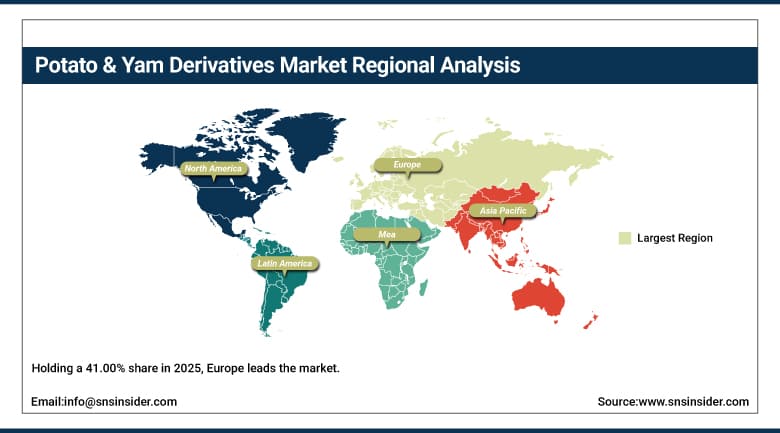
Holding a 41.00% share in 2025, Europe leads the market on the strength of its concentrated starch-industry base, built around processors in Germany, the Netherlands, France and Poland supplying buyers for decades. Germany anchors regional processing volume, supported by dense potato-growing regions and rail and barge logistics that keep raw-crop transport cost low for large extraction plants. The European Commission's September 2026 potato dashboard recorded a 2025 harvest of 57 million tonnes, up from 51 million tonnes in 2024, giving processors a larger raw-crop base this cycle. That combination of processing history, geographic density and an improved harvest keeps Europe the largest derivative-producing region.
European processors are increasingly diversifying beyond commodity starch into specialty protein and texture ingredients, following buyer demand from the region's large plant-based and clean-label food sector. Strict environmental permitting for new wet-milling capacity and rising energy costs for extraction and drying have slowed some expansion plans, pushing processors toward efficiency upgrades at existing sites rather than greenfield plants. Trade policy and input cost pressure originating outside the region are also being watched closely by processors that export derivative ingredients to North American and Asian buyers. Even with these cost pressures, Europe's scale, infrastructure and specialty-ingredient pivot are expected to keep it the leading region through 2035.
⮞In September 2025, KMC (Kartoffelmelcentralen) began a USD 78.5 million (DKK 500 million) investment at its Brande, Denmark plant to expand production of potato-based ingredients for plant-based cheese, confectionery and dressing applications, alongside upgrades to existing facilities. Capital commitment of that scale at a leading Danish starch cooperative points to continued European investment in higher-value derivative capacity.
Get Customized Report as Per Your Business Requirement - Enquiry Now
Asia Pacific Potato & Yam Derivatives Market Insights
Asia Pacific is the fastest-growing region, projected to expand at a CAGR of approximately 8.20% from 2026 to 2035, led by China's processing base and India's rapidly scaling value chain. China's local processors are expanding to serve snack and bakery manufacturers and a growing export market, while India is building frozen, flake and starch capacity for its food industry and overseas buyers. Rising urban food manufacturing and government programs supporting value-added agricultural processing are pulling more raw tuber volume into formal derivative supply chains across the region. That combination of scale in China and rapid buildout in India gives Asia Pacific the fastest expansion trajectory among all regions.
India's export value chain illustrates the pace of change, as local manufacturers and overseas buyers draw rising volumes of frozen, flaked and starch potato exports into organized supply channels. Processors across the region are investing in new extraction lines closer to growing areas to cut transport loss and serve local manufacturers and export buyers alike. Fragmented smallholder farming in parts of the region still limits consistent raw-crop quality for some processors, though consolidation among larger buyers is gradually addressing that constraint. As more governments back value-added processing, Asia Pacific's derivative output is expected to keep growing ahead of the global average.
⮞Preview materials published ahead of India’s Global Potato Summit, scheduled for December 16-17, 2026 in Gandhinagar, cite UN Comtrade data showing India’s combined exports of frozen, prepared, flaked, granulated and starch potato products reaching about USD 449.6 million in calendar 2025. Export growth of that magnitude from a single Asia Pacific country points to the region’s expanding role in global derivative supply.
North America Potato & Yam Derivatives Market Insights
North America holds a 14.80% share of the global total in 2025, with the United States supplying 85.20% of regional output on the strength of Idaho, Washington and Maine processing capacity. That tighter raw-crop supply has pushed some processors to renegotiate grower contracts earlier in the season to secure volume for extraction lines. Consolidation among large frozen and dehydrated processors, several of which also run dedicated derivative-extraction operations, continues to concentrate regional purchasing power.
Tariff-driven cost increases on imported fertilizer, chemicals and processing equipment are adding pressure to regional processing margins, with growers and processors in several states reporting input cost increases well above historical norms through 2025. Export demand for North American frozen and starch derivatives into Latin American and Asian markets continues to add a revenue channel beyond local food manufacturing, supporting continued investment in processing capacity. Labor availability at processing plants and rising energy costs for drying and extraction remain ongoing operating constraints across the region. Even with these pressures, established infrastructure and reliable growing regions keep North America a steady, moderately growing contributor to global derivative supply through 2035 overall.
⮞In December 2025, the USDA's National Agricultural Statistics Service reported 2025 U.S. potato production of 412.062 million hundredweight, down 2% from 421.172 million hundredweight in 2024, alongside Canadian output of 125.835 million hundredweight. A regional production decline of that scale tightens raw-crop availability for the derivative processors that depend on steady North American tuber supply.
MEA & Latin America Potato & Yam Derivatives Market Insights
The Middle East and Africa region remains a smaller processing base, with South Africa supplying the largest share of output and most other markets relying on imported starch and flour. South African growers reported potato volumes rising about 8% by mid-season even as market value fell, a pattern that keeps raw-crop costs favorable for processors as farm-level returns come under pressure. Limited cold-storage and processing infrastructure outside South Africa restricts how much raw tuber volume the region can convert into derivative products locally rather than exporting unprocessed crop. Government programs supporting agricultural value-addition in several Gulf and African markets are gradually encouraging investment in local starch and flour processing capacity.
Latin America is building export-oriented processing capacity, illustrated by Lamb Weston’s new 40,000-square-meter facility in Mar del Plata, Argentina, capable of handling up to 200 million pounds of potatoes annually and shipping most of its output to Brazil and other regional markets. Brazil remains the region's largest derivative-consuming market, drawing on both local processing and imports to supply its food manufacturing and foodservice sectors. Currency volatility and uneven rural logistics in several Latin American countries continue to complicate raw-crop sourcing for processors operating across multiple national markets. Even so, new processing capacity entering the region points to steady growth in locally produced derivative supply through 2035.
⮞In November 2025, McCain Foods announced a USD 334 million (BRL 1.8 billion) expansion of its Araxá, Minas Gerais, Brazil plant, its largest regional investment to date, adding a new French fry production line and pre-formed products line alongside expanded raw-potato and cold storage. Investment of that scale at an existing Brazilian facility signals rising confidence in regional derivative demand across Latin America.
Market Dynamics:
Growth Drivers: Expanding food manufacturing demand and functional-ingredient innovation are lifting derivative procurement
Processed and packaged food manufacturing keeps pulling more raw tuber volume into derivative supply chains, since starch, flour and protein ingredients sit inside a wide range of bakery, snack, sauce and processed meat formulations that food companies reformulate on a regular cycle. Buyers increasingly specify functional properties rather than generic starch, pushing processors to supply tailored viscosity, gelling and binding characteristics rather than commodity-grade output alone. Gluten-free and clean-label reformulation across packaged food categories has added a further demand channel, since potato-based starch and flour meet both labeling goals without major recipe redesign. Together these forces keep procurement volumes rising even in years when raw-crop supply tightens.
A second driver is the buildout of dedicated protein-isolation capacity, as plant-based formulators look for functional proteins outside soy and pea that carry a cleaner flavor profile and fewer allergen concerns. Ingredient makers are now investing directly in protein-extraction lines rather than treating protein as a secondary byproduct stream of starch processing, a shift that signals buyers see it as a primary growth category worth dedicated capital. Fermented beverage brands building single-origin, tuber-based positioning are also widening the buyer base beyond traditional food and industrial customers. As more categories qualify tuber-derived ingredients in finished products, processors are expected to keep expanding capacity ahead of near-term demand.
⮞In July 2025, Royal Avebe began working with TNO and Wageningen University & Research on 3D-printed plant-based food made from potato starch, with Avebe supplying the starch base and TNO providing the printing technology. Research investment of that kind shows ingredient buyers are already testing potato-derived feedstock in entirely new food-manufacturing formats beyond conventional baking and snacking.
Restraints: Tariff-driven input costs and raw-crop supply volatility pressure processor margins
Trade policy changes have raised input costs across major processing regions, with the effective tariff rate on imported goods reaching its highest level in roughly nine decades during 2025, raising costs for fertilizer and equipment. Processors that export a meaningful share of frozen and starch derivatives also face the risk that overseas buyers shift sourcing to other suppliers if retaliatory measures raise their landed cost in export markets. Smaller processors with thinner margins are more exposed to these cost shifts than large, vertically integrated operators that can absorb short-term input volatility. These pressures are concentrated most heavily in regions with substantial export exposure for frozen and starch derivatives.
Raw-crop supply volatility compounds the cost pressure, since weather-driven yield swings and acreage reductions in major growing regions directly affect how much tuber volume processors can secure at predictable prices. The Oregon Potato Commission has warned that fertilizer costs well above sustainable levels, combined with tariff exposure on more than half of the state's potato exports, are squeezing grower economics in ways that eventually flow through to processor procurement costs. Processors with multi-year grower contracts are better insulated than those buying on the spot market, widening the cost gap between large contracted buyers and smaller processors. Combined, tariff exposure and raw-crop volatility represent the category's most significant near-term margin pressure.
⮞In September 2025, the Oregon Potato Commission's Gary Roth said that if new U.S. tariffs remain in place, growers will see continued increases in fertilizer costs, with some Morrow County processors already reporting input cost increases of 5% to 15% over the prior year. Cost pressure of that magnitude at the grower level ultimately raises the raw-crop price that derivative processors must pay.
Opportunities: New extraction capacity, specialty applications and underused crop bases open fresh revenue streams
Processors are opening new extraction capacity closer to growing regions, cutting transport cost and raw-crop spoilage while positioning plants to serve local manufacturers and export buyers alike. Specialty applications in plant-based protein, fermented beverages and gluten-free formulation are commanding premium pricing relative to commodity starch, giving processors an incentive to diversify product mix rather than compete purely on bulk volume. Retail-facing B2C packaging of starch, flour and flake derivatives is opening a consumer channel that was largely untapped a decade ago, adding a second customer base alongside traditional B2B contracts. Processors that move early into these higher-value categories stand to capture margin that commodity-only competitors cannot match.
Underused crop bases, particularly yam supply chains in West Africa, represent an untapped feedstock opportunity as government programs formalize smallholder value chains and build export-grade storage infrastructure. Converting even a modest share of currently informal yam trade into organized derivative feedstock would meaningfully expand the category's available raw-crop base beyond potato alone. Export-oriented processing investment in Asia Pacific and Latin America is also creating new regional supply hubs serving local and international buyers directly, without routing volume through established plants. Processors willing to invest in these emerging feedstock and geographic bases are positioned to capture growth that mature markets can no longer generate on their own.
⮞In February 2024, Emsland Group began a project to more than double potato flake production capacity at its Emlichheim, Germany site, adding new roller dryers and washing, peeling and grinding lines ahead of a planned 2027 commissioning. Capacity investment of that scale shows established processors are positioning well ahead of near-term demand rather than waiting for existing lines to reach their limits.
Recent Developments:
-
In July 2025, Brenntag Specialties extended its partnership with Royal Avebe to supply potato starch and specialty proteins to the North American food and nutrition market for the first time, building on an existing European distribution agreement. Expansion of a potato-ingredient distribution partnership into a new continent signals rising buyer demand for clean-label starch and protein derivatives beyond Europe.
-
In July 2025, KRIBHCO and Farm Frites signed a joint venture agreement to build a new potato processing facility in India, aimed at expanding frozen and processed potato output to serve both local and export buyers.
-
In January 2026, HyFun Foods began commercial operation of a new 18,000-tonne-per-year potato flake line at its Mehsana, Gujarat facility, built with Kiremko drum-drying technology under a 2024 agreement with Kiremko and Rabobank Netherlands. A dedicated flake-processing investment of that scale illustrates derivative-specific capacity growth serving Southeast Asian, Latin American and Far East export markets.
Potato & Yam Derivatives Market Key Players:
-
PEPEES S.A.
-
AGRANA Beteiligungs-AG
-
Royal Avebe
-
Tereos
-
Ingredion Incorporated
-
Emsland Group
-
Roquette Frères
-
Keystone Potato Products, LLC
-
KMC (Kartoffelmelcentralen)
-
Basic American Foods
-
Lamb Weston Holdings, Inc.
-
McCain Foods Limited
Potato & Yam Derivatives Market Report Scope:
| Report Attributes | Details |
|---|---|
| Market Size in 2025 | USD 667.50 Billion |
| Market Size by 2035 | USD 914.94 Billion |
| CAGR | CAGR of 3.20% From 2026 to 2035 |
| Base Year | 2025 |
| Forecast Period | 2026-2035 |
| Historical Data | 2022-2024 |
| Report Scope & Coverage | Market Size, Segments Analysis, Competitive Landscape, Regional Analysis, DROC & SWOT Analysis, Forecast Outlook |
| Key Segments | • By Source (Potato, Sweet Potato, Yam) • By Derivative Type (Starch, Protein, Flour, Flakes & Granules, Feed, Frozen & Dehydrated Products) • By Application (Food, Animal Feed, Fermented Beverages, Others) • By Distribution Channel (B2B, B2C) |
| Regional Analysis/Coverage | North America (US, Canada), Europe (Germany, UK, France, Italy, Spain, Russia, Poland, Rest of Europe), Asia Pacific (China, India, Japan, South Korea, Australia, ASEAN Countries, Rest of Asia Pacific), Middle East & Africa (UAE, Saudi Arabia, Qatar, South Africa, Rest of Middle East & Africa), Latin America (Brazil, Argentina, Mexico, Colombia, Rest of Latin America). |
| Company Profiles | PEPEES S.A., AGRANA Beteiligungs-AG, Royal Avebe, Tereos, Ingredion Incorporated, Emsland Group, Roquette Frères, Keystone Potato Products, LLC, KMC (Kartoffelmelcentralen), Basic American Foods, Lamb Weston Holdings, Inc., McCain Foods Limited |

Frequently Asked Questions
The key growth factor is rising food manufacturing demand for functional starch, flour and protein ingredients, combined with buyer interest in gluten-free, clean-label and plant-based formulation.
Europe dominated the market with approximately 41.00% share in 2025, supported by its concentrated starch-processing base. Asia Pacific is the fastest-growing region with a projected CAGR of approximately 8.20% from 2026 to 2035.
The market includes PEPEES, AGRANA, Royal Avebe, Tereos, Ingredion, Emsland Group, Roquette Frères, Keystone Potato Products, KMC (Kartoffelmelcentralen), Basic American Foods, Lamb Weston, and McCain Foods, among others.
The main opportunities lie in new extraction capacity near growing regions, specialty protein and fermented-beverage applications, B2C retail packaging and converting underused yam supply chains into organized derivative feedstock.
By derivative type, the Starch segment dominated the market with approximately 34.00% share in 2025, supported by its broad base of food and industrial buyers.
