
Natural Food Colors Market Report Scope & Overview:
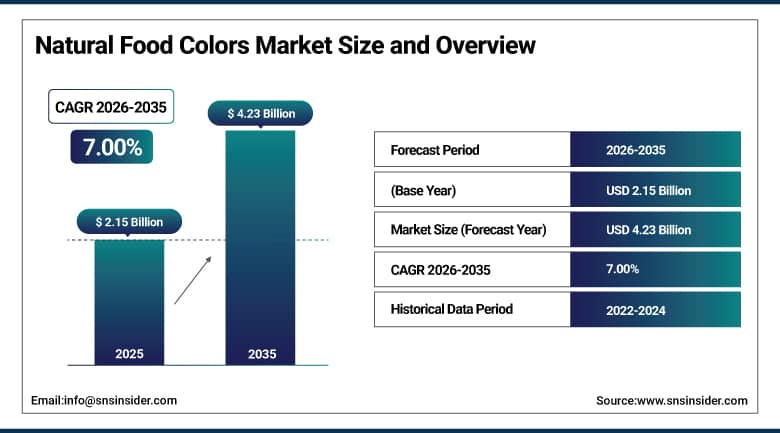
The Natural Food Colors Market was valued at USD 2.15 billion in 2025 and is expected to reach USD 4.23 billion by 2035, growing at a CAGR of 7.00% from 2026-2035.
The Natural Food Colors Market will be influenced by the increased need for natural, clean-label, and minimally processed food products that meet evolving consumer preferences and reduce dependence on synthetic food colorants. Food and beverage makers continue to invest in naturally derived coloring solutions, obtained from sources such as beta carotene, anthocyanins, curcumin, paprika and spirulina, used across bakery, confectionery, dairy, beverages and processed food applications. The increasing demand for organic food products and growing concerns about the potential health effects of artificial additives have further stimulated the continued market demand. The market growth can be attributed to the developments in the pigment extraction, encapsulation and formulation technologies that improve the color stability, heat resistance and application versatility in diverse food categories.
⮞In November 2025, Chromologics raised EUR 7 million from Novo Holdings, EIFO, Döhler Ventures, Collateral Good Ventures, and Synergetic to advance regulatory submissions, product commercialization, and production scale-up of its fermentation-based natural red food color, Natu.Red®.
To Get More Information On Natural Food Colors Market - Request Free Sample Report
Natural Food Colors Market Trends:
-
Growing consumer preference for clean-label, natural, and plant-based food coloring alternatives over synthetic colorants.
-
Rising demand for natural food colors across bakery, confectionery, beverages, dairy, and processed food applications.
-
Increasing adoption of anthocyanins, carotenoids, curcumin, and spirulina-based colors to enhance product appeal and nutritional positioning.
-
Continued advancements in extraction, stabilization, and encapsulation technologies improving the color consistency, shelf life, and heat stability of natural food colors.
-
Expanding use of sustainable and plant-derived raw materials, including fruits, vegetables, flowers, and agricultural by-products, for natural color production.
-
Increasing regulatory support and growing restrictions on synthetic food dyes encouraging food manufacturers to transition toward natural coloring ingredients.
U.S. Natural Food Colors Market Outlook:
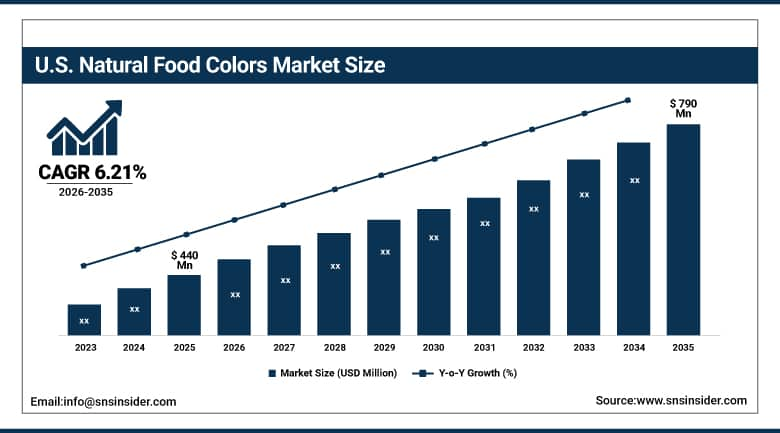
The U.S. Natural Food Colors Market was valued at USD 440 Million in 2025 and is expected to reach USD 790 Million by 2035, growing at a CAGR of 6.21% from 2026-2035.
U.S. growth of Natural Food Colors Market will remain supported by increasing consumer preference for clean-label food products, rising demand for natural and plant-based ingredients, and the presence of prominent food ingredient manufacturers investing in the development of innovative natural coloring solutions. In terms of demand drivers, it should be noted that domestic demand will benefit from beverages and bakery & confectionery applications accounting for significant consumption, while natural colors derived from anthocyanins and spirulina are expected to benefit from growing demand for plant-based and visually appealing food products. The market is further driven by the increasing investments in research and development, technological innovations in color extraction technologies, and the increasing adoption of natural alternatives to synthetic food dyes in food and beverage applications.
⮞In March 2025, Sensient Food Colors launched Marine Blue™ Capri, a clean-label natural alternative to synthetic Blue 1, addressing growing demand for natural blue color solutions in food and beverage applications.
Natural Food Colors Market Segment Analysis:
-
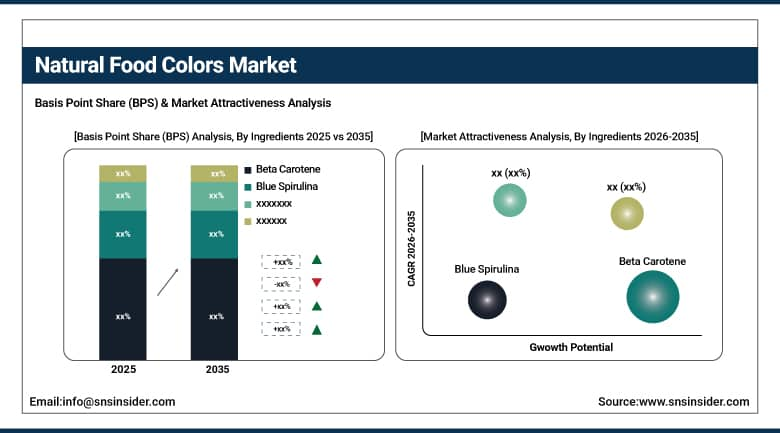
By Ingredients, the Beta Carotene segment dominated the Natural Food Colors Market with approximately 14.37% share in 2025, while the Blue Spirulina segment is the fastest growing with a CAGR of approximately 8.80%.
-
By Source, the Plant-Based Colors segment dominated the Natural Food Colors Market with approximately 63.47% share in 2025, while the Algae-Based Colors segment is the fastest growing with a CAGR of approximately 8.21%.
-
By Form, the Powder segment dominated the Natural Food Colors Market with approximately 48.37% share in 2025, while the Liquid segment is the fastest growing with a CAGR of approximately 7.41%.
-
By Application, the Bakery & Confectionery segment dominated the Natural Food Colors Market with approximately 21.37% share in 2025, while the Breakfast Cereals & Snacks segment is the fastest growing with a CAGR of approximately 7.49%.
-
By Distribution Channel, the Direct Sales segment dominated the Natural Food Colors Market with approximately 46.37% share in 2025, while the Online & Specialist Retail segment is the fastest growing with a CAGR of approximately 8.48%.
-
By End User, the Food & Beverage Manufacturers segment dominated the Natural Food Colors Market with approximately 78.43% share in 2025, while the Foodservice Operators segment is the fastest growing with a CAGR of approximately 7.40%.
By Ingredients, Beta Carotene dominates and Blue Spirulina grows fastest
Beta Carotene constitutes the dominating segment in the Natural Food Colors Market due to its extensive use in bakery products, beverages, dairy products, and processed foods. Its natural occurrence, its attractive yellow-orange coloring properties, and its proven use in many food segments have made it a popular choice with food producers. The growing consumer preference for clean-label ingredients is also expected to drive the demand for beta carotene.
Blue Spirulina is the fastest growing segment of the Natural Food Colors Market due to the rising demand for natural blue coloring alternatives and increasing interest in plant-based food ingredients. Manufacturers are looking for alternatives to synthetic blue colorants and its use is expanding in beverages, confectionery, dairy products and functional foods. The segment’s growth is being fueled by rising demand for visually appealing food products and clean-label formulations.
By Source, Plant-Based Colors dominate and Algae-Based Colors grow fastest
Plant Based Colors hold the dominating segment in the Natural Food Colors Market due to their wide availability, extensive application across food categories, and strong consumer acceptance. Ingredients obtained from fruits, vegetables, roots and spices are widely used in bakery products, beverages, dairy products and confectionery. The growing preference for naturally derived ingredients and clean-label food formulations continues to support the dominance of plant-based colors.
Algae-Based Colors is the fastest growing segment within the Natural Food Colors Market, driven by increasing demand for innovative natural coloring ingredients and sustainable food solutions. Algae pigments like phycocyanin and chlorophyll are attracting attention for their unique coloring characteristics and potential applications in beverages, confectionery and functional foods. The growth in the segment is driven by the increasing interest in alternative sources of natural pigments and the growing product development activities.
By Form, Powder dominates and Liquid grows fastest
Powder is the leading segment in the Natural Food Colors Market, owing to its longer shelf life, easy storage, transportation benefits and applicability for dry food formulations. Food manufacturers widely use powdered colors in bakery products, confectionery, seasoning blends and powdered beverages. Its ease of handling, relatively stable formulation and compatibility with large-scale food processing operations remain the basis of its dominant market position.
Liquid is the fastest-growing segment in the Natural Food Colors Market. This is due to the increasing demand for easy incorporation of color and uniform dispersion across food and beverage formulations. Liquid colors are being used more and more in beverages, dairy, sauces and confectionery applications due to their easy blend ability and precise dosing. Increasing beverage innovation and the rising demand for ready to use food ingredients are aiding the growth of the segment.
By Application, Bakery & Confectionery dominates and Breakfast Cereals & Snacks grow fastest
Bakery & confectionery application segment is the dominating segment in the natural food colors market, due to the extensive use of coloring ingredients in cakes, pastries, biscuits, chocolates, candies, and decorative confectionery products. Food manufacturers use natural colors to enhance the appearance of products, ensure visual consistency and meet the growing consumer preference for clean-label ingredients. Increasing demand for visually appealing baked goods and confectionery products continues to underpin segment dominance.
Breakfast Cereals & Snacks is the fastest growing application segment in the Natural Food Colors Market. Increasing demand for healthy packaged foods and naturally colored snack products is driving the segment growth. Producers are putting natural colorants into breakfast cereals, cereal bars, crisps, extruded snacks and other convenience foods to improve the look of the product and reduce reliance on synthetic additives. The segment is also benefiting from rising demand for clean-label packaged foods.
By Distribution Channel, Direct Sales dominates and Online & Specialist Retail grows fastest
Direct Sales is the dominant segment in the Natural Food Colors Market, with large food and beverage manufacturers preferring to purchase ingredients directly from producers and established suppliers. Direct procurement allows buyers to guarantee consistent product quality, ensure bulk supplies, negotiate long-term contracts and receive technical support for formulation needs. The channel remains strong, with solid ties between color manufacturers and industrial food processors.
Online & Specialist Retail channel is the fastest growing distribution channel in the Natural Food Colors Market, driven by the rising digitalization of ingredient procurement and the rising demand from small and medium food businesses. Online platforms provide easy access to a wider variety of natural coloring ingredients, product specifications, and supplier options. Growth of the segment is supported by the expansion of e-commerce infrastructure and rising adoption of digital buying channels.
By End User, Food & Beverage Manufacturers dominate and Foodservice Operators grow fastest
Food & Beverage Manufacturers represent the dominating end-user segment in the Natural Food Colors Market owing to their large-scale consumption of coloring ingredients in processed foods, beverages, dairy products, bakery items, and confectionery. Clean-label preferences and evolving ingredient requirements are driving these manufacturers to increasingly incorporate natural colors into product formulations. The high production volumes and constant product innovations further strengthen their leading position in the market.
Foodservice Operators is the fastest-growing end-user segment in the Natural Food Colors Market. The growing demand for attractive food presentations and the increased use of natural ingredients in restaurants, cafes, bakeries, and catering businesses are driving the growth of the foodservice operators segment. With consumers increasingly leaning towards healthier and natural food choices, operators are turning to natural colors in desserts, beverages, bakery products and prepared foods. Growth in the segment is also being supported by the expansion of organized foodservice businesses.
Regional Analysis:
|
Region |
Major Country |
Share within Region, 2025 (%) |
|---|---|---|
|
North America |
United States |
24.87% |
|
Asia Pacific |
China |
32.46% |
|
Europe |
Germany |
21.38% |
|
Latin America |
Brazil |
56.73% |
|
Middle East & Africa |
Saudi Arabia |
24.81% |
Europe Natural Food Colors Market Insights
Europe is a key regional market for natural food colorants, supported by high consumer inclination towards clean-label food products and stringent regulations on the use of synthetic food additives. Germany accounts for a large share of regional demand, supported by its mature food processing sector, strong market for organic products, and growing uptake of naturally sourced ingredients in bakery, confectionery and beverages.
The United Kingdom and France add to the regional demand, due to increasing consumer awareness about transparency of food ingredients and increasing demand for plant-based and naturally colored products. Steady regional demand for natural food colors coupled with the continuing emphasis on food safety, sustainability and regulatory compliance across the European Union supports the substitution of synthetic colorants with natural alternatives.
Get Customized Report as Per Your Business Requirement - Enquiry Now
North America Natural Food Colors Market Insights
North America accounted for approximately 24.87% of the global Natural Food Colors Market in 2025, driven by rising consumer preference for clean-label products, increasing demand for naturally derived food ingredients, and growing awareness of the health and safety benefits associated with natural colorants. The United States accounts for the substantial majority of regional demand, reflecting its large processed food and beverage industry, established food ingredient manufacturers and increasing adoption of natural alternatives to synthetic food colors.
Canada contributes additional regional demand through growing consumption of organic and clean-label food products and increasing use of plant-based color ingredients across food and beverage applications. North America is expected to continue to be a key regional market for natural food colors due to technological improvements in the extraction and formulation of natural colors, such as color stability and heat resistance.
Asia Pacific Natural Food Colors Market Insights
Asia Pacific is anticipated to witness the highest 8.04% CAGR among all regional segments of the Natural Food Colors Market throughout the forecast period from 2026 to 2035 on account of rising demand for processed and packaged foods, increasing consumer awareness of clean-label ingredients, and growing adoption of natural food colorants across the food and beverage industry. China will be the largest contributing country among all countries in the region due to its large food processing industry, growing middle-class population and rising demand for naturally sourced food ingredients.
India’s contribution will come from rising demand for natural colors derived from turmeric, beetroot and other plant-based sources, supported by the expansion of packaged food and beverage manufacturing. Japan will have a growing contribution in terms of demand for high-quality food ingredients and clean-label products while South Korea will assist the region with growing consumption of processed foods and premium food and beverage products.
MEA & Latin America Natural Food Colors Market Insights
The Middle East & Africa is an emerging region for natural food colors. The demand for natural food colors in this region is supported by countries such as the United Arab Emirates, Saudi Arabia, and South Africa, where growing food processing industries and growing consumption of packaged food products are driving market growth. The demand in the Gulf Cooperation Council markets is driven by increasing investments in food manufacturing and consumer preference for products made from natural and recognizable ingredients.
In Latin America, the Natural Food Colors Market is dominated by Brazil, which represents a major contributor to regional demand owing to its extensive food and beverage processing industry, availability of agricultural raw materials, and growing interest in naturally sourced food ingredients. Growth in packaged food production and the adoption of clean-label formulations are adding demand in Mexico, while consumer preference for healthier food products is gradually supporting regional demand for natural food colors.
Market Dynamics:
Growth Drivers: Rising Demand for Clean-Label Products and Natural Ingredients
Growing consumer preference for clean-label food products and increasing awareness of the potential health concerns associated with synthetic food additives represent primary growth drivers for the Natural Food Colors Market. Food and beverage manufacturers are increasingly switching to naturally derived colorants over synthetic ones to mirror changing consumer expectations for ingredient transparency, product safety and healthier formulations. The trend is also boosted by the increasing demand for plant-based, organic and minimally processed foods, which continues to push manufacturers to add natural colors from fruits, vegetables, spices and other botanical sources.
Another important route to market growth is increasing applications of natural food colors in bakery and confectionery, dairy products, beverages and processed foods. Extraction, formulation and stabilization technologies are advancing to overcome the traditional disadvantages of natural colorants, improving color uniformity, heat stability and shelf life. Increasing regulatory support for natural ingredients and growing adoption of clean-label product formulations further support market expansion across developed and emerging economies.
Restraints: High Production Costs and Stability Limitations
High production and processing costs of natural food colors are a significant restraint on the Natural Food Colors Market, as manufacturers need to invest in specialized extraction, purification, and formulation processes to get consistent color quality from natural raw materials. This dynamism is compounded by the higher cost and variable availability of botanical sources, as seasonal fluctuations, agricultural conditions, and raw material quality can affect production volumes and pricing.
The stability of natural food colors is limited over different conditions of temperature, pH, light and storage. This causes a further challenge for manufacturers as some pigments may fade, degrade or change color intensity during processing and storage of the food product. These technical limitations limit their use in products with long shelf life and consistent appearance. Furthermore, variation in color performance across food formulations and the need for additional stabilization technologies contribute to formulation complexity and cost of manufacture.
Opportunities: Expanding Plant-Based Applications and Advanced Color Extraction Technologies
Rising demand for plant-based, organic, and functional food products offers a significant growth opportunity for the Natural Food Colors Market, as food manufacturers are increasingly looking for naturally derived ingredients that support clean-label positioning and changing consumer preferences. Growing use of natural colorants in beverages, dairy alternatives, confectionery, bakery products and nutritional foods is likely to provide further opportunities for manufacturers to extend their product portfolios. As the move away from synthetic food additives continues, companies that can provide stable, high-performance natural color solutions at competitive prices are likely to benefit.
Another major opportunity for the market participants is the advancement in extraction, microencapsulation, fermentation, and biotechnology-based production to enhance pigment stability, color intensity, and production efficiency. The development of innovative color solutions is expected to be supported by growing research into alternative natural pigment sources such as algae, fruits, vegetables, and microbial sources. As global food manufacturers continue to focus on clean-label reformulation and sustainable ingredient sourcing, suppliers with advanced processing capabilities and diversified natural color portfolios are likely to benefit from the growing commercial demand.
Recent Developments:
-
March 2026: Sensient Technologies announced up to USD 250 million investment to expand natural food color manufacturing capacity and strengthen supply capabilities.
-
May 2026: Oterra and Debut Biotechnology partnered to develop fermentation-based natural alternatives to Red 40 for food and beverage applications.
-
August 2025: Lycored launched three superstable, nature-based color emulsions, expanding its clean-label portfolio for food, beverage, and supplement applications.
Natural Food Colors Market Key Players:
-
Sensient Technologies Corporation
-
Oterra A/S
-
GNT Group B.V.
-
Archer Daniels Midland Company (ADM)
-
Givaudan SA
-
Döhler GmbH
-
Symrise AG
-
Kalsec Inc.
-
ROHA Group
-
Chenguang Biotech Group Co., Ltd.
-
San-Ei Gen F.F.I., Inc.
-
Allied Biotech Corporation
-
Lycored Ltd.
-
Synthite Industries Ltd.
-
Aarkay Food Products Ltd.
-
Vinayak Ingredients India Pvt. Ltd.
-
Kerry Group plc
-
DSM-Firmenich AG
-
International Flavors & Fragrances Inc. (IFF)
-
AVT Natural Products Ltd.
Natural Food Colors Market Report Scope:
| Report Attributes | Details |
|---|---|
| Market Size in 2025 | USD 2.15 Billion |
| Market Size by 2035 | USD 4.23 Billion |
| CAGR | CAGR of 7.00% From 2026 to 2035 |
| Base Year | 2025 |
| Forecast Period | 2026-2035 |
| Historical Data | 2022-2024 |
| Report Scope & Coverage | Market Size, Segments Analysis, Competitive Landscape, Regional Analysis, DROC & SWOT Analysis, Forecast Outlook |
| Key Segments | • By Ingredients (Beta Carotene, Lycopene, Curcumin, Anthocyanin, Carmine, Copper Chlorophyllin, Paprika, Betanin, Riboflavin, Blue Spirulina, Caramel, Annatto, Others) • By Source (Plant-Based Colors, Algae-Based Colors, Mineral-Based Colors, Animal-Derived Colors) • By Form (Powder, Liquid, Gel & Paste) • By Application (Bakery & Confectionery, Beverages, Breakfast Cereals & Snacks, Dairy & Frozen Products, Meat & Meat Alternatives, Savory Foods, Oils & Fats, Fruits, Vegetables & Fruit Preparations, Pet Food) • By Distribution Channel (Direct Sales, Distributors, Online & Specialist Retail) • By End User (Food & Beverage Manufacturers, Foodservice Operators, Household & Artisanal Users) |
| Regional Analysis/Coverage | North America (US, Canada), Europe (Germany, UK, France, Italy, Spain, Russia, Poland, Rest of Europe), Asia Pacific (China, India, Japan, South Korea, Australia, ASEAN Countries, Rest of Asia Pacific), Middle East & Africa (UAE, Saudi Arabia, Qatar, South Africa, Rest of Middle East & Africa), Latin America (Brazil, Argentina, Mexico, Colombia, Rest of Latin America). |
| Company Profiles | MAHLE GmbH, BorgWarner Inc., Valeo SA, DENSO Corporation, Hanon Systems, Modine Manufacturing Company, Garrett Motion Inc., T.RAD Co., Ltd., Dana Incorporated, Marelli Holdings Co., Ltd., Nissens Automotive A/S, AKG Group, Banco Products (India) Ltd., Bell Intercoolers, Mishimoto Automotive, PWR Advanced Cooling Technology, Forge Motorsport Ltd., CSF Radiators, Treadstone Performance Engineering, Pro Alloy Motorsport Ltd. |

Frequently Asked Questions
Leading companies in the Natural Food Colors Market include Sensient Technologies Corporation, Oterra A/S, GNT Group B.V., Givaudan SA, and Döhler GmbH, among others.
Key opportunities include expanding plant-based food applications, increasing demand for clean-label ingredients, and advancements in extraction, fermentation, and encapsulation technologies.
Rising consumer preference for clean-label products and naturally derived ingredients, combined with increasing replacement of synthetic food colorants, is the major factor driving market growth.
The Bakery & Confectionery segment dominated the Natural Food Colors Market with approximately 21.37% share in 2025.
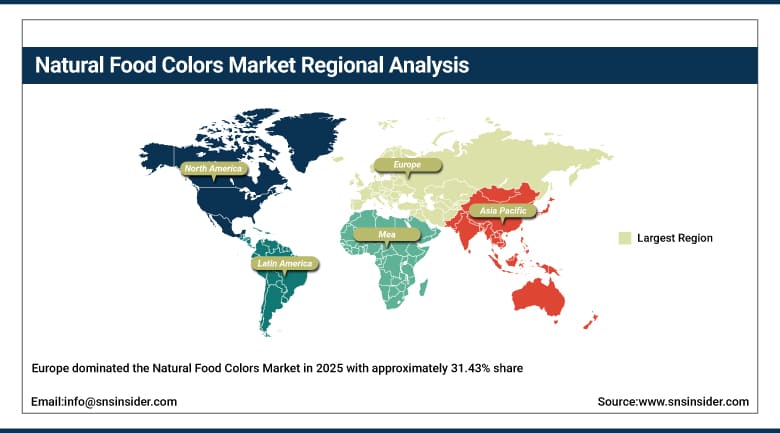
Europe dominated the Natural Food Colors Market in 2025 with approximately 31.43% share, driven by strong consumer preference for clean-label products and stringent regulations on synthetic food additives.
