
Citrus Fiber Market Report Scope & Overview:
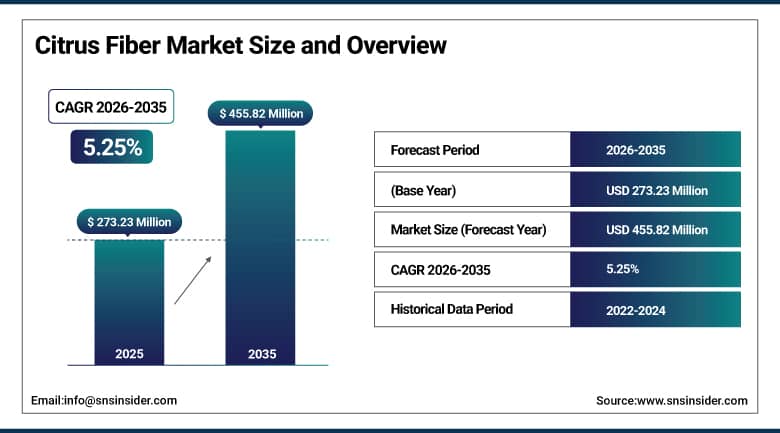
The Citrus Fiber Market was valued at USD 273.23 million in 2025 and is expected to reach USD 455.82 million by 2035, growing at a CAGR of 5.25% from 2026-2035.
The Citrus Fiber Market will be influenced by the growing demand for natural, plant-based and clean-label food ingredients across the food and beverage industry. Citrus fiber is being increasingly used by food manufacturers in bakery products, dairy alternatives, beverages, sauces, dressings and meat products for its water-binding, thickening, stabilizing and emulsifying properties. The increasing demand from consumers for healthier food products with fewer synthetic additives and improved nutritional profiles is driving the use of citrus fibre as a functional ingredient. The rising consumption of citrus by-products, in particular orange peels obtained from the juice processing, is another factor driving the market. They offer a sustainable and cost-effective source of dietary fiber, while minimizing waste from food processing and supporting circular economy initiatives.
⮞In January 2026, CEAMSA acquired PeelPioneers' Finix citrus fiber product line and associated intellectual property, expanding its CEAMFIBRE portfolio and strengthening its sustainable citrus fiber ingredient offerings.
To Get More Information On Citrus Fiber Market - Request Free Sample Report
Citrus Fiber Market Trends:
-
Growing demand for natural and clean-label ingredients in food and beverage formulations.
-
Rising utilization of citrus fiber as a functional ingredient in bakery, dairy, sauces, and meat products.
-
Increasing adoption of citrus fiber as a natural fat replacer, stabilizer, and texture modifier.
-
Expanding use of upcycled citrus peel and processing by-products for sustainable fiber production.
-
Rising demand for plant-based and dietary fiber ingredients driven by health-conscious consumer preferences.
U.S. Citrus Fiber Market Outlook:
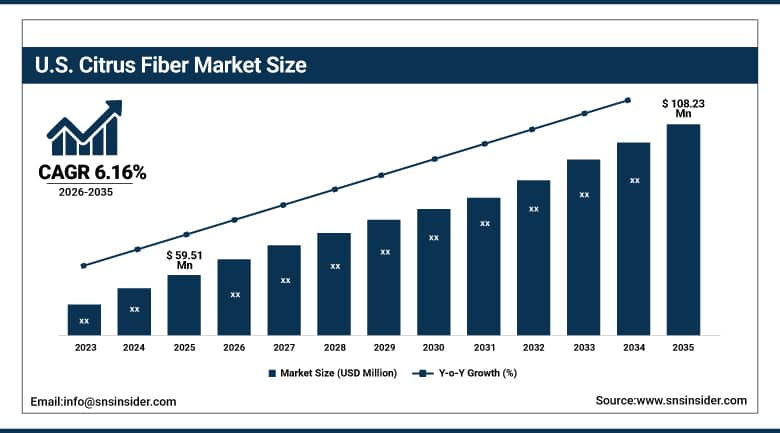
The U.S. Citrus Fiber Market was valued at USD 59.51 Million in 2025 and is expected to reach USD 108.23 Million by 2035, growing at a CAGR of 6.16% from 2026-2035.
U.S. growth of Citrus Fiber Market will remain supported by increasing demand for clean-label food ingredients, rising consumer preference for natural and plant-based products, and growing utilization of citrus fiber as a functional ingredient in food and beverage formulations. The texture of food products is improved by the emulsifying, thickening and water-binding properties of citrus fiber. Therefore, food manufacturers are using citrus fiber in bakery products, dairy alternatives, beverages, sauces, dressings and processed meat products. Regarding demand drivers, domestic demand will benefit from food and beverage industry being the largest application segment and increasing adoption in nutraceuticals and personal care applications will provide additional growth opportunities. The former will be fueled by increasing consumer interest in dietary fiber enrichment, sustainable sourcing of ingredients and use of upcycled by-products from citrus processing.
⮞In February 2026, Fiberstar launched Citri-Fi Pro, a natural citrus fiber ingredient designed as an alternative to acacia gum in beverage emulsions, supporting clean-label formulations and improved ingredient functionality.
Citrus Fiber Market Segment Analysis:
-
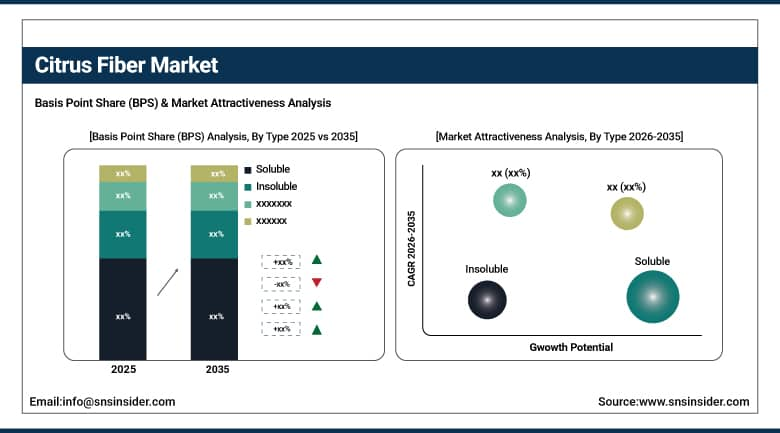
By Type, the Soluble segment dominated the Citrus Fiber Market with approximately 62.38% share in 2025, while the Insoluble segment is the fastest growing with a CAGR of approximately 5.75%.
-
By Fruit Source, the Orange segment dominated the Citrus Fiber Market with approximately 58.42% share in 2025, while the Lemon and Lime segment is the fastest growing with a CAGR of approximately 6.11%.
-
By Function, the Thickening Agent segment dominated the Citrus Fiber Market with approximately 24.36% share in 2025, while the Water Binding & Moisture Management segment is the fastest growing with a CAGR of approximately 5.66%.
-
By Application, the Bakery segment dominated the Citrus Fiber Market with approximately 27.42% share in 2025, while the Pharmaceutical & Nutraceutical Industry segment is the fastest growing with a CAGR of approximately 8.54%.
-
By Distribution Channel, the Supermarkets/Hypermarkets segment dominated the Citrus Fiber Market with approximately 28.64% share in 2025, while the Online Retail segment is the fastest growing with a CAGR of approximately 8.43%.
By Type, Soluble dominates and Insoluble grows fastest
Soluble citrus fiber is the major segment in the citrus fiber market due to its widespread use in food and beverage formulations, where it provides effective thickening, stabilization, emulsification and texture enhancing properties. Its wide acceptance in bakery, dairy, beverage and processed food applications is driven by its ability to enhance product consistency, maintain formulation stability and support clean-label ingredient requirements.
Insoluble citrus fiber is the fastest growing segment, driven by growing demand for dietary fiber ingredients for digestive health, nutritional value enhancement and product texture. The segment is expanding because of its increasing incorporation in functional foods, bakery products, nutritional supplements, and plant-based formulations. Rising consumer preference for fiber-enriched products and naturally derived ingredients is further expected to benefit this segment.
By Fruit Source, Orange dominates and Lemon and Lime grows fastest
Orange-based citrus fiber leads the market for citrus fiber. This is due to the plentiful supply of by-products from orange processing, especially peels and pulp, which provide a consistent and economical supply of raw material. Good functional properties such as water retention, thickening, emulsification and stabilization are conducive to the wide application in bakery, dairy, beverage, sauce and processed food.
Lemon and lime derived citrus fiber is the fastest growing segment due to increasing utilization of alternative citrus processing by-products and increasing demand for naturally derived functional ingredients. The growing adoption is fueled by its increasing use in beverages, bakery products, sauces, dressings and clean-label food formulations. Increased interest in sustainable ingredient sourcing and the effective utilization of citrus processing waste are expected to boost the segment.
⮞In January 2026, CEAMSA highlighted CEAMFIBRE, a multifunctional citrus fiber ingredient obtained from lemon, lime, and orange peels for bakery, dairy, meat, and juice applications.
By Function, Thickening Agent dominates and Water Binding & Moisture Management grows fastest
Thickening Agent will continue to be the dominating segment in the citrus fiber market, owing to its wide application in improving viscosity, consistency, and texture of various food and beverage products. Citrus fiber offers natural thickening properties for clean-label product development, decreasing reliance on synthetic additives. Its widespread inclusion in bakery products, sauces, dressings, dairy alternatives and processed foods is helping the segment maintain its dominance.
Water Binding and Moisture Management is the fastest growing functional segment, driven by demand for ingredients that improve moisture retention, product stability and shelf life. Citrus fiber can bind water and maintain texture, making it a promising ingredient to add to bakery, meat alternatives, dairy products, and processed foods. Moreover, the segment is expected to benefit from the rising demand for clean label formulations with enhanced product quality.
By Application, Bakery dominates and Pharmaceutical & Nutraceutical Industry grows fastest
Bakery is the dominating segment for the citrus fiber market due to its wide use in bread, cakes, biscuits, pastries and other bakery products for improving moisture retention, texture, volume and shelf life. The demand for clean-label and fiber-enriched bakery formulations is leading to the use of citrus fiber as a natural functional ingredient. Its water-binding and stabilizing properties further reinforce its adoption across commercial bakery applications.
Pharmaceutical and Nutraceutical Industry is the fastest growing application segment, owing to the rising demand for plant-derived dietary fiber ingredients and functional formulations. Interest is growing in the use of citrus fiber in fiber supplements, digestive health products, nutritional formulations and natural excipient applications. This segment is projected to benefit from growing consumer demand for digestive health, preventive nutrition and natural ingredients.
By Distribution Channel, Supermarkets/Hypermarkets dominates and Online Retail grows fastest
Supermarkets & Hypermarkets dominate the distribution channel in the citrus fiber market due to their large retail footprint, broad product selections, and established relationships with food manufacturers and ingredient buyers. The channels make it easy to obtain packaged functional ingredients and food products with citrus fiber. Their wide availability and ability to offer several brands and varieties of products have made them the market leaders.
Online retail channel is growing at the fastest rate, supported by increasing consumer preference for digital purchasing, growth of e-commerce platforms and easy access to specialized functional ingredients. Online channels allow manufacturers, food businesses and individual consumers to compare product specifications, pricing and suppliers. The segment is likely to benefit from the growing adoption of digital procurement, improved distribution networks, and increased availability of specialty clean-label ingredients.
Regional Analysis:
|
Region |
Major Country |
Share within Region, 2025 (%) |
|---|---|---|
|
North America |
United States |
81.36% |
|
Asia Pacific |
China |
24.87% |
|
Europe |
Germany |
23.68% |
|
Latin America |
Brazil |
38.43% |
|
Middle East & Africa |
South Africa |
18.76% |
Europe Citrus Fiber Market Insights
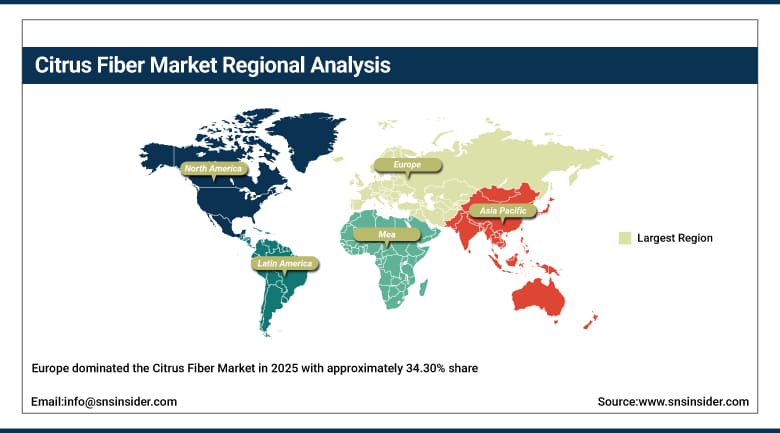
Europe is a major regional market for citrus fiber, driven by strict regulations on food ingredients, increasing demand for clean-label formulations and a strong consumer preference for natural and sustainable food products. Germany, the United Kingdom and France are the major contributors to the regional demand due to their well-established food and beverage manufacturing industries and rising consumption of plant-based functional ingredients. The rise in the use of citrus fiber in bakery products, dairy alternatives, sauces, dressings and meat products is consistent with regional consumption.
Germany contributes with its large food processing industry and increasing demand of natural stabilizing and texturizing ingredients. The UK and France are adding to regional demand with increased interest in healthier food formulations, plant-based products and clean-label ingredient alternatives. Europe’s citrus fiber market is poised for growth due to continuous innovation in food formulations and a shift from synthetic additives to naturally derived ingredients.
Get Customized Report as Per Your Business Requirement - Enquiry Now
North America Citrus Fiber Market Insights
North America accounted for approximately 26.77% of the global Citrus Fiber Market in 2025, driven by increasing demand for clean-label food ingredients, rising consumer preference for natural and plant-based products, and strong utilization of functional ingredients across the food and beverage industry. A large majority of the regional demand is from the United States, supported by a mature food processing industry, a growing number of health-conscious consumers and the increasing use of citrus fiber in bakery products, dairy alternatives, beverages, sauces, dressings and processed foods.
Canada contributes additional regional demand through the expanding natural food ingredients industry and increasing adoption of plant-based and clean-label formulations. Another driver of regional demand is the increasing demand for ingredients which have water binding, thickening, stabilization and emulsification properties. North America’s status as a key market for citrus fiber is being further bolstered by ongoing product innovation and the growing push from food manufacturers to replace synthetic additives with naturally derived alternatives.
⮞In 2025, Fiberstar continued promoting its Citri-Fi natural citrus fiber portfolio for North American food applications, highlighting water retention, emulsification, stabilization, and clean-label benefits across bakery, dairy, beverages, sauces, and plant-based products.
Asia Pacific Citrus Fiber Market Insights
Asia Pacific accounted for approximately 5.38% of the global Citrus Fiber Market in 2025, supported by the expanding food and beverage processing industry, rising disposable incomes, and increasing consumer preference for natural and healthier food ingredients. China is a key driver of regional demand due to its large food manufacturing base, growing processed food industry and increasing use of functional ingredients in bakery, dairy, beverages and convenience food products.
India contributes to regional market growth through increasing demand for clean-label food products, expanding packaged food consumption, and growing awareness of plant-based ingredients. Japan is also an important market, supported by its established food processing industry and demand for functional food ingredients that improve product texture, stability and nutritional properties. Rising investments in food innovation and the growing adoption of naturally derived ingredients are expected to underpin growth in the Asia Pacific market.
MEA & Latin America Citrus Fiber Market Insights
The Middle East & Africa Citrus Fiber Market is growing steadily driven by the rising demand for processed food products, increasing consumer consciousness towards healthier food ingredients and the growth of the regional food and beverage manufacturing industry. The demand in the region is driven by the increasing consumption of packaged food, bakery products, beverages and dairy-based formulations in countries such as United Arab Emirates, Saudi Arabia and South Africa. The increasing interest in natural ingredients with functional properties is encouraging the food industry to include citrus fiber in product formulations.
In Latin America, Brazil represents a major contributor to the Citrus Fiber Market owing to its extensive citrus production, established fruit processing industry, and growing food and beverage manufacturing sector. The rise in processed food consumption and the growing demand for clean-label ingredients also support the regional demand, particularly in Mexico and Argentina. The gradual expansion of the regional market is expected to be driven by the availability of citrus-based raw materials and the growing demand for natural thickening, stabilizing and emulsifying agents.
Market Dynamics:
Growth Drivers: Rising Demand for Natural and Clean-Label Food Ingredients
Increasing consumer demand for natural, plant-based, and clean-label food ingredients is driving the growth of the Citrus Fiber Market. Citrus fiber is being increasingly used by food and beverage manufacturers in a variety of products as a natural alternative to synthetic additives, stabilizers and thickeners. Increasing consumer awareness about health benefits of dietary fiber such as improved digestive health, gut health, and weight management also aids in the market growth. Manufacturers are increasing the use of citrus fiber in food applications due to growing demand for minimally processed foods and products with recognizable, naturally derived ingredients.
Another important area of growth is the growing use of citrus fiber as a multi-functional ingredient. It is suitable for bakery products, dairy alternatives, beverages, sauces, dressings, meat products and confectionery thanks to its water-binding, emulsifying, thickening and stabilizing properties. The increasing demand for plant-based and gluten-free food products and rising innovation in food formulations are also supporting the adoption of citrus fiber. Furthermore, the growing focus on sustainable food processing and the utilization of citrus peel waste as a valuable raw material is creating favorable opportunities for market expansion.
Restraints: High Processing Costs and Raw Material Availability Challenges
High manufacturing and processing costs related to citrus fiber act as a major restraint to the market growth. Manufacturers have to invest in special extraction, drying, purification and processing technologies to manufacture high quality fiber with constant functional properties. To preserve fiber quality, water holding capacity and functional performance during the production process, it is necessary to use citrus peels effectively and to implement advanced processing technologies. These requirements can lead to increased production costs and pricing challenges, especially for smaller manufacturers and food producers in cost-sensitive markets.
Fluctuations in citrus fruit production and seasonal availability of raw materials also impose constraints on market participants. The production of citrus fibers depends mainly on the availability of citrus processing by-products, mainly consisting of peels of oranges, lemons and other citruses. Changes in citrus harvests, weather patterns, agricultural yields and volumes of fruit processed may impact raw material availability and procurement costs. In addition, the need to maintain product quality, performance and regulatory acceptance in different food applications can pose further technical challenges. These factors, along with competition from other dietary fibers and traditional food additives, may hinder market penetration in price sensitive applications.
Opportunities: Growing Plant-Based Food Consumption and Advancements in Citrus Fiber Processing Technologies
The markets for plant-based and functional foods are expanding continuously, providing significant growth opportunities for the Citrus Fiber Market, particularly as manufacturers seek natural ingredients that enhance the texture, stability and nutritional profile of food products. Growing demand for dairy alternative, meat substitute, gluten-free bakery products and clean-label packaged foods is driving the use of citrus fiber as a multifunctional ingredient. It is becoming more and more ideal for new food compositions because it can improve moisture retention, improve texture, stabilize emulsions and substitute some synthetic additives. Growing consumer demand for digestive health and fiber fortification also underpins opportunities across functional foods and beverages.
Advances made in the technologies for extraction and processing of citrus fiber provide additional chances for market participants. Developments in enzymatic treatment, mechanical processing, drying techniques and fiber modification are allowing manufacturers to improve functional properties, processing efficiency and develop application-specific citrus fiber products. Moreover, rising focus on circular economy practices and sustainable food manufacturing is driving the transformation of citrus processing waste into value-added ingredients. Expanding applications in the global food & beverage industry, as food manufacturers focus on clean-label formulations, ingredient sustainability and product innovation, are expected to benefit ingredient suppliers developing high-performance citrus fiber solutions.
Recent Developments:
-
February 2026: Fiberstar launched Citri-Fi® Pro, a natural citrus fiber ingredient designed as an alternative to acacia gum for beverage emulsions and clean-label formulations.
-
January 2026: CEAMSA acquired PeelPioneers’ Finix citrus fiber product line and associated intellectual property, expanding its CEAMFIBRE portfolio and natural fiber solutions.
-
June 2026: Foodchem launched a new Citrus Fiber Portfolio offering plant-based ingredients with water-binding, oil-binding, thickening, stabilization, and emulsification properties for food applications.
Citrus Fiber Market Key Players:
-
Cargill, Incorporated
-
Ingredion Incorporated
-
Tate & Lyle PLC
-
Fiberstar, Inc.
-
CEAMSA
-
Herbafood Ingredients GmbH
-
J. Rettenmaier & Söhne GmbH + Co KG
-
CP Kelco U.S., Inc.
-
Naturex S.A. (Givaudan)
-
Kerry Group plc
-
DuPont de Nemours, Inc.
-
SunOpta Inc.
-
Florida Food Products, Inc.
-
Quadra Chemicals Ltd.
-
Yantai Andre Pectin Co., Ltd.
-
Hebei Lemont Biotechnology Co., Ltd.
-
Carolina Ingredients, Inc.
-
Cifal Herbal Pvt. Ltd.
-
Lemont Chemical Co., Ltd.
-
Nans Products Private Limited
Citrus Fiber Market Report Scope:
| Report Attributes | Details |
|---|---|
| Market Size in 2025 | USD 273.23 Million |
| Market Size by 2035 | USD 455.82 Million |
| CAGR | CAGR of 5.25% From 2026 to 2035 |
| Base Year | 2025 |
| Forecast Period | 2026-2035 |
| Historical Data | 2022-2024 |
| Report Scope & Coverage | Market Size, Segments Analysis, Competitive Landscape, Regional Analysis, DROC & SWOT Analysis, Forecast Outlook |
| Key Segments | • By Type (Soluble, Insoluble) • By Fruit Source (Orange, Tangerines/Mandarins, Lemon and Lime, Grapefruit) • By Function (Thickening Agent, Stabilizer & Emulsion Support, Gelling Agent, Water Binding & Moisture Management, Fat Replacement, Texture & Viscosity Modification, Fiber Enrichment, Others) • By Application (Bakery, Desserts & Ice Cream, Sauces & Seasonings, Pharmaceutical & Nutraceutical Industry, Personal Care & Cosmetics Industry, Animal Feed Industry, Others) • By Distribution Channel (Online Retail, Convenience Stores, Supermarkets/Hypermarkets, Specialty Health Stores, Foodservice & Hospitality, Others) |
| Regional Analysis/Coverage | North America (US, Canada), Europe (Germany, UK, France, Italy, Spain, Russia, Poland, Rest of Europe), Asia Pacific (China, India, Japan, South Korea, Australia, ASEAN Countries, Rest of Asia Pacific), Middle East & Africa (UAE, Saudi Arabia, Qatar, South Africa, Rest of Middle East & Africa), Latin America (Brazil, Argentina, Mexico, Colombia, Rest of Latin America). |
| Company Profiles | Cargill, Incorporated, Ingredion Incorporated, Tate & Lyle PLC, Fiberstar, Inc., CEAMSA, Herbafood Ingredients GmbH, J. Rettenmaier & Söhne GmbH + Co. KG, CP Kelco U.S., Inc., Naturex S.A. (Givaudan), Kerry Group plc, DuPont de Nemours, Inc., SunOpta Inc., Florida Food Products, Inc., Quadra Chemicals Ltd., Yantai Andre Pectin Co., Ltd., Hebei Lemont Biotechnology Co., Ltd., Carolina Ingredients, Inc., Cifal Herbal Pvt. Ltd., Lemont Chemical Co., Ltd., Nans Products Private Limited |

Frequently Asked Questions
Leading companies in the Citrus Fiber Market include Cargill, Incorporated, Ingredion Incorporated, Tate & Lyle PLC, Fiberstar, Inc., and CEAMSA, among others.
Key opportunities include growing consumption of plant-based foods, increasing demand for clean-label ingredients, and advancements in citrus fiber extraction and processing technologies.
Rising consumer demand for natural, plant-based, and clean-label food ingredients, coupled with increasing utilization of citrus fiber in functional food formulations, drives market growth.
The Bakery segment dominated the Citrus Fiber Market with approximately 27.42% share in 2025, supported by increasing demand for clean-label and fiber-enriched bakery products.
Europe dominated the Citrus Fiber Market in 2025 with approximately 34.30% share, driven by strong demand for clean-label ingredients and sustainable food formulations.
