
Heat-Stable Probiotics Market Report Scope & Overview:
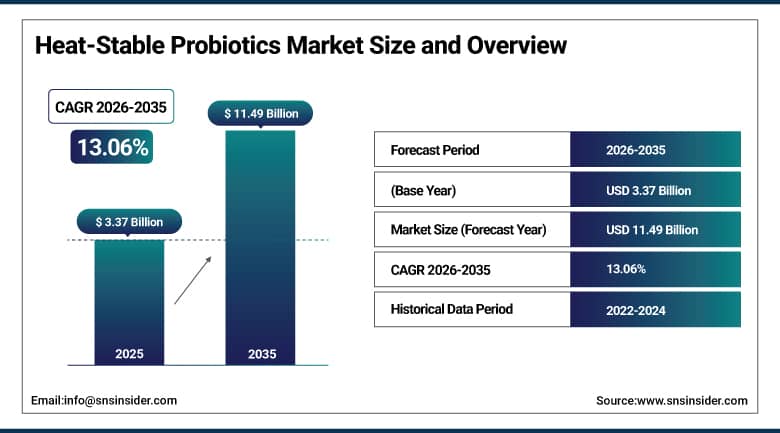
The Heat-Stable Probiotics Market was valued at USD 3.37 billion in 2025 and is expected to reach USD 11.49 billion by 2035, growing at a CAGR of 13.06% from 2026-2035.
The Heat-Stable Probiotics Market will be influenced by the growing demand for probiotic products that can maintain their viability and effectiveness under high-temperature conditions during manufacturing, storage, transportation, and distribution. Increasing consumer awareness of gut health, digestive wellness, immunity and preventive healthcare is propelling the adoption of probiotics in functional foods, dietary supplements, infant nutrition and animal feed. The growing demand for shelf-stable probiotic formulations is also supporting the market growth, especially in regions with warm climatic conditions and limited cold-chain infrastructure. The market is further supported by the developments in microencapsulation and spray drying, freeze drying and protective formulation technologies that improve the probiotic stability and extend the product shelf life. The rising applications of heat stable probiotic strains including Bacillus Coagulans and Bacillus subtilis across food and beverage, pharmaceutical, dietary supplement and animal nutrition industries are creating new growth opportunities. Growing R&D spending, product innovations and regulatory support for probiotic ingredients are likely to further boost the market.
⮞In April 2026, Novonesis launched Bovacillus, a heat-stable probiotic for dairy cattle feed designed to withstand temperatures up to 95°C and support animal health and feed efficiency.
To Get More Information On Heat-Stable Probiotics Market - Request Free Sample Report
Heat-Stable Probiotics Market Trends:
-
Growing demand for heat-stable probiotic strains that maintain viability and functionality during high-temperature food processing and storage.
-
Rising adoption of spore-forming probiotic strains, particularly Bacillus coagulans, Bacillus subtilis, and Bacillus clausii, in functional foods and dietary supplements.
-
Increasing incorporation of heat-stable probiotics into baked goods, hot beverages, ready-to-drink beverages, and other shelf-stable food products.
-
Continued advancements in microencapsulation, strain engineering, and stabilization technologies improving probiotic survival during manufacturing, transportation, and storage.
-
Expanding consumer preference for gut health, digestive wellness, and functional nutrition products driving the development of heat-stable probiotic formulations.
U.S. Heat-Stable Probiotics Market Outlook:
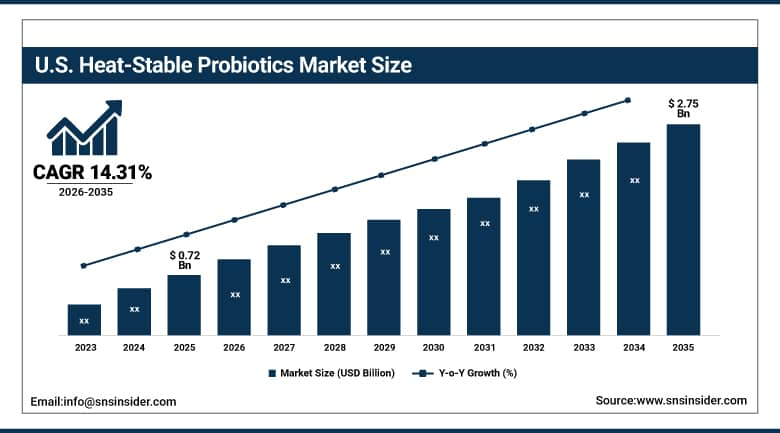
The U.S. Heat-Stable Probiotics Market was valued at USD 0.72 Billion in 2025 and is expected to reach USD 2.75 Billion by 2035, growing at a CAGR of 14.31% from 2026-2035.
U.S. growth of the Heat-Stable Probiotics Market will remain supported by increasing demand for functional foods and dietary supplements, rising consumer awareness regarding gut health and digestive wellness, and growing investments by food and biotechnology companies in the development of advanced probiotic formulations. Established probiotic manufacturers and growing research on heat resistant bacterial strains will further support the market growth. Key demand drivers include domestic demand from food and beverage applications, which is the largest segment, and dietary supplements, which are expected to be among the fastest-growing application areas The growth of these applications can be attributed to the rising demand for convenient probiotic products, growing functional food consumption, and advancements in the microbial encapsulation and stabilization technologies.
⮞In October 2025, Actus Nutrition launched BeneSpore™ BV379, a heat-stable, spore-forming Bacillus velezensis probiotic ingredient for dietary supplements, beverages, and fortified foods.
Heat-Stable Probiotics Market Segment Analysis:
-
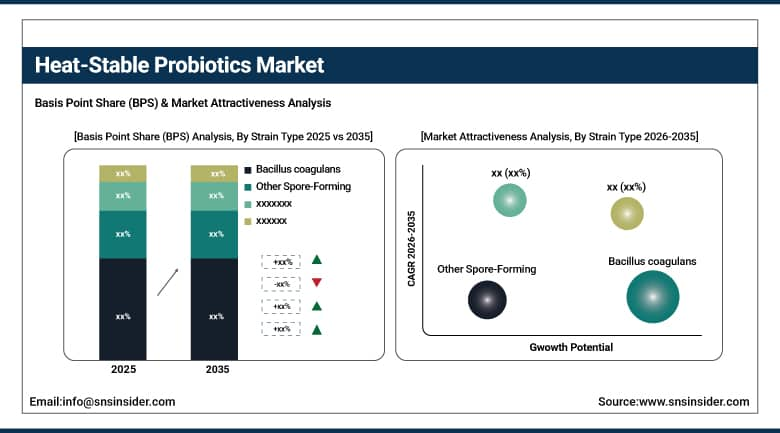
By Strain Type, the Bacillus coagulans segment dominated the Heat-Stable Probiotics Market with approximately 38.46% share in 2025, while the Bacillus coagulans segment is also the fastest growing with a CAGR of approximately 14.57%.
-
By Application, the Shelf-Stable Supplements segment dominated the Heat-Stable Probiotics Market with approximately 32.48% share in 2025, while the Ready-to-Drink Beverages segment is the fastest growing with a CAGR of approximately 14.45%.
-
By Distribution Channel, the Pharmacies segment dominated the Heat-Stable Probiotics Market with approximately 36.42% share in 2025, while the E-commerce segment is the fastest growing with a CAGR of approximately 14.85%.
-
By End Use, the Dietary Supplements segment dominated the Heat-Stable Probiotics Market with approximately 38.42% share in 2025, while the Clinical Nutrition segment is the fastest growing with a CAGR of approximately 13.63%.
By Strain Type, Bacillus coagulans dominates and also grows fastest
Bacillus coagulans is dominating the Heat-Stable Probiotics Market due to its high heat tolerance, spore-forming ability and ability to remain viable during the manufacturing, processing and storage processes. Its stability under demanding temperature conditions makes it suitable for inclusion in a wide range of functional food, dietary supplements and beverages. The segment is also expected to grow on the back of rising demand for probiotics with longer shelf life.
Bacillus coagulans is also the fastest growing segment due to growing product development activities and increased demand for heat resistant probiotic strains. Its ability to survive harsh processing conditions and still function in the finished product is driving manufacturers to expand its use in baked goods, beverages and shelf-stable supplements. Growing consumer preference for convenient probiotic products is likely to drive the segment growth.
By Application, Shelf-Stable Supplements dominates and Ready-to-Drink Beverages grows fastest
shelf-stable supplements dominate the heat-stable probiotics market. The demand for convenient probiotic formulations that do not require special storage conditions but maintain their efficacy is increasing among consumers. Manufacturers can also use heat-stable probiotic strains to develop capsules, powders, tablets and other forms of supplements with improved storage stability. Shelf-stable probiotic supplements are also being fueled by the growing consumer awareness around digestive health, immunity and preventive wellness.
Ready-to-Drink Beverages is the fastest growing application segment, driven by the increasing demand for functional beverages that combine convenience with digestive and overall health benefits. Better heat-resistant probiotic formulations are enabling manufacturers to incorporate live probiotic strains in beverage products while maintaining product stability. The segment is likely to see growth through increasing interest in functional drinks, on-the-go nutrition and novel probiotic beverage formulations.
By Distribution Channel, Pharmacies dominates and E-commerce grows fastest
Pharmacies are the dominating segment in the Heat-Stable Probiotics Market due to the presence of well-established healthcare distribution networks and consumer trust in pharmacy-recommended nutritional products. Pharmacists and healthcare professionals in pharmacies provide probiotic supplements to help make well-informed purchasing decisions. The increasing awareness of consumers about digestive health and preventive nutrition is boosting the sales of heat-stable probiotic formulations through pharmacies and specialized healthcare retail outlets.
E-commerce is the fastest growing distribution channel with increasing number of purchases online of dietary supplements and functional nutrition products. Digital platforms are providing consumers with increased access to a wider selection of probiotic brands, formulations and price points. As subscription-based purchases and easy home delivery continue to grow as direct-to-consumer sales, manufacturers are feeling the pressure to ramp up their online presence and develop digital distribution strategies.
By End Use, Dietary Supplements dominates and Clinical Nutrition grows fastest
Dietary Supplements dominate the Heat-Stable Probiotics Market owing to increasing consumer attention towards digestive health, immunity and preventive healthcare. Heat-stable probiotic strains are commonly included in capsules, tablets, powders and other nutritional products, as they can survive processing and storage conditions. The segment is further supporting the leading market position due to increasing demand for convenient supplements with longer shelf stability.
Clinical nutrition segment is the fastest-growing end-use segment on account of increasing demand for specialized nutritional products to support digestive health and overall wellness among patients and individuals with specific dietary needs. Heat-stable probiotic formulations offer flexibility in storage and are compatible with a range of clinical nutrition products. The increasing interest in targeted nutritional interventions and advancements in probiotic formulation technologies are likely to support segment growth.
Regional Analysis:
|
Region |
Major Country |
Share within Region, 2025 (%) |
|---|---|---|
|
North America |
United States |
78.36% |
|
Asia Pacific |
China |
30.47% |
|
Europe |
Germany |
24.63% |
|
Latin America |
Brazil |
48.72% |
|
Middle East & Africa |
South Africa |
27.83% |
Asia Pacific Heat-Stable Probiotics Market Insights
Asia Pacific is anticipated to witness the significant CAGR of approximately 12.32% among all regional segments of the Heat-Stable Probiotics Market throughout the forecast period from 2026 to 2035 on account of increasing consumer awareness of gut health, rising disposable incomes, and growing demand for functional foods and dietary supplements. China will be the largest contributor from the region due to its large consumer base, growing functional food industry and rising adoption of probiotic-enriched products.
Japan’s contribution will be backed by its established functional food and nutraceutical industries and strong consumer interest in digestive health and scientifically formulated probiotic products. India will have a growing role to play in raising health awareness, expanding food and beverage manufacturing and rising appetite for affordable probiotic supplements and functional food products.
Get Customized Report as Per Your Business Requirement - Enquiry Now
North America Heat-Stable Probiotics Market Insights
North America accounted for approximately 27.36% of the global Heat-Stable Probiotics Market in 2025, driven by rising consumer demand for functional foods, dietary supplements, and products supporting gut health and digestive wellness. The United States accounts for a major chunk of the regional demand, owing to the presence of a mature functional food and nutraceuticals industry, high consumer awareness about the benefits of probiotics, and the presence of key players in the probiotics market.
Canada contributes additional regional demand through increasing consumption of health-focused food and beverage products and growing interest in digestive health solutions. North America’s dominance as the largest regional market for heat-stable probiotics is further reinforced by the continued advancements in probiotic formulation technologies, especially the development of heat-resistant bacterial strains that can maintain their stability during processing and storage conditions.
Europe Heat-Stable Probiotics Market Insights
Europe is a key regional market for heat-stable probiotics, underpinned by growing consumer demand for functional foods, digestive health products and science-backed nutritional solutions. Germany accounts for a considerable share of regional demand, buoyed by its established food & beverage manufacturing industry, strong nutraceutical market and rising adoption of probiotic enriched products.
The United Kingdom and France contribute additional regional demand through rising awareness of gut microbiome health, increasing consumption of dietary supplements, and growing interest in functional dairy and non-dairy products. The growth of the European market is supported by further development of food processing technologies coupled with increased investments in the development of stable probiotic formulations.
MEA & Latin America Heat-Stable Probiotics Market Insights
The Middle East & Africa is an emerging market for heat-stable probiotics. The demand for heat-stable probiotics in this region is being driven by growing awareness of digestive health, increasing disposable incomes and increasing interest in functional foods and dietary supplements. The demand in the region is driven by countries like the United Arab Emirates and Saudi Arabia owing to the growing health and wellness market, increasing availability of probiotic products and increasing consumer interest in preventive nutrition. South Africa’s developing nutraceutical and functional food industries also create further demand.
In Latin America, the Heat-Stable Probiotics Market is dominated by Brazil, which represents a major contributor to regional demand owing to its large consumer base, expanding functional food industry, and increasing awareness of digestive wellness. Demand in Mexico is boosted by rising consumption of fortified food and beverage products and a growing interest in probiotic supplements. The growth in modern retail channels and the growing availability of functional nutritional products is slowly supporting the regional market growth.
Market Dynamics:
Growth Drivers: Rising Demand for Functional Food Ingredients and Improved Probiotic Stability
Rising consumer demand for functional foods, dietary supplements and products that support digestive and gut health is a primary growth driver for the Heat-Stable Probiotics Market. “Consumers are increasingly looking for convenient food products that provide additional health benefits. The trend is further reinforced by the increasing use of probiotics in functional beverages, dietary supplements, bakery goods, plant-based dairy products, and other processed food categories, where improved thermal stability enables producers to add beneficial microbes to products that are processed at high temperatures.
Innovations in probiotic strain development, encapsulation technologies and formulation techniques that enhance probiotic survival through manufacturing, storage and distribution are another major source of market growth. Another factor driving market growth is the growing demand for shelf-stable probiotic products. Food and beverage manufacturers are focusing on ingredients that can maintain viability under different temperature conditions without the need for extensive refrigeration.
Restraints: High Development Costs and Strain Viability Challenges
High research and development costs related to the discovery, development, and commercialization of heat-resistant probiotic strains are a considerable restraint on the Heat-Stable Probiotics Market, as manufacturers need to conduct thorough testing to confirm microbial survival, stability, and functional performance at elevated processing temperatures. This dynamic is made more complex by the technical difficulties of maintaining probiotic viability during food processing especially in applications requiring baking, pasteurization, extrusion, and other heat-intensive manufacturing processes.
Differences in strain performance in different food matrices and storage conditions also limit use on a broad scale, as probiotic survival can be affected by moisture content, pH, exposure to oxygen, and interactions with other ingredients. Regulatory requirements for probiotic safety, health claims and product labelling vary between jurisdictions, adding complexity and increasing the costs of commercialization for manufacturers looking to enter international markets.
Opportunities: Expansion of Functional Foods and Advancements in Probiotic Formulation Technologies
Increasing incorporation of heat-stable probiotics in functional foods and beverages is a substantial growth opportunity for the Heat-Stable Probiotics Market as manufacturers are increasingly exploring applications beyond conventional refrigerated dairy products. The development of heat-resistant strains such as Bacillus coagulans and Bacillus subtilis allows for the inclusion of probiotics in baked goods, nutritional bars, powdered beverages, infant nutrition products, and shelf-stable functional foods. Manufacturers that can develop commercially viable probiotic formulations with consistent microbial viability are expected to benefit from expanding demand across various food and beverage categories.
Increasing investment in microencapsulation, advanced drying techniques, and strain-specific formulation technologies is yet another long-term opportunity for market participants to improve probiotic’s stability and functionality. With growing consumer awareness on gut health and preventive nutrition, suppliers of scientifically proven, application-specific heat-stable probiotic solutions are poised to benefit from the increasing demand in the food, beverage, dietary supplement and animal nutrition industries.
Recent Developments:
-
November 2025: Evonik introduced an enhanced Ecobiol® spore-forming probiotic featuring 46% faster outgrowth, strengthening its poultry nutrition portfolio.
-
August 2025: Nucaps launched UHTCAPS, an R&D project developing heat-resistant microcapsules to protect probiotics during ultra-high-temperature food processing.
-
November 2024: MilkyMist partnered with SIG and AnaBio Technologies to launch long-life probiotic buttermilk using encapsulation and aseptic filling technologies.
Heat-Stable Probiotics Market Key Players:
-
Kerry Group plc (Ganeden Biotech)
-
Sabinsa Corporation
-
Lallemand Inc.
-
Novonesis A/S (Chr. Hansen)
-
Morinaga Milk Industry Co., Ltd.
-
International Flavors & Fragrances Inc. (IFF)
-
Archer Daniels Midland Company (ADM)
-
BASF SE
-
Ingredion Incorporated
-
Unique Biotech Limited
-
Sanzyme Biologics
-
Deerland Probiotics & Enzymes
-
Mitsubishi Chemical Group Corporation
-
Wecare Probiotics Co., Ltd.
-
Synbio Tech Inc.
-
Probi AB
-
Lesaffre Group
-
SporeGen Ltd.
-
Probiotical S.p.A.
-
Advanced Enzyme Technologies Limited
Heat-Stable Probiotics Market Report Scope:
| Report Attributes | Details |
|---|---|
| Market Size in 2025 | USD 3.37 Billion |
| Market Size by 2035 | USD 11.49 Billion |
| CAGR | CAGR of 13.06% From 2026 to 2035 |
| Base Year | 2025 |
| Forecast Period | 2026-2035 |
| Historical Data | 2022-2024 |
| Report Scope & Coverage | Market Size, Segments Analysis, Competitive Landscape, Regional Analysis, DROC & SWOT Analysis, Forecast Outlook |
| Key Segments | • By Strain Type (Bacillus coagulans, Bacillus subtilis, Bacillus clausii, Other Spore-Forming) • By Application (Baked Goods, Hot Beverages, Shelf-Stable Supplements, Ready-to-Drink Beverages, Functional Foods) • By Distribution Channel (Pharmacies, Supermarkets, E-commerce, Food Service Distributors) • By End Use (Food & Beverage Manufacturing, Dietary Supplements, Clinical Nutrition, Animal Feed) |
| Regional Analysis/Coverage | North America (US, Canada), Europe (Germany, UK, France, Italy, Spain, Russia, Poland, Rest of Europe), Asia Pacific (China, India, Japan, South Korea, Australia, ASEAN Countries, Rest of Asia Pacific), Middle East & Africa (UAE, Saudi Arabia, Qatar, South Africa, Rest of Middle East & Africa), Latin America (Brazil, Argentina, Mexico, Colombia, Rest of Latin America). |
| Company Profiles | Kerry Group plc (Ganeden Biotech), Sabinsa Corporation, Lallemand Inc., Novonesis A/S (Chr. Hansen), Morinaga Milk Industry Co., Ltd., International Flavors & Fragrances Inc. (IFF), Archer Daniels Midland Company (ADM), BASF SE, Ingredion Incorporated, Unique Biotech Limited, Sanzyme Biologics, Deerland Probiotics & Enzymes, Mitsubishi Chemical Group Corporation, Wecare Probiotics Co., Ltd., Synbio Tech Inc., Probi AB, Lesaffre Group, SporeGen Ltd., Probiotical S.p.A., Advanced Enzyme Technologies Limited |

Frequently Asked Questions
Leading companies in the Heat-Stable Probiotics Market include Kerry Group plc, Sabinsa Corporation, Lallemand Inc., Novonesis A/S, and Morinaga Milk Industry Co., Ltd., among others.
Key opportunities include expanding incorporation of heat-stable probiotics into functional foods and beverages, and advancements in microencapsulation and formulation technologies improving probiotic stability.
Rising demand for functional foods, dietary supplements, and digestive health products, combined with advancements in heat-resistant probiotic strains, is driving market growth.
The Shelf-Stable Supplements segment dominated the Heat-Stable Probiotics Market with approximately 32.48% share in 2025, supported by increasing demand for convenient probiotic formulations.
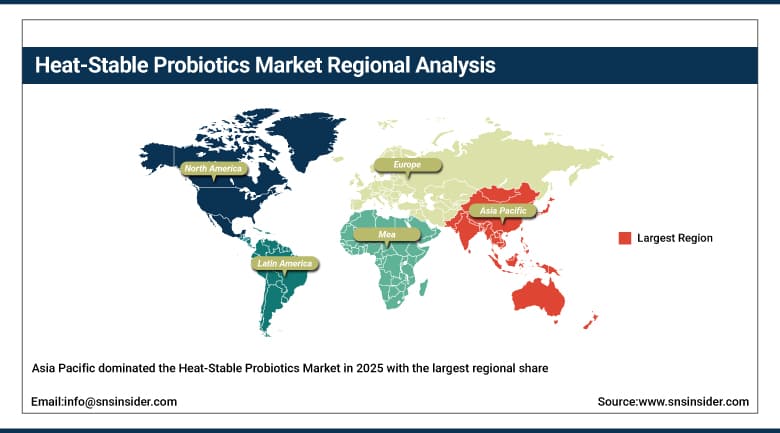
Asia Pacific dominated the Heat-Stable Probiotics Market in 2025 with the largest regional share, driven by expanding functional food industries and increasing probiotic consumption.
