
Power T&D Equipment Market Report Scope & Overview:
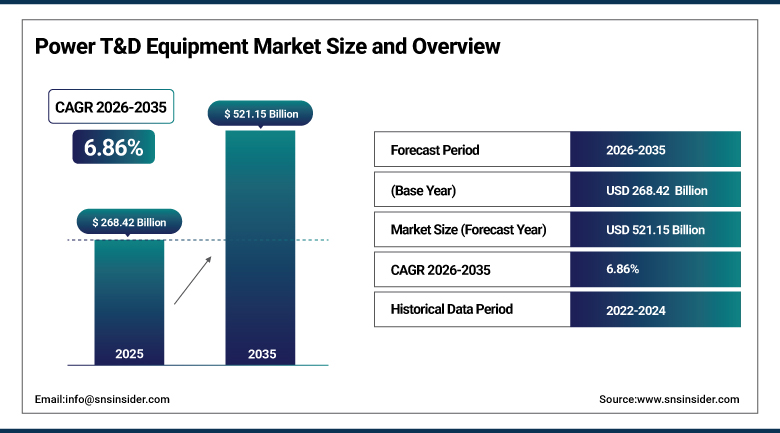
The Power T&D Equipment Market was valued at USD 268.42 Billion in 2025 and is expected to reach USD 521.15 Billion by 2035, growing at a CAGR of 6.86% from 2026-2035.
The Power T&D Equipment Market is expected to witness growth as the utilities and grid operators invest in upgrading outdated grids, connecting renewable generators, and meeting the growing electricity demand. The transformers, switchgear, cables, circuit breakers, and protection systems are crucial components of power transmission and distribution, and much of the equipment currently installed in North America and Europe is old. As the electricity consumption grows due to an increased number of electric vehicles, heat pumps, industrial electricity consumption, and artificial intelligence data centers, the governments fund inter-regional transmission, offshore wind farms, and HVDC connections between the wind and solar parks and the grid. The countries also set specific goals and change regulations and permit procedures to raise the grid investment rate.
⮞SF6-free high-voltage technology reached a new milestone when GE Vernova launched, in August 2026 at CIGRE Paris, its F35g 170 kV gas-insulated switchgear, completing its SF6-free range for transmission grids and marking ten years of its g³ gas innovation.
To Get more information Power T&D Equipment Market - Request Free Sample Report
Power T&D Equipment Market Trends
-
Rising adoption of SF6-free gas-insulated and air-insulated switchgear.
-
Growing deployment of HVDC transmission links for renewable and interregional power.
-
Expanding investment in large power transformer manufacturing capacity.
-
Increasing use of digital substations and IEC 61850-based protection systems.
-
Rising grid connection demand from AI data centers and industrial electrification.
-
Growing replacement of aging transformers, cables, and breakers in mature grids.
U.S. Power T&D Equipment Market Outlook
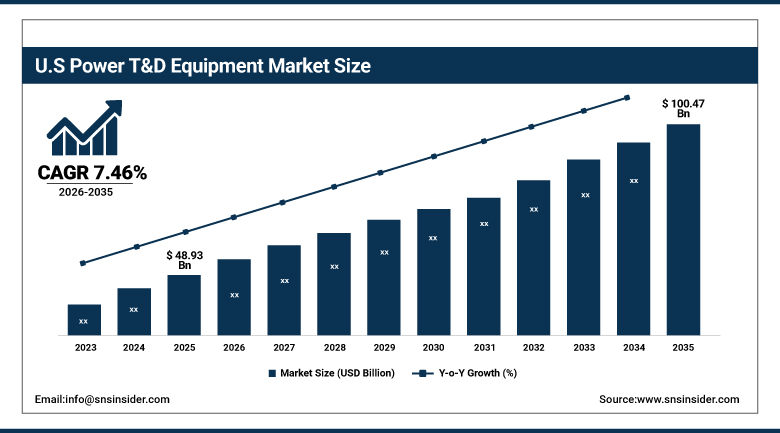
The U.S. Power T&D Equipment Market was valued at USD 48.93 Billion in 2025 and is expected to reach USD 100.47 Billion by 2035, growing at a CAGR of 7.46% from 2026-2035.
The U.S. Power T&D Equipment Market continues to grow due to aging grid replacement, increased demand for power, and large utility investment programs. Much of the transformers and transmission lines in the U.S. are past their design life, leading to accelerated investment in replacement and fortification initiatives. Data center development in Virginia, Texas, Arizona, Ohio, and Georgia is leading to investments in substations and transmission, with manufacturing expansion and building electrification adding additional demand. Federal resilience programs, state renewable energy targets, and inter-regional transmission planning are enabling the construction of new high voltage transmission lines. Wildfire prevention measures in California and the western states are increasing demand for covered conductors and underground cables.
⮞Large power transformer supply in the United States advanced when Hitachi Energy broke ground, in June 2026, on its USD 457 million transformer factory in South Boston, Virginia, which is expected to become the largest producer of large power transformers in the country and create 825 jobs.
Power T&D Equipment Market Segment Analysis
-
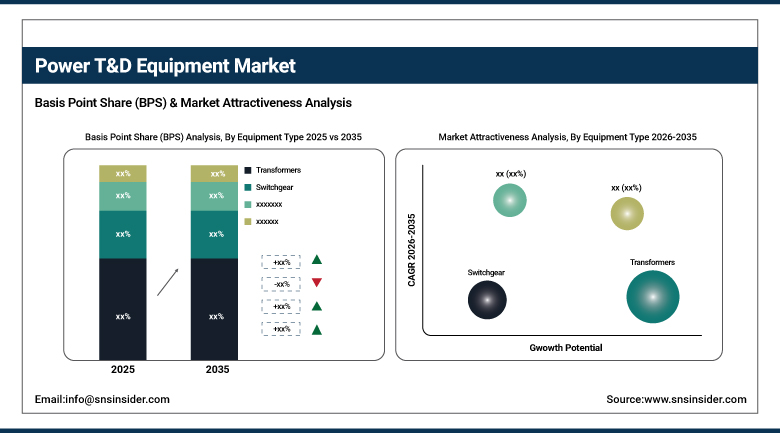
By Equipment Type, the Transformers segment dominated the Power T&D Equipment Market with approximately 31.42% share in 2025, while the Switchgear segment is the fastest growing with a CAGR of approximately 7.84%.
-
By Voltage, the Medium segment dominated the Power T&D Equipment Market with approximately 38.26% share in 2025, while the Extra-High segment is the fastest growing with a CAGR of approximately 8.42%.
-
By Application, the Distribution segment dominated the Power T&D Equipment Market with approximately 58.64% share in 2025, while the Transmission segment is the fastest growing with a CAGR of approximately 7.26%.
-
By End-User, the Utilities segment dominated the Power T&D Equipment Market with approximately 62.48% share in 2025, while the Commercial segment is the fastest growing with a CAGR of approximately 8.14%.
By Equipment Type, Transformers Dominate the Power T&D Equipment Market and Switchgear Grows Fastest
Transformers dominated the market in 2025 as they are needed at all levels of power transmission from step-up transformers in generators to large power transformers in transmission substations and even distribution transformers that feed houses and commercial premises. There are literally tens of millions of distribution transformers in power grids around the world. High cost per unit, long time frame of production, and their crucial function in voltage conversion make them the top-grossing segment. Transformers are being replaced with newer versions, installed to add capacity, and are being used in renewable facilities and data centers. Chronic undersupply and orders backlog at the biggest players sustain the dominance of transformers in the market.
Switchgear is the fastest-growing equipment type due to the expansion of substations by utilities and other players as well as upgrade of protective and control systems by the former. Increasing demand for batteries and EV charging stations is fueling demand for medium voltage switchgear. In addition, increasing popularity of gas-insulated switchgear for dense cities and offshore platforms on account of their smaller size and SF6-free switchgears manufactured by Hitachi Energy, Siemens Energy, GE Vernova, and Schneider Electric are replacing old-fashioned solutions. Digital switchgears that are equipped with sensors and remote monitoring features improve reliability and decrease the cost of maintaining them.
⮞September 2026: Hitachi announced a planned USD 528 million investment in a new transformer factory in Mississippi, expanding U.S. manufacturing capacity for critical grid equipment. The project adds to industry efforts to address transformer supply constraints and rising demand from grid modernization and data center development.
By Voltage, Medium Dominates the Power T&D Equipment Market and Extra-High Grows Fastest
Medium voltage equipment led the market in 2025, due to the fact that distribution networks working at the range of 1 kV to 72.5 kV make the majority in terms of number of transformers, switchgear, cables, and protective elements. Additionally, medium voltage networks are also serving as the key interface of distributed energy resources in many countries. Medium voltage equipment serves for connecting substations with commercial facilities, industrial sites, data centers, and residential feeders. Expansion of urban networks, grid automation, and electrification of transportation and heating add up to the growing installations.
The extra-high voltage category is the fastest growing one as various countries lay down extra high voltage lines and HVDC cables for transporting energy from distant places to the load centers. These extra-high voltage transmission lines are capable of carrying up to several gigawatts of power over distances of more than 1000 km. The projects under development in China, India, Germany, the U.S. and the Middle East have been using 500 kV, 765 kV and higher voltage level technology to minimize transmission losses. Wind farms offshore in Europe and Asia are making use of extra high voltage cables and converters.
⮞May 2026: Siemens Energy highlighted its role in Germany’s SuedLink HVDC transmission project, which is designed to carry up to 4 GW of renewable electricity across approximately 700 kilometers. Converter stations and transformers support high-capacity transmission between renewable-rich northern areas and southern demand centers.
By Application, Distribution Dominates the Power T&D Equipment Market and Transmission Grows Fastest
Distribution led the market in 2025, since distribution networks have the maximum number of devices, such as distribution transformers, ring main units, reclosers, sectionalizers, cables, and overhead lines. Utility investments in distribution infrastructure are higher than in transmission infrastructure for the majority of utility companies across the world. Utilities invest huge amounts in the modernization of their distribution networks to serve new consumers, install rooftop solar photovoltaic panels, and electric vehicle charging stations, besides reducing outages. Grid automation, smart meters, and distribution management systems are raising the worth of installed equipment per feeder. The size of distribution networks, along with the reliability programs, makes distribution the largest market segment.
Transmission is the fastest-growing application due to investments by utilities and governments in building new high-voltage transmission lines, substations, and interconnectors in order to add renewable power and to increase grid resilience. Investment in transmission systems is also becoming an important aspect of many countries’ national energy security strategies. Numerous areas have been suffering from transmission congestion, which is hampering development of wind, solar and storage installations, leading to plans for national grid expansion in the U.S., Europe, India, China and Australia. HVDC projects and offshore wind farm connections will continue to require sophisticated converter stations, cabling and high-voltage switchgear.
⮞September 2026: Brazil’s electricity regulator, ANEEL, confirmed a transmission auction scheduled for October 30, 2026, covering eight lots across seven states. The tender includes 1,866 kilometers of new transmission lines and 12,694 MVA of transformer capacity, creating prospective demand for transmission infrastructure and substation equipment.
By End-User, Utilities Dominate the Power T&D Equipment Market and Commercial Grows Fastest
Utilities led the market in 2025, as they owned and operated the bulk of power infrastructure in the world and accounted for the largest proportion of purchases of equipment. Purchasing decisions by utilities determined the standards of the products and technology adoption within the industry. The utilities bought transformers, switchgears, cables, and protection systems to upgrade the old infrastructure, increase the capacity of the grids, and to integrate new generation of power. The regulated investment budgets for utilities and government funding ensured the stability and predictability of demand. The procurement processes involving leading companies and the transmission expansion programs ensured that the utilities continued to be the largest end-users.
The commercial segment is the fastest-growing end user as data centers, hospitals, airports, office campuses, and retail facilities invest in their own substations, switchgear, and transformers. Many operators now build private substations to secure faster and more reliable grid access. AI data centers in particular require large medium voltage and high-voltage connections, redundant power distribution, and fast-acting protection equipment. Commercial buildings are adding electric vehicle charging, heat pumps, and on-site solar and storage, increasing electrical capacity requirements. Growing demand for reliable power, faster grid connections, and modular prefabricated substations continues to drive the fastest growth in the commercial end-user segment over the forecast period.
⮞August 2026: Hitachi Energy announced a USD 300 million investment to expand power transformer and component manufacturing in Hefei, China. The investment is intended to strengthen manufacturing capacity and supply-chain resilience as utilities and other electricity users require more grid equipment.
Regional Analysis
|
Region |
Major Country |
Share within Region, 2025 (%) |
|---|---|---|
|
North America |
United States |
84.86% |
|
Asia Pacific |
China |
58.42% |
|
Europe |
Germany |
24.36% |
|
Latin America |
Brazil |
42.64% |
|
Middle East & Africa |
Saudi Arabia |
31.28% |
North America Power T&D Equipment Market Insights
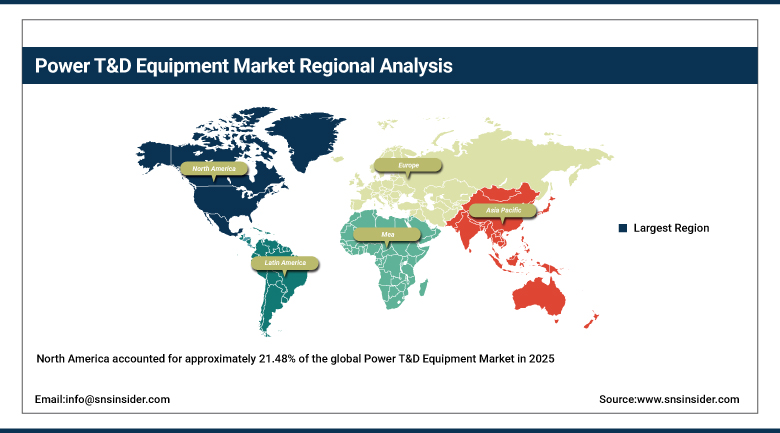
North America accounted for approximately 21.48% of the global Power T&D Equipment Market in 2025 and is the fastest-growing regional market, expanding at a CAGR of approximately 7.38% from 2026 to 2035. Utility capital expenditure plans in the region have reached record levels in recent years. Growth is supported by aging grid replacement, rapid data center expansion, rising electricity demand, and federal and state grid resilience programs. Transformer and switchgear shortages have prompted Hitachi Energy, Siemens Energy, Eaton, Prolec GE, Schneider Electric, and ABB to expand regional production, while utilities are increasing multiyear capital spending on transmission and distribution networks across the region.
The United States anchors regional demand through utility investment in substations, transmission lines, wildfire mitigation, and storm hardening, along with large grid connections for data centers and manufacturing plants. Southeastern and Midwestern states are seeing particularly strong growth in large industrial and data center loads. Canada is investing in interprovincial transmission, hydropower connections, and electrification programs in Ontario, Quebec, and British Columbia. Mexico is expanding transmission capacity to support nearshoring-driven industrial growth and renewable generation. Strong order backlogs at equipment manufacturers, rising interconnection queues, and continued investment in high-voltage infrastructure are expected to keep North America the fastest-growing regional market for power transmission and distribution equipment over the forecast period.
⮞September 2026: Hitachi announced a USD 528 million investment in a new transformer manufacturing facility in Mississippi. The project is expected to expand domestic production capacity and strengthen the supply of grid equipment amid increasing electricity demand and infrastructure modernization needs.
Get Customized Report as per Your Business Requirement - Enquiry Now
Europe Power T&D Equipment Market Insights
Europe holds a significant share of the Power T&D Equipment Market, fueled by the EU’s Action Plan for Grids, offshore wind growth, and cross-border interconnections. Renewable energy target commitments need substantial strengthening of the transmission infrastructure network in Europe. Germany is the biggest European market by value, building north-south HVDC transmission lines like SuedLink and SuedOstLink and developing distribution networks for electric vehicles and heat pumps. Framework agreements of several years' duration are being awarded to companies like TenneT, Amprion, 50Hertz, RTE, and National Grid for cables, converters, transformers, and switchgears.
The United Kingdom, France, the Netherlands, Italy, and Spain are increasing their capacity for transmitting power through connecting their offshore wind farms, solar farms, and battery storage plants while renewing their aged distribution infrastructure. The European utilities are also making investments in the automation of their distribution systems owing to the increased production of solar rooftop installations. There is also a growing trend toward SF6-free switchgears owing to the EU F-Gas regulation, which creates opportunities for the sale of new equipment types as replacement units. The companies like Siemens Energy, Hitachi Energy, Prysmian, Nexans, and NKT are increasing their European manufacturing facilities for their cables, transformers, and HVDC technologies.
⮞May 2026: Siemens Energy detailed its contribution to Germany’s SuedLink HVDC project, which is designed to transport up to 4 GW of renewable electricity across around 700 kilometers. The project requires high-capacity converter stations and transformers to improve long-distance electricity transmission.
Asia Pacific Power T&D Equipment Market Insights
Asia Pacific is the largest regional market, holding approximately 46.36% of global revenue in 2025 and expanding at a CAGR of approximately 6.92% from 2026 to 2035. The country commissions more new transmission capacity each year than any other nation. The region's leadership reflects China's massive investment in ultra-high-voltage transmission, distribution upgrades, and renewable connections through State Grid Corporation of China and China Southern Power Grid. Leading Chinese manufacturers, including TBEA, China XD Electric, and Pinggao Group, supply large volumes of transformers, switchgear, and cables for both regional and international projects, strengthening the region's influential position in global grid equipment supply chains.
India is a major growth contributor, as it builds its interstate transmission network, green energy corridors, and distribution initiatives to cater to the rising demand for energy and the renewable energy targets set by the country. The regional governments are also encouraging manufacturing facilities for the grid equipment in order to cut down on imports. Japan and South Korea are focusing on grid reinforcement and connections for offshore wind, along with HVDC lines. Australia is creating transmission facilities as part of the national renewable energy zones initiative. The Southeast Asian countries such as Indonesia, Vietnam, and the Philippines are upgrading their network facilities due to high demands for electricity in the region.
⮞August 2026: Hitachi Energy announced a USD 300 million investment to expand power transformer and component manufacturing in Hefei, China. The expansion is intended to reinforce China’s role in the company’s global manufacturing network and help address supply constraints for critical grid equipment.
MEA & Latin America Power T&D Equipment Market Insights
The Middle East & Africa represents a growing market, driven by markets such as Saudi Arabia, the UAE, Qatar, and South Africa. With high population and urbanization, there is a significant increase in demand for power in this region. The Gulf nations are developing their transmission lines, substations, and interconnections to provide power for mega projects, industrial areas, and large-scale solar plants under their diversification strategies. The Kingdom of Saudi Arabia is increasing its high voltage transmission and plans for HVDC links, while the UAE is improving its grid system to cater to increased demand.
Latin America is developing steadily, due to the efforts of Brazil, Mexico, Chile, and Colombia. The increase in renewables in the area has created a greater demand for grid interconnections through auctions held in the region. Brazil has been carrying out significant transmission auctions involving line and substation interconnections linking wind and solar resources in the northern region to electricity load centers in the southern part of the country. Chile has been establishing HVDC and high voltage interconnections in order to transport power from its northern regions while Colombia and Peru have been developing transmission in order to ensure reliability and rural electrification.
⮞September 2026: Brazil’s ANEEL confirmed a transmission auction for October 30, 2026, with estimated investment of approximately BRL 8.9 billion. The planned projects cover eight lots in seven states, including new transmission lines and additional substation transformer capacity.
⮞February 2026: Hitachi Energy reported delivery from its Brazilian manufacturing facility of 14 HVDC transformers intended for a Saudi Arabian interconnection project. Each transformer is rated at 580 MVA and 380 kV, highlighting demand for specialized equipment to support high-capacity electricity transmission in the region.
Market Dynamics
Growth Drivers: Grid Modernization and Rising Electricity Demand from Data Centers and Electrification
Modernization of the grid is the key factor behind the growth of the Power T&D Equipment market, given that utilities upgrade their aged transformers, switch gears, cables, and protective equipment, which was installed long ago. Moreover, the share of the outages caused by the aged equipment is getting higher, along with the expenses on maintenance. The majority of the installed base of equipment in North America, Europe, and Japan is near or over its operational lifetime. The investments in smart substations, automated distribution, and protection systems will be used to ensure reliability and resilience from the effects of severe weather.
Growth in the demand for electricity from data centers and electrification has boosted the growth of the market further, as the increased demand in AI data centers, electric vehicles, heat pumps, and industrial electrification provides significant additional load to the power grids. The demand for electricity has been growing in some advanced economies after a period of stagnancy in the demand for electricity. Modern data centers require hundreds of megawatts of energy, which requires building new substations, connections at high voltage, and large transformers. Industrial manufacturing, hydrogen production, and industrial electrification have also increased the demand for the capacity of power grids.
⮞September 2026: Schneider Electric introduced software-defined medium-voltage switchgear for AI-focused data center infrastructure, designed to accelerate manufacturing and commissioning while allowing upgrades without downtime. The development illustrates how rising data center electricity requirements are encouraging investment in advanced distribution equipment.
Restraints: Supply Chain Constraints and Long Permitting Timelines
Constraints within the supply chain continue to be an important limiting factor for the Power T&D Equipment Market, as the need for transformers, switch gears, and high voltage cables exceeds the capacity to manufacture them. Equipment producers are focusing on long-term contracts with utilities, leaving less equipment for smaller companies to purchase. It has taken up to two years to manufacture large power transformers, thus causing delays in grid development and connection works. Grain oriented electrical steel, copper, components, and personnel shortages complicate production processes. Increasing raw materials costs affect equipment costs for utilities, but manufacturers are building more factories that take several years to start producing at full capacity.
Further delaying the growth of the market are lengthy permitting processes, where many transmission lines take years to be developed because of environmental impact assessments, land acquisition, and multiple jurisdictional permits. Many interconnection queues in different nations currently have more capacity than the current grid systems can accommodate. Obstruction from local communities, disagreements over right-of-way, and complex cost allocation rules can prevent interconnection lines from being built. Approval of utilities to increase tariffs could hinder utilities' ability to raise their capital expenditure. Financial difficulties of utilities in developing nations could also slow down development of grid infrastructure.
Opportunities: HVDC and Offshore Wind Connections and SF6-Free and Digital Substation Equipment
Connections using HVDC and offshore wind technology have major potentials for the Power T&D Equipment Market, since countries are increasingly looking for ways of linking through long distance and underwater connections their networks and renewable energy sources. The value of a contract for a converter station installation is usually higher than one billion dollars. HVDC technology includes not only a converter station but also power transformers, high voltage cables and controls, thus the value of a project becomes very attractive for top manufacturers. Europe's targets in offshore wind, China's ultra-high voltage strategy, India's renewable corridors and the U.S. interregional projects contribute to the growing number of projects in the pipeline.
Another area of opportunity exists through SF6-free and digital substation technology as regulatory and sustainability needs of utilities push the use of a greenhouse gas that is prevalent in traditional switchgear and needs to be substituted. SF6-free provisions are becoming part of procurement criteria by many utilities. There are deadlines set under the European Union’s F-Gas Regulation on the use of SF6 in new medium and high voltage equipment, and utilities in North America and Asia have taken up voluntary actions to use alternative solutions. Digital substations with use of sensors, fiber optics communication, and IEC 61850 protocol minimize wiring, enhance monitoring and enable predictive maintenance.
⮞May 2026: Siemens Energy highlighted the SuedLink HVDC project in Germany, designed to transmit up to 4 GW of renewable electricity across approximately 700 kilometers. Projects of this scale create opportunities for high-voltage transformers, converter stations, transmission systems, and associated grid equipment.
Recent Developments:
-
October 2026: Schneider Electric introduced its RM AirSeT 38 Software Defined GIS at YOTTA 2026, extending its SF6-free AirSeT platform from 24 kV to 38 kV using pure air insulation and vacuum interruption, with first deliveries planned for 2028.
-
August 2026: Hitachi Energy expanded its EconiQ SF6-free portfolio at CIGRE 2026 with a 300 kV gas-insulated circuit breaker, a 245 kV dead tank circuit breaker, and a 420 kV, 80 kA live tank circuit breaker for transmission networks.
Power T&D Equipment Market Key Players
-
Hitachi Energy Ltd.
-
Siemens Energy AG
-
GE Vernova Inc.
-
Schneider Electric SE
-
ABB Ltd.
-
Eaton Corporation plc
-
Mitsubishi Electric Corporation
-
Toshiba Energy Systems & Solutions Corporation
-
Prysmian S.p.A.
-
Nexans S.A.
-
NKT A/S
-
LS Electric Co., Ltd.
-
Hyundai Electric & Energy Systems Co., Ltd.
-
HD Hyundai Electric Co., Ltd.
-
Hyosung Heavy Industries Corporation
-
TBEA Co., Ltd.
-
China XD Electric Co., Ltd.
-
Prolec GE
-
CG Power and Industrial Solutions Limited
-
Bharat Heavy Electricals Limited (BHEL)
Power T&D Equipment Market Report Scope:
| Report Attributes | Details |
|---|---|
| Market Size in 2025 | USD 268.42 Billion |
| Market Size by 2035 | USD 521.15 Billion |
| CAGR | 6.86% from 2026-2035 |
| Base Year | 2025 |
| Forecast Period | 2026-2035 |
| Historical Data | 2022-2024 |
| Report Scope & Coverage | Market Size, Segments Analysis, Competitive Landscape, Regional Analysis, DROC & SWOT Analysis, Forecast Outlook |
| Key Segments | • By Equipment Type: Dominant – Transformers (31.42% share in 2025); Fastest-Growing – Switchgear (CAGR 7.84%) • By Voltage: Dominant – Medium (38.26% share in 2025); Fastest-Growing – Extra-High (CAGR 8.42%) • By Application: Dominant – Distribution (58.64% share in 2025); Fastest-Growing – Transmission (CAGR 7.26%) • By End-User: Dominant – Utilities (62.48% share in 2025); Fastest-Growing – Commercial (CAGR 8.14%) |
| Regional Analysis/Coverage | North America (US, Canada), Europe (Germany, UK, France, Italy, Spain, Russia, Poland, Rest of Europe), Asia Pacific (China, India, Japan, South Korea, Australia, ASEAN Countries, Rest of Asia Pacific), Middle East & Africa (UAE, Saudi Arabia, Qatar, South Africa, Rest of Middle East & Africa), Latin America (Brazil, Argentina, Mexico, Colombia, Rest of Latin America). |
| Company Profiles | Hitachi Energy Ltd., Siemens Energy AG, GE Vernova Inc., Schneider Electric SE, ABB Ltd., Eaton Corporation plc, Mitsubishi Electric Corporation, Toshiba Energy Systems & Solutions Corporation, Prysmian S.p.A., Nexans S.A., NKT A/S, LS Electric Co., Ltd., Hyundai Electric & Energy Systems Co., Ltd., HD Hyundai Electric Co., Ltd., Hyosung Heavy Industries Corporation, TBEA Co., Ltd., China XD Electric Co., Ltd., Prolec GE, CG Power and Industrial Solutions Limited, Bharat Heavy Electricals Limited (BHEL) |

Frequently Asked Questions
Key players include Hitachi Energy Ltd., Siemens Energy AG, GE Vernova Inc., Schneider Electric SE, ABB Ltd., Eaton Corporation plc, and Mitsubishi Electric Corporation, among other global power equipment manufacturers.
HVDC and offshore wind connections, along with SF6-free and digital substation equipment, represent the primary opportunities.
Growth is primarily driven by grid modernization combined with rising electricity demand from data centers and electrification.
By Equipment Type, Transformers dominated the market with approximately 31.42% share in 2025, reflecting their essential role across transmission and distribution networks.
Asia Pacific dominated the market with approximately 46.36% share in 2025, driven by large-scale grid investment in China and India.
