
Probabilistic Bit (p-bit) Chip Market Report Scope & Overview:
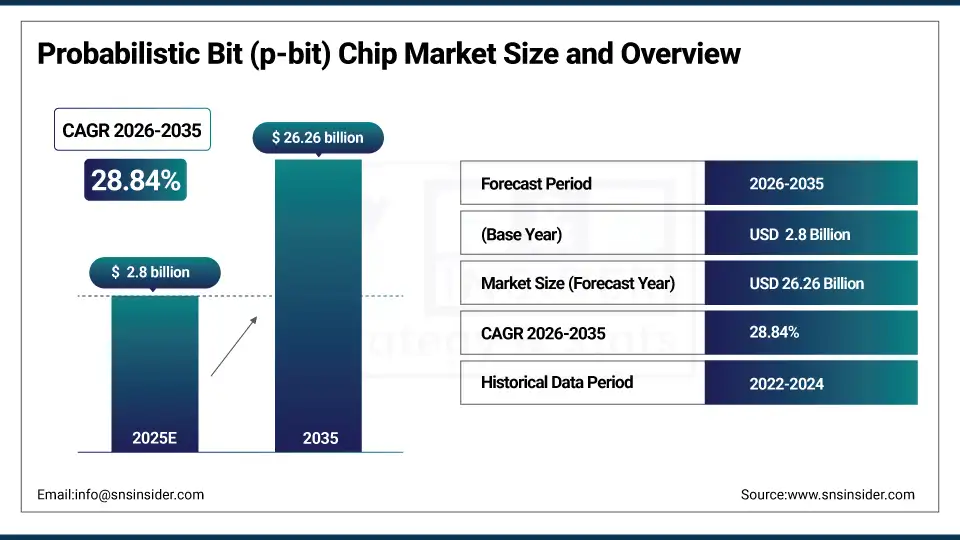
The Probabilistic Bit (p-bit) Chip Market size is valued at USD 2.8 Billion in 2025 and is expected to reach USD 26.26 Billion by 2035 and grow at a CAGR of 28.84% over the forecast period 2026-2035.
The market for p-bit chips is projected to develop at a fast pace, owing to the growing demand for energy-efficient computing solutions that can solve complex probabilistic and optimization problems. Growth for artificial intelligence, machine learning and data intensive applications is fueling demand for hardware architectures that are much faster and more energy-efficient than conventional deterministic processors. Steps forward in semiconductor devices (including stochastic CMOS circuits, spintronics and others) are improving the scalability, reliability and commercial potential of p-bit chips. Moreover, with the rising investment in next gen computing research and continuation of AI data centers investments, there has been a constant emphasis on decreasing energy consumption and carbon footprint within the computing infrastructure, which is further expected to fuel market growth during outlook period.
According to industry insights, nearly 40% of Probabilistic Bit (p-bit) Chip adoption is attributed to data centers and research laboratories, driven by increasing investment in advanced computing architectures, demand for faster optimization processing, and the need to reduce power consumption in high-performance computing environments.
To Get more information On Probabilistic Bit (p-bit) Chip Market - Request Free Sample Report
Probabilistic Bit (p-bit) Chip Market Trends:
-
Growing shift toward energy-efficient AI and optimization computing as data centers seek alternatives to power-hungry deterministic processors
-
Increasing adoption of CMOS-compatible p-bit designs to leverage existing semiconductor manufacturing infrastructure
-
Rising interest in spintronic and MTJ-based technologies for scalable and low-power probabilistic hardware
-
Expanding use of p-bit chips in AI inference, combinatorial optimization, and probabilistic modeling workloads
-
Strong focus on hybrid classical–probabilistic architectures integrating p-bit accelerators with conventional CPUs and GPUs
U.S. Specialty Probabilistic Bit (p-bit) Chip Market Size Outlook:
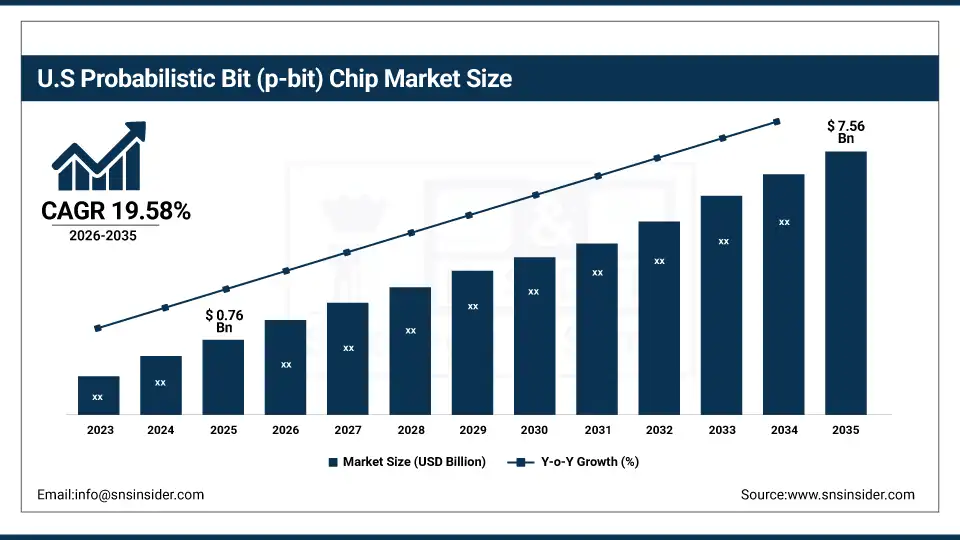
The U.S. Probabilistic Bit (p-bit) Chip Market size is USD 0.76 Billion in 2025 and is expected to reach USD 7.56 Billion by 2035, growing at a CAGR of 19.58% over the forecast period of 2026-2035. US demand for Probabilistic Bit (p-bit) Chips is to be fuelled by heavy investments in AI and advanced computing, growing demand for energy-efficient hardware from data centres and a surge of optimization and probabilistic workloads. Ongoing developments in the semiconductor field, as well as significant research at major technology companies and universities, are expediting commercialization.
Probabilistic Bit (p-bit) Chip Market Growth Drivers:
-
Rising Demand for Energy-Efficient AI and Optimization Computing
Rising demand for energy-efficient computing solutions to process complex AI, optimization and probabilistic workloads is significantly driving the market growth of Probabilistic Bit (p-bit) Chip. Power and scaling limitations inherent to traditional deterministic processors have driven organizations to seek alternative designs. According to industry research, the demand for p-bit chips stems from over 55% of AI inference, optimization and probabilistic modeling applications demonstrating their increasing importance. Growing use of AI accelerators in data centers and research institutions also encourages market growth.
Probabilistic Bit (p-bit) Chip Market Growth Restraints:
-
Limited Commercial Maturity and Ecosystem Readiness
Market development is limited by the commercial immaturity and software/development ecosystem of the p-bit chip technologies at pre-silicon stage. Some of the solutions are currently in prototype or pilot, needing validation for large-scale deployment. Research indicates that almost 40% of prospective users postpone adopting new technologies because of integration difficulties, insufficient standardization and uncertainty of the long-term performance. The high cost of R&D, lack of expertise and skilled manpower also inhibited extensive implementation.
Probabilistic Bit (p-bit) Chip Market Growth Opportunities:
-
Expansion of Next-Generation Computing and Data Center Infrastructure
There are substantial upside opportunities from rising investments in next-generation computing architectures and AI-based data center infrastructure. Increasing attention to energy consumption, computational efficiency and acceleration in advanced devices is driving increasing interest in p-bit chips. Industry analysis has demonstrated that investment in advanced AI specific hardware and alternative computing paradigms are growing at a CAGR of over 25% and thus provides strong opportunities for p-bit chip integration. Increasing government support, public-private partnerships and inclination towards sustainable computing are other key factors contributing to the growth of mobile computing.
Probabilistic Bit (p-bit) Chip Market Segment:
-
By Component Type: In 2025, p-bit Processing Units dominated with 48% share; Random Number Generator Modules are the fastest-growing segment during 2026–2035.
-
By Technology: In 2025, CMOS-based p-bit Technology led with 52% share; Spintronic MTJ-based Technology is the fastest-growing during 2026–2035.
-
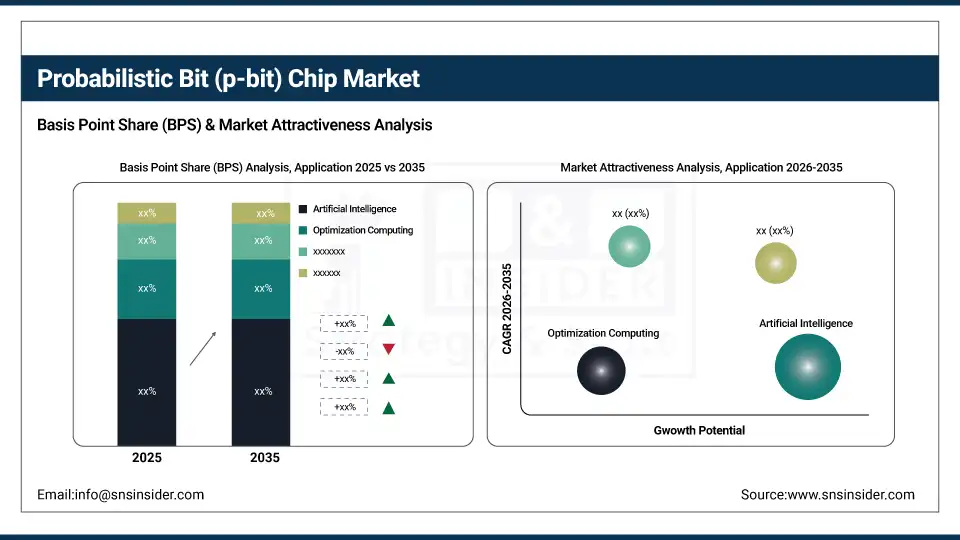
By Application: In 2025, Artificial Intelligence dominated with 50% share; Optimization Computing is the fastest-growing segment through 2035.
-
By End User: In 2025, IT Data Centers held the largest share with 47%; Defense Research Institutions are expected to grow the fastest during 2026–2035.
By Component Type: p-bit Processing Units Lead as Random Number Generator Modules Expand Rapidly
The Probabilistic Bit (p-bit) Chip market is dominated by p-bit Processing Units as they play a central role in performing probabilistic logic, AI inference & optimization workloads. Due to their direct effect on performance and power efficiency, they are also the primary target of early commercial deployments in data centers and research solutions.
Random Number Generator Modules are also emerging fast because good quality stochastic behavior is increasingly essential in the accurate modeling and optimization of probabilistic systems. Increasing need of high-quality randomness in AI and inference loads is driving the growth of advanced RNG modules.
By Technology: CMOS-based p-bit Technology Leads as Spintronic MTJ-based Technology Accelerates.
The CMOS-based p-bit Technology takes the lead due to compatibility with conventional CMOS production, lower risk of mass production and quicker integration in contemporary computer architectures. This allows for faster commercialization and broader early adoption.
The Spintronic MTJ-based Technology is advancing at fast pace powered with its ultra-low power, scalability and applicability to energy-efficient computing beyond exascale. Continuing R&D and advancements in fabricating the material make it likely it will only keep growing.
By Application: Artificial Intelligence Leads as Optimization Computing Grows Rapidly.
As p-bit chips are deployed for probabilistic inference, learning algorithms, and energy-efficient AI acceleration Artificial Intelligence is fast emerging as the killer application. Booming AI workloads in data centers and research labs remain strong drivers of demand.
Optimization Computing is becoming more important as industries are starting to use stochastic tools for solving complex scheduling, routing and decision making problems. This trend is driven by the capability of p-bit chips to quickly navigate through large solutions spaces.
By End User: IT Data Centers Lead as Defense Research Institutions Accelerate.
IT Data Centers continue to hold a significant share in the market, on account of implementation of high-end computing devices for AI, machine learning and data analytics at large scale. Strong uptake of p-bit chips is driven by the demand for lower power consumption and increasing computational efficiency.
Defense Research Facilities are quickly expanding as governments to invest in high-performance computing for simulation, optimization, cryptography and national security analysis. The higher growth rate of adoption of cybersecurity solutions and services in this vertical can be attributed to the increase in defense R&D budgets along with an increased focus on next-generation technologies.
Probabilistic Bit (p-bit) Chip Market Regional Analysis:
North America Probabilistic Bit (p-bit) Chip Market Insights:
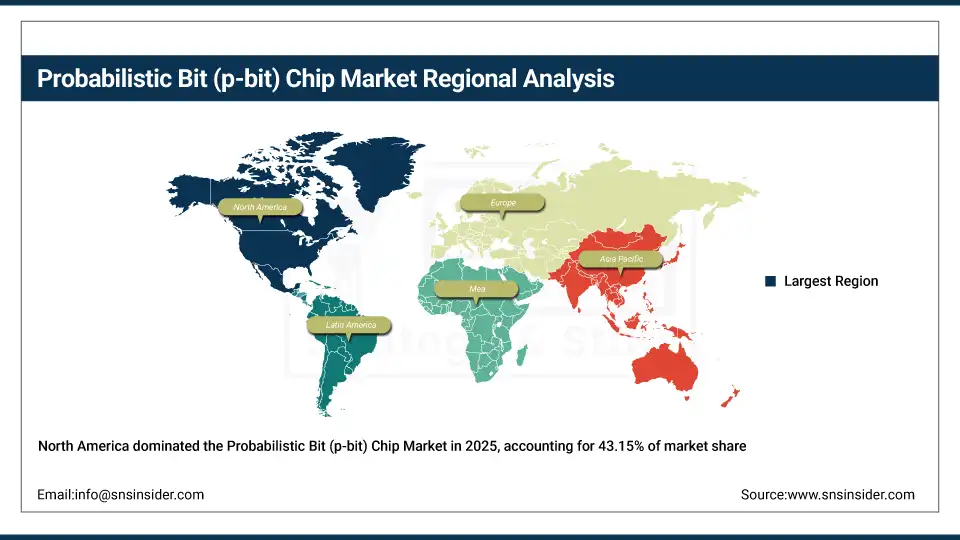
In 2025, North America’s Probabilistic Bit (p-bit) Chip Market accounting for the highest regional revenue share of approximately 43.15% in 2025. The domination of North America is due to the substantial investments in development of advanced computing systems, the adoption of AI and machine learning across all industries including consumer electronics, while also being home to leading semiconductor and technology companies working on both probabilistic and neuromorphic architecture. Many of these PNT are implemented in existing research eco-systems, such as universities, national labs or defense research facilities that provide the infrastructure and capability to support proof-of-concept demonstrations.
Get Customized Report as per Your Business Requirement - Enquiry Now
U.S. and Canada Probabilistic Bit (p-bit) Chip Market insights:
US and Canada p-bit Chip market (Passive Q-Switches) is backed by strong investments in AI, quantum-inspired computing, advanced semiconductor R&D. The U.S. is first because it hosts some of the world’s largest technology companies as well as defense research and data center expansions. Canada contributes by strong academic research, government funding initiatives, and growing adoption in AI-optimization or probabilistic computing applications.
Asia Pacific Probabilistic Bit (p-bit) Chip Market Insights:
Asia Pacific represents a high-growth region for the Probabilistic Bit (p-bit) Chip market, registering a CAGR of 31.84% during 2026–2035. The rapid expansion of AI, high performance computing and quantum inspired research across Asia Pacific is fuelling this growth. Rising government support for the semiconductor manufacturing, growing investments in advanced computing technologies and a surging adoption of p-bit chips in optimization, AI acceleration and probabilistic modeling are augmenting the market growth. The presence of top electronics companies, growing data center installations, and increasing academic–industrial partnerships are further driving the market between 2026 and 2035.
Europe Probabilistic Bit (p-bit) Chip Market Insights:
Market in Europe is driven by good adoption of advanced computing for AI and optimization, growing investments in smart manufacturing, and rising demand for energy-efficient semiconductors. Government sponsored digitalization campaigns, autonomous leadership agendas and R&D investments across the automotive, industrial control and research sectors, are catalysing pilot rollouts and commercial uptake in leading European economies..
Latin America Probabilistic Bit (p-bit) Chip Market Insights:
Latin America’s market is gaining traction due to growing digital transformation, expanding data center investments, and rising interest in AI-driven optimization solutions. Increasing government support for technology innovation, improving semiconductor supply chains, and adoption of advanced computing in finance, logistics, and research sectors are creating strong growth potential across Brazil, Mexico, and other emerging markets.
Middle East and Africa Probabilistic Bit (p-bit) Chip Market Insights:
Middle East & Africa is fueled by increasing investments on digital infrastructure and AI research and smart city projects. Governments are investing in supercomputers, data centers and semiconductor advancements to fuel economic diversification. Increasing needs such as the energy, defense and logistics optimization computing in addition to rise in R&D contracts are some of the contributing factors for the slow growth of market across these regions.
Probabilistic Bit (p-bit) Chip Market Competitive Landscape:
IBM is a key player in the Probabilistic Bit (p-bit) Chip ecosystem, recognized for its leadership in advanced semiconductor research, neuromorphic computing, and probabilistic/Ising-based computing architectures. IBM focuses on using p-bit concepts to solve complex optimization, AI inference, and probabilistic modeling problems, supported by strong R&D capabilities and collaborations with academic and defense research institutions.
-
October 2025, IBM Research announced progress in scalable CMOS-based p-bit architectures integrated with AI accelerators, demonstrating improved performance for optimization and probabilistic inference workloads in data center and research applications.
Intel is investigating p-bit chips through its neuromorphic computing, spintronic devices, and hybrid digital-analog architecture research. The semiconductor manufacturer uses its semiconducting manufacturing proficiency to develop p-bit integration in energy-efficient-AI, optimization-computing and next- generation accelerators for data centers and automotive applications.
-
September 2025, Intel Labs unveiled a prototype hybrid p-bit computing platform combining CMOS logic with probabilistic processing units, aimed at accelerating combinatorial optimization and AI workloads with significantly lower power consumption.
Google is a prominent contributor to the Probabilistic Bit (p-bit) Chip market through its focus on probabilistic computing, Ising machines, and AI optimization research. Google applies p-bit-inspired architectures to enhance machine learning, optimization, and cloud-based AI services, supported by its large-scale data center infrastructure and deep expertise in AI algorithms.
-
August 2025, Google Research reported successful deployment of p-bit-inspired probabilistic processors in experimental cloud environments, showcasing faster convergence for optimization and probabilistic modeling tasks used in AI training and inference.
Probabilistic Bit (p-bit) Chip Market Companies:
-
Intel Corporation
-
Google LLC (Alphabet)
-
NVIDIA Corporation
-
Advanced Micro Devices, Inc (AMD)
-
Samsung Electronics Co. Ltd.
-
Rain Neuromorphics
-
BrainChip Holdings Ltd.
-
Graphcore Ltd.
-
Tenstorrent
-
Groq Inc.
-
Cerebras Systems Inc.
-
D-Wave Systems Inc.
-
Rigetti Computing Inc.
-
Extropic Inc.
-
Flo Labs
-
Analog Devices Inc.
-
SynSense Group AG
| Report Attributes | Details |
|---|---|
| Market Size in 2025 | USD 2.08 Billion |
| Market Size by 2035 | USD 26.26 Billion |
| CAGR | CAGR of 28.84% From 2026 to 2035 |
| Base Year | 2025 |
| Forecast Period | 2026-2035 |
| Historical Data | 2022-2024 |
| Report Scope & Coverage | Market Size, Segments Analysis, Competitive Landscape, Regional Analysis, DROC & SWOT Analysis, Forecast Outlook |
| Key Segments | • By Component Type: (p-bit Processing Units, Random Number Generator Modules, Control Interface Circuits) • By Technology: (CMOS-based p-bit Technology, Spintronic MTJ-based Technology, Hybrid Digital-Analog p-bit Technology) • By Application: (Artificial Intelligence, Optimization Computing, Probabilistic Modeling) • By End User: (IT Data Centers, Automotive Mobility, Defense Research Institutions) |
| Regional Analysis/Coverage | North America (US, Canada), Europe (Germany, UK, France, Italy, Spain, Russia, Poland, Rest of Europe), Asia Pacific (China, India, Japan, South Korea, Australia, ASEAN Countries, Rest of Asia Pacific), Middle East & Africa (UAE, Saudi Arabia, Qatar, South Africa, Rest of Middle East & Africa), Latin America (Brazil, Argentina, Mexico, Colombia, Rest of Latin America). |
| Company Profiles | IBM Corporation, Intel Corporation, Google LLC (Alphabet), Microsoft Corporation, NVIDIA Corporation, Advanced Micro Devices (AMD), Qualcomm Technologies Inc., Samsung Electronics Co. Ltd., Rain Neuromorphics, BrainChip Holdings Ltd., Graphcore Ltd., Tenstorrent Inc., Groq Inc., Cerebras Systems Inc., D-Wave Systems Inc., Rigetti Computing Inc., Extropic Inc., Flo Labs, Analog Devices Inc., SynSense Group AG. |

Frequently Asked Questions
North-America dominated the Probabilistic Bit (p-bit) Chip market in 2025.
The Technology Type segment, particularly CMOS-based p-bit technology, dominated the Probabilistic Bit (p-bit) Chip market due to its compatibility with existing semiconductor manufacturing processes and early-stage commercial adoption.
The key drivers of the Probabilistic Bit (p-bit) Chip market include rising demand for energy-efficient AI computing, increasing adoption of optimization and probabilistic workloads, growing complexity of data-intensive applications.
The market was valued at USD 2.08 Billion in 2025 and is projected to reach USD 26.26 Billion by 2035.
The Probabilistic Bit (p-bit) Chip market is expected to grow at a CAGR of 28.84% during 2026-2035.
