
Radio Frequency MEMS Market Report Scope & Overview:
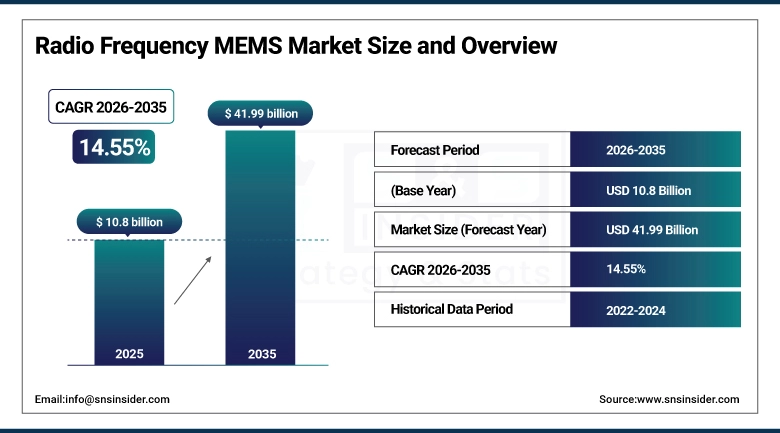
The Radio Frequency MEMS Market size was valued at USD 10.8 Billion in 2025 and is projected to reach USD 41.99 Billion by 2035, growing at a CAGR of 14.55% during 2026–2035.
The RF MEMS beamforming technology market is experiencing the rapid transformation owing to advances in high-frequency communication systems including satellite communications, 5G, 6G, and defense applications. Some recent developments indicate RF MEMS-based ICs can miniaturize and achieve higher frequency with lower weight and power consumption compared with currently existing solutions and allow efficient signal steering allowing better performance of a system level. The rapid adoption of compact and energy efficient antenna arrays for aerospace and military radar systems is driven by increasing demand. Moreover, the migration towards millimeter-wave technologies and mass production of RF MEMS technologies is producing great prospects of future proof wireless infrastructure and advanced connectivity ecosystems worldwide.
October 2025 – Sofant Technologies showed a fully functional Ka-band transmit array based on its proprietary RF MEMS beamforming IC, a breakthrough for high-frequency wireless systems. The innovation reinforces RF MEMS benefits with proven size, weight, and power consumption for aerospace satellite communications, 5G/6G communications networks, and next-generation defense radar applications.
To Get more information on Radio Frequency MEMS Market - Request Free Sample Report
Radio Frequency MEMS Market Trends Highlights:
-
Rapid growth driven by increasing demand for high-frequency, low-power, and miniaturized RF components in advanced wireless communication systems
-
Expanding adoption in 5G infrastructure, IoT devices, and next-generation smartphones enhancing signal efficiency and performance
-
Rising integration of RF MEMS switches, capacitors, and inductors for improved frequency tuning and reduced signal loss
-
Strong shift toward compact and high-performance RF solutions supporting satellite communication and defense applications
-
Increasing investments in MEMS-based RF technologies to enhance reliability, scalability, and energy efficiency
-
Growing deployment across automotive connectivity, aerospace, and telecom sectors accelerating market expansion
U.S. Radio Frequency MEMS Market Size Outlook:
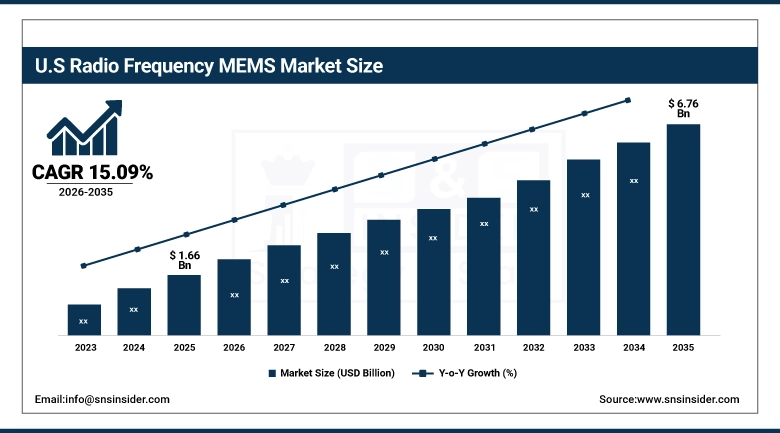
The U.S. Radio Frequency MEMS Market size was valued at USD 1.66 Billion in 2025 and is projected to reach USD 6.76 Billion by 2035, growing at a CAGR of 15.09% during 2026–2035, owing to increasing demand for high speed wireless communication, 5G infrastructure development coupled with accelerating adoption in defense, aerospace and automotive radar systems. An increasing penetration of IoT devices in various application end-users, coupled with the increasing need for the RF components with low power consumption and high efficiency is further bolstering the growth of the market; moreover, the development and advancement of technology in MEMS-based switching technology are facilitating the high performance and integration in next-gen electronic systems.
Radio Frequency MEMS Market Drivers:
-
Rising Demand for High-Performance Wireless Connectivity Driving RF MEMS Adoption
The RF MEMS market is gaining strong momentum due to the rising demand for high-performance, low-power, and miniaturized wireless communication systems. The rapid roll-out of 5G networks, connected IoT ecosystems & next-generation satellite comms is driving demand for high-performance RF switching solutions which offer higher linearity with low insertion loss & fast switching speeds. Increasing usability in smart devices, automotive radar systems, aerospace and defence applications is also driving this market at a high pace. Moreover, the continous rise in data traffic & spectrum congestion is carrying out signal management more efficiently, and therefore RF MEMS are becoming key enablers to be incorporated into the future wireless infrastructure components.
In June 2025 Hackers exploit RF leakage from MEMS microphones, allowing radio-wave interception of private conversations even through walls without direct device access or malware. The vulnerability highlights security risks in modern digital devices, where unintended electromagnetic emissions can turn everyday electronics into passive audio transmitters.
Radio Frequency MEMS Market Restraints:
-
Barriers Limiting Large-Scale Adoption of RF MEMS Switching Technologies
The RF MEMS switch market faces several restraints that may slow its widespread adoption despite strong technological advantages. The manufacturing complexity and precision fabrication has severely raised the cost of production, therefore hindering large scale commercialization. There are also reliability issues like stiction, dielectric charging, and mechanical fatigue under long-term cycling, which present limitations on widespread adoption into mission-critical applications. Moreover, RF adaptive architectures are also difficult to integrate due to the deteriorated design and cost when compared to low-level system integration, as well as special packaging requirements, that eventually are passed on as increases in overall system costs. Mature semiconductor-based RF switches such as SOI and CMOS technologies exert pricing pressure. Minimal standardization and slower qualification in the aerospace and telecom sectors also inhibit rapid market expansion.
Radio Frequency MEMS Market Opportunities:
-
RF MEMS Switch Innovation Driving Next-Generation 5G/6G Network Expansion Opportunities
With the increasing demand for high performance wireless communication systems in both 5G and emerging 6G networks, the RF MEMS switch market is set for a healthy growth over the next few years. With ultra-low insertion loss, high linearity, fast switching speed, and energy-efficient operation, these switches are a crucial component for next-generation RF signal routing and network optimization applications. The global demand is further boosted by the growing deployment of smartphones, IoT devices, base stations, automotive connectivity and aerospace communication systems. Due to the ultimate compactness and higher electrical performance properties, they have enormous potential in empowering the next-generation communication infrastructure and integration of advanced electronic systems, leading to efficient spectrum use and reduced power consumption across the globe.
In Nov 2025, Menlo Micro announced ground-breaking RF MEMS switch technology capability to support the next generation of 5G and emerging 6G communication systems in Nov 2025, offering ultra-low loss, high linearity, fast switching speed, and high power handling for improved signal routing, network reliability, and performance in modern cellular and wireless infrastructure applications.
Radio Frequency MEMS Market Segment Highlights:
-
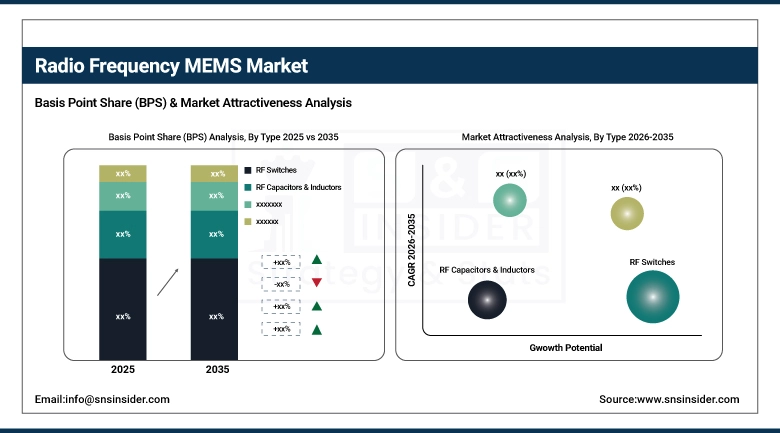
By Type: Dominant – RF Switches (37.60% in 2025 → 42.40% in 2035); Fastest-Growing – RF Capacitors & Inductors (CAGR 16.48%).
-
By Application: Dominant – Personal Communication Devices (47.40% in 2025 → 42.60% in 2035); Fastest-Growing – Aerospace & Defense (CAGR 18.24%).
-
By End User: Dominant – Consumer Electronics (44.50% in 2025 → 40.50% in 2035); Fastest-Growing – Industrial (CAGR 17.18%).
-
By Technology: Dominant – Capacitive RF MEMS (41.60% in 2025 → 38.40% in 2035); Fastest-Growing – Piezoelectric RF MEMS (CAGR 18.04%).
By Type: RF Switches (Dominant) and RF Capacitors & Inductors (Fastest-Growing) in the Radio Frequency MEMS Market
RF Switches hold market dominance owing to their critical role in signal routing, high-frequency performance, and low power consumption, making them ideal for smartphones, wireless communication systems, and IoT devices. In contrast, RF Capacitors & Inductors type segment is witnessing the highest growth on account of miniaturization and better performance, growing deployment of 5G technologies, and growing use for mobile devices and for Aerospace & Defense & Personal Communication Devices in Radio Frequency MEMS Market.
By Application: Personal Communication Devices (Dominant) and Aerospace & Defense (Fastest-Growing) in the Radio Frequency MEMS Market
The largest application for RF MEMS is in Personal Communication Devices, due to large penetration of smart phones, increased demand for high-speed wireless connectivity, and high integration of the RF MEMS components into Mobile devices for high performance signal processing. On the other hand, Aerospace & Defense is the fastest growing segment, owing to demand for developing latest radar systems, secure communication technologies and increasing utilization of RF MEMS technologies in mission-critical defense applications that require high reliability and precision.
By End User: Consumer Electronics (Dominant) and Industrial (Fastest-Growing) in the Radio Frequency MEMS Market
Consumer Electronics leads the market owing to strong demand for smartphones, wearables, smart home devices, and IoT-enabled gadgets that require compact and efficient RF MEMS solutions. Meanwhile, the Industrial segment is the most fast-growing one, owing to rising penetration of automation, smart manufacture and IIoT systems that end in requirement for advanced wireless connectivity and also high-performance RF components.
By Technology: Capacitive RF MEMS (Dominant) and Piezoelectric RF MEMS (Fastest-Growing) in the Radio Frequency MEMS Market
Capacitive RF MEMS dominate the market due to their high switching speed, low power consumption, and strong performance in RF filtering and switching applications. In contrast, Piezoelectric RF MEMS is the fastest-growing segment due to its advantage of more sensitivity, energy-efficient using less power and is being widely adopted for next-generation communication systems and advanced sensing applications. systems.
Radio Frequency MEMS Market Regional Highlights:
-
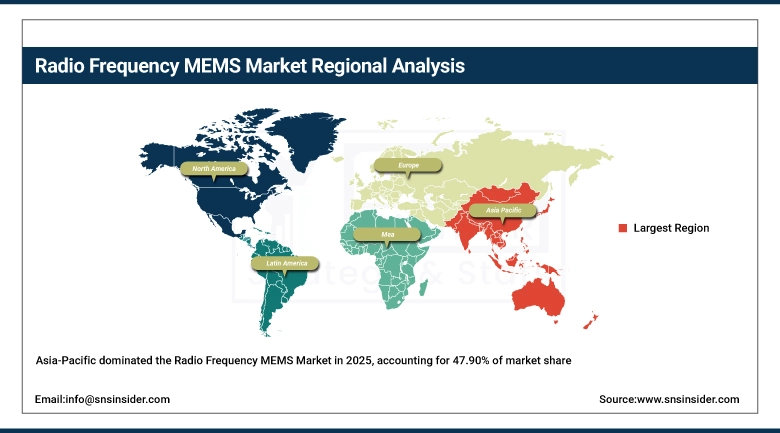
Asia-Pacific (Dominant – 47.90% in 2025 → 45.30% in 2035, CAGR 13.91%)
-
Middle East & Africa (Fastest-Growing – 5.90% in 2025 → 5.80% in 2035, CAGR 14.35%)
-
North America (23.20% → 24.80%, CAGR 15.31%)
-
Europe (17.10% → 19.00%, CAGR 15.75%)
-
Latin America (5.90% → 5.10%, CAGR 12.88%)
Asia-Pacific Radio Frequency MEMS Market Insights:
Asia-Pacific dominates the Radio Frequency MEMS market due to its strong semiconductor manufacturing base, rapid expansion of 5G networks, and high demand for advanced consumer electronics. Countries such as China, Japan, South Korea, and India are driving growth through large-scale investments in telecommunications infrastructure and MEMS-based device production. The region benefits from the presence of major foundries, cost-efficient manufacturing, and a well-established electronics supply chain. Increasing adoption of smartphones, IoT devices, automotive electronics, and defense communication systems further accelerates demand for RF MEMS technologies. Supportive government initiatives aimed at semiconductor self-reliance and technological innovation continue to strengthen the region’s leadership position in the global market.
Get Customized Report as per Your Business Requirement - Enquiry Now
China Radio Frequency MEMS Market Insights:
China is expected to be a primary driver of the Radio Frequency MEMS market, owing to its significant semiconductor manufacturing capacity, faster deployment of 5G, large-scale mobile devices market, and rising investments in Internet of Things (IoT) and automotive electronics require MEMS components, as well as a need for advanced communication technologies.
North America Radio Frequency MEMS Market Insights:
Radio Frequency MEMS Market North America is the fastest-growing market for Radio Frequency MEMS, owing to strong technological innovations in recent years, rapid growth in 5G network, technological evolution in advanced wireless communication systems and high demand for LTE based services. The presence of top semiconductor & MEMS players, high R&D activity, and high end-user demand mainly of Defense, Aerospace, Automotive, & Consumer electronics is also driving the growth of North America MEMS sensors market. Market growth is further driven by widespread investments in IoT, smart devices, and next-generation connectivity solutions. The U.S. also contributes significantly with an advanced fabrication base and innovation ecosystem to support ongoing development of high-performance RF MEMS technologies and regional market enhancement.
U.S. Radio Frequency MEMS Market Insights:
The U.S. Radio Frequency MEMS market is driven by strong demand for advanced wireless communication, rapid 5G deployment, and significant investments in defense and aerospace technologies. The presence of leading semiconductor companies and continuous R&D in MEMS innovation further support market growth.
Europe Radio Frequency MEMS Market Insights:
The growth of Europe Radio Frequency MEMS market is being driven by, the rapid adoption of the advanced wireless communication systems, and high demand for automotive electronics, and growing applications of industrial automation. Availability of leading semiconductor and MEMS technology companies, strong R&D capabilities, and investments in Germany, France, and the UK benefit the regional market. The escalating investments in 5G infrastructure, Internet of Things (IoT)-enabled products, and defense communication systems also aid in market growth. Moreover, the growing demand for energy-efficient and miniaturized electronic components in Europe is supporting the utilization of RF MEMS technologies throughout consumer electronics and automotive applications, resulting in a stable and sustainable expansion of the market.
Germany Radio Frequency MEMS Market Insights:
Germany Radio Frequency MEMS demand propelled by robust automotive electronics functionalities, advanced industrial automation, and growing penetration of 5G-enabled communication systems. A strong semiconductor ecosystem, in addition to high-precision engineering in the country, also helps these RF MEMS technologies that will scale across applications.
Latin America Radio Frequency MEMS Market Insights:
The Latin America Radio Frequency MEMS market is growing at a steady pace, owing to the growing mobile connectivity, and gradual rollout of 4G and 5G networks, coupled with the rising adoption of smart consumer electronics across the region. Brazil and Mexico Growth in demand is seeing countries like Brazil and Mexico take up the lead due to expanding telecommunications infrastructure and rising penetration of smartphones and IoT-supported devices. Additionally, rising investments on digital transformation and industrial automation in the region would support RF MEMS technologies in communication systems. In addition to this, growth in automotive electronics adoption and economic recovery are expected to provide stable development of the market across the Latin America region.
Brazil Radio Frequency MEMS Market Insights:
Brazil Radio Frequency MEMS market is expected to grow at a steady pace as number of smartphone penetration record is rising with 4G & early 5G network are on the go and increment of IoT-based devices market. Expansion of telecommunication infrastructure and rising demand for advanced systems for wireless communication are some of the key support to the continuous growth of market in this region.
Middle East & Africa Radio Frequency MEMS Market Insights:
Middle East & Africa Radio Frequency MEMS market is experiencing gradual growth driven by increasing investments in telecommunications infrastructure, expanding 4G and emerging 5G networks, and rising adoption of smart devices across the region. Countries such as the UAE, Saudi Arabia, and South Africa are leading demand due to ongoing digital transformation initiatives and smart city projects. The region is also witnessing growing use of RF MEMS technologies in defense, aerospace, and industrial automation applications. Additionally, improving internet penetration, rising mobile connectivity, and government efforts to diversify economies are supporting steady adoption of advanced wireless communication technologies across the Middle East & Africa.
United Arab Emirates (UAE) Radio Frequency MEMS Market Insights:
UAE and Saudi Arabia are the top countries in terms of contributing to the market fuelled by heavy investments in 5G, smart city initiatives, digital transformation programs, and proactive Defense and Telecom sectors.
Radio Frequency MEMS Market Competitive Landscape:
Analog Devices, Inc. (founded 1965) is a semiconductor company specializing in RF, analog and mixed-signal technologies worldwide. It offers high-performance RF transceivers and signal chain solutions for communications, industrial, automotive, and audio applications to power efficient connectivity, accurate signal processing, and enhanced wireless and wired system performance.
-
In May 2025 Analog Devices, Inc. is a leading semiconductor company specializing in RF, analog, and mixed-signal solutions for communications, industrial, and audio applications. Its advanced transceiver technology enabled Sennheiser’s WMAS-based Spectera ecosystem, improving wireless audio performance with low latency, high reliability, and enhanced RF signal processing.
STMicroelectronics N.V., established in 1987, is a global semiconductor leader serving customers in automotive, industrial, and consumer applications with MEMS and sensors, analog, and power solutions. Acquisitions and new RF, IoT and smart mobility technologies strengthen the MEMS-based sensor portfolio.
-
In July 2024, STMicroelectronics agreed to acquire part of NXP Semiconductors’ sensor business for up to USD 950 million in cash strengthening its MEMS-based sensor portfolio used in automotive, industrial, and smart device applications.
Radio Frequency MEMS Companies are:
-
Broadcom Inc.
-
Qorvo Inc
-
Analog Devices Inc.
-
STMicroelectronics N.V.
-
Texas Instruments Incorporated
-
NXP Semiconductors N.V.
-
Skyworks Solutions Inc
-
Teledyne Technologies Incorporated
-
Panasonic Corporation
-
AAC Technologies
-
Cavendish Kinetics (Qorvo)
-
OMRON Corporation
-
SiTime Corporation
-
MEMSIC Inc.
-
Radant MEMS Inc.
-
DelfMEMS SA
-
NEDITEK
-
Menlo Microsystems Inc.
| Report Attributes | Details |
|---|---|
| Market Size in 2025 | USD 10.8 Billion |
| Market Size by 2035 | USD 41.99 Billion |
| CAGR | CAGR of 14.55% From 2026 to 2035 |
| Base Year | 2025 |
| Forecast Period | 2026-2035 |
| Historical Data | 2022-2024 |
| Report Scope & Coverage | Market Size, Segments Analysis, Competitive Landscape, Regional Analysis, DROC & SWOT Analysis, Forecast Outlook |
| Key Segments | • By Type (RF Switches, RF Capacitors & Inductors, RF Filters and Others) • By End User (Personal Communication Devices, Telecommunications Infrastructure, Aerospace & Defense, Automotive and Others) • By Technology (Consumer Electronics, Telecom Operators, Industrial, Automotive, Healthcare and Aerospace & Defense) • By Application (Capacitive RF MEMS, Ohmic RF MEMS, Piezoelectric RF MEMS and Others) |
| Regional Analysis/Coverage | North America (US, Canada), Europe (Germany, UK, France, Italy, Spain, Russia, Poland, Rest of Europe), Asia Pacific (China, India, Japan, South Korea, Australia, ASEAN Countries, Rest of Asia Pacific), Middle East & Africa (UAE, Saudi Arabia, Qatar, South Africa, Rest of Middle East & Africa), Latin America (Brazil, Argentina, Mexico, Colombia, Rest of Latin America). |
| Company Profiles | Broadcom Inc., Qorvo Inc., Analog Devices Inc., Murata Manufacturing Co., Ltd., STMicroelectronics N.V., Texas Instruments Incorporated, NXP Semiconductors N.V., Infineon Technologies AG, Skyworks Solutions Inc., Teledyne Technologies Incorporated, Panasonic Corporation, AAC Technologies, Cavendish Kinetics (Qorvo), OMRON Corporation, SiTime Corporation, MEMSIC Inc., Radant MEMS Inc., DelfMEMS SA, NEDITEK, Menlo Microsystems Inc. |

Frequently Asked Questions
Asia-Pacific dominated the Radio Frequency MEMS Market in 2025.
The “RF Switches” segment dominated during the projected period.
Rising demand for 5G/6G networks, IoT connectivity, and high-performance, low-power RF components is driving the growth of the Radio Frequency MEMS market globally.
The Market was valued at USD 10.8 Billion in 2025 and is projected to reach USD 41.99 Billion by 2035.
The Market is expected to grow at a CAGR of 14.55% during 2026–2035.
