
Satellite Transponder Market Report Scope & Overview:
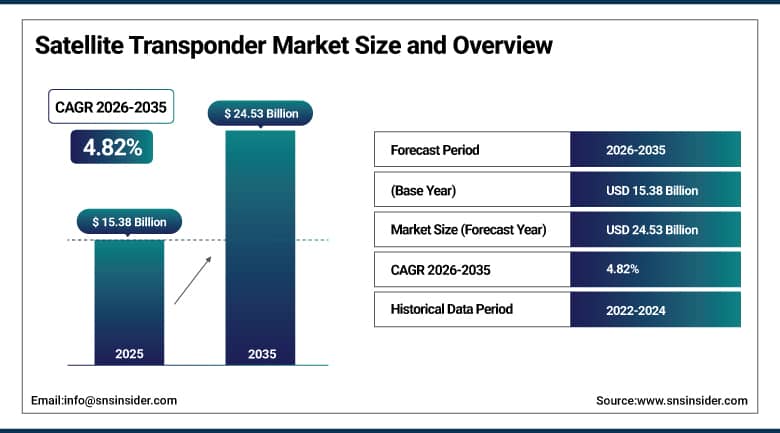
The Satellite Transponder Market was valued at USD 15.38 billion in 2025 and is expected to reach USD 24.53 billion by 2035, growing at a CAGR of 4.82% from 2026–2035.
The satellite transponder market is experiencing consistent growth because of the growing need for broadband connections, advancements in the satellite communication infrastructure, and the use of HTS systems. These developments are being aided by the increasing demands for video transmissions, corporate communications, mobility services, defense communications, and remote connectivity applications. There will be continued dependence on the satellite communications infrastructure for aviation connectivity, maritime communications, disaster recovery services, and rural broadband services. Further improvements in satellite technologies are also helping to improve the efficiency of the communication ecosystem with respect to satellite transponders.
In September 2025, SES S.A. announced continued expansion of its next-generation satellite capacity strategy focused on delivering enhanced high-throughput connectivity and integrated multi-orbit communication capabilities. The development strengthened bandwidth availability for enterprise, mobility, and government customers while supporting evolving global connectivity requirements.
To Get More Information On Satellite Transponder Market - Request Free Sample Report
Satellite Transponder Market Trends
- Rising deployment of high-throughput satellites (HTS) is improving bandwidth capacity and network efficiency.
- Increasing adoption of software-defined payloads is enabling flexible bandwidth allocation.
- Growing integration of GEO, MEO, and LEO networks is enhancing multi-orbit connectivity.
- Rising demand for in-flight and maritime connectivity is expanding satellite communication services.
- Increasing investments in broadband satellite constellations are accelerating market growth.
The US Satellite Transponder Market Size Outlook
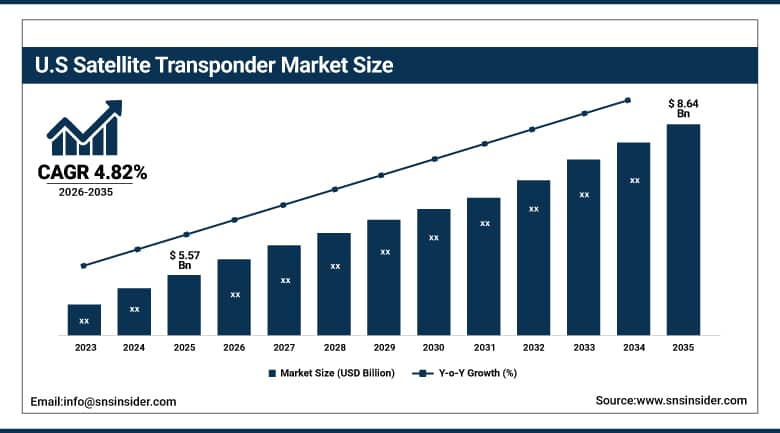
The U.S. satellite transponder market was valued at USD 5.57 billion in 2025 and is expected to reach around USD 8.64 billion by 2035, growing at a CAGR of 4.82% from 2026–2035.
The United States dominates the global satellite transponder market through its leadership in commercial satellite operations, strong presence of major operators including Intelsat S.A., Viasat Inc., and EchoStar Corporation, and its extensive deployment of satellite-enabled broadband, aviation connectivity, and secure government communication systems. Increasing investments in software-defined satellites, multi-orbit architectures, and next-generation bandwidth optimization technologies continue supporting long-term market expansion.
In 2025, major satellite operators including SES S.A. and Intelsat S.A. expanded multi-orbit and high-throughput satellite capacity programs to strengthen global broadband and enterprise connectivity services, improving transponder utilization efficiency across GEO–MEO integrated networks.
Satellite Transponder Market Segment Analysis
- By Band Type, c-band dominated the satellite transponder market with 35.56% share in 2025; ka-band is the fastest growing segment with the highest CAGR.
- By Service, fixed satellite service (fss) dominated the market with 52.29% share in 2025; mobile satellite service (mss) is the fastest growing segment with a CAGR.
- By Application, video broadcasting segment dominated the market with 32.42% share in 2025; broadband & data connectivity is the fastest growing segment with a CAGR.
- By End User, commercial segment dominated the market with 37.36% share in 2025; aviation & maritime is the fastest growing segment with a CAGR.
- By Satellite orbit, geostationary earth orbit (geo) dominated the market with 66.29% share in 2025; low earth orbit (leo) is the fastest growing segment with a CAGR.
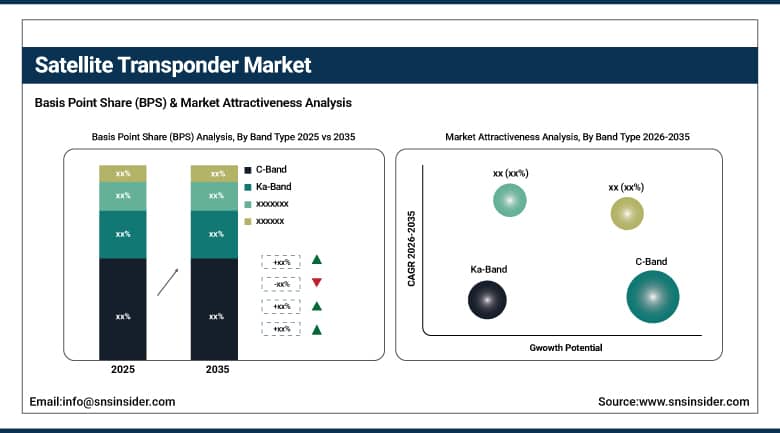
By Band Type, C-Band dominates the satellite transponder market, while Ka-Band is the fastest-growing segment.
C-Band segment dominated the satellite transponder market with the highest revenue share of about 35.56% in 2025, primarily characterized by its excellent reliability, extensive coverage, and great immunity against rain fading, it makes it an excellent choice for video broadcasting, governmental communication applications, and business networking services.
Ka-Band segment is projected to register the highest CAGR during 2026–2035 as a result of the increasing need for high-throughput satellite (HTS) capability, broadband internet, and data-heavy applications. The potential to provide increased bandwidth capabilities and accommodate future LEO and GEO-HTS constellations is making it an increasingly attractive option in communications systems.
By Service, Fixed Satellite Service (FSS) dominates the satellite transponder market, while mobile satellite service (MSS) is the fastest-growing segment.
FSS segment dominated the market with a share of about 52.29% in 2025, driven by its extensive use in television broadcasting, corporate connectivity, and secure government communications. Its stable performance, wide geographic reach, and established satellite capacity allocation make it the backbone of global transponder utilization.
MSS segment is expected to grow at the highest CAGR during 2026–2035 due to increasing demand for on-the-move connectivity in aviation, maritime, defense mobility, and remote field operations. Rising adoption of connected transportation systems and emergency communication networks is further boosting MSS expansion.
By Application, Video Broadcasting dominates the satellite transponder market, while broadband & data connectivity is the fastest-growing segment.
Video Broadcasting segment held the largest share of about 32.42% in 2025, sustained by high demand for DTH services, TV distribution, and sports broadcasting. The relevance of this technology in both developed countries and emerging markets continues to support its supremacy amid increasing competition from online video streaming.
Broadband & Data Connectivity segment is projected to register the fastest CAGR during 2026–2035 due to increasing global demand for high-speed internet, rural connectivity programs, enterprise data services, and LEO-based broadband constellations expanding satellite internet access worldwide.
By End User, Commercial segment dominates the satellite transponder market, while aviation & maritime is the fastest-growing segment.
Commercial segment dominated the market with a share of about 37.36% in 2025, driven by widespread use across telecom operators, broadcasters, enterprises, and service providers relying on satellite capacity for communication and content distribution.
Aviation & Maritime segment is expected to witness the highest CAGR during 2026–2035 due to rising adoption of in-flight connectivity, vessel tracking systems, and real-time communication solutions for global transportation networks, supported by expanding satellite-based mobility services.
By Satellite Orbit, Geostationary Earth Orbit (GEO) dominates the satellite transponder market, while Low Earth Orbit (LEO) is the fastest-growing segment.
GEO segment dominated the market with a share of about 66.29% in 2025 due to the existing infrastructure, wide coverage range, and its capability for providing uninterrupted services. The stability and low cost of using the transponders on a large scale have contributed to its leading position.
LEO segment is projected to grow at the highest CAGR during 2026–2035 owing to rapid deployment of satellite constellations, low-latency communication demand, and rising investment in global broadband networks, significantly transforming the satellite transponder ecosystem.
Satellite Transponder Market Regional Analysis:
|
Region |
Major Country |
Share within Region, 2025(%) |
|---|---|---|
|
North America |
United States |
87.54% |
|
Europe |
Germany |
25.97% |
|
Asia Pacific |
China |
45.14% |
|
Middle East & Africa |
UAE |
21.56% |
|
Latin America |
Brazil |
37.39% |
North America Satellite Transponder Market Insights
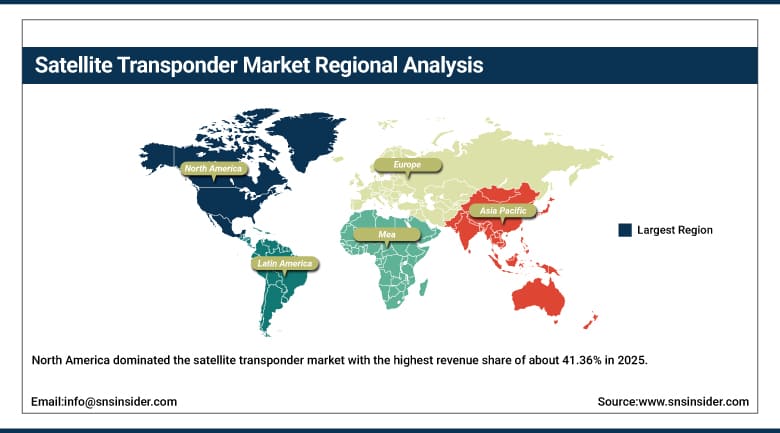
North America dominated the satellite transponder market with the highest revenue share of about 41.36% in 2025, powered by an excellent satellite communication network, the need for communication security, and commercial video broadcasting in the United States and Canada. This region enjoys the advantage of having highly sophisticated satellite constellations, a large number of transponder lease capacity, and the early development of High Throughput Satellite (HTS) systems. Another added advantage is that of the significant presence of major satellite companies, telecoms, and defense organizations in the region.
Supporting this leadership, large-scale government and private investments in next-generation space infrastructure particularly expansion of LEO constellations and modernization of GEO satellite fleets are accelerating demand for transponder capacity.
Get Customized Report as Per Your Business Requirement - Enquiry Now
Europe Satellite Transponder Market Insights
Europe represents a key market for satellite transponders because of its high focus on secure communications, broadcasting services, and international satellite links. Countries like Germany, France, United Kingdom, and Italy have increased their demands through their respective satellite companies and also due to increased use of broadband satellite services. The other advantage is the presence of good regulation and increased dependence on satellites in terms of disaster management, maritime communication, and government use. In addition, efforts by the European Union towards digital sovereignty and secure space communications will increase investments in satellite technology.
Asia Pacific Satellite Transponder Market Insights
Asia Pacific is emerging as the fastest-growing region in the satellite transponder market, and it is expected to grow at the fastest CAGR of about 5.46% from 2026-2035, as a result of fast proliferation in broadband Internet connectivity, massive deployment of satellite programs, and investment in digital infrastructure in countries including China, India, Japan, and Southeast Asia. High need for video broadcast, telecom backhauls, and connectivity services in underdeveloped regions is driving the utilization of transponders. In addition, there has been high uptake of LEO satellites and communication services in this region. Supporting this trend, there has been the development of national space programs, which include the satellite programs in India and China.
Middle East & Africa and Latin America Satellite Transponder Market Insights
The Middle East & Africa (MEA) and Latin America regions are witnessing a stable growth of satellite transponder market owing to the growing requirement of satellite communications for remote regions, defense communication advancements, and growth in the commercial infrastructure. In MEA region, Saudi Arabia, UAE, and South Africa are playing major roles in the growing adoption of the technology via smart city projects, oil & gas infrastructure needs, and satellite-based defense communication system developments. Similarly, Latin America is witnessing a high demand in terms of satellite communications from countries such as Brazil and Mexico in form of growing demand of satellite broadcasting services and rural connectivity solutions.
Market Dynamics:
Growth Drivers: Rising global connectivity demand and rapid expansion of advanced satellite communication infrastructure are accelerating satellite transponder market growth
Growth in reliance on satellite communication systems for broadband services, television broadcasts, military communications, and corporate networking purposes has been fueling demand for satellite transponders. Use of high throughput satellites (HTS), development of hybrid GEO-LEO satellite networks, and requirement of high bandwidth for data transfer have increased the bandwidth efficiency of networks around the world. Moreover, the increasing need for continuous communications in distant places, shipping lanes, aircraft paths, and zones vulnerable to natural disasters has been contributing to more advanced uses of satellite transponders.
Restraints: High deployment costs, orbital spectrum limitations, and technological complexity are restricting market expansion
The satellite transponder market faces restrictions because of very heavy capital expenditure involved in the production of satellites, satellite launch, and their maintenance. The shortage of available slots in space and increased clutter of spectrum is posing challenges for effective allocation of capacity. Moreover, the prolonged process of developing satellites, dependence on costly ground equipment, and risk of interference or latency issues are still posing strong challenges, especially in the emerging markets where land-based options prove to be more economical.
Opportunities: LEO satellite expansion and next-generation digital connectivity ecosystems are unlocking strong future growth potential
The exponential growth in the deployment of Leo satellites and the adoption of hybrid GEO/LEO networks is generating many avenues for improved transponder use. The increasing needs for ultra-low latency and fast internet connectivity services for the aerospace, marine transport, military mobility, and even enterprise applications have brought about the emergence of advanced software-defined payloads and flexible transponders. In addition, government efforts geared toward rural broadband coverage, intelligent infrastructure developments, and global digitalization initiatives will lead to more investments in satellite communication networks.
Recent Developments:
• 2026: Inmarsat (Viasat) expanded its satellite capacity utilization by upgrading GEO-based transponder allocation for aviation and maritime connectivity services, improving in-flight broadband performance and global mobility communication coverage across high-traffic air and sea routes.
• 2026: EchoStar Corporation enhanced its satellite communications infrastructure by optimizing Ku-band and Ka-band transponder deployment across its Hughes Network Systems platform, strengthening fixed broadband services and enterprise connectivity solutions in underserved and rural regions.
• 2025: Lockheed Martin advanced its satellite communications segment by delivering next-generation digital payload technologies with flexible transponder switching capabilities, enabling more efficient bandwidth management for defense and government satellite missions.
• 2025: Northrop Grumman Corporation strengthened its space systems portfolio by supporting modular satellite bus platforms integrated with high-capacity transponders, improving scalability and operational efficiency for GEO-based communication satellites used in national security applications.
Satellite Transponder Market Key Players are:
- Intelsat S.A.
- SES S.A.
- Eutelsat Group
- Viasat Inc.
- Telesat Corporation
- Arabsat
- Thaicom Public Company Limited
- Asia Satellite Telecommunications Company Limited (AsiaSat)
- Hispasat S.A.
- JSAT Corporation
- EchoStar Corporation
- Inmarsat Maritime (Viasat)
- ABS Global Ltd.
- China Satcom Co., Ltd.
- Turksat A.S.
- Russian Satellite Communications Company (RSCC)
- Yahsat Space Services
- KT SAT Corporation
- Nilesat
- Spacecom Satellite Communications Ltd.
Satellite Transponder Market Report Scope:
| Report Attributes | Details |
|---|---|
| Market Size in 2025 | USD 15.38 Billion |
| Market Size by 2035 | USD 24.53 Billion |
| CAGR | CAGR of 4.82% From 2026 to 2035 |
| Base Year | 2025 |
| Forecast Period | 2026-2035 |
| Historical Data | 2022-2024 |
| Report Scope & Coverage | Market Size, Segments Analysis, Competitive Landscape, Regional Analysis, DROC & SWOT Analysis, Forecast Outlook |
| Key Segments | • By Band Type (C-Band, Ku-Band, Ka-Band, X-Band, Others) • By Service (Fixed Satellite Service (FSS), Broadcasting Satellite Service (BSS), Mobile Satellite Service (MSS)) • By Application (Video Broadcasting, Broadband & Data Connectivity, Navigation & Communication, Military & Defense Communication, Remote Sensing & Earth Observation, Others) • By End User (Commercial, Government & Defense, Media & Entertainment, Aviation & Maritime, Others) • By Satellite Orbit (Geostationary Earth Orbit (GEO), Medium Earth Orbit (MEO), Low Earth Orbit (LEO)) |
| Regional Analysis/Coverage | North America (US, Canada), Europe (Germany, UK, France, Italy, Spain, Russia, Poland, Rest of Europe), Asia Pacific (China, India, Japan, South Korea, Australia, ASEAN Countries, Rest of Asia Pacific), Middle East & Africa (UAE, Saudi Arabia, Qatar, South Africa, Rest of Middle East & Africa), Latin America (Brazil, Argentina, Mexico, Colombia, Rest of Latin America). |
| Company Profiles | Intelsat S.A., SES S.A., Eutelsat Group, Viasat Inc., Telesat Corporation, Arabsat, Thaicom Public Company Limited, Asia Satellite Telecommunications Company Limited (AsiaSat), Hispasat S.A., JSAT Corporation, EchoStar Corporation, Inmarsat Maritime (Viasat), ABS Global Ltd., China Satcom Co., Ltd., Turksat A.S., Russian Satellite Communications Company (RSCC), Yahsat Space Services, KT SAT Corporation, Nilesat, Spacecom Satellite Communications Ltd.. |

Frequently Asked Questions
North America dominated the satellite transponder market in 2025.
Rising demand for ultra-fast air travel, increasing investments in next-generation supersonic aircraft development, and growing focus on defense and commercial aviation modernization are driving demand for advanced supersonic jet systems globally.
The satellite transponder market was valued at USD 15.38 billion in 2025.
The satellite transponder market is expected to grow at a CAGR of 4.82% from 2026 to 2035.
The c-band segment dominated the Satellite Transponder market in 2025.
