
Drone Propulsion Market Report Scope & Overview:
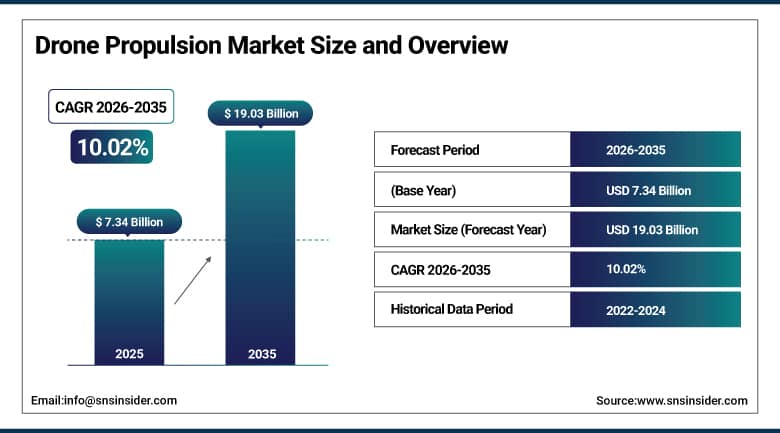
The Drone Propulsion Market was valued at USD 7.34 billion in 2025 and is expected to reach USD 19.03 billion by 2035, growing at a CAGR of 10.02% from 2026–2035.
The drone propulsion market is witnessing strong growth in the global market owing to rising demand for advanced unmanned aerial systems. Increasing defense modernization programs and commercial drone deployments across logistics, agriculture, and surveillance sectors are boosting adoption. Growing investments in electric propulsion technologies are supporting market expansion. Manufacturers are focusing on lightweight motors, efficient power systems, and extended flight endurance. Rising demand for autonomous aerial mobility, precision operations, and sustainable propulsion solutions is driving innovation. Increasing use in industrial inspection, emergency response, and environmental monitoring applications is further accelerating market adoption.
According to the FAA Aerospace Forecast FY 2025-2045 report, there will be more than 1,030,000 commercial drones in the United States in 2025, growing from 965,524 in 2024, and reaching a total of 1,180,000 drones by 2029. Additionally, there are more than 782,000 registered drones and almost 383,000 commercial drones that are active according to FAA registration numbers. There is increasing use of drones in infrastructure inspections, agriculture, logistics.
To Get More Information On Drone Propulsion Market - Request Free Sample Report
Drone Propulsion Market Trends
-
Increasing adoption of hydrogen fuel cell propulsion enables longer flight endurance with reduced emissions across drone applications.
-
Electric propulsion systems are gaining popularity through lightweight designs, higher efficiency, and lower maintenance requirements globally.
-
Continuous battery and hybrid-electric technology advancements are improving drone performance, payload capacity, and operational reliability significantly.
-
Aerospace companies are investing heavily in sustainable propulsion technologies to support next-generation unmanned aerial platforms worldwide.
-
Growing commercial drone deployment across logistics, inspection, agriculture, and surveillance is accelerating advanced propulsion technology demand.
-
Collaborative research initiatives are enhancing fuel cell efficiency, lightweight materials, and intelligent propulsion system integration capabilities.
The U.S. Drone Propulsion Market Outlook
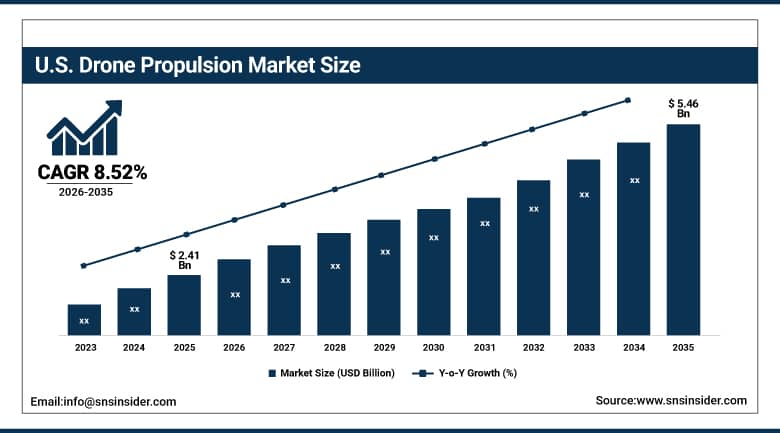
The U.S. Drone Propulsion Market was valued at USD 2.41 billion in 2025 and is expected to reach around USD 5.46 billion by 2035, growing at a CAGR of 8.52% from 2026–2035.
The U.S. drone propulsion market is expanding steadily owing to strong demand for advanced unmanned aerial platforms. Increasing defense modernization initiatives and commercial drone deployment across logistics, agriculture, and infrastructure sectors are supporting market growth. Rising adoption of electric propulsion technologies is driving implementation across organizations. Growth in autonomous aerial operations and long-endurance drone applications is further accelerating demand. Manufacturers are focusing on lightweight motors, efficient power systems, and advanced propulsion components. Increasing use in surveillance, emergency response, and industrial inspection applications is strengthening market penetration.
According to FAA Aerospace Forecast FY2025-FY2045 of the United States, the commercial drone register in the US will stand at 1.03 million aircraft in 2025 compared to 965,524 in 2024. The register for recreational small drones will be 1.89 million aircraft. In addition to that, 420,000 Remote Pilot Certificates have been granted in line with Part 107, enabling more drone flights for commercial purposes.
Drone Propulsion Market Segment Analysis
-
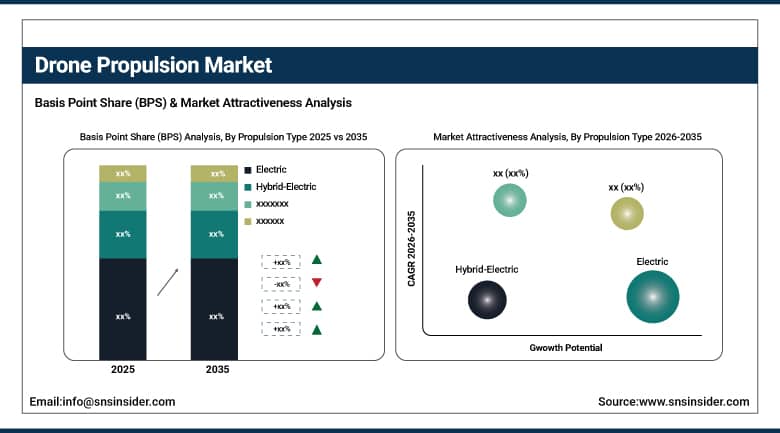
By Propulsion Type, electric dominated the market with 46.80% share in 2025; while hydrogen fuel cell is the fastest growing segment with CAGR of 18.82% during 2026 to 2035.
-
By Power Source, battery dominated the market with 48.60% share in 2025; while hydrogen is the fastest growing segment with CAGR of 18.45% during 2026 to 2035.
-
By Drone Type, multirotor dominated the market with 44.50% share in 2025; while lift plus cruise is the fastest growing segment with CAGR of 17.99% during 2026 to 2035.
-
By Takeoff & Landing Type, Vtol dominated the market with 51.80% share in 2025 and it is also the fastest growing segment with CAGR of 11.06% during 2026 to 2035.
By Propulsion Type, electric dominated the drone propulsion market, while hydrogen fuel cell is the fastest growing segment.
Electric propulsion accounted for the dominating share in drone propulsion market revenues in 2025 owing to its high-level penetration in the commercial, defense, and consumer applications of drones around the world. Electric propulsion provides higher efficiency and lower maintenance costs compared to other forms of propulsions. Moreover, ongoing innovations in the fields of batteries, lightweight motors, and electronic speed controllers have increased the reliability of electric propulsion systems. Growing regulations favoring emission-free aviation are also fueling the use of such technologies.
Hydrogen fuel cells are anticipated to experience a fastest CAGR between 2026 and 2035. An increasing need for higher endurance and emissions-free propulsion is resulting in huge investments being made in the industry. The hydrogen fuel cells offer better energy densities and endurance compared to traditional battery propulsion technologies. Technological innovations are constantly enhancing the performance of the fuel cell systems. Increasing interest in the commercial and defense long-range missions and sustainable aviation initiatives will drive their adoption further.
By Power Source, battery dominated the drone propulsion market, while hydrogen is the fastest growing segment.
Battery segment has been the market leader within the drone propulsion market in terms of revenue in 2025, driven by extensive use of electric drones in applications such as commercial, defense, agriculture, and inspection across the world. Technological advances in lithium-ion batteries with respect to efficiency, performance, and energy storage helped in boosting the reliability of drones. Availability and affordability of the batteries, coupled with their compatibility with multirotor drones, were additional factors driving their use. Regulations that encourage the adoption of environmentally friendly technology have also helped in growing demand for battery drones.
Hydrogen segment is expected to grow with the fastest CAGR from 2026 to 2035, owing to the increasing need for energy-efficient and higher endurance propulsion systems. Advances in technologies related to lightweight fuel cells and storage of hydrogen have boosted the performance of hydrogen-based systems in applications including commercial and defense drones. Investment made towards sustainable aviation and zero emission initiatives is also providing ample growth opportunities for this technology.
By Drone Type, multirotor dominated the drone propulsion market, while lift plus cruise is the fastest growing segment.
Multirotor segment had a dominant market share of maximum revenue in the drone propulsion market in 2025. The dominance was because of wide adoption in commercial, industrial, agricultural, and defense applications, which require hovering capabilities. These drones offer better maneuverability, vertical take-off and landing, and easy operation in tight spaces. The increasing demand for drones for aerial photography, inspection, surveillance, and agriculture applications boosted adoption. The advancements in battery technology and flight control system also contributed to market dominance.
Lift Plus Cruise segment is expected to witness the fastest CAGR during 2026-2035. The rising demand for unmanned aerial vehicles that are capable of traveling long distances in logistics, defense, and urban air mobility application is boosting the adoption rate. This segment offers efficient cruising capabilities along with vertical take-off and landing operations, thereby offering flexible operating capabilities. Investments made in propulsion and autonomous flight systems are aiding the commercialization process.
By Takeoff & Landing Type, Vtol dominated the drone propulsion market and it is also the fastest growing segment.
VTOL segment emerged as the market leader within the drone propulsion market, holding the dominating share of revenues in 2025. This was due to the widespread usage in military, commercial, and public safety drones where there was a need for vertical takeoff. The technology made drones free of runways and gave better operational flexibility in constrained spaces. Growing usage in surveillance, inspection, logistic, and emergency response missions boosted its demand. Efficiency improvements in terms of propulsion, flight stability, and payload capacity further helped it in dominating the market.
VTOL segment is predicted to register the fastest CAGR during 2026-2035. Growing investment in the fields of autonomous aerial mobility and advanced electric propulsion systems has increased the use of VTOLs across various sectors. Growing application in last-mile delivery, urban air mobility, infrastructure surveillance, and disaster management are providing significant growth avenues to the market. Growing government investments in unmanned aviation and positive regulatory outlook is also boosting commercialization prospects. Further developments in battery power, lightweight materials, and intelligent flight control systems are aiding market growth.
Regional Analysis
|
Region |
Major Country |
Share within Region, 2025(%) |
|---|---|---|
|
North America |
United States |
84.60% |
|
Europe |
Germany |
24.60% |
|
Asia Pacific |
China |
41.30% |
|
Middle East & Africa |
UAE |
17.40% |
|
Latin America |
Brazil |
44.80% |
North America Drone Propulsion Market Insights.
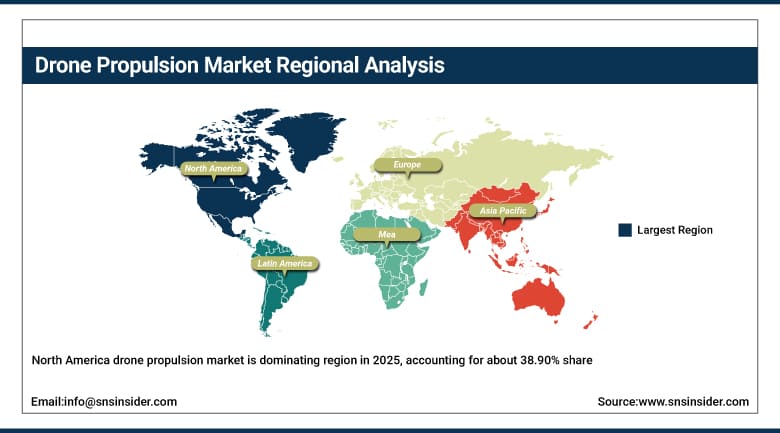
North America drone propulsion market is dominating region in 2025, accounting for about 38.90% share, driven by strong demand from defense, commercial, and industrial drone applications. The region benefits from advanced aerospace manufacturing capabilities and continuous propulsion technology innovation. Increasing investments in autonomous unmanned systems are significantly strengthening product adoption. Expansion of military modernization programs is accelerating demand. A strong focus on electric propulsion, surveillance, and long-endurance platforms further reinforces the region’s dominant position in the market.
According to the Transport Canada, there are in excess of 120,000 remote aircraft registered in Canada, along with more than 100,000 drone pilots who are licensed. These quantifiable metrics demonstrate that there is increasing usage of drones in North America.
Get Customized Report as Per Your Business Requirement - Enquiry Now
Europe Drone Propulsion Market Insights.
Europe drone propulsion market is characterized by stable growth in 2025 owing to strong demand for advanced unmanned aviation technologies. Key countries include Germany, France, United Kingdom, and Italy. Rising investments in electric propulsion research and aerospace innovation are driving adoption. Increasing focus on sustainable aviation regulations is boosting demand. Growth in industrial inspection, border surveillance, and defense applications is further supporting market expansion. Strict regulatory standards are encouraging innovation in advanced drone propulsion technologies.
The European Union Aviation Safety Agency, as well as the Drone Strategy 2.0 from the European Commission, indicates that the number of drone operators in Europe exceeded 1.8 million entering 2025 due to the increasing use of drones commercially and recreationally. EASA requires all drones above 250 grams or fitted with cameras to be registered. According to the European Commission, there will be a potential of up to 145,000 job opportunities in the drone industry by 2030.
Asia Pacific Drone Propulsion Market Insights.
Asia Pacific is the fastest growing region in the drone propulsion market, registering a CAGR of about 11.68% during 2026–2035. Rapid industrialization and expanding aerospace manufacturing capabilities are driving strong demand across China, India, Japan, South Korea, and Southeast Asia. Increasing production of commercial and defense drones is boosting market growth. Rising investments in autonomous aviation are further accelerating adoption. Growth in logistics, agriculture, and infrastructure inspection applications is supporting large scale market expansion.
According to the Civil Aviation Administration of China, the number of civil drones in China exceeds 2 million, whereas the number of registered drone pilots in China exceeds 225,000. Updated requirements about real name registration and tracing of drone ownerships help develop the market even more. In addition, according to the Civil Aviation Safety Authority (CASA) of Australia, the number of drones in Australia exceeds 230,000.
Middle East & Africa and Latin America Drone Propulsion Market Insights.
The Middle East & Africa along with Latin America regions are witnessing steady growth due to expanding defense capabilities and increasing commercial drone adoption. Key contributing countries include Brazil, Mexico, UAE, Saudi Arabia, and South Africa. Increasing demand for aerial surveillance and infrastructure monitoring is driving adoption. Growth in agriculture, mining, and energy inspection is further supporting market expansion. Rising investments in unmanned aviation technologies are boosting regional demand.
With the assistance of international civil aviation standards from the International Civil Aviation Organization and spectrum allocation from the International Telecommunication Union, drone integration is rapidly developing within the Middle East, Africa, and Latin America regions. Infrastructure inspection, agriculture surveying, and utility inspection services are expanding the use of commercial drones. The Model UAS Regulations from the ICAO have facilitated numerous harmonization processes for regulation amongst its 193 member nations, driving demand for high-performance drone propulsion and endurance systems.
Market Dynamics
Growth Drivers: Growing electric propulsion demand drives innovation in lightweight, energy-efficient, long-endurance drone technologies.
The use of electric propulsion technology is witnessing greater acceptance due to its reduced need for maintenance and greater efficiency of operations. The companies are making use of efficient motors, batteries, and propulsion architecture designs that enhance flight time and carrying capacity. The increasing environmental consciousness is driving companies towards adopting clean and alternate forms of propulsion technology for commercial drones. There are increased efforts being made in research and development in improving battery technology and hybrid-electric propulsion technology among others. The application of drones in areas like mapping, industrial inspection, environmental surveillance, and last mile delivery is contributing towards greater market demand.
As reported by the FAA Aerospace Forecast 2025-2045, in 2025, the US commercial drone fleet is forecasted to reach 1.03 million drones and cross the barrier of 2 million in the overall registered fleet of drones. Simultaneously, as noted in the IEA Global EV Outlook 2025, there is an unprecedented expansion in battery production, leading to more efficient lithium-ion batteries. This leads to advancements in energy-efficient electric propulsion systems.
Restraints: Limited battery endurance restricts long-duration drone operations across demanding commercial and industrial applications.
The current battery technologies still suffer from shortcomings in energy density, time to charge and life cycle while using the drones intensively. The commercial customers always need longer flights in order to carry out various missions such as inspecting, mapping, delivering and surveilling. The frequent need to replace the batteries or recharge them causes disruption in the process and makes the whole system less effective. In addition, heavy loads decrease the endurance and efficiency even more. Despite the development of hybrid and hydrogen propulsion technologies, their commercial use is still difficult due to high expenses.
Opportunities: Hydrogen fuel cell advancements enable sustainable, high-endurance propulsion for next-generation unmanned aerial platforms.
Advantages in terms of flight time, less emission, and quick refueling make hydrogen fuel cells an attractive alternative for drone propulsion than battery-powered systems. The growing importance of sustainable air travel has been prompting investment in the development of unmanned aircraft that are hydrogen powered. Various research firms and aerospace companies are working in collaboration to increase the efficiency of fuel cells, reduce weight, and enhance their performance. There is growing interest in hydrogen propulsion in drones for long range surveillance and cargo operations.
As per the IEA Global Hydrogen Review 2025, global hydrogen production reached around 100 million tonnes, thus boosting the development of fuel cells within the transportation sector. Also, as per the U.S. Department of Energy, fuel cell technology can attain system efficiency of up to 40-60%. These developments have resulted in the emphasis of FAA Aerospace Forecast on next generation of aviation.
Recent Developments
-
2026: Honeywell International Inc. announced new brand identities ahead of spinning off its Aerospace business to accelerate autonomous flight technologies.
-
2025: RTX Corporation's Pratt & Whitney completed critical small turbofan engine testing, unlocking a 20% thrust increase for unmanned combat aircraft applications.
-
2025: Rolls-Royce Liberty Works secured a US Air Force contract to refine propulsion designs for medium-thrust autonomous collaborative platform drones.
-
2024: LaunchPoint Electric Propulsion Solutions, Inc. secured a US Air Force AFWERX contract to design modular, power-dense UAS generator systems.
Drone Propulsion Market Key Players are:
-
Honeywell International Inc.
-
RTX Corporation
-
Safran S.A.
-
Rolls-Royce plc
-
T-Motor Technology Co., Ltd.
-
KDE Direct LLC
-
H3X Technologies, Inc.
-
Maxon Group
-
Faulhaber Group
-
Plettenberg Elektromotoren GmbH
-
MAD Components Co., Ltd. (MAD Motors)
-
Nidec Corporation
-
Emrax d.o.o.
-
LaunchPoint Electric Propulsion Solutions, Inc.
-
UAV Propulsion Tech Ltd.
-
Rotron Aerospace
-
MagLev Aero Inc.
-
Hacker Motor GmbH
-
Foxtech Technology Co., Ltd.
-
Northwest UAV Inc.
Drone Propulsion Market Report Scope:
| Report Attributes | Details |
|---|---|
| Market Size in 2025 | USD 7.34 Billion |
| Market Size by 2035 | USD 19.03 Billion |
| CAGR | CAGR of 10.02% From 2026 to 2035 |
| Base Year | 2025 |
| Forecast Period | 2026-2035 |
| Historical Data | 2022-2024 |
| Report Scope & Coverage | Market Size, Segments Analysis, Competitive Landscape, Regional Analysis, DROC & SWOT Analysis, Forecast Outlook |
| Key Segments | • By Propulsion Type: Electric, Hybrid-Electric, Gas Piston Engine, Gas Turbine/Jet Turbine, Hydrogen Fuel Cell • By Power Source: Battery, Liquid Fuel, Hybrid Gas-Electric, Hydrogen • By Drone Type: Fixed-Wing, Rotary-Wing (Single Rotor), Multirotor, Lift Plus Cruise, Tiltrotor/Tiltwing • By Takeoff & Landing Type: Vtol, Ctol, Stol, Hand Launch, Catapult Launch |
| Regional Analysis/Coverage | North America (US, Canada), Europe (Germany, UK, France, Italy, Spain, Russia, Poland, Rest of Europe), Asia Pacific (China, India, Japan, South Korea, Australia, ASEAN Countries, Rest of Asia Pacific), Middle East & Africa (UAE, Saudi Arabia, Qatar, South Africa, Rest of Middle East & Africa), Latin America (Brazil, Argentina, Mexico, Colombia, Rest of Latin America). |
| Company Profiles | Honeywell International Inc., RTX Corporation, Safran S.A., Rolls-Royce plc, T-Motor Technology Co., Ltd., KDE Direct LLC, H3X Technologies, Inc., Maxon Group, Faulhaber Group, Plettenberg Elektromotoren GmbH, MAD Components Co., Ltd. (MAD Motors), Nidec Corporation, Emrax d.o.o., LaunchPoint Electric Propulsion Solutions, Inc., UAV Propulsion Tech Ltd., Rotron Aerospace, MagLev Aero Inc., Hacker Motor GmbH, Foxtech Technology Co., Ltd., Northwest UAV Inc. |
Frequently Asked Questions
North America dominated the drone propulsion market in 2025.
The major growth factors include rising defense modernization, expanding commercial drone deployment, increasing electric and hydrogen propulsion adoption, and advancements in lightweight motors, batteries, and autonomous flight.
The drone propulsion market is expected to grow at a CAGR of 10.02% from 2026 to 2035.
