
Self-Cleaning Coating Market Report Scope & Overview:
Self-Cleaning Coating Market was valued at USD 4.18 billion in 2025 and is expected to reach USD 9 billion by 2035, growing at a CAGR 7.99% of from 2026-2035.
The Self-Cleaning Coating Market is experiencing strong growth, driven by increasing demand for low-maintenance, durable, and environmentally friendly surface solutions across construction, automotive, solar energy, textiles, and electronics applications. These coatings, including hydrophobic and photocatalytic types, repel water, dust, and contaminants, reducing cleaning frequency, maintenance costs, and chemical usage. Rising focus on sustainability, green building initiatives, energy efficiency, and advanced material innovations are further accelerating the adoption of self-cleaning coatings across multiple industries.
Self-cleaning coatings reduce exterior building maintenance costs by up to 35% over a building’s lifecycle.

To Get more information On Self-Cleaning Coating Market - Request Free Sample Report
Key Trends in the Self-Cleaning Coating Market
-
Green Buildings: Increasing adoption in commercial and residential projects to cut maintenance and support sustainability certifications.
-
Solar Panels: Rapid growth driven by efficiency maintenance in dusty and arid regions.
-
Nano-Coatings: Shift toward durable, high-performance hydrophobic and photocatalytic coatings.
-
Automotive & Consumer Goods: Expanding use in vehicles, textiles, and household products.
-
Eco-Friendly Formulations: Rising demand for low-VOC, water-based, and non-toxic coatings.
U.S. Self-Cleaning Coating Market Insights:
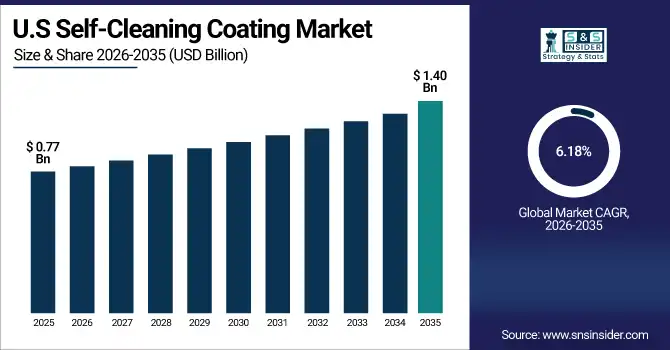
The U.S. Self-Cleaning Coating Market is projected to grow from USD 0.77 Billion in 2025 to USD 1.40 Billion by 2035, at a CAGR of 6.18%. Growth is driven by increasing adoption in construction, automotive, and solar applications, rising demand for low-maintenance surfaces, sustainability initiatives, and technological advancements in hydrophobic and photocatalytic coatings.
Self-Cleaning Coating Market Growth Drivers:
-
Rising Demand for Low-Maintenance and Sustainable Surfaces
The growing focus on reducing maintenance costs and improving sustainability is a major driver for the self-cleaning coating market. In 2025, over 40% of newly constructed commercial buildings globally incorporated low-maintenance surface technologies to reduce water usage, labor costs, and chemical cleaners. Self-cleaning coatings, particularly hydrophobic and photocatalytic variants, help maintain surface cleanliness using rainwater and sunlight, aligning well with green building certifications and long-term cost-efficiency goals.
Self-Cleaning Coating Market Restraints:
-
High Initial Cost and Limited Awareness in Emerging Markets
The relatively high upfront cost of advanced self-cleaning coatings compared to conventional coatings remains a key restraint. Nano-enabled and photocatalytic coatings require specialized materials and application processes, increasing overall project costs. Additionally, limited awareness and technical expertise in emerging economies slow adoption, especially in price-sensitive residential and small commercial projects.
Self-Cleaning Coating Market Opportunities:
-
Rapid Expansion of Solar Energy and Smart Infrastructure Projects
The global expansion of solar energy installations and smart infrastructure presents significant growth opportunities for the self-cleaning coating market. Dust accumulation can reduce solar panel efficiency by 25% annually in arid and polluted regions. Self-cleaning coatings help maintain optimal energy output while minimizing water-based cleaning, making them increasingly attractive for large-scale solar farms, smart cities, and transportation infrastructure projects worldwide.
Self-Cleaning Coating Market Segment:
-
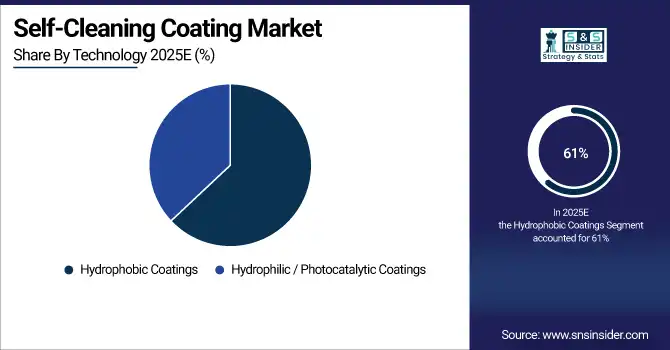
By Technology: In 2025, Hydrophobic Coatings dominated with 61% share; Hydrophilic / Photocatalytic Coatings fastest growing segment during 2026-2035
-
By Material Type: In 2025, Titanium Dioxide (TiO₂) dominated with 45% share; Silica-Based Coatings fastest growing segment during 2026-2035
-
By Application: In 2025, Construction & Building Materials dominated with 36% share; Solar Panels & Energy Systems fastest growing segment during 2026-2035
-
By End User: In 2025, Construction & Infrastructure Companies dominated with 35% share; Solar Energy Providers fastest growing segment during 2026-2035
Self-Cleaning Coating Market Segment Analysis:
By Technology: Hydrophobic Coatings Dominate, Hydrophilic/Photocatalytic Coatings Fastest-Growing
Hydrophobic coatings dominate the technology segment due to their strong water-repellent properties, ease of application, and cost-effectiveness. These coatings enable water droplets to roll off surfaces, carrying away dust and contaminants, which makes them widely adopted in construction façades, automotive windshields, glass surfaces, and consumer products. Their compatibility with multiple substrates and immediate performance benefits have supported large-scale commercial deployment.
Hydrophilic and photocatalytic coatings are the fastest-growing segment, driven by increasing adoption of self-cleaning glass and air-purifying surfaces. These coatings use photocatalysis, primarily based on titanium dioxide, to break down organic pollutants under sunlight and allow water to spread evenly for effective cleaning. Rising environmental regulations, green building certifications, and demand for pollution-mitigating materials are accelerating their uptake.
By Material Type: Titanium Dioxide (TiO₂) Dominates, Silica-Based Coatings Fastest-Growing
Titanium dioxide dominates the material segment due to its proven photocatalytic efficiency, chemical stability, and strong self-cleaning and antimicrobial properties. TiO₂-based coatings are extensively used in architectural glass, exterior building materials, and solar panels, where long-term durability and UV-activated performance are critical. Wide commercial availability and regulatory acceptance further reinforce its dominant position.
Silica-based coatings are the fastest-growing material segment, supported by their high transparency, scratch resistance, and environmental friendliness. Their ability to form ultra-thin, durable layers makes them increasingly preferred for electronics, optical applications, and premium glass surfaces. Growing demand for non-toxic and aesthetically neutral coatings is driving rapid adoption.
By Application: Construction & Building Materials Dominate, Solar Panels Fastest-Growing
Construction and building materials dominate the application segment due to extensive use of self-cleaning coatings on glass façades, windows, roofs, and exterior walls. These coatings significantly reduce maintenance costs, improve building aesthetics, and support sustainable infrastructure development. Expansion of urban infrastructure and green building initiatives continues to reinforce this dominance.
Solar panels represent the fastest-growing application segment, as dust and soiling directly impact energy output. Self-cleaning coatings enhance panel efficiency, reduce water usage for cleaning, and lower operational costs, making them increasingly attractive for large-scale solar farms and rooftop installations, particularly in dusty and arid regions.
By End User: Construction & Infrastructure Companies Dominate, Solar Energy Providers Fastest-Growing
Construction and infrastructure companies dominate the end-user segment due to high-volume adoption in commercial buildings, public infrastructure, and residential projects. Long-term cost savings and compliance with sustainability standards have driven widespread implementation across new construction and renovation projects.
Solar energy providers are the fastest-growing end-user segment, driven by the need to maximize power generation efficiency and reduce maintenance expenses. Rapid expansion of solar capacity worldwide and increasing investments in renewable energy infrastructure are accelerating adoption of self-cleaning coating solutions within this segment.
Self-Cleaning Coating Market - Regional Analysis
Asia-Pacific Self-Cleaning Coating Market Insights:
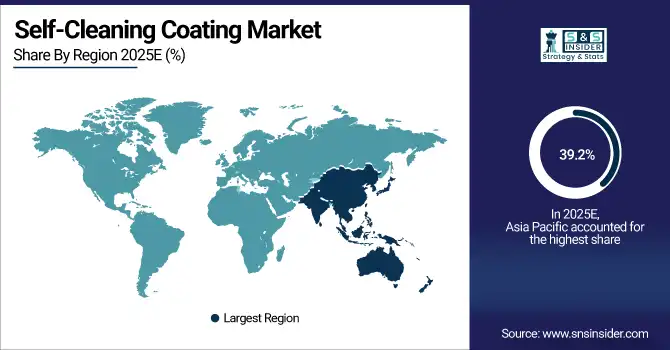
The Asia-Pacific region dominates the Self-Cleaning Coating Market, holding a market share of 39.2% in 2025. The region is also the fastest-growing market, projected to expand at a CAGR of 9.85% from 2026 to 2035. This growth is fueled by rapid urbanization, which drives demand for commercial and residential buildings requiring low-maintenance surfaces. Infrastructure development across smart cities and public facilities boosts construction applications. Expanding automotive production increases adoption of self-cleaning coatings for windshields and exteriors, while rising solar energy installations necessitate coatings to maintain panel efficiency and reduce cleaning costs.
Get Customized Report as per Your Business Requirement - Enquiry Now
North America Self-Cleaning Coating Market Insights:
The North American Self-Cleaning Coating Market is witnessing steady growth, driven by increasing demand for low-maintenance and sustainable building solutions. Adoption is rising in construction, automotive, and solar applications, supported by stringent environmental regulations and green building initiatives. Advanced coating technologies, including hydrophobic and photocatalytic variants, are increasingly preferred for durability, energy efficiency, and reduced maintenance requirements across commercial and residential projects.
Europe Self-Cleaning Coating Market Insights:
The European Self-Cleaning Coating Market is growing steadily, driven by strong regulatory frameworks promoting sustainability and environmentally friendly building practices. Adoption is increasing in construction, automotive, and industrial applications, with a focus on energy-efficient and low-maintenance surfaces. Advanced hydrophobic and photocatalytic coatings are gaining traction for their durability, eco-friendliness, and ability to reduce cleaning and maintenance costs across commercial, residential, and infrastructure projects.
Latin America Self-Cleaning Coating Market Insights:
The Latin American Self-Cleaning Coating Market is gradually expanding, supported by growing awareness of sustainable and low-maintenance building solutions. Adoption is primarily seen in commercial construction, automotive, and solar panel applications. The market is also benefiting from increasing urbanization, infrastructure development, and rising interest in eco-friendly coatings that reduce maintenance costs and enhance surface durability.
Middle East & Africa Self-Cleaning Coating Market Insights:
The Middle East & Africa Self-Cleaning Coating Market is experiencing moderate growth, driven by increasing construction activities, urban infrastructure development, and adoption of sustainable building practices. Demand is rising in commercial buildings, automotive, and solar energy applications, with a focus on durable, low-maintenance coatings that withstand harsh environmental conditions such as heat, dust, and sand.
Self-Cleaning Coating Market Competitive Landscape:
PPG Industries, headquartered in Pittsburgh, Pennsylvania, USA, is a leading player in the self-cleaning coating market, offering advanced hydrophobic and photocatalytic coating solutions for architectural, automotive, and industrial applications. The company focuses on durable, high-performance surface technologies that reduce maintenance requirements and improve sustainability, serving construction firms, automotive OEMs, and infrastructure developers worldwide.
-
In March 2025: PPG Industries expanded its self-cleaning and low-maintenance architectural coating portfolio by introducing advanced nano-enabled exterior coatings designed to enhance dirt resistance, weather durability, and lifecycle performance for commercial buildings.
Akzo Nobel, headquartered in Amsterdam, Netherlands, is a prominent global manufacturer in the self-cleaning coating market, providing innovative surface solutions for construction, automotive, marine, and industrial end uses. The company emphasizes sustainable chemistry, low-VOC formulations, and functional coatings that improve surface cleanliness, durability, and environmental performance, working closely with OEMs and infrastructure stakeholders globally.
-
In May 2025: Akzo Nobel strengthened its sustainable coatings portfolio by advancing self-cleaning and easy-to-clean technologies within its architectural and protective coatings businesses, targeting green building projects and long-term infrastructure applications.
Self-Cleaning Coating Market Key Players
-
PPG Industries, Inc.
-
Akzo Nobel N.V.
-
The Sherwin-Williams Company
-
BASF SE
-
Nippon Paint Holdings Co., Ltd.
-
Jotun Group
-
Sika AG
-
Axalta Coating Systems
-
RPM International Inc.
-
Dow Inc.
-
3M Company
-
Daikin Industries, Ltd.
-
Koninklijke DSM N.V.
-
Hempel A/S
-
NeverWet (Rust-Oleum Brand)
-
Lotus Leaf Coatings
-
Aculon, Inc.
-
Advanced Nanotech Lab
| Report Attributes | Details |
|---|---|
| Market Size in 2025 | USD 4.18 Billion |
| Market Size by 2035 | USD 9.00 Billion |
| CAGR | CAGR of 7.99% From 2026 to 2035 |
| Base Year | 2025 |
| Forecast Period | 2026-2035 |
| Historical Data | 2022-2024 |
| Report Scope & Coverage | Market Size, Segments Analysis, Competitive Landscape, Regional Analysis, DROC & SWOT Analysis, Forecast Outlook |
| Key Segments | • By Technology: (Hydrophobic Coatings, Hydrophilic/Photocatalytic Coatings) • By Material Type: (Titanium Dioxide (TiO₂), Silica-Based Coatings, Fluoropolymer Coatings, Others) • By Application: (Construction & Building Materials, Automotive & Transportation, Solar Panels & Energy Systems, Textiles & Consumer Goods, Electronics & Displays) • By End User: (Construction & Infrastructure Companies, Automotive OEMs, Solar Energy Providers, Consumer Goods Manufacturers, Electronics Manufacturers) |
| Regional Analysis/Coverage | North America (US, Canada), Europe (Germany, UK, France, Italy, Spain, Russia, Poland, Rest of Europe), Asia Pacific (China, India, Japan, South Korea, Australia, ASEAN Countries, Rest of Asia Pacific), Middle East & Africa (UAE, Saudi Arabia, Qatar, South Africa, Rest of Middle East & Africa), Latin America (Brazil, Argentina, Mexico, Colombia, Rest of Latin America). |
| Company Profiles | PPG Industries, Akzo Nobel, Sherwin-Williams, BASF, Nippon Paint Holdings, Jotun Group, Saint-Gobain, Sika, Axalta Coating Systems, RPM International, Dow, 3M, Daikin Industries, DSM, Hempel, Nanogate, NeverWet (Rust-Oleum), Lotus Leaf Coatings, Aculon, Advanced Nanotech Lab |
Frequently Asked Questions
Asia-Pacific dominated the Self-Cleaning Coating Market in 2025.
The “Construction & Building Materials” segment dominated during the projected period.
The key drivers of the Self-Cleaning Coating Market include growing demand for low-maintenance surfaces, sustainability initiatives, construction and automotive adoption, solar applications, and advanced hydrophobic and photocatalytic technologies.
The market was valued at USD 4.18 Billion in 2025 and is projected to reach USD 9 Billion by 2035.
The Self-Cleaning Coating Market is expected to grow at a CAGR of 7.99% during 2026–2035.
