
Spintronic Material Market Report Scope & Overview:
The Spintronic Material Market size is valued at USD 2.23 Billion in 2025 and is expected to reach USD 33.71 Billion by 2035 and grow at a CAGR of 31.22% over the forecast period 2026-2035.
The Spintronic Material market is expected to grow rapidly due to increasing adoption of MRAM technology and rising demand for energy-efficient memory and sensing solutions. Additionally, growing integration of advanced electronics in consumer devices, automotive, and data centers is driving the need for high-performance spintronic materials. Advancements in spin transfer torque (STT), spin orbit torque (SOT), and tunnel magnetoresistance (TMR) technologies further support market growth. Increasing R&D investments and industry collaborations for next-generation computing also accelerate market expansion.
According to industry studies, over 60% of Spintronic Material demand is driven by MRAM and sensor applications in electronics and automotive sectors, driven by rising demand for low-power high-speed memory and advanced magnetic sensing technologies.

To Get more information On Spintronic Material Market - Request Free Sample Report
Spintronic Material Market Trends:
-
Growing adoption of MRAM technology is driving demand for spintronic materials, particularly in consumer electronics, data centers, and embedded systems.
-
Increasing need for energy-efficient and high-performance memory solutions is boosting the use of spintronic materials in next-generation electronics.
-
Rising integration of spintronic sensors in automotive and industrial applications is expanding market growth for magnetic materials.
-
Advancements in STT, SOT, and TMR technologies are enhancing device performance and supporting wider commercialization of spintronics.
-
Increased R&D investments and industry collaborations are accelerating development of advanced spintronic materials such as topological insulators and antiferromagnetic alloys.
U.S. Specialty Spintronic Material Market Insights:
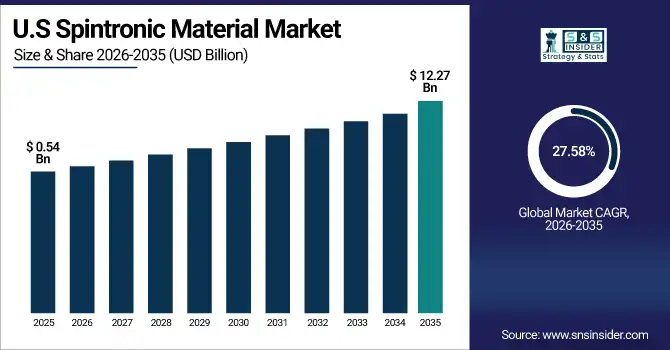
The U.S. Spintronic Material Market size is USD 0.54 Billion in 2025 and is expected to reach USD 12.27 Billion by 2035, growing at a CAGR of 27.58% over the forecast period of 2026-2035.
The U.S. Spintronic Material market is expected to grow rapidly due to increasing adoption of MRAM technology and rising demand for energy-efficient memory and sensing solutions across electronics and automotive sectors. Additionally, growing integration of advanced electronic systems in consumer devices, data centers, and defense applications is driving the need for high-performance spintronic materials. Advancements in STT, SOT, and TMR technologies and increased R&D investments further support market growth. Strategic collaborations and technology commercialization initiatives also accelerate market expansion.
Spintronic Material Market Growth Drivers:
-
Rising MRAM Adoption and Demand for Low-Power High-Performance Memory
The Spintronic Material market is strongly driven by the increasing adoption of MRAM technology and the need for energy-efficient, high-speed memory solutions. MRAM offers non-volatile memory, faster read/write speed, and lower power consumption compared to traditional memory types, making it highly suitable for modern electronics and data centers. The global demand for low-power memory is increasing due to rapid growth in AI, IoT, and edge computing. As more devices require faster processing and lower energy usage, MRAM adoption continues to expand, driving demand for spintronic materials. Additionally, the growth of 5G and next-generation communication networks further supports MRAM integration in network equipment and edge devices.
Spintronic Material Market Growth Restraints:
-
High Manufacturing Complexity and Cost of Advanced Spintronic Materials
Market growth is restrained by the high cost and complex manufacturing processes required for advanced spintronic materials. Producing high-quality ferromagnetic and antiferromagnetic layers, topological insulators, and precise thin-film structures requires specialized equipment and strict process controls. This increases production costs and limits mass commercialization. Additionally, integration challenges with existing semiconductor manufacturing processes and compatibility issues with CMOS technology can delay adoption. Limited availability of advanced spintronic materials and supply chain constraints further restrict market growth. The requirement for specialized fabrication and testing facilities increases overall capital expenditure, discouraging new entrants and slowing the pace of commercialization.
Spintronic Material Market Growth Opportunities:
-
Integration with Quantum Computing, Neuromorphic Chips, and Next-Gen AI Hardware
ignificant opportunities arise from integrating spintronic materials into quantum computing, neuromorphic architectures, and AI accelerators. Spintronics offers unique advantages such as low power consumption, non-volatility, and high-speed operation, making it ideal for next-generation computing platforms. The growing investment in quantum computing and AI hardware is driving research and commercialization of spintronic devices, such as spin qubits and spin-based logic circuits. As semiconductor scaling approaches physical limits, spintronics provides a viable alternative to traditional CMOS-based systems. Additionally, integration of spintronic materials into AI accelerators can improve performance and energy efficiency, creating strong demand for advanced spintronic materials.
Spintronic Material Market Segment:
-
By Material Type: In 2025, Ferromagnetic Materials dominated with 45% share; Topological Insulators fastest growing segment during 2026–2035.
-
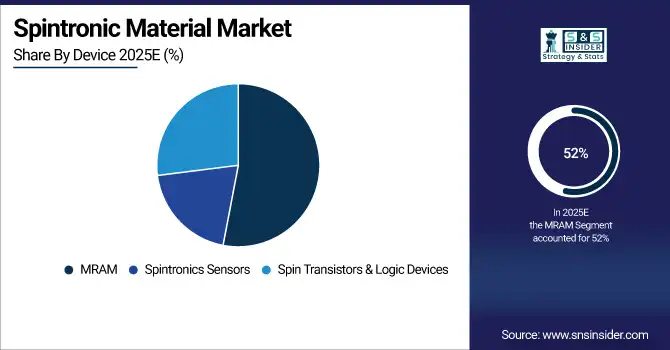
By Device: In 2025, MRAM dominated with 52% share; Spin Transistors & Logic Devices fastest growing segment during 2026–2035
-
By Technology Type: In 2025, Spin Transfer Torque (STT) dominated with 50% share; Spin Orbit Torque (SOT) fastest growing segment during 2026–2035.
-
By End-User Industry: In 2025, Electronics & Consumer Devices dominated with 55% share; Automotive & Transportation fastest growing segment during 2026–2035.
Spintronic Material Market Segment Analysis:
By Material Type: Ferromagnetic Materials Led as Topological Insulators Expand Rapidly.
Ferromagnetic materials dominate the Spintronic Material market due to their widespread use in MRAM and magnetic sensor applications, offering reliable magnetic switching, high stability, and mature manufacturing processes. These materials are integral to current spintronic device architectures and are widely adopted across consumer electronics and industrial applications.
Topological insulators are expanding rapidly due to their potential for ultra-low power spin transport and improved spin coherence, which are critical for next-generation spintronic devices such as spin logic and quantum computing components. Their unique surface conduction properties make them promising for future high-performance applications.
By Device: MRAM Led as Spin Transistors & Logic Devices Expand Rapidly.
MRAM dominates the market due to its strong adoption in non-volatile memory applications, offering faster speed, lower power consumption, and better endurance compared to traditional memory technologies. MRAM is increasingly used in consumer electronics, data centers, and embedded systems where high performance and reliability are essential.
Spin transistors & logic devices are expanding rapidly as research and development progress toward spin-based computing and neuromorphic architectures. These devices promise to overcome CMOS scaling limits by enabling energy-efficient logic operations and advanced computing paradigms.
By Technology Type: Spin Transfer Torque (STT) Led as Spin Orbit Torque (SOT) Expands Rapidly.
STT technology dominates due to its maturity and commercial availability in MRAM products. It offers efficient switching, strong scalability, and compatibility with existing semiconductor processes, making it the preferred choice for current MRAM deployments.
SOT technology is expanding rapidly due to its potential for faster switching speeds and lower energy consumption, making it ideal for next-generation spintronic devices. SOT-based MRAM and logic devices are gaining traction as the industry seeks higher performance and improved energy efficiency.
By End-User Industry: Electronics & Consumer Devices Led as Automotive & Transportation Expand Rapidly.
Electronics & consumer devices dominate the market as MRAM and spintronic sensors are widely used in smartphones, wearables, IoT devices, and computing systems, where energy efficiency and high-speed memory are critical.
Automotive & transportation are expanding rapidly due to increasing adoption of advanced driver-assistance systems (ADAS), autonomous driving, and electric vehicles, which require high-performance sensors and reliable memory for safety and data processing applications. Spintronic sensors and MRAM are increasingly used in automotive electronics for enhanced performance and durability.
Spintronic Material Market Regional Analysis:
Asia Pacific Spintronic Material Market Insights:
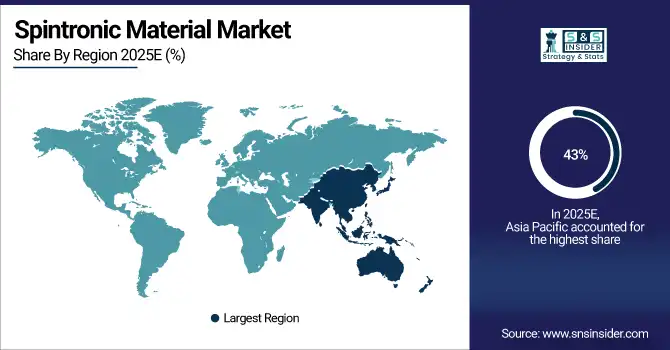
In 2025, Asia Pacific Spintronic Material Market accounting for the highest regional revenue share of approximately 43% in 2025. Asia Pacific dominates the Spintronic Material market due to its strong semiconductor manufacturing base and high investment in advanced electronics. The region hosts major memory and chip manufacturers, particularly in China, South Korea, Japan, and Taiwan, driving large-scale adoption of MRAM and spintronic sensors. Rapid growth in consumer electronics, data centers, and automotive electronics also fuels demand. Additionally, government support for technology innovation and strong R&D infrastructure accelerates commercialization of spintronic materials and devices, reinforcing regional leadership.
Get Customized Report as per Your Business Requirement - Enquiry Now
North America Spintronic Material Market Insights:
North America represents a fastest-growth region for the Spintronic Material market, registering a CAGR of 28.22% during 2026–2035. North America is witnessing the fastest growth in the Spintronic Material market, driven by strong investments in semiconductor research, growing adoption of MRAM and spintronic sensors in high-performance computing, and rapid expansion of AI, data centers, and defense electronics. Supportive government programs, extensive R&D collaborations, and the presence of leading semiconductor companies further accelerate commercialization of spintronic materials and devices, driving rapid market growth over the forecast period.
Europe Spintronic Material Market Insights:
Europe is a key region in the Spintronic Material market, supported by strong industrial electronics and automotive sectors. The region’s focus on advanced research, innovation, and high-quality manufacturing drives demand for spintronic materials, especially in MRAM and sensor applications. Increasing adoption of electric and autonomous vehicles, along with growth in aerospace and defense electronics, further boosts market growth. Strong government initiatives and collaborations between research institutes and semiconductor companies accelerate technology development and commercialization in Europe.
Latin America Spintronic Material Market Insights:
Latin America’s Spintronic Material market is gradually expanding, driven by growing adoption of advanced electronics and increasing investment in industrial automation and smart infrastructure. The region is witnessing rising demand for energy-efficient memory and sensor solutions, particularly in consumer electronics and automotive applications. Although market growth is slower compared to Asia Pacific and North America, increasing technology transfer, strategic partnerships, and expanding electronics manufacturing capabilities are supporting gradual market development. Continued investments in R&D and infrastructure are expected to strengthen the spintronic ecosystem in the region.
Middle East and Africa Spintronic Material Market Insights:
The Middle East and Africa Spintronic Material market is in the early growth stage, driven by rising demand for advanced electronics, defense systems, and industrial automation. Growing investments in smart infrastructure, telecommunications, and digital transformation are creating opportunities for spintronic materials in sensors and memory applications. However, limited local manufacturing and high dependency on imports constrain rapid growth. Strategic partnerships, government initiatives in technology development, and increasing adoption of advanced electronics are expected to gradually strengthen market growth in the region.
Spintronic Material Market Competitive Landscape:
Everspin Technologies, Inc. is a leading global spintronic material and MRAM technology company known for its high-performance magnetoresistive random-access memory (MRAM) solutions that deliver non-volatile, fast, and robust memory for industrial IoT, data centers, automotive, aerospace, and defense applications. The company’s core strength lies in its MRAM portfolio, including advanced STT-MRAM products that support extreme operating environments and persistent memory requirements across mission-critical systems. Everspin also focuses on expanding strategic partnerships and design wins to broaden its market presence and technology adoption.
-
March 2025, Everspin expanded its high-reliability MRAM portfolio by launching the EM064LX HR and EM128LX HR STT-MRAM devices, designed for extreme temperature ranges and meeting automotive and industrial standards, enhancing its applicability in aerospace, automotive, and industrial systems.
Samsung Electronics Co. Ltd. is a major global semiconductor and spintronics technology leader with extensive R&D in spintronic memory and advanced memory architectures. The company leverages its broad semiconductor expertise to develop and scale embedded MRAM (eMRAM) and spintronics-related components, contributing to next-generation memory solutions for high-performance computing, AI, and mobile applications. Samsung’s competitive strengths include its large manufacturing footprint, technological innovations in memory scaling, and integration of spintronics into broader memory product roadmaps.
-
In 2025, Samsung highlighted its memory innovation vision at the Future Memory & Storage (FMS) 2025 event, showcasing its commitment to advancing memory and storage technologies — including eMRAM developments — as part of AI and high-performance systems, reinforcing its role in the evolving spintronics ecosystem.
NVE Corporation is a U.S.-based spintronics company specializing in ultra-low-power magnetic sensors, isolators, and spintronic device technologies. The company’s portfolio includes giant magnetoresistive (GMR) sensors and spintronics components leveraged in industrial, automotive, IoT, and medical applications. NVE focuses on robust, precision magnetic sensing solutions that deliver high performance and reliability in compact form factors, supporting advanced applications where energy efficiency and precision are critical.
-
In 2025, NVE continued innovation in spintronics sensors and related technologies, with industry analysis noting its development of advanced ultra-low-power sensors and isolators, positioning the company for expanded applications across IoT, robotics, and other sectors, despite near-term revenue fluctuations.
Spintronic Material Market Key Players:
-
Everspin Technologies Inc.
-
NVE Corporation
-
Crocus Technology (Allegro MicroSystems)
-
Intel Corporation
-
IBM Corporation
-
SK hynix Inc.
-
Micron Technology Inc.
-
STMicroelectronics N.V.
-
Renesas Electronics Corporation
-
Hitachi Ltd.
-
Toshiba Corporation
-
Western Digital Corporation
-
Qualcomm Technologies Inc.
-
Honeywell International Inc.
-
Avalanche Technology Inc.
| Report Attributes | Details |
|---|---|
| Market Size in 2025 | USD 2.23 Billion |
| Market Size by 2035 | USD 33.71 Billion |
| CAGR | CAGR of 31.22% From 2026 to 2035 |
| Base Year | 2025 |
| Forecast Period | 2026-2035 |
| Historical Data | 2022-2024 |
| Report Scope & Coverage | Market Size, Segments Analysis, Competitive Landscape, Regional Analysis, DROC & SWOT Analysis, Forecast Outlook |
| Key Segments |
• By Material Type: (Ferromagnetic Materials, Antiferromagnetic Materials, Topological Insulators) |
| Regional Analysis/Coverage | North America (US, Canada), Europe (Germany, UK, France, Italy, Spain, Russia, Poland, Rest of Europe), Asia Pacific (China, India, Japan, South Korea, Australia, ASEAN Countries, Rest of Asia Pacific), Middle East & Africa (UAE, Saudi Arabia, Qatar, South Africa, Rest of Middle East & Africa), Latin America (Brazil, Argentina, Mexico, Colombia, Rest of Latin America). |
| Company Profiles | Everspin Technologies Inc., Samsung Electronics Co. Ltd., NVE Corporation, Crocus Technology (Allegro MicroSystems), Intel Corporation, IBM Corporation, SK hynix Inc., Micron Technology Inc., Infineon Technologies AG, STMicroelectronics N.V., Renesas Electronics Corporation, Hitachi Ltd., Toshiba Corporation, Western Digital Corporation, Qualcomm Technologies Inc., Honeywell International Inc., Avalanche Technology, Inc. |

Frequently Asked Questions
Asia Pacific dominated the Spintronic Material market in 2025.
The MRAM (Magnetoresistive RAM) segment dominated the Spintronic Material market due to its wide adoption in non-volatile memory.
The key drivers of the Spintronic Material market are rising MRAM adoption, increasing demand for low-power high-performance electronics, growing automotive sensor applications, and advancements in quantum/neuromorphic computing.
The market was valued at USD 2.23 Billion in 2025 and is projected to reach USD 33.71 Billion by 2035.
The Spintronic Material market is expected to grow at a CAGR of 31.22% during 2026-2035.
