
Self-Healing Polymer Market Report Scope & Overview:
The Self-Healing Polymer Market size is valued at USD 3.45 Billion in 2025 and is expected to reach USD 27.34 Billion by 2035 and grow at a CAGR of 23.01% over the forecast period 2026-2035.
The Self-Healing Polymer market is witnessing rapid growth as industries increasingly adopt advanced materials that can automatically repair damage, extend product lifespan, and reduce maintenance costs. Strong demand from automotive, aerospace, electronics, healthcare, and construction sectors is driving market expansion. Technological advancements in intrinsic and microcapsule-based healing systems, along with rising focus on sustainability, lightweight materials, and long-term cost efficiency, are key factors accelerating adoption and supporting robust market growth globally.
According to industry studies, over 65% of global Self-Healing Polymer adoption is driven by automotive, aerospace, and electronics manufacturers, reflecting strong demand for durable, low-maintenance materials that enhance product lifespan, reduce repair costs, and support advanced, high-performance applications.

To Get more information on Self-Healing Polymer Market - Request Free Sample Report
Self-Healing Polymer Market Trends:
-
Rising Adoption in Automotive & Transportation: Self-healing polymers are increasingly used in coatings, interiors, and structural components to enhance durability, reduce maintenance, and extend vehicle lifespan.
-
Advancement in Self-Healing Technologies: Innovations in intrinsic, microcapsule-based, and nanocomposite self-healing mechanisms are improving healing efficiency and material performance.
-
Shift Toward Sustainable Materials: Growing focus on bio-based, recyclable, and environmentally friendly self-healing polymers is supporting sustainability and circular economy initiatives.
-
Integration into High-Performance Applications: Self-healing polymers are being adopted in aerospace, electronics, and medical devices to improve reliability, safety, and long-term performance.
-
Expansion in Construction & Infrastructure: Increasing use of self-healing coatings, sealants, and composites is reducing repair costs and extending the service life of infrastructure assets.
U.S. Specialty Self-Healing Polymer Market Insights:
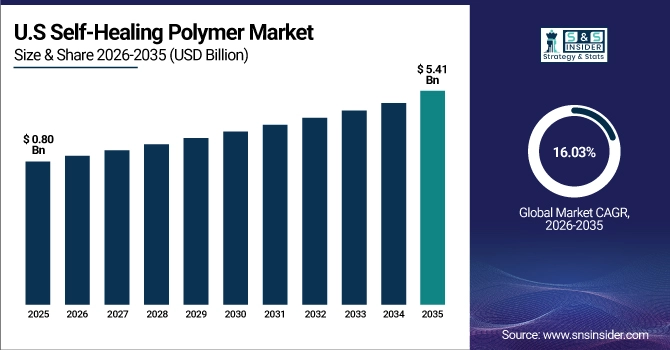
The U.S. Self-Healing Polymer Market size is USD 0.80 Billion in 2025 and is expected to reach USD 5.41 Billion by 2035, growing at a CAGR of 16.03% over the forecast period of 2026-2035.
The U.S. specialty self-healing polymer market is experiencing strong growth due to increasing adoption across high-value industries such as automotive, aerospace, electronics, healthcare, and advanced manufacturing. Rising demand for durable, low-maintenance materials that reduce lifecycle costs, along with strong R&D capabilities, early technology adoption, and increasing focus on sustainability and performance efficiency, are key factors supporting market expansion throughout the forecast period.
Self-Healing Polymer Market Growth Drivers:
-
Rising Demand for Durable, Low-Maintenance Materials
The Self-Healing Polymer market is driven by increasing demand for advanced materials that enhance product lifespan, reduce maintenance costs, and improve structural reliability. Rapid adoption in automotive, aerospace, electronics, and construction industries is supporting growth, as manufacturers seek lightweight, high-performance materials. Growing emphasis on sustainability, reduced material waste, and lifecycle cost optimization is further accelerating adoption. Strong R&D investments and technological advancements in intrinsic and extrinsic self-healing mechanisms continue to expand commercial applications globally.
Self-Healing Polymer Market Growth Restraints:
-
High Production Costs and Limited Commercial Scalability
Market growth is restrained by the high cost of raw materials, complex manufacturing processes, and limited large-scale commercialization of self-healing polymers. Performance trade-offs, such as reduced mechanical strength in certain formulations, also limit adoption. Lack of standardization, limited long-term performance data, and challenges in integrating self-healing polymers into existing manufacturing systems further slow market penetration, particularly in cost-sensitive industries and developing regions.
Self-Healing Polymer Market Growth Opportunities:
-
Sustainability Focus, Emerging Applications, and Technological Innovation
Significant opportunities exist due to rising demand for sustainable, recyclable, and bio-based self-healing polymers aligned with circular economy goals. Expanding applications in flexible electronics, medical devices, energy storage, and smart infrastructure are opening new revenue streams. Advancements in nanotechnology, smart materials, and multifunctional polymers are expected to enhance healing efficiency and performance, while rapid industrialization in emerging economies offers strong long-term growth potential.
Self-Healing Polymer Market Segment:
-
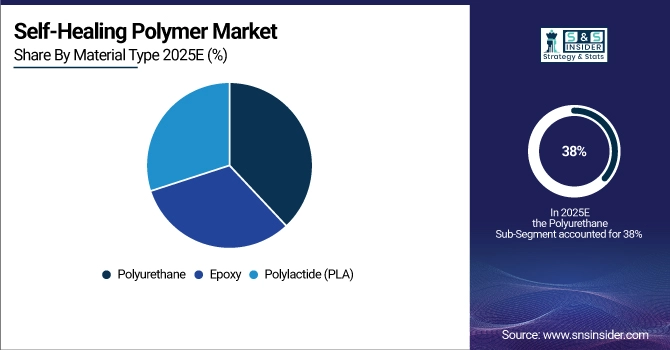
By Material Type: In 2025, Polyurethane dominated the market with approximately 38% share; Polylactide (PLA) is the fastest growing segment during 2026–2035 due to rising demand for bio-based and sustainable polymers.
-
By Technology Type: In 2025, Intrinsic/Autonomic self-healing technology led with nearly 42% share; Shape Memory technology is the fastest growing segment during 2026–2035 driven by advanced functional applications.
-
By Application: In 2025, Automotive & Transportation dominated with about 36% share; Electronics & Consumer Goods is the fastest growing segment during 2026–2035 due to miniaturization and smart device adoption.
-
By End-user Industry: In 2025, Automotive dominated with roughly 40% share; Aerospace & Defense is the fastest growing segment during 2026–2035 owing to demand for lightweight, high-performance materials.
Self-Healing Polymer Market Segment Analysis:
By Material Type: Polyurethane Led as Polylactide (PLA) Emerges as the Fastest-Growing Segment.
Polyurethane dominates the Self-Healing Polymer market due to its excellent mechanical flexibility, abrasion resistance, and strong healing efficiency across repeated damage cycles. Its versatility enables widespread use in automotive coatings, protective films, sealants, and industrial applications where durability and cost-effectiveness are critical. Polyurethane-based self-healing systems are favored for their balance between performance and scalability, supporting consistent commercial adoption.
Polylactide (PLA) is the fastest-growing segment, driven by increasing demand for bio-based, biodegradable, and sustainable materials. Growing environmental regulations, circular economy initiatives, and adoption in electronics, packaging, and medical applications are accelerating PLA-based self-healing polymer development and commercialization.
By Technology Type: Intrinsic/Autonomic Technology Dominated as Shape Memory Polymers Grow Rapidly.
Intrinsic or autonomic self-healing technology leads the market due to its ability to repair damage repeatedly without external triggers or embedded capsules. This technology offers long-term durability, consistent performance, and reduced maintenance, making it highly suitable for high-stress applications such as aerospace components, automotive structures, and electronics. Its seamless healing mechanism enhances product lifespan and reliability, driving strong adoption.
Shape memory self-healing polymers are the fastest-growing technology segment, supported by advancements in smart materials and multifunctional applications. Their ability to recover shape and functionality under stimuli such as heat or light is expanding use in medical devices, actuators, and advanced electronics.
By Application: Automotive & Transportation Led as Electronics & Consumer Goods Expand Rapidly.
Automotive and transportation applications dominate the Self-Healing Polymer market due to increasing demand for scratch-resistant coatings, impact-tolerant components, and reduced maintenance materials. Automakers are adopting self-healing polymers to enhance vehicle aesthetics, durability, and lifecycle efficiency while supporting lightweight design and sustainability goals. High production volumes and continuous innovation reinforce this segment’s leadership.
Electronics and consumer goods represent the fastest-growing application segment, driven by rising demand for flexible electronics, wearables, smartphones, and smart devices. Self-healing materials improve device longevity, surface protection, and reliability, making them increasingly attractive to manufacturers in this rapidly evolving sector.
By End-user Industry: Automotive Led as Aerospace & Defense Shows Strong Growth Momentum.
The automotive industry leads the Self-Healing Polymer market due to its early adoption of advanced materials for coatings, interiors, and structural components. Cost reduction, durability enhancement, and reduced repair requirements are key drivers supporting large-scale integration across passenger and commercial vehicles. Continuous innovation and electrification trends further strengthen adoption.
Aerospace and defense is the fastest-growing end-user industry, driven by demand for lightweight, high-performance, and damage-tolerant materials. Self-healing polymers enhance safety, structural integrity, and maintenance efficiency in aircraft and defense systems, supporting rapid growth as advanced materials gain strategic importance.
Self-Healing Polymer Market Regional Analysis:
Asia Pacific Self-Healing Polymer Market Insights:
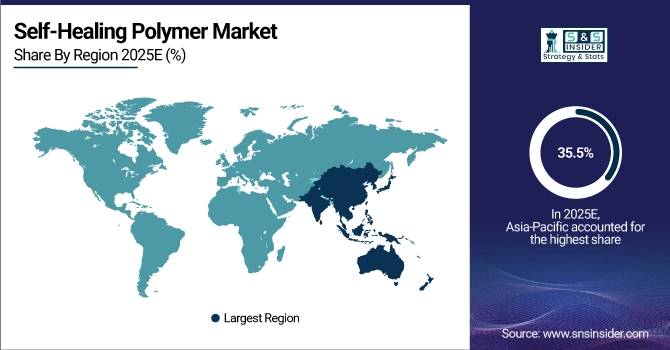
In 2025, Asia-Pacific holds the largest market share of approximately 35.5%, making it both the dominant and fastest-growing region in the Industrial Fine Grinding Mills market. The region is projected to grow at a CAGR of around 25.85% during 2026-2035. This domination of the region in Self-Healing Polymer market is due to rapid industrialization, strong manufacturing bases, and high adoption across automotive, electronics, aerospace, and construction sectors in countries such as China, Japan, South Korea, and India. Rising investments in advanced materials, expanding electric vehicle production, and increasing demand for durable, low-maintenance, and lightweight materials are key growth drivers. Additionally, supportive government initiatives, growing R&D activities, and rising sustainability awareness are accelerating adoption, positioning Asia Pacific as both the leading and fastest-growing regional market.
Get Customized Report as per Your Business Requirement - Enquiry Now
North America Self-Healing Polymer Market Insights:
North America represents a significant share of the Self-Healing Polymer market, driven by strong R&D capabilities, early adoption of advanced materials, and high demand from automotive, aerospace & defense, electronics, and construction industries. The presence of major material manufacturers, robust innovation ecosystems, and substantial investments in sustainable and high-performance materials support steady market growth. Increasing focus on lightweighting, durability, and lifecycle cost reduction, along with rising adoption of smart and self-repairing materials, continues to strengthen North America’s position in the global Self-Healing Polymer market.
Europe Self-Healing Polymer Market Insights:
Europe holds a strong position in the Self-Healing Polymer market, supported by advanced manufacturing capabilities, stringent environmental regulations, and high adoption of sustainable materials. Countries such as Germany, France, the UK, and Italy are driving demand across automotive, aerospace, electronics, and construction sectors. The region’s emphasis on lightweight materials, energy efficiency, and circular economy initiatives is accelerating the adoption of bio-based and recyclable self-healing polymers. Strong R&D activity, collaborative innovation programs, and regulatory support for advanced materials continue to foster steady market growth across Europe.
Latin America Self-Healing Polymer Market Insights:
Latin America’s Self-Healing Polymer market is gaining momentum as industries increasingly focus on enhancing durability, reducing maintenance costs, and improving product performance. Growth is supported by rising automotive manufacturing, expanding construction activities, and growing demand for advanced materials in electronics and industrial applications. However, market expansion is tempered by limited local manufacturing capacity and higher reliance on imports. Ongoing investments in infrastructure development, industrial modernization, and increasing adoption of sustainable materials are expected to drive stronger growth in the region over the forecast period.
Middle East and Africa Self-Healing Polymer Market Insights:
The Middle East and Africa (MEA) Self-Healing Polymer market is growing steadily, driven by rising infrastructure development, expanding industrialization, and increased adoption of advanced materials in construction, automotive, and oil & gas sectors. Demand for durable, low-maintenance materials is growing due to harsh environmental conditions and the need for long-lasting infrastructure. However, market growth is moderated by limited local manufacturing capacity and dependency on imports. Increasing investments in smart cities, renewable energy projects, and industrial modernization are expected to support future market expansion.
Self-Healing Polymer Market Competitive Landscape:
BASF SE is a global chemical company known for its diversified portfolio, including advanced polymers, coatings, and specialty materials. In the self-healing polymer space, BASF focuses on high-performance materials for automotive, construction, and industrial applications, emphasizing durability, lightweighting, and sustainability. The company’s strong R&D capabilities and global manufacturing network support commercialization of innovative polymer solutions.
-
March 12, 2025, BASF launched a new self-healing polyurethane coating for automotive and industrial applications, enhancing scratch resistance and durability.
Covestro AG is a leading manufacturer of high-performance polymers, including polyurethanes and polycarbonates, used in automotive, electronics, and construction sectors. Covestro invests heavily in sustainable materials and advanced polymer technologies, focusing on enhancing material longevity and reducing environmental impact. Its innovation-driven approach supports the development of self-healing polymer solutions for high-demand applications such as lightweight automotive components and protective coatings.
-
June 10, 2025, Covestro announced a partnership with a major automotive OEM to develop self-healing polyurethane components for next-generation electric vehicles.
Arkema S.A. is a global specialty chemicals company specializing in advanced materials, including high-performance polymers and specialty coatings. Arkema’s self-healing polymer research focuses on microencapsulation and intrinsic healing technologies for automotive, aerospace, and industrial applications. The company emphasizes sustainability and material efficiency, leveraging strong innovation pipelines to deliver durable, high-performance self-healing solutions.
-
September 8, 2025, Arkema introduced a new intrinsic self-healing epoxy resin designed for aerospace composites, improving damage tolerance and service life.
Self-Healing Polymer Market Key Players:
-
Autonomic Materials Inc.
-
BASF SE
-
Arkema S.A.
-
Evonik Industries AG
-
Huntsman International Corporation
-
Akzo Nobel N.V.
-
High Impact Technology LLC
-
Sensor Coating Systems Ltd.
-
CompPair Technologies Ltd.
-
Sika AG
-
Michelin Group
-
Advanced Polymer Materials Inc.
-
3M Company
-
DuPont de Nemours Inc.
-
LG Chem Ltd.
-
Mitsui Chemicals Inc.
-
SABIC
| Report Attributes | Details |
|---|---|
| Market Size in 2025 | USD 3.45 Billion |
| Market Size by 2035 | USD 27.34 Billion |
| CAGR | CAGR of 23.01% From 2026 to 2035 |
| Base Year | 2025 |
| Forecast Period | 2026-2035 |
| Historical Data | 2022-2024 |
| Report Scope & Coverage | Market Size, Segments Analysis, Competitive Landscape, Regional Analysis, DROC & SWOT Analysis, Forecast Outlook |
| Key Segments | •By Material Type: (Polyurethane, Epoxy, Polylactide (PLA), Others) •By Technology Type: (Microcapsule-based, Intrinsic/Autonomic, Shape Memory) •By Application: (Automotive & Transportation, Aerospace & Defense, Electronics & Consumer Goods) •By End-user Industry: (Automotive, Aerospace & Defense, Electronics) |
| Regional Analysis/Coverage | North America (US, Canada), Europe (Germany, UK, France, Italy, Spain, Russia, Poland, Rest of Europe), Asia Pacific (China, India, Japan, South Korea, Australia, ASEAN Countries, Rest of Asia Pacific), Middle East & Africa (UAE, Saudi Arabia, Qatar, South Africa, Rest of Middle East & Africa), Latin America (Brazil, Argentina, Mexico, Colombia, Rest of Latin America). |
| Company Profiles | Autonomic Materials Inc., BASF SE, Covestro AG, Arkema S.A., Dow Inc., Evonik Industries AG, Huntsman International Corporation, Akzo Nobel N.V., NEI Corporation, High Impact Technology LLC, Sensor Coating Systems Ltd., CompPair Technologies Ltd., Sika AG, Michelin Group, Advanced Polymer Materials Inc., 3M Company, DuPont de Nemours Inc., LG Chem Ltd., Mitsui Chemicals Inc., SABIC. |

Frequently Asked Questions
North America dominated the Self-Healing Polymer Market in 2025.
The polyurethane-based self-healing polymers, dominated the Self-Healing Polymer Market due to their versatility, durability, and wide adoption across multiple end-use industries.
The key drivers of the Self-Healing Polymer Market are the growing demand for durable, low-maintenance materials across automotive, aerospace, electronics, healthcare, and construction industries, along with advancements in smart and sustainable material technologies.
The market was valued at USD 3.45 Billion in 2025 and is projected to reach USD 27.34 Billion by 2035.
The Self-Healing Polymer Market is expected to grow at a CAGR of 23.01% during 2026-2035.
